
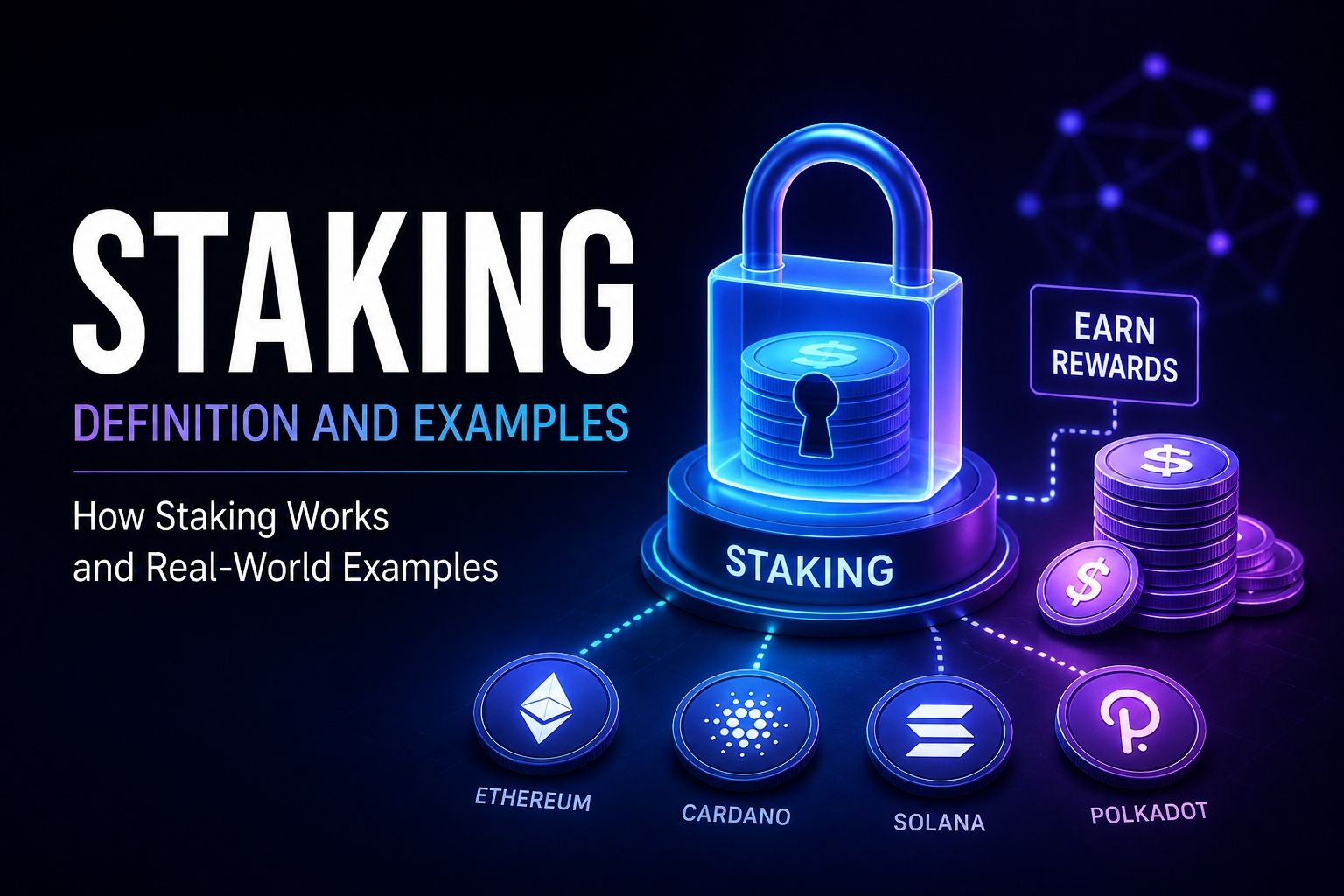
Staking definition: Crypto staking is the process of committing cryptocurrency to a Proof-of-Stake blockchain to help secure its network and, in return, potentially earn rewards. Depending on the blockchain, users can operate their own validators, delegate tokens, or participate through staking pools.
But staking has evolved far beyond its original purpose. Today, investors encounter liquid staking, restaking, staking derivatives and increasingly sophisticated reward strategies. These innovations create new opportunities, but they also introduce risks that are not always obvious.
Can staking genuinely generate passive income? What happens to your cryptocurrency while it is staked? Is restaking a better option, and how much could an investor realistically earn?
This guide answers these questions with practical examples, explanations and comparisons designed for both beginners and experienced cryptocurrency investors.
If you follow crypto and DeFi news, understanding how blockchain staking works is increasingly important for evaluating the long-term sustainability of digital asset projects.
Staking definition: the essentials
What is staking? Participating in the economic security of a Proof-of-Stake blockchain by committing or delegating eligible cryptocurrency.
Why are rewards paid? Validators help process transactions and maintain network consensus.
Is staking risk-free? No. Cryptocurrency prices, validator penalties, custody arrangements and liquidity restrictions can produce losses.
What is restaking? A mechanism that allows certain staked assets to support additional blockchain services, potentially earning additional rewards while accepting additional risks.
Important: A high advertised APY is not necessarily a high real return.
Staking definition: what does staking mean in crypto?
The staking definition describes the commitment of cryptocurrency to a blockchain’s Proof-of-Stake consensus mechanism. The economic stake helps secure the network by creating incentives for validators to behave correctly.
Unlike Bitcoin mining, which relies on specialized computers performing energy-intensive calculations, Proof-of-Stake networks use cryptocurrency-backed validators to participate in consensus.
The role of staking extends beyond simply generating additional tokens. It is part of the security architecture of the blockchain itself.
Why do blockchain networks need staking?
Public blockchains need a mechanism to determine which transactions are valid and which participants are authorized to propose or confirm blocks.
In Proof-of-Stake systems, validators commit economic value that may be exposed to penalties if they violate protocol rules. The amount of cryptocurrency involved can also influence validator selection or consensus weight, depending on the network.
This creates an economic incentive to maintain reliable infrastructure and follow consensus requirements.
A well-designed staking mechanism can help deliver:
- Network security: Validators face financial consequences for certain forms of misconduct.
- Transaction validation: Participants contribute to the blockchain’s consensus process.
- Economic participation: Token holders may delegate assets instead of operating infrastructure.
- Reward distribution: Networks compensate eligible participants according to protocol rules.
- Decentralization: Independent validators can reduce dependence on a limited number of infrastructure operators.
However, staking does not automatically guarantee decentralization. If a small number of custodians or validators control a substantial proportion of the total stake, concentration risks can emerge.
Does staking always require locking cryptocurrency?
No. This is an important distinction often overlooked in introductory explanations.
Some networks require assets to be bonded or subject to an exit period. Others allow token holders to delegate their stake while maintaining considerable flexibility.
For example, Cardano supports delegation without requiring ADA holders to lock their coins in the same way as certain other networks. Delegated ADA can generally be spent without first going through a conventional unbonding process.
Therefore, a more accurate staking definition refers to committing economic stake to consensus, rather than assuming every participant must place tokens into a locked smart contract.
How does crypto staking work step by step?
The staking process varies between blockchains, but most Proof-of-Stake systems share several fundamental mechanisms.
Choosing a Proof-of-Stake cryptocurrency
The first requirement is owning a cryptocurrency that supports staking within its network.
Examples include Ethereum (ETH), Cardano (ADA), Solana (SOL), Cosmos Hub (ATOM), Polkadot (DOT) and Tezos (XTZ).
Holding Bitcoin (BTC), by contrast, does not provide native Proof-of-Stake rewards because Bitcoin uses Proof-of-Work consensus.
Products advertising Bitcoin staking may instead use lending arrangements, wrapped tokens or additional protocols. Their security models should not be confused with native blockchain staking.
Selecting a validator or staking method
Depending on the network, a user may operate validator infrastructure directly or delegate participation to an existing validator.
Validators run specialized software, maintain connectivity and follow network consensus rules. Their performance can influence rewards and penalties.
Delegators typically avoid operating the infrastructure themselves, although they may remain exposed to validator-related risks.
Committing or delegating tokens
The cryptocurrency is then assigned to the staking process through the network’s supported mechanism.
Depending on the protocol, this might involve a staking contract, an account-level delegation instruction, a bonded position or a pooled staking arrangement.
Ownership and withdrawal rights differ considerably among these methods.
Receiving staking rewards
Eligible participants receive rewards according to the network’s economic rules.
These rewards may be financed through newly issued tokens, transaction-related revenue or a combination of mechanisms.
Reward rates are not necessarily constant. They can change with network participation, validator performance, protocol parameters and transaction activity.
Unstaking and withdrawing
When investors decide to exit, they must follow the network’s withdrawal procedure.
Some blockchains impose unbonding periods. Others use exit queues, while certain delegated systems allow more flexible movement of assets.
For Ethereum, validator exits and withdrawals can be subject to network queues. Investors using third-party staking services may also face provider-specific withdrawal procedures.
Staking examples: Ethereum, Cardano, Solana and other blockchains
Understanding the staking definition becomes easier when examining how different blockchain networks implement the same general concept.
| Blockchain | Token | Main staking approach | Key consideration |
|---|---|---|---|
| Ethereum | ETH | Solo validation, delegated services, pools | Validator requirements and withdrawal queues |
| Cardano | ADA | Stake delegation | Delegated ADA remains spendable |
| Solana | SOL | Validator delegation | Epoch-based activation and deactivation |
| Cosmos Hub | ATOM | Delegated staking | Validator selection and unbonding rules |
| Polkadot | DOT | Native staking mechanisms | Nomination, pooling and protocol rules |
| Tezos | XTZ | Baking and delegation | Protocol-specific staking and delegation arrangements |
Ethereum staking: securing the largest smart-contract ecosystem
Ethereum transitioned to Proof-of-Stake through The Merge in September 2022, replacing its former Proof-of-Work consensus mechanism.
Under Ethereum’s staking model, validators participate in block proposals and attestations. Correct participation helps maintain consensus, while certain violations can trigger substantial penalties.
Activating a solo Ethereum validator requires a minimum of 32 ETH.
However, important technical developments have made Ethereum staking more flexible.
Validators using compounding withdrawal credentials can have an effective balance between 32 ETH and 2,048 ETH. Eligible rewards can increase the validator’s effective stake rather than being automatically withdrawn above the original 32 ETH threshold.
Users with smaller holdings can access pooled staking solutions, although these introduce intermediaries or additional protocol risks.
Ethereum therefore offers several different staking arrangements rather than a single universal method.
Cardano staking: delegation without traditional token lock-up
Cardano provides another useful example because its staking model differs from Ethereum’s.
ADA holders can delegate their stake to a pool operator without transferring ownership of their tokens to that operator.
Delegation contributes to the network’s consensus and reward allocation system.
One important characteristic is that delegated ADA remains spendable. Users do not generally need to unlock their ADA through a conventional multi-day unbonding process before transferring it.
This flexibility demonstrates why investors should examine the precise rules of each blockchain instead of treating all staking mechanisms as identical.
Solana staking: delegating SOL to network validators
Solana uses a Proof-of-Stake-based consensus architecture in which validators contribute to transaction processing and network consensus.
SOL holders can delegate stake to validators through supported wallets.
Delegation does not normally require handing over the wallet’s private keys to the validator.
However, staking activation and deactivation are coordinated with Solana’s epoch system. Users should account for these timing rules when planning to enter or exit a position.
Validator reliability, commissions and overall performance can affect the rewards received.
Cosmos, Polkadot and Tezos
Other established Proof-of-Stake ecosystems illustrate additional variations.
Cosmos Hub allows ATOM holders to delegate to validators and participate economically in network security. Unbonding and slashing conditions require particular attention.
Polkadot offers native staking options involving validators, nominators and pooling mechanisms, with participation rules influenced by the network’s design and upgrades.
Tezos uses a staking architecture associated with its baking process, alongside delegation mechanisms that allow token holders to support network participants.
The most important lesson is that the staking definition describes a common economic principle, while the technical implementation differs from one blockchain to another.
How much can you earn from staking?
Staking rewards are among the main reasons cryptocurrency holders participate in Proof-of-Stake networks.
However, advertised percentages can be misleading when investors fail to distinguish between token rewards, investment returns and the market value of the underlying cryptocurrency.
Understanding APR and APY
APR (Annual Percentage Rate) generally describes a non-compounded annualized reward rate.
APY (Annual Percentage Yield) incorporates the effect of compounding, assuming rewards are reinvested according to the calculation method.
For example, a hypothetical 5% annual rate with monthly compounding results in an effective annual yield of approximately 5.12%, before fees and other adjustments.
But this calculation does not account for cryptocurrency price fluctuations.
Example: staking $10,000 worth of cryptocurrency
Imagine an investor holds $10,000 worth of a cryptocurrency and receives rewards equivalent to 5% annually in token terms.
For simplicity, assume the reward rate remains constant, all rewards are received at the end of the year and no fees apply.
| Scenario | Token price change | Final portfolio value |
|---|---|---|
| Bullish market | +30% | $13,650 |
| Stable market | 0% | $10,500 |
| Bearish market | -30% | $7,350 |
Illustrative calculations, not forecasts. Values assume the same percentage price change applies to the original tokens and accumulated rewards.
The example highlights a fundamental issue: receiving more cryptocurrency does not guarantee an increase in the dollar value of an investment.
Even when the amount of tokens increases, the portfolio can lose substantial value.
Why do staking reward rates change?
Staking yields depend on several factors:
- The total amount of cryptocurrency participating in staking.
- Network issuance and monetary policy.
- Transaction-related rewards where applicable.
- Validator reliability and uptime.
- Validator commissions and service fees.
- Compounding frequency and reward distribution methods.
- Changes to the blockchain protocol.
Higher participation can reduce the reward rate available to individual stakers on some networks, although the precise relationship depends on the protocol.
Investors should never assume that an advertised annual percentage will remain unchanged for years.
Nominal staking yield versus real economic return
A further consideration is token inflation.
Suppose a blockchain distributes staking rewards through newly created tokens. If network supply grows substantially, token holders face dilution even when they receive additional units.
For example, a 6% increase in an investor’s token balance is not equivalent to a guaranteed 6% increase in purchasing power.
The value of the rewards ultimately depends on supply dynamics, market demand and the cryptocurrency’s price.
For investors evaluating long-term returns, understanding token issuance is often as important as comparing advertised yields.
Different types of crypto staking
Not all staking opportunities provide the same degree of ownership, flexibility or exposure to intermediaries.
The following categories are particularly useful when evaluating a staking strategy.
Solo staking
Solo staking involves operating validator infrastructure directly and meeting the blockchain’s technical and financial requirements.
It offers greater operational independence and avoids certain intermediary risks.
However, running infrastructure also creates responsibilities related to software configuration, connectivity, security and maintenance.
Solo staking is generally more suitable for technically capable participants who can commit sufficient resources.
Delegated staking
Delegated staking allows token holders to assign staking participation to a validator or staking service without personally performing validation duties.
Delegators can receive a share of rewards while the validator manages the operational process.
Depending on the blockchain, delegation may retain user custody, require bonding or involve specific withdrawal restrictions.
Validator selection remains essential because poor performance, excessive commissions or protocol penalties can affect outcomes.
Pooled staking
Staking pools combine participation from multiple users.
This can make staking accessible to investors who do not have the minimum amount required for individual validation.
For Ethereum, pooled services allow participation with less than the 32 ETH required to activate a solo validator.
However, users must examine how funds are held, whether smart contracts are involved and which party controls withdrawals.
Exchange staking
Centralized cryptocurrency exchanges may offer staking services through simplified interfaces.
The main attraction is convenience: investors may not need to interact directly with blockchain infrastructure.
However, convenience introduces potential custody, insolvency, withdrawal and transparency risks.
Some exchange products marketed as staking may also involve lending or other yield-generating arrangements rather than direct participation in blockchain consensus.
It is essential to examine the actual mechanism rather than rely on the marketing label.
What is liquid staking in crypto?
Liquid staking is a mechanism that allows users to stake eligible cryptocurrency while receiving a transferable token representing their economic position in the staked assets.
These tokens are commonly called Liquid Staking Tokens (LSTs).
The principal advantage is that they can potentially be transferred, traded or used within decentralized finance applications without first completing a conventional staking withdrawal.
How does liquid staking work?
Consider an investor who wants to stake ETH but also maintain access to DeFi opportunities.
Through a liquid staking protocol, the investor deposits ETH and receives a representation of the staked position.
That representation can potentially be held in a wallet or integrated into supported DeFi applications.
Meanwhile, the underlying ETH participates in staking through the protocol’s arrangements.
However, transferring the liquid staking token does not mean the underlying ETH has been withdrawn from Ethereum staking.
The token represents a claim or economic exposure governed by the liquid staking protocol.
Example: Lido and stETH
Lido is a well-known example of a liquid staking protocol on Ethereum.
Users deposit ETH and receive stETH, which represents their participation in Lido’s staking system.
The stETH token can potentially be used in compatible decentralized finance applications.
This introduces additional flexibility compared with holding a conventional illiquid staking position.
However, its usefulness depends on market liquidity, supported integrations and the functioning of the underlying protocol.
Liquid staking is not risk-free liquidity
The term “liquid” can create a misleading impression that investors will always be able to recover the full value of their initial deposit immediately.
In reality, LSTs may trade at a discount to their underlying assets, particularly during periods of market stress.
Redemption mechanisms can also involve withdrawal queues, smart contract procedures or specific liquidity conditions.
Additional risks include smart contract vulnerabilities, governance changes and concentration among infrastructure operators.
For these reasons, liquid staking should be understood as a trade-off between flexibility and additional protocol exposure.
What is restaking in crypto?
Restaking is a mechanism that allows eligible staked assets or staking-related positions to provide economic security for additional services beyond the original blockchain consensus system.
It expands the concept of staking by reusing economic collateral rather than requiring every new service to establish an entirely independent security base.
Restaking is particularly associated with Ethereum’s ecosystem and protocols such as EigenLayer.
Its potential attraction is additional compensation for providing security to multiple systems. Its principal danger is the introduction of additional obligations and potential losses.
How does restaking work?
Imagine a participant who already has ETH committed to Ethereum staking.
Through an eligible restaking protocol, the participant may allocate economic security to other decentralized services.
These services might need validators or operators to perform functions such as data availability, verification or other specialized infrastructure tasks.
Rather than building an independent staking token and validator economy, the service can potentially obtain security from an existing restaking ecosystem.
In return, participating operators and restakers may qualify for additional rewards.
However, restaking is not simply depositing the same coins into several independent wallets. It involves specific contractual, protocol-level or delegated security arrangements.
EigenLayer: a concrete example of restaking
EigenLayer is one of the best-known protocols associated with Ethereum restaking.
Its architecture enables eligible economic stake to support additional services, often referred to as Actively Validated Services (AVSs).
Operators can participate in these services and allocate eligible stake to defined operator sets.
These arrangements can introduce additional reward opportunities and service-specific slashing conditions.
EigenLayer’s architecture includes mechanisms for allocating stake, distributing rewards and enforcing penalties when eligible operator sets violate applicable conditions.
Consequently, restaking participants must examine both their original staking exposure and the obligations introduced by the additional services.
Native restaking versus liquid restaking
Two related concepts should be distinguished.
Native restaking typically refers to an arrangement where eligible Ethereum validator stake participates in a restaking protocol through supported infrastructure.
Liquid restaking adds an additional layer in which users may receive tokens representing exposure to restaked assets.
These are often called Liquid Restaking Tokens (LRTs).
LRTs can provide transferability and DeFi compatibility, but they may also expose holders to the original staking system, the restaking protocol, the token-issuing protocol and secondary-market liquidity conditions.
Not every restaking product has the same reward model, allocation mechanism or withdrawal rights.
Staking vs restaking vs liquid staking: what is the difference?
These three concepts are related but serve different purposes.
Staking provides economic security to a blockchain. Liquid staking creates a transferable representation of certain staking positions. Restaking extends eligible economic security to additional services.
| Feature | Staking | Liquid staking | Restaking |
|---|---|---|---|
| Main purpose | Secure blockchain consensus | Represent staking exposure with a transferable token | Secure additional services |
| Possible rewards | Native staking rewards | Underlying staking rewards | Staking and eligible additional rewards |
| Liquidity | Depends on blockchain | Token may be transferable or tradable | Depends on implementation |
| Additional risks | Validator and market risks | Smart contracts and LST pricing | Additional slashing and service risks |
| Complexity | Low to high | Moderate to high | Generally high |
These approaches are not mutually exclusive. Some products combine liquid staking and restaking, creating multiple layers of exposure.
That flexibility can be attractive, but it also makes risk analysis more difficult.
Can restaking generate higher returns?
Restaking may create additional reward opportunities because participants provide security to services beyond the original blockchain.
However, additional rewards are neither universal nor guaranteed.
They depend on the protocol, operator arrangements, participating services, reward funding, distribution schedules and applicable fees.
A simplified staking and restaking example
Consider a hypothetical investor with an eligible staking position worth $20,000.
Assume the underlying staking process provides a 4% annual token-denominated return, while a restaking arrangement generates an additional 1.5% equivalent return.
Under these simplifying assumptions:
- Base staking rewards would be equivalent to $800 annually.
- Additional restaking rewards would be equivalent to $300 annually.
- The combined hypothetical annual reward value would be $1,100.
- The indicated return would be approximately 5.5% before fees, token price changes and other factors.
This is an illustration, not an available or guaranteed EigenLayer yield. In practice, rewards can vary, be paid in different assets or fail to materialize.
Additional compensation must be evaluated against additional risks.
Why chasing restaking APY can be dangerous
High advertised yields can result from temporary token incentives rather than sustainable protocol revenue.
Some products distribute rewards in newly issued tokens whose market value may be highly volatile.
Others rely on incentives that can diminish as more capital enters the strategy.
Restaking can also introduce correlated risks. A problem affecting an operator or an underlying service may have consequences across several positions.
The most important question is therefore not simply how much restaking can earn, but what additional risk is being accepted for each additional percentage point of expected return?
What are the risks of staking and restaking?
The term passive income can make staking sound similar to interest paid on a bank deposit.
That comparison is misleading.
Cryptocurrency staking involves market risk, operational exposure and protocol-specific rules. Advanced strategies can introduce further dependencies between protocols.
Cryptocurrency price volatility
The most obvious risk is a decline in the market value of the staked asset.
An investor might earn 5% more tokens while the cryptocurrency loses 40% of its market value.
In this situation, staking rewards provide only limited protection against the decline.
This is why staking is often better understood as a way to increase exposure to a cryptocurrency rather than as an independent source of stable income.
Slashing and validator misconduct
Slashing is a penalty mechanism used by certain Proof-of-Stake protocols.
It may apply to serious validator violations, such as specific forms of conflicting attestations or consensus misconduct.
The rules differ between networks.
Not every validator problem results in slashing. On Ethereum, ordinary offline periods can cause penalties without necessarily triggering slashing.
Restaking can expose participants to additional slashing conditions connected to the services they help secure.
Smart contract vulnerabilities
Staking pools, liquid staking protocols and restaking systems may rely on smart contracts.
Vulnerabilities in those contracts can expose users to losses even when the underlying blockchain continues operating normally.
Security audits reduce certain uncertainties but cannot eliminate all risks.
Withdrawal delays and liquidity shortages
Some staking arrangements require waiting before assets become withdrawable.
Others provide transferable receipt tokens, but their market liquidity can deteriorate during stressful conditions.
A liquid staking token may trade below the value of its underlying assets if demand for immediate exits exceeds available liquidity.
Custodial and counterparty risks
When staking through a centralized intermediary, investors should understand who controls the cryptocurrency and what legal rights users retain.
Exchange insolvency, restrictions or operational failures could prevent withdrawals even when the blockchain’s staking mechanism functions correctly.
Restaking concentration and correlated failures
One of the less obvious problems with restaking is the reuse of economic security across multiple systems.
If several services depend on overlapping operators and collateral, certain incidents may create correlated consequences.
This interconnectedness is especially relevant when investors combine staking, LSTs, LRTs, lending protocols and leveraged DeFi strategies.
The resulting exposure can become difficult to measure without understanding every layer.
Before investing: five questions worth asking
What actually generates the advertised rewards?
Who controls the underlying cryptocurrency and withdrawal rights?
Can the position be slashed or lose value independently of market prices?
How can I exit during a period of extreme market volatility?
Would the strategy still make sense if its reward rate fell substantially?
How to choose a staking validator or platform
For users interested in participating, selecting a suitable validator or provider is one of the most important decisions.
The evaluation should cover far more than the percentage displayed on a dashboard.
Validator performance and reputation
Review the validator’s track record, reliability, commission structure and participation history.
A validator with attractive advertised rewards may not be the most appropriate choice if operational reliability is poor.
Where possible, consult official blockchain explorers and independently verifiable performance data.
Decentralization and operator concentration
Delegating to the largest validator or provider is not automatically the safest decision.
Concentration can create governance, operational and systemic risks.
Supporting reliable independent validators can contribute to the broader decentralization of a network, although individual decisions should still account for technical reliability and protocol-specific risks.
Fees and net rewards
Validators, exchanges and liquid staking protocols may deduct commissions or service fees.
The relevant figure is the expected net reward after applicable charges, not merely the advertised headline rate.
Also consider transaction costs and potential expenses associated with moving or converting rewards.
Transparency and security
Prefer arrangements that explain their staking mechanisms, custody model, reward calculations and withdrawal procedures clearly.
For smart contract protocols, review available audits, incident history, contract permissions and governance structures.
Remember that an established brand does not eliminate the possibility of technical failure.
How to start staking crypto safely
For beginners, a simple staking strategy is generally easier to understand and monitor than a complex combination of DeFi protocols.
Start with an asset you understand
Before selecting a staking product, assess the underlying cryptocurrency’s monetary policy, market liquidity, adoption and security model.
Receiving rewards in a token with deteriorating fundamentals may not represent an attractive investment outcome.
Understand custody before depositing
Determine whether assets remain in your wallet, are delegated through native blockchain functionality or move to a third-party contract or custodian.
Never share private keys or recovery phrases.
For larger positions, hardware wallets and carefully managed signing procedures can reduce certain security risks.
Test the staking and withdrawal process
When possible, consider using a small amount first to understand how staking, reward tracking and withdrawals work.
Testing does not eliminate risk, but it may help reveal operational mistakes before larger amounts are involved.
Monitor rather than ignore your position
Staking is often described as passive, but investors still need to monitor material changes.
Validator commission changes, governance decisions, protocol upgrades and deteriorating security conditions may affect a position.
For restaking, monitoring additional services and operator allocations becomes even more important.
Staking vs lending vs yield farming: why the distinction matters
Cryptocurrency platforms sometimes group different reward-generating products under similar labels.
However, their economic purposes and risks can be fundamentally different.
| Strategy | Primary source of rewards | Distinctive risk |
|---|---|---|
| Native staking | Blockchain consensus participation | Validator penalties and token volatility |
| Crypto lending | Borrowing demand and lending interest | Borrower, liquidation or protocol risk |
| Yield farming | Liquidity provision, fees and incentives | Impermanent loss and incentive sustainability |
| Restaking | Additional security services and incentives | Additional slashing and interdependent protocols |
A product promising yield on a stablecoin does not automatically qualify as native staking.
Depending on the arrangement, returns might come from lending, trading strategies, token incentives or other activities unrelated to Proof-of-Stake consensus.
Understanding the actual source of rewards is essential for evaluating whether the strategy is sustainable.
Is staking suitable for long-term crypto investors?
Staking can be relevant for investors who already intend to maintain long-term exposure to a particular Proof-of-Stake cryptocurrency.
In such cases, participating in network security may generate additional tokens without requiring the investor to sell the underlying position.
However, long-term participation introduces considerations that extend beyond the current reward percentage.
Compounding over several years
If staking rewards can be reinvested, compounding may increase the number of tokens held over time.
For illustration, suppose an investor begins with 100 tokens and achieves a constant 4% annual effective return.
After five years, the position would contain approximately 121.67 tokens, assuming all rewards are compounded and there are no deductions.
After ten years, it would contain approximately 148.02 tokens under the same hypothetical conditions.
These figures demonstrate the mathematical effect of compounding, not a prediction of future cryptocurrency value or staking rates.
Why holding more tokens is not always better
Token accumulation can be undermined by inflation, declining demand, protocol weaknesses or deteriorating market liquidity.
For long-term investors, staking rewards should therefore complement an investment thesis rather than replace it.
The quality and future prospects of the underlying blockchain remain central.
When does restaking become attractive?
Restaking may interest investors who understand the underlying staking model and are comfortable evaluating the additional protocols involved.
But it is not necessarily an improvement over conventional staking.
Some investors may reasonably prefer a lower-complexity strategy with fewer intermediaries and more predictable exit procedures.
For other participants, the ability to provide economic security to additional services may justify a carefully limited exposure.
The appropriate choice depends on investment objectives, technical expertise, liquidity needs and tolerance for loss.
What does the future hold for staking and restaking?
Staking has become an important part of the infrastructure supporting Proof-of-Stake blockchains.
Its development increasingly involves improvements in validator operations, staking accessibility, withdrawal mechanisms and decentralization.
At the same time, liquid staking and restaking have expanded the ways investors can use staking-related positions within decentralized finance.
Better staking infrastructure
Improved validator tools, more flexible account structures and better monitoring systems can reduce some operational barriers.
For Ethereum, developments involving compounding validators illustrate how staking architecture can evolve without changing its fundamental consensus purpose.
Competition among liquid staking protocols
Liquid staking protocols compete on decentralization, security, available integrations, withdrawal processes and costs.
The market may continue to distinguish between highly transparent protocols and less verifiable custodial products.
For users, greater choice does not automatically imply greater safety.
Restaking and shared security
Restaking introduces the possibility of using existing economic security to support additional decentralized infrastructure.
This may reduce certain barriers for services that would otherwise need to establish their own security arrangements.
However, a sustainable restaking economy requires more than temporary incentive programs.
Services must generate genuine demand, establish credible security requirements and compensate operators and restakers appropriately.
Otherwise, additional complexity may fail to deliver meaningful long-term economic value.
Why risk management will remain essential
As staking positions become integrated across more protocols, the ability to understand correlated exposures becomes increasingly important.
Investors may need to evaluate not only individual smart contracts but also dependencies between validators, liquid staking tokens, restaking services and lending markets.
In this environment, transparent documentation and a clear understanding of withdrawal rights should remain priorities.
FAQ — Staking definition and restaking
What is the simplest staking definition?
Staking is the process of committing cryptocurrency to help secure a Proof-of-Stake blockchain, usually in exchange for potential rewards. Users may participate directly or through delegation and pooling arrangements.
What is restaking in simple words?
Restaking allows eligible staked assets to provide economic security for additional services. Participants may receive additional rewards but accept additional technical, operational and slashing risks.
What is the difference between staking and restaking?
Staking primarily secures a blockchain’s consensus mechanism. Restaking extends certain staking-related economic commitments to additional services, potentially creating new rewards and obligations.
Is staking guaranteed passive income?
No. Staking rewards can fluctuate, validators may face penalties and the cryptocurrency’s market value can decline. The term passive income does not imply capital protection or guaranteed profits.
Can you lose cryptocurrency while staking?
Yes. Losses may arise from slashing, smart contract exploits, intermediary failures or adverse market movements. The exact exposure depends on the blockchain and staking arrangement.
Does Ethereum staking still require 32 ETH?
Activating a solo Ethereum validator requires a minimum of 32 ETH. However, pooled solutions can accommodate smaller deposits. Compounding validators can have effective balances of up to 2,048 ETH under Ethereum’s supported withdrawal credential model.
What is the difference between APR and APY?
APR typically represents a non-compounded annualized rate, while APY reflects compounding under specified assumptions. Neither measure guarantees the future dollar value of staking rewards.
Can you stake Bitcoin?
Bitcoin does not use native Proof-of-Stake consensus. Products offering Bitcoin-related yield generally rely on separate protocols, token structures or financial arrangements and should not be confused with native Bitcoin staking.
Can staking rewards be withdrawn immediately?
Withdrawal rules depend on the blockchain and provider. Some delegated systems are highly flexible, while others require unbonding periods, validator exit queues or protocol-specific redemption procedures.
Is liquid staking better than traditional staking?
Liquid staking can offer transferable representations of staking positions, creating additional flexibility. However, it also introduces smart contract, liquidity and token-pricing risks that may not exist in simpler native staking arrangements.
Is restaking safer than ordinary staking?
Not necessarily. Restaking generally introduces additional protocol dependencies and possible penalty conditions. Its potential rewards should be weighed against these additional risks.
Are staking rewards taxable?
Tax treatment depends on the investor’s jurisdiction, personal circumstances and the structure of the staking arrangement. Relevant rules may distinguish between receiving rewards, selling tokens, exchanging liquid staking tokens and other taxable events.
What happens if a staking validator goes offline?
Consequences depend on the blockchain. On Ethereum, ordinary validator downtime may result in missed rewards or inactivity penalties without necessarily causing slashing. More serious consensus violations can trigger different penalties.
Can restaking rewards disappear?
Yes. Additional rewards may depend on temporary incentives, participating services, operator performance and changing protocol economics. Future eligibility and reward rates should not be assumed.
Which is better for beginners: staking or restaking?
Conventional native staking or transparent delegation is generally easier to understand than multi-layer restaking strategies. Beginners should prioritize custody, withdrawal procedures, network security and manageable risk before pursuing additional yield.
Conclusion: staking definition, opportunities and risks
Understanding the staking definition is an important first step toward understanding modern Proof-of-Stake cryptocurrencies.
Staking is not simply a way to earn additional tokens. It provides economic incentives that support blockchain consensus and network security.
For investors, it can offer a means of participating in the growth of networks they already intend to hold for the long term.
Liquid staking adds transferable representations of staking positions, while restaking extends eligible economic security to additional decentralized services.
These innovations broaden the possibilities of decentralized finance, but additional opportunities also bring additional sources of risk.
Rather than focusing exclusively on advertised APY figures, investors should understand how rewards are generated, who controls the assets, which withdrawal restrictions apply and what circumstances could produce losses.
The central principle remains simple: a sustainable staking strategy begins with understanding the blockchain and its risks, not with chasing the highest advertised yield.
Continue exploring decentralized finance
Staking and restaking are only part of the broader DeFi ecosystem. New protocols, security mechanisms and token models continue to reshape how digital assets are used.
Follow Mediasnet’s latest crypto news and DeFi insights for further analysis, explanations and developments across decentralized finance.
Official references and further reading
The following resources provide primary technical documentation for the staking and restaking mechanisms described in this article.
- Ethereum.org — Ethereum staking
- Ethereum.org — Staking withdrawals
- Cardano documentation — Delegation
- EigenLayer — Restaking allocation and slashing architecture
Editorial update: October 9, 2026. This guide is educational and does not constitute personalized financial, investment or tax advice. Reward rates, staking rules and protocol risks may change.
Which Crypto Staking Platform Should You Choose?

Understanding staking rewards is only the beginning.
Platform fees, validator performance and withdrawal conditions
can make a significant difference to your actual returns.
Our detailed comparison explores
Lido, Rocket Pool, Kraken, Coinbase and native staking,
helping you identify the advantages, costs and risks of each solution.


Trader, investor and author specializing in cryptocurrencies, DeFi and Web3.
On Mediasnet, I share my market analysis, practical guides and research on crypto markets, decentralized protocols and emerging trends across the ecosystem.
Follow me on: Facebook – X (Twitter)
35 thoughts on “Staking Definition: How It Works, Rewards and Restaking”
Comments are closed.