
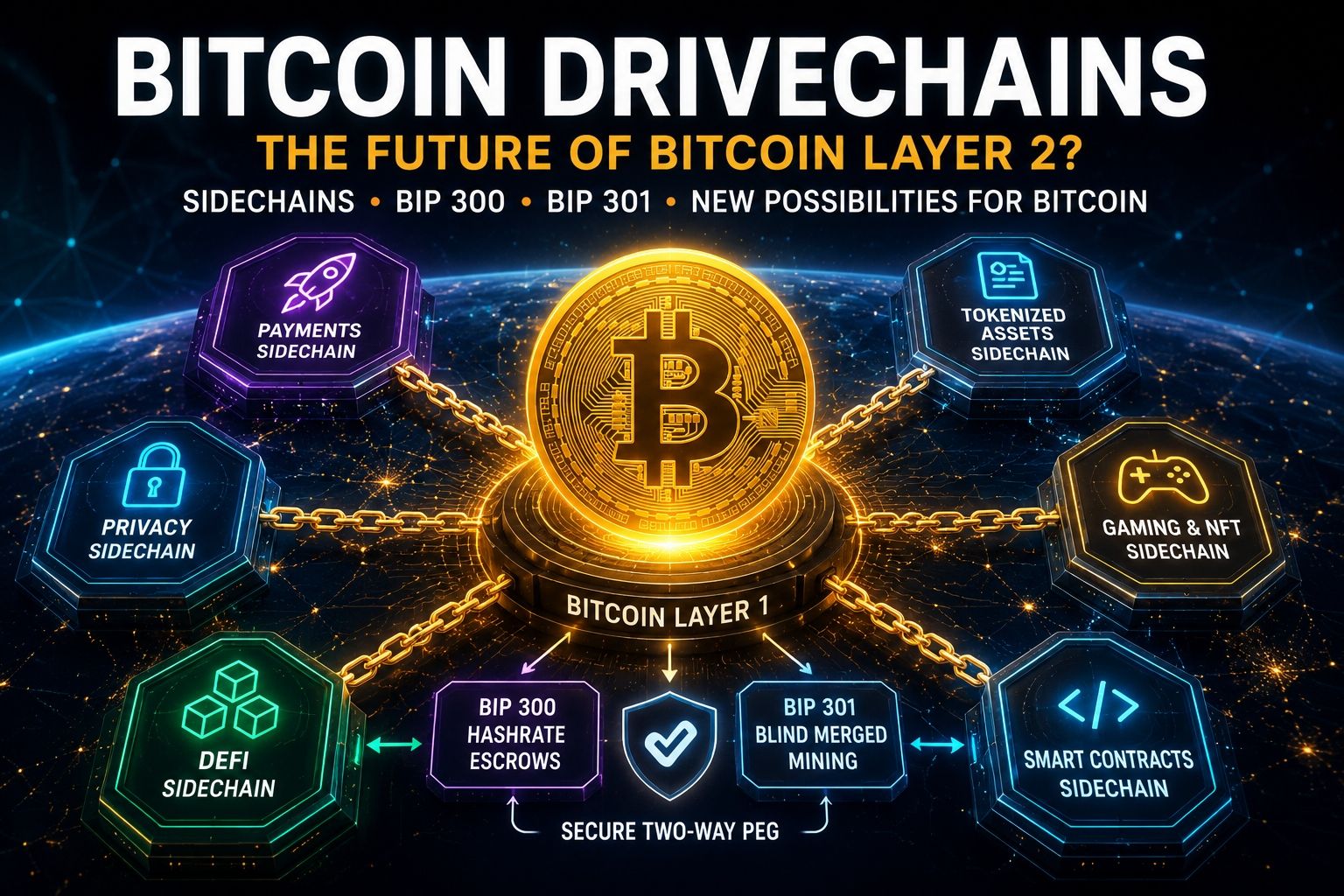
Bitcoin Drivechains are one of the most ambitious—and controversial—attempts to expand what can be built around Bitcoin without transforming its main blockchain into a general-purpose smart contract network.
The concept would allow users to move BTC between the Bitcoin base layer and specialized Bitcoin sidechains. Each sidechain could follow its own rules, support different applications and experiment with features that would be difficult or undesirable to introduce directly on Bitcoin.
One sidechain could prioritize fast payments. Another could support decentralized finance, privacy tools, tokenized assets or more advanced smart contracts. A third could test an entirely different block size, fee model or virtual machine.
The central idea is simple: Bitcoin remains the settlement asset, while optional networks provide additional functionality.
However, the technical and political debate surrounding Bitcoin Drivechains is far from simple. The proposal depends mainly on two specifications known as BIP 300 and BIP 301. Both would require changes to Bitcoin’s consensus rules, and neither is currently activated on the network.
This guide explains how Bitcoin Drivechains work, why they were created, how they compare with other Bitcoin Layer 2 solutions and why they divide developers, miners and long-term Bitcoin users.
Important distinction
Bitcoin Drivechains are proposals, not an active feature of Bitcoin. BIP 300 and BIP 301 remain drafts, and their publication does not mean that the Bitcoin community has approved them.
What are Bitcoin Drivechains?
Bitcoin Drivechains are a proposed mechanism for creating blockchain networks connected to Bitcoin through a two-way peg.
These connected networks are generally described as Bitcoin sidechains. They operate independently from the main Bitcoin blockchain but use BTC as their primary asset.
Users would lock bitcoin on the main chain and receive a corresponding amount of BTC on a selected sidechain. When they want to return, the sidechain BTC would be destroyed or withdrawn, and the associated bitcoin would become available again on the base layer.
The supply is not supposed to be duplicated permanently. The same economic unit moves between two environments:
- BTC is locked on the Bitcoin main chain;
- an equivalent amount becomes usable on the sidechain;
- the sidechain BTC can later be withdrawn;
- the original BTC is released after the withdrawal process is completed.
This architecture aims to let developers create new blockchain systems without launching a completely independent cryptocurrency.
Instead of issuing a new native token to fund or secure each network, a Drivechain could use bitcoin. This may reduce the monetary fragmentation found across the broader crypto ecosystem, where thousands of applications depend on separate and often highly speculative tokens.
Why were Bitcoin Drivechains proposed?
Bitcoin’s conservative development model is one of its greatest strengths. The network deliberately evolves slowly because changes to its consensus rules can affect a monetary system securing substantial value.
That caution protects decentralization, predictability and monetary credibility. It also limits the range of experiments that can be conducted directly on the base layer.
Developers cannot simply add a complex smart contract environment, change the block interval or introduce a radically different privacy model without creating technical risks and political disagreement.
Bitcoin Drivechains were proposed as a compromise between two opposing objectives:
- preserving a simple and stable Bitcoin base layer;
- allowing developers and users to experiment with new blockchain features.
Under this model, innovation would move away from the main chain and into optional sidechains. Users who are not interested in those systems could continue using Bitcoin normally.
Supporters therefore describe Drivechains as a way to protect Bitcoin from unnecessary complexity while giving the wider ecosystem more room to evolve.
How do Bitcoin Drivechains work?
The Drivechain architecture has several components, but its general operation can be divided into four stages:
- creating or activating a sidechain;
- depositing BTC into that sidechain;
- using the BTC under the sidechain’s rules;
- withdrawing the BTC back to Bitcoin.
1. Creating a specialized Bitcoin sidechain
A Drivechain could be designed for a specific purpose. Its developers would choose its consensus mechanism, transaction format, block size, execution environment and governance rules.
A sidechain might resemble Ethereum, Zcash, Monero, Solana or an entirely new network architecture. It could support features that do not exist natively on Bitcoin, provided users voluntarily choose to move BTC into that environment.
Bitcoin itself would not need to validate every rule or application running on the sidechain. It would mainly need to recognize the mechanism used to lock and release BTC.
2. Depositing BTC
To enter a Drivechain, users would send bitcoin to a designated output on the Bitcoin blockchain.
Those coins would become locked on the main chain. After the deposit is recognized by the sidechain, an equivalent amount could be credited to the user within that network.
The user would then be able to spend the sidechain BTC according to the rules of that environment.
For example, the BTC could be used for:
- faster or cheaper payments;
- decentralized trading;
- collateralized lending;
- privacy-focused transactions;
- tokenized securities or real-world assets;
- games and digital collectibles;
- smart contract applications.
3. Operating independently from Bitcoin
Once BTC has entered a sidechain, transactions are processed according to that sidechain’s rules.
The Bitcoin base layer does not necessarily need to understand whether the sidechain contains an automated market maker, a lending protocol, a stablecoin or a privacy system.
This separation is central to the Drivechain philosophy. Sidechain users accept the rules and risks of the system they choose, while ordinary Bitcoin users do not have to participate.
4. Withdrawing BTC back to Bitcoin
The withdrawal process is the most sensitive element of the proposal.
Depositing bitcoin into another system is relatively straightforward. Releasing the locked BTC safely is more difficult because the Bitcoin network needs a method to determine whether a withdrawal is legitimate.
Drivechains propose that Bitcoin miners help process these withdrawals over an extended period. This mechanism is described in BIP 300 and is one of the main sources of controversy.
What role does BIP 300 play?
BIP 300 is commonly known as Hashrate Escrows. It proposes the consensus mechanism that would allow bitcoin to move back from Drivechains to the main Bitcoin network.
Under the model, BTC assigned to a sidechain would be held in a special on-chain escrow. Miners would gradually signal whether a proposed withdrawal should be approved.
The process is deliberately slow. A withdrawal would not be finalized after a single block or a small number of confirmations. Instead, miners would evaluate and signal support for it over thousands of Bitcoin blocks.
This long delay is intended to make fraudulent withdrawals visible before they are completed.
Participants could observe:
- which withdrawal is being proposed;
- how miners are voting;
- how long the proposal has remained active;
- whether the required approval threshold is being approached.
The objective is to create a transparent and auditable withdrawal mechanism without relying on a permanent federation of companies or identifiable key holders.
Why use miners?
In a federated sidechain, a predefined group of entities controls the keys required to release locked bitcoin. Users must trust that the federation will remain honest, operational and resistant to regulatory pressure.
Drivechains replace that fixed group with Bitcoin’s changing set of miners.
Supporters argue that miners already secure the Bitcoin blockchain and have a financial incentive to protect the broader ecosystem. If successful sidechains generate additional fees, miners would also benefit economically from keeping them secure and useful.
Critics respond that mining hash rate was designed to order Bitcoin transactions, not to act as a custodian for external networks. They fear that giving miners influence over large BTC escrows could increase their political and economic power.
What role does BIP 301 play?
BIP 301 introduces a complementary mechanism called Blind Merged Mining.
Merged mining generally allows miners to contribute proof-of-work to more than one blockchain. However, traditional merged mining can require miners to operate additional software and follow the rules of each secondary network.
Blind Merged Mining attempts to reduce that burden.
Under the proposed design, specialized sidechain participants would construct sidechain blocks and offer fees to Bitcoin miners. The miners would include the relevant commitment in a Bitcoin block without needing to fully validate the sidechain’s activity.
The process is “blind” because the miner does not necessarily need to understand or verify every transaction occurring on the secondary network.
This would create two distinct roles:
- sidechain participants build and validate sidechain blocks;
- Bitcoin miners include commitments and collect fees.
Supporters believe this division could allow Bitcoin’s proof-of-work infrastructure to support many sidechains without forcing every miner to operate dozens of additional full nodes.
Are Drivechains really Bitcoin Layer 2 networks?
The expression Bitcoin Layer 2 is used broadly and does not always refer to the same technical architecture.
Some Layer 2 systems process transactions away from the base chain and later settle their final state on Bitcoin. Others use federations, external consensus mechanisms, multisignature bridges or sidechains.
Drivechains are frequently described as Layer 2 networks because they extend Bitcoin while using BTC and relying on the base chain for deposits, withdrawals and final settlement.
However, they are more specifically a form of Bitcoin sidechain.
Unlike a payment-channel network such as Lightning, a Drivechain would operate as a separate blockchain with its own blocks, rules and validation system.
It is therefore helpful to understand Bitcoin Layer 2 as a broad category containing several different models rather than one standardized technology.
Bitcoin Drivechains vs the Lightning Network
Drivechains and the Lightning Network are both designed to expand Bitcoin, but they address different problems.
| Feature | Bitcoin Drivechains | Lightning Network |
|---|---|---|
| Main purpose | Create specialized sidechains | Enable rapid BTC payments |
| Architecture | Independent blockchains | Payment channels |
| Smart contracts | Potentially extensive | More limited and payment-focused |
| Withdrawals | Through the proposed Drivechain escrow process | Through cooperative or unilateral channel closure |
| Primary risk | Sidechain and withdrawal security | Liquidity, channel management and routing |
Lightning is primarily a payment network. It allows users to transact rapidly without recording every payment individually on the Bitcoin blockchain.
Drivechains have a broader ambition. They could support complete blockchain environments with their own smart contracts, tokens, privacy systems and decentralized applications.
The two systems are not necessarily competitors. A Drivechain could theoretically include its own Lightning-style payment channels, while Lightning could continue serving users who want fast BTC payments without entering a separate blockchain environment.
Bitcoin Drivechains vs federated sidechains
Some existing Bitcoin sidechains use a federation to control the bridge between the main chain and the secondary network.
A federation is a defined group of participants that collectively manages the keys or authorization process required to release BTC.
This structure can provide practical advantages:
- withdrawals may be processed relatively quickly;
- the system can be operated without changing Bitcoin’s consensus rules;
- the responsible entities are identifiable;
- technical upgrades may be easier to coordinate.
However, federations introduce trust assumptions. Members may collude, suffer security breaches, face regulatory pressure or become unavailable.
Bitcoin Drivechains attempt to remove the permanent federation and replace it with a miner-driven process. This reduces dependence on a fixed set of key holders but introduces a different trust model involving hash rate, miner incentives and long withdrawal periods.
Neither architecture eliminates risk. It changes who must be trusted and how failures may occur.
Could Bitcoin Drivechains support DeFi?
One of the most discussed applications for Bitcoin Drivechains is decentralized finance.
The Bitcoin base layer intentionally offers a limited scripting environment. It can support sophisticated transaction conditions, but it was not designed to execute the type of general-purpose smart contracts commonly found on Ethereum or Solana.
A specialized Drivechain could potentially offer:
- decentralized exchanges;
- BTC-backed lending markets;
- stablecoins;
- derivatives and prediction markets;
- automated market makers;
- tokenized real-world assets;
- structured financial products;
- on-chain insurance mechanisms.
Users could employ BTC directly within those applications rather than relying on wrapped bitcoin issued by a centralized custodian on another blockchain.
This could make Bitcoin more useful as productive collateral while keeping BTC at the center of the economic system.
Nevertheless, using BTC in DeFi would expose users to additional risks. A bitcoin held on the base layer is not equivalent, from a security perspective, to bitcoin deposited in a complex smart contract system.
The sidechain could suffer:
- software vulnerabilities;
- oracle manipulation;
- bridge failures;
- liquidity crises;
- governance attacks;
- unstable collateral mechanisms;
- application-level exploits.
Drivechains may reduce the need for external wrapped assets, but they cannot make DeFi risk-free.
Could Drivechains bring smart contracts to Bitcoin?
Bitcoin Drivechains would not necessarily add general-purpose smart contracts directly to the Bitcoin base layer.
Instead, they could allow a separate Bitcoin sidechain to run a more expressive virtual machine.
Developers could theoretically create a network compatible with Ethereum tools, or design a new execution environment specifically optimized for BTC.
This distinction matters.
Bitcoin nodes would not have to execute every smart contract. Users interested only in holding or transferring BTC on the main chain could ignore the sidechain.
Meanwhile, users willing to accept additional complexity could access programmable applications.
This separation might reduce pressure to transform Bitcoin itself into an Ethereum-style platform.
Could Drivechains improve Bitcoin privacy?
A dedicated privacy sidechain could use transaction technologies that are difficult to add directly to Bitcoin.
It might experiment with:
- confidential transaction amounts;
- stronger address privacy;
- alternative signature systems;
- shielded transfers;
- different transaction graph structures.
Users could move BTC into the privacy-focused network, transact according to its rules and later attempt to withdraw to the base layer.
However, privacy would depend on the specific sidechain design. Entering and leaving through an identifiable peg can also create analytical clues.
Regulators and exchanges might treat coins associated with certain privacy sidechains differently, creating possible compliance or liquidity problems.
Could Bitcoin sidechains support tokenization?
Tokenization is another potential use case.
A Drivechain could support digital representations of:
- currencies and stablecoins;
- government bonds;
- company shares;
- funds;
- commodities;
- real estate interests;
- collectibles and gaming assets.
BTC could serve as the settlement currency, transaction fee asset or collateral supporting these markets.
This could connect Bitcoin with the growing real-world asset sector without requiring the Bitcoin base layer to record every asset transfer.
Yet tokenized assets remain dependent on legal and operational structures. A blockchain token representing a bond or a property does not automatically guarantee ownership rights, redemption or regulatory compliance.
Why do supporters consider Drivechains important?
More experimentation without changing Bitcoin for everyone
Drivechains could allow optional experimentation while keeping the main blockchain relatively conservative.
Users would decide whether to enter a particular sidechain. Those who reject its security model or applications could simply remain on Bitcoin.
BTC could remain the central asset
Many blockchain applications currently launch their own tokens. Some are needed for network security, while others mainly serve fundraising, speculation or governance.
Bitcoin Drivechains could allow new systems to operate with BTC instead of creating another monetary asset.
This may concentrate economic activity around bitcoin rather than fragmenting liquidity across thousands of tokens.
Additional fee revenue for miners
Blind Merged Mining could generate additional fees for Bitcoin miners.
This argument may become increasingly relevant over the long term as Bitcoin’s block subsidy continues to decline through successive halvings.
A larger fee economy could help finance proof-of-work security without changing Bitcoin’s fixed issuance schedule.
Competition between different blockchain models
Drivechains could let developers test multiple approaches simultaneously.
One Bitcoin sidechain could prioritize decentralization. Another could favor speed. Others could focus on privacy, smart contracts or institutional settlement.
Users and markets—not a single protocol committee—would decide which models provide lasting value.
Reduced pressure on the base layer
Some activities could move away from Bitcoin’s limited block space.
Payments, token transfers, games and complex financial transactions could occur on separate networks, while the base layer remains focused on secure settlement.
Why are Bitcoin Drivechains controversial?
The controversy does not come from a disagreement about whether Bitcoin should become more useful. It comes from disagreement about security, incentives and acceptable changes to the base protocol.
Miners could gain additional influence
The withdrawal mechanism gives miners an important role in deciding whether BTC can leave a sidechain escrow.
Critics worry that mining pools could coordinate to approve an invalid withdrawal, especially if a sidechain holds a very large amount of bitcoin.
A fraudulent withdrawal could effectively redirect BTC that belongs to sidechain users.
Supporters respond that the process is intentionally slow and visible, giving users time to react to suspicious behavior. They also argue that miners would damage Bitcoin and their own businesses by carrying out a widely observed theft.
The disagreement concerns whether economic incentives and transparency provide sufficient protection.
Slow withdrawals can be inconvenient
The extended withdrawal period is designed as a security feature, but it also creates a practical disadvantage.
Users may not want to wait months to move BTC from a sidechain back to the base layer.
Liquidity providers could offer faster exits, but this would introduce intermediaries, market spreads and counterparty risk.
Sidechains may increase Bitcoin’s complexity
Although each sidechain is optional, Bitcoin nodes would still need to recognize parts of the Drivechain mechanism.
Critics argue that consensus changes should be reserved for features offering clear benefits to the majority of Bitcoin users.
They question whether the base protocol should accommodate potentially unlimited external systems with unpredictable risks.
New attack surfaces
Each sidechain could introduce new vulnerabilities.
Even when an exploit does not directly affect the Bitcoin base layer, major losses could harm users, miners and Bitcoin’s wider reputation.
A poorly designed sidechain could fail because of:
- consensus bugs;
- smart contract exploits;
- centralized sequencers;
- governance capture;
- oracle failures;
- insufficient liquidity;
- economic attacks.
The proposal requires a soft fork
Bitcoin Drivechains cannot simply be launched through an independent application. Their intended two-way peg requires changes to Bitcoin’s consensus rules.
Consensus changes are sensitive because upgraded and non-upgraded nodes must continue operating within a coherent network.
Technical implementation alone is not enough. Developers, miners, companies, node operators and users would need to evaluate the proposal and determine whether activation is desirable.
Can miners steal coins from a Drivechain?
This is the central security question.
In theory, miners controlling sufficient hash rate could attempt to approve a withdrawal that the sidechain itself did not authorize.
The proposal attempts to reduce this risk through long delays, transparent voting and economic incentives.
Supporters argue that a theft would be:
- visible well before completion;
- damaging to miner reputations;
- harmful to the value of BTC;
- destructive to future sidechain fee revenue;
- potentially opposed by users and other ecosystem participants.
Critics argue that deterrence is not the same as cryptographic prevention. They prefer systems where invalid withdrawals are technically impossible rather than merely economically irrational.
The real question is therefore not whether miners have any theoretical power. It is whether the combination of time delays, monitoring and incentives makes abuse sufficiently unlikely.
Would Drivechains change Bitcoin’s 21 million limit?
Bitcoin Drivechains are not intended to change Bitcoin’s maximum supply.
BTC transferred to a sidechain would first be locked on the base layer. An equivalent balance could then be recognized on the secondary network.
This should not create additional bitcoin in the same way that launching an independent altcoin creates a new asset.
However, a sidechain could issue its own tokens under its own rules. Those assets would not be native BTC, even if they traded against bitcoin.
Users would still need to distinguish between:
- BTC secured directly by the Bitcoin base layer;
- BTC claims or balances operating on a sidechain;
- independent tokens issued within that sidechain.
Do Bitcoin users have to use Drivechains?
No. The model is designed around voluntary participation.
A user could continue to hold BTC, operate a full node or transact on the main chain without entering any Drivechain.
This optionality is one of the proposal’s strongest arguments. Developers can experiment without requiring every Bitcoin user to adopt every new feature.
Nevertheless, critics note that optional applications can still create system-wide consequences. Miner incentives, fee markets, regulatory attention and reputational damage may affect Bitcoin beyond the users of one sidechain.
Bitcoin Drivechains vs Ethereum and Solana
Ethereum and Solana were designed to support broad on-chain applications. Developers can deploy tokens, exchanges, lending systems and games within their established execution environments.
Drivechains would take a different approach.
Instead of one main programmable environment, Bitcoin could support multiple specialized sidechains using BTC.
| Criterion | Bitcoin Drivechains | Ethereum | Solana |
|---|---|---|---|
| Base asset | BTC | ETH | SOL |
| Application model | Multiple optional sidechains | Shared smart contract base layer and rollups | High-performance integrated network |
| Primary advantage | BTC-centered experimentation | Large developer and DeFi ecosystem | Speed and low transaction costs |
| Main limitation | Not activated and disputed security model | Complexity and fragmented Layer 2 liquidity | Higher infrastructure demands and concentration concerns |
Drivechains would not automatically replace Ethereum or Solana. Those ecosystems already have developers, applications, liquidity and mature infrastructure.
Their significance would come from offering an alternative: programmable blockchain environments built around bitcoin rather than a different native monetary asset.
Would every Bitcoin sidechain be equally secure?
No. The security of a Bitcoin sidechain would depend on its architecture.
Using BTC does not automatically give every application the same security guarantees as the Bitcoin base layer.
Users would need to evaluate:
- the sidechain consensus rules;
- the number and diversity of validators;
- the quality of its software;
- the security of smart contracts;
- the withdrawal mechanism;
- the liquidity available for entering and exiting;
- the degree of governance control;
- the presence of administrators or emergency keys.
A highly decentralized payment sidechain and an experimental DeFi sidechain might carry very different risks, even though both use BTC.
Could Bitcoin Drivechains help secure mining after future halvings?
Bitcoin miners receive revenue from two main sources:
- the block subsidy;
- transaction fees.
The subsidy is reduced approximately every four years and will eventually become negligible.
Bitcoin’s long-term security will therefore depend increasingly on transaction fees and the market value of BTC.
Supporters believe Bitcoin Drivechains could create an additional fee market. Sidechain participants would pay miners to include commitments and support Blind Merged Mining.
If many sidechains generated meaningful economic activity, miners could receive revenue without forcing all transactions onto the limited Bitcoin base layer.
However, this remains theoretical. No one can guarantee that Drivechains would attract enough users or fees to materially strengthen Bitcoin’s security budget.
What could prevent Bitcoin Drivechains from succeeding?
The greatest obstacle may not be technical implementation. It may be the absence of broad consensus.
Bitcoin protocol changes are evaluated conservatively. A proposal can remain technically functional for years without attracting sufficient support for activation.
Drivechains face several possible barriers:
- opposition from developers and node operators;
- concerns about miner power;
- competition from other Bitcoin Layer 2 technologies;
- limited demand from users;
- difficult wallet integration;
- poor sidechain liquidity;
- regulatory uncertainty;
- major security incidents during testing.
Even if the necessary consensus changes were activated, successful sidechains would still need developers, applications, users and liquid markets.
Protocol access does not guarantee adoption.
What are the main advantages of Bitcoin Drivechains?
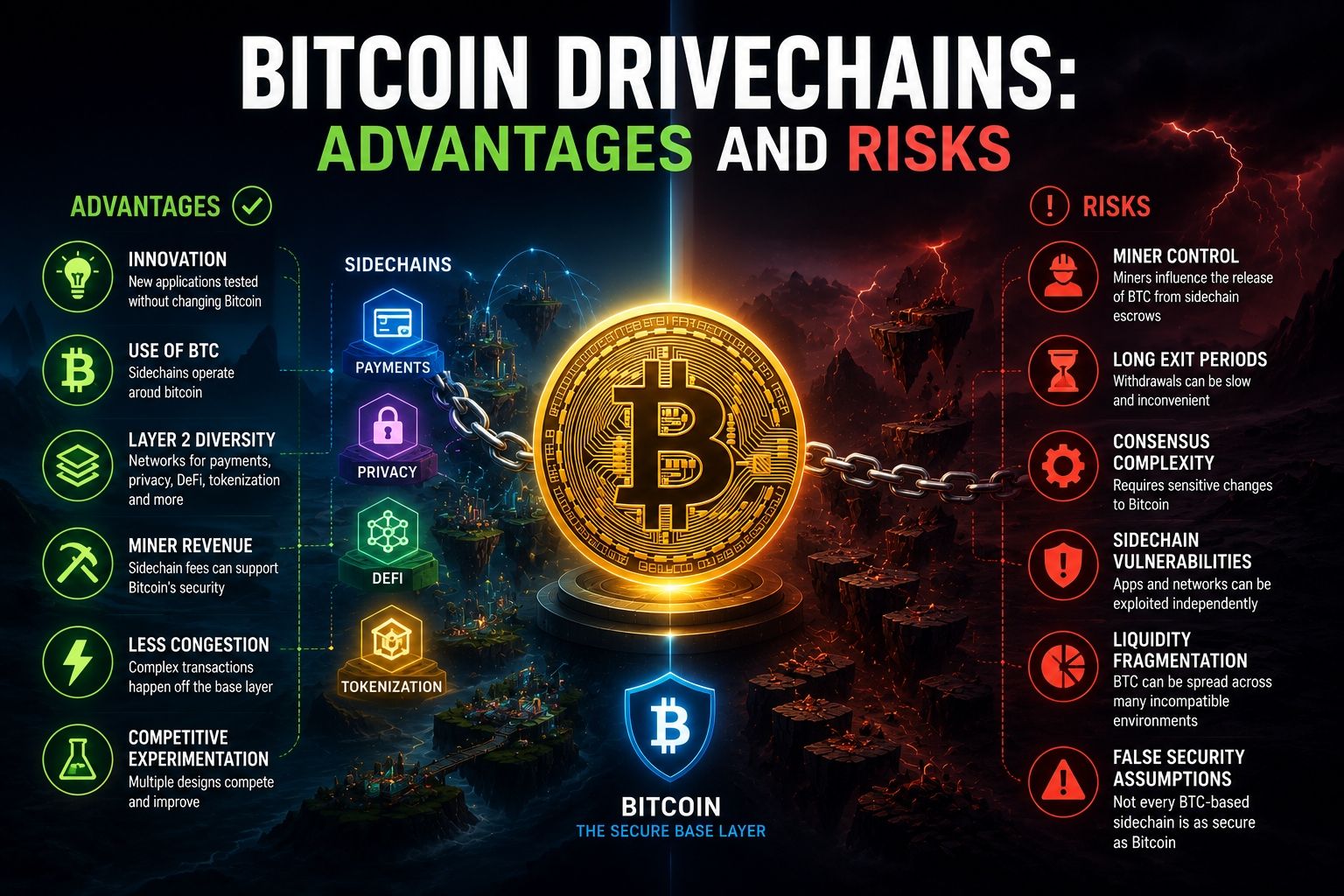
Supporters believe Bitcoin Drivechains could expand Bitcoin’s capabilities without overloading the base layer with every new application, rule or execution model. Instead of attempting to transform Bitcoin itself into a general-purpose blockchain, developers could build specialized Bitcoin sidechains designed for specific use cases.
This modular approach could give users access to new services while keeping participation optional. A sidechain could focus on payments, privacy, decentralized finance or tokenization, while users who are not interested in those applications could continue using Bitcoin exactly as they do today.
- Optional innovation: new applications could be tested without adding all their rules to Bitcoin’s base layer.
- Use of BTC: sidechains could operate around bitcoin rather than requiring a new native currency.
- More Bitcoin Layer 2 diversity: different networks could specialize in payments, privacy, DeFi or tokenization.
- Potential miner revenue: sidechain fees could contribute to Bitcoin’s long-term security economy.
- Reduced base-layer congestion: complex transactions could occur outside Bitcoin’s limited block space.
- Competitive experimentation: multiple blockchain designs could be tested without forcing one model on every user.
Another important advantage is that Bitcoin Drivechains could allow several competing blockchain models to develop in parallel. Rather than asking the entire Bitcoin community to agree on one major expansion of the protocol, different Bitcoin sidechains could experiment independently and allow the market to determine which designs provide lasting value.
However, none of these benefits are guaranteed. Their real impact would depend on adoption, developer activity, liquidity and the willingness of the Bitcoin community to approve the protocol changes required to support the Drivechain model.
What are the main risks of Bitcoin Drivechains?
Despite their potential, Bitcoin Drivechains remain controversial. The most sensitive questions concern the withdrawal mechanism, the influence of miners and the additional complexity that the proposal could introduce into Bitcoin’s consensus rules.
It is also essential to distinguish between the security of Bitcoin and the security of an application built around bitcoin. A Drivechain may use BTC and remain connected to the Bitcoin ecosystem, but its smart contracts, bridges, governance mechanisms and applications could still create risks that do not exist on Bitcoin’s base layer.
- Miner-controlled withdrawals: miners would influence the release of BTC from sidechain escrows.
- Long exit periods: direct withdrawals could be slow and operationally inconvenient.
- Consensus complexity: the proposal requires sensitive changes to Bitcoin.
- Sidechain vulnerabilities: applications and networks could suffer exploits independently of the base layer.
- Liquidity fragmentation: BTC could become distributed across many incompatible environments.
- False security assumptions: users may incorrectly assume that every BTC-based sidechain is as secure as Bitcoin itself.
The role of miners is particularly important. Under the Drivechain model, miners would help process withdrawal requests from sidechains. Supporters argue that the long withdrawal periods and economic incentives would make dishonest behavior difficult. Critics respond that giving miners this responsibility could create a new security assumption around funds locked outside the base layer.
Liquidity fragmentation could become another challenge. If numerous Bitcoin sidechains emerge, BTC may be divided across different environments, applications and liquidity pools. This could make the broader Bitcoin Layer 2 ecosystem harder to navigate and may increase users’ dependence on exchanges, fast-withdrawal providers or other intermediaries.
Ultimately, Bitcoin Drivechains should be viewed as a trade-off rather than a perfect solution. They could unlock important new capabilities for Bitcoin, but their success would depend on whether the security model, withdrawal process and economic incentives prove robust enough to earn broad community trust.
Are Bitcoin Drivechains likely to be activated?
It is impossible to state with certainty whether Bitcoin Drivechains will eventually be activated.
BIP 300 and BIP 301 remain draft proposals. They have supporters, functioning research implementations and years of discussion behind them, but they also face substantial opposition.
Bitcoin does not have a central authority capable of approving an upgrade by decree.
Activation would require a combination of:
- technical confidence;
- software implementation;
- miner participation;
- node operator acceptance;
- user and business support;
- a deployment mechanism considered legitimate.
A proposal can be technically sophisticated without achieving the social consensus required for Bitcoin adoption.
How should investors evaluate Bitcoin Drivechains?
Bitcoin Drivechains should not be treated as a guaranteed upgrade or an immediate investment catalyst.
They are better understood as a long-term debate about Bitcoin’s architecture.
Investors should distinguish between three levels:
- The proposal: BIP 300 and BIP 301 describe possible changes.
- The implementation: developers can build and test software based on those ideas.
- Activation and adoption: Bitcoin users would still need to accept the changes, and sidechains would need to attract real activity.
Announcements, test networks and demonstrations do not mean that Drivechains are active on Bitcoin.
It is also important to avoid assuming that every project using the word “Drivechain” has the same security, legitimacy or connection to the formal proposals.
Follow the broader Bitcoin market
Protocol innovations can influence Bitcoin’s utility and long-term adoption, but price also depends on liquidity, institutional flows, macroeconomic conditions and market structure.
Read our:

Bitcoin price, technical and fundamental analysis
Bitcoin Drivechains FAQ
What are Bitcoin Drivechains?
BTC Drivechains are proposed sidechains that would allow users to move BTC between the Bitcoin base layer and specialized blockchain networks. These networks could support payments, smart contracts, privacy, DeFi or tokenized assets.
Are Bitcoin Drivechains currently active?
No. The principal specifications remain draft proposals and have not been activated as Bitcoin consensus rules.
Are Drivechains the same as Bitcoin sidechains?
Drivechains are a specific model for creating and connecting Bitcoin sidechains. Not every Bitcoin sidechain uses the Drivechain architecture.
Are Drivechains a Bitcoin Layer 2?
They are commonly classified as Bitcoin Layer 2 networks because they extend Bitcoin through secondary systems using BTC. More precisely, they are independent sidechains connected through a proposed two-way peg.
What is BIP 300?
BIP 300 proposes the Hashrate Escrow mechanism used to manage BTC assigned to Drivechains and process withdrawals back to Bitcoin.
What is BIP 301?
BIP 301 proposes Blind Merged Mining, which would allow Bitcoin miners to include sidechain commitments and collect fees without fully validating every sidechain transaction.
Do Drivechains create new bitcoin?
The intended two-way peg does not increase Bitcoin’s maximum supply. BTC would be locked on the base layer before an equivalent amount becomes usable on a sidechain.
Could Drivechains bring DeFi to Bitcoin?
Yes, a specialized sidechain could support exchanges, lending, stablecoins and other DeFi applications using BTC. Users would nevertheless face smart contract, liquidity and sidechain security risks.
Could Drivechains compete with Ethereum?
They could provide Bitcoin-based alternatives to some Ethereum applications. However, Ethereum already has a large developer ecosystem, significant liquidity and established infrastructure, so competition would depend on adoption rather than technology alone.
Can miners steal Drivechain BTC?
Critics argue that miners controlling enough hash rate could attempt to approve a fraudulent withdrawal. The proposal seeks to deter this through long delays, transparency and economic incentives, but the security model remains controversial.
Would ordinary Bitcoin users have to participate?
No. Drivechain participation would be optional. Users could continue holding and transferring BTC on the base layer without using a sidechain.
What is the difference between Drivechains and Lightning?
Lightning uses payment channels to enable fast BTC transfers. Drivechains would create independent blockchains capable of supporting a much wider range of applications.
Conclusion: Could Bitcoin Drivechains reshape Bitcoin Layer 2?
Bitcoin Drivechains propose a modular future in which Bitcoin remains a secure and conservative settlement layer while optional networks handle experimentation.
Through specialized Bitcoin sidechains, developers could build faster payment systems, privacy networks, smart contract platforms, tokenization infrastructure and decentralized financial applications using BTC.
The model could reduce the need for new native tokens and give Bitcoin miners additional sources of fee revenue. It could also allow competing blockchain architectures to develop without forcing their complexity onto every Bitcoin user.
But these benefits come with significant trade-offs.
The withdrawal mechanism gives miners a sensitive role. Direct exits may be slow. Sidechains create additional attack surfaces, and Bitcoin users may disagree about whether the base protocol should be modified to support them.
Drivechains are therefore neither a guaranteed revolution nor a simple technical upgrade. They represent a deeper question about Bitcoin’s future:
Should Bitcoin remain primarily a monetary settlement network, or should it also become the foundation for an open ecosystem of specialized blockchains?
The answer will depend not only on code, but also on incentives, security assumptions and social consensus.
Until that consensus exists, Bitcoin Drivechains remain one of the most important—and most disputed—ideas in the broader Bitcoin Layer 2 debate.
Stay informed about Bitcoin, crypto and DeFi
Drivechains are only one part of Bitcoin’s evolving ecosystem. Follow the latest protocol developments, market signals and decentralized finance trends in our crypto and DeFi news
Disclaimer: This content is provided for educational and informational purposes only. It does not constitute financial, investment, legal or technical advice. Bitcoin Drivechains remain proposals and may never be activated. Cryptocurrency and decentralized finance technologies involve substantial risks.


Trader, investor and author specializing in cryptocurrencies, DeFi and Web3.
On Mediasnet, I share my market analysis, practical guides and research on crypto markets, decentralized protocols and emerging trends across the ecosystem.
Follow me on: Facebook – X (Twitter)