
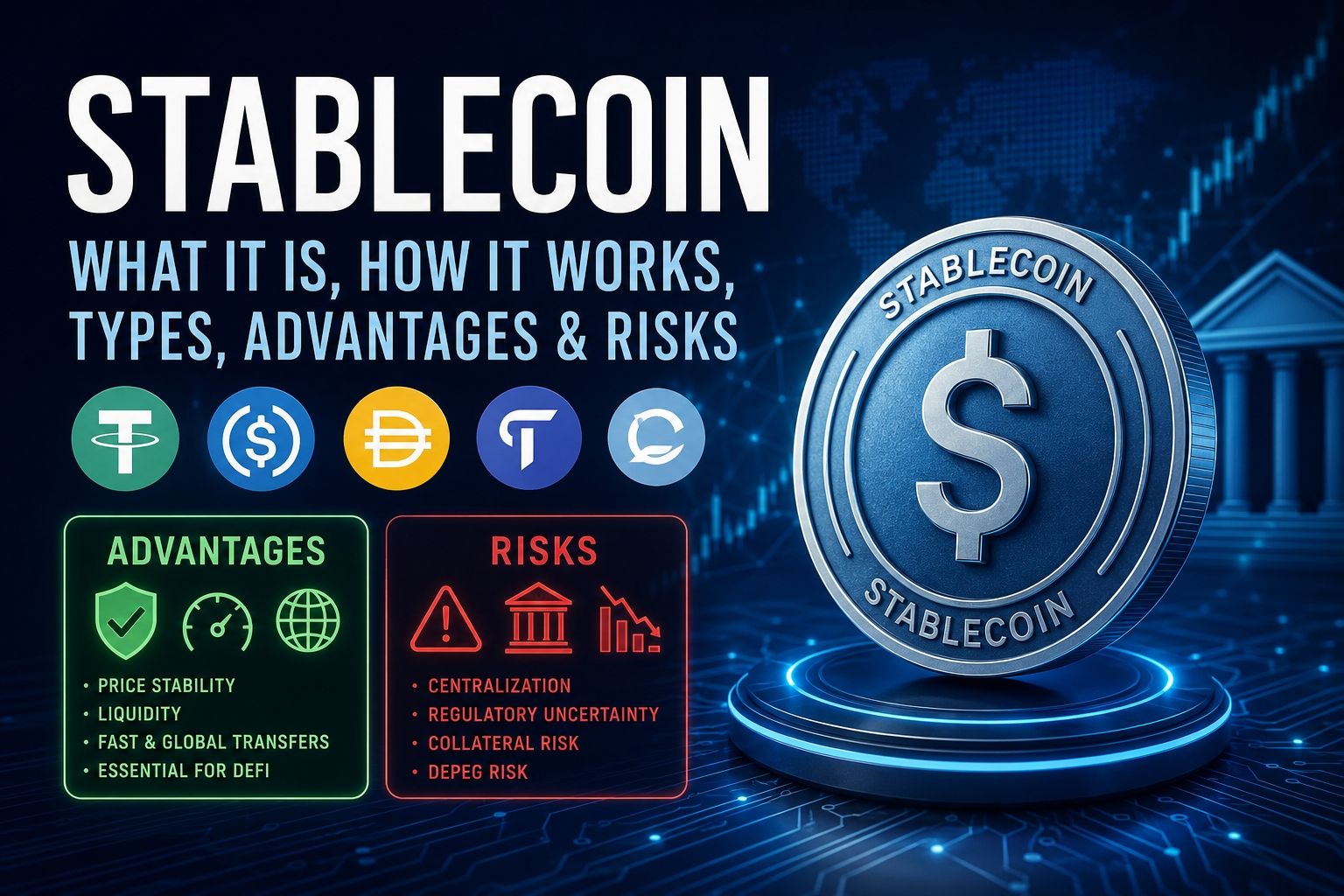
Updated on July 3, 2026.
A stablecoin is a cryptocurrency designed to keep a stable value, usually close to the US dollar. But these digital assets do not all work the same way. Some are backed by cash and Treasury bills, others by crypto collateral, while newer models rely on synthetic or algorithmic mechanisms.
A stablecoin is a type of cryptocurrency designed to maintain a relatively stable value. In most cases, it tries to stay close to the value of a traditional currency, especially the US dollar.
This is why you often see these tokens trading around $1. The goal is not to rise like Bitcoin or Ethereum. The goal is to remain stable, liquid and easy to use inside the crypto economy.
Dollar-pegged crypto assets have become essential in cryptocurrency markets and decentralized finance. Traders use them to move quickly between positions. Investors use them to reduce exposure to volatility. DeFi users rely on them for lending, borrowing, liquidity pools and yield strategies.
They are also becoming more important for institutions, regulators and payment companies. The market is now worth hundreds of billions of dollars, and these digital dollars are increasingly discussed as a bridge between traditional finance and blockchain-based finance.
Simple definition
A stablecoin is a cryptocurrency whose value is designed to remain stable, usually by tracking the price of a fiat currency such as the US dollar. However, the mechanism used to maintain that stability can vary greatly from one project to another.
Stablecoin: What Is It?
A stablecoin is a digital asset created on a blockchain and designed to reduce the extreme volatility often seen in cryptocurrencies.
Bitcoin can move sharply in a single day. Ethereum can gain or lose several percentage points in a few hours. Smaller crypto assets can be even more volatile. This volatility can be attractive for traders, but it can also be difficult for users who simply want a reliable digital unit of account.
Dollar-pegged tokens try to solve this problem. Instead of fluctuating freely like Bitcoin, they aim to keep a relatively stable price. Most of them are linked to the US dollar, which means one token is designed to be worth around one dollar.
For example, if you hold 1 USDC, 1 USDT or 1 USDe, the goal is that each token remains close to $1. The exact mechanism behind that stability depends on the model used.
These assets are still cryptocurrencies because they are issued and transferred on blockchains. They can be stored in crypto wallets, sent across networks, used in smart contracts and traded on crypto exchanges. But unlike most cryptocurrencies, they are not designed primarily for price appreciation.
Are Stablecoins Cryptocurrencies?
Yes, stablecoins are cryptocurrencies, but they are a specific category of crypto assets.
They use blockchain infrastructure like other cryptocurrencies. They can be transferred from one wallet to another. They can be used on decentralized applications. They can interact with smart contracts. They can also circulate across different blockchain networks.
The difference is their price objective. Bitcoin is not designed to stay at one dollar. Ethereum is not designed to maintain a fixed value. A dollar-pegged crypto asset, however, is created specifically to track the value of another asset, usually a fiat currency.
This makes them one of the most practical tools in the crypto market. They are less about speculation and more about liquidity, settlement, payments and risk management.
Why Do Stablecoins Matter?
Stablecoins matter because they provide a stable unit of value inside a volatile market.
Without them, crypto users would often need to move back into traditional bank accounts whenever they wanted to avoid volatility. That process can be slow, expensive and inconvenient.
With digital dollars, users can stay inside the crypto ecosystem while reducing exposure to price swings. A trader can sell Bitcoin into USDT or USDC instead of converting back into dollars through a bank. A DeFi user can lend these assets, borrow against them or provide liquidity.
They are also important because they connect crypto markets to the real economy. They are used for trading, remittances, payments, savings, DeFi strategies and institutional settlement.
Why Use a Dollar-Pegged Token Instead of Dollars?
At first, the idea may seem strange. If a crypto token is supposed to be worth one dollar, why not just use dollars?
The answer is that blockchain-based dollars combine the stability of fiat money with the speed and programmability of crypto networks.
They can be transferred 24 hours a day, 7 days a week. They can move across borders quickly. They can be used in decentralized finance without going through a traditional bank. They can also be integrated into smart contracts, trading platforms and blockchain applications.
For crypto traders, these assets are practical because many exchanges and DeFi protocols use them as the main unit of account. Trading pairs such as BTC/USDT, ETH/USDC or SOL/USDC are common across the market.
They also reduce friction. Moving dollars in and out of a bank account can take time. Tokenized dollars allow users to remain liquid inside the crypto ecosystem.
The Main Types of Stablecoins
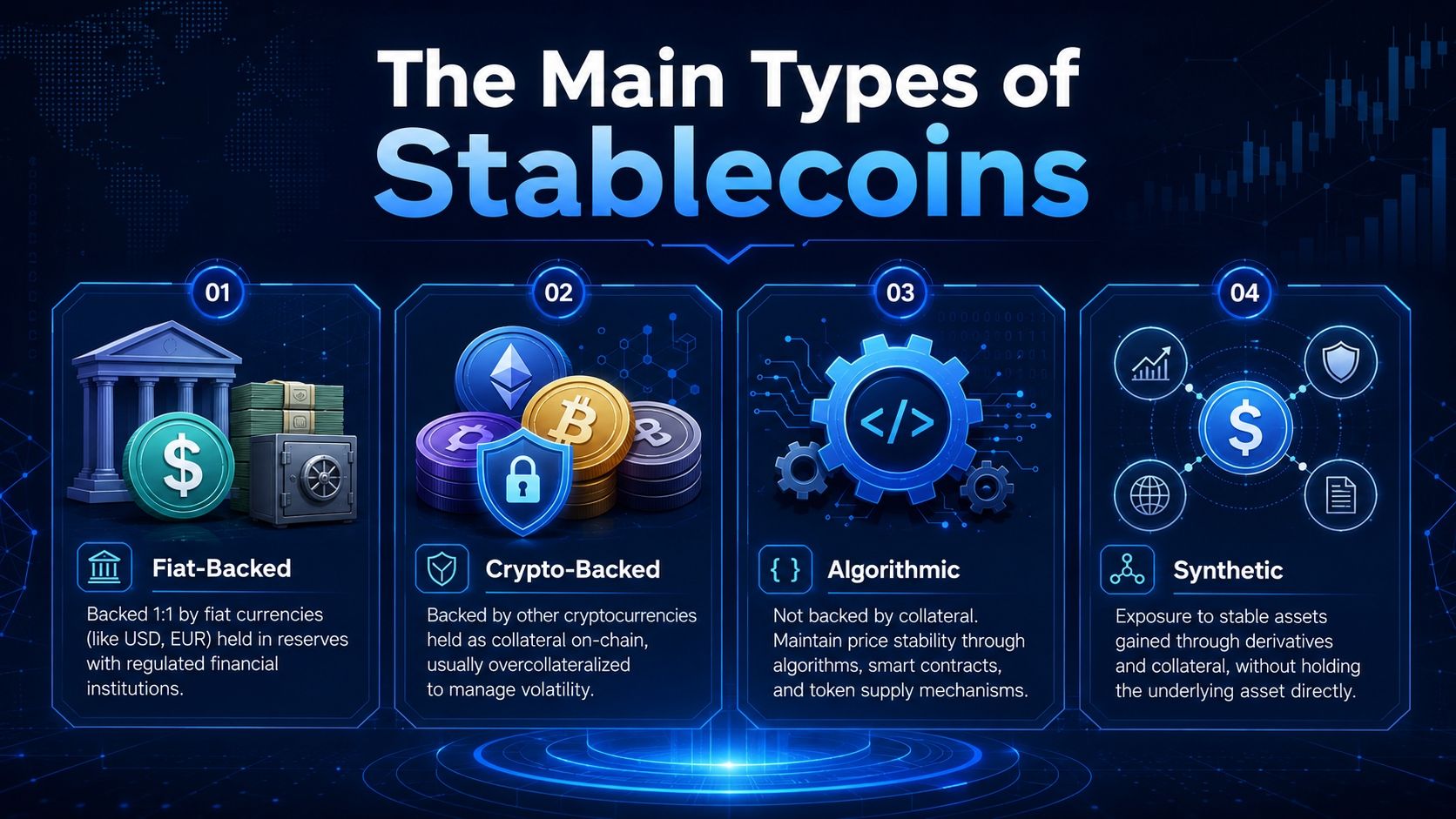
Not all stablecoins work the same way. This is one of the most important points to understand.
A dollar-pegged asset can be backed by fiat reserves, crypto collateral, tokenized assets, algorithms, derivatives or a combination of different mechanisms. The design matters because it determines the risk.
1. Fiat-backed models
Fiat-backed tokens are the most common type. They are usually backed by traditional assets such as cash, bank deposits, Treasury bills or other short-term instruments.
The idea is simple: for every token issued, the company or issuer should hold equivalent reserves. If users want to redeem their tokens, the issuer should be able to provide dollars or equivalent assets.
Examples include USDT and USDC, two of the largest dollar-pegged crypto assets in the world.
The main advantage of this model is simplicity. The main risks are reserve quality, transparency, regulation, banking access and issuer trust.
2. Crypto-backed models
Crypto-backed assets are backed by cryptocurrencies instead of traditional bank reserves.
Because crypto assets are volatile, these models usually need to be overcollateralized. This means users must deposit more value in collateral than the amount they borrow or mint.
For example, a user may need to deposit $150 worth of crypto to mint $100 worth of a dollar-pegged token. If the collateral price falls too much, the position can be liquidated to protect the system.
This model is more decentralized, but it is also exposed to crypto market volatility, liquidation risk and smart contract risk.
3. Algorithmic models
Algorithmic designs try to maintain their peg through supply and demand mechanisms rather than direct reserves.
In theory, the system expands supply when the price is above the peg and contracts supply when the price is below the peg. In practice, this model has been very difficult to maintain during periods of stress.
The collapse of several algorithmic designs showed that confidence is essential. If users lose trust in the mechanism, the peg can break quickly.
Algorithmic dollar-pegged assets are therefore among the riskiest designs.
4. Synthetic stablecoins
Synthetic stablecoins are a newer and more complex category.
A synthetic dollar does not necessarily rely only on cash reserves or simple crypto collateral. Instead, it can use financial strategies to create exposure that behaves like a dollar.
One important example is USDe stablecoin, issued through the Ethena protocol. USDe is designed as a synthetic dollar. Its model uses crypto-native collateral and hedging strategies, especially through derivatives markets.
This type of asset can be innovative because it may generate yield and remain deeply integrated with DeFi. But it can also be more complex and harder to evaluate.
Important distinction
A fiat-backed model is usually backed by traditional reserves. A crypto-backed model relies on digital collateral. A synthetic design may use hedging strategies and derivatives to create dollar-like exposure. These models are not equivalent, and their risks are very different.
How Do Stablecoins Maintain Their Value?
A stablecoin maintains its value through a mechanism designed to keep the token close to its peg.
For a fiat-backed model, the peg depends on reserves and redemption. If one token can be redeemed for one dollar, traders have an incentive to buy it when it falls below one dollar and redeem it at par. This arbitrage helps stabilize the price.
For a crypto-backed model, the peg depends on collateral, liquidation systems and market incentives. If the system is well designed, collateral should protect the value of the token even when crypto prices fall.
For an algorithmic model, the peg depends on confidence in the supply adjustment mechanism. This is generally more fragile because there may be no direct reserve backing the token.
For a synthetic design, the peg depends on the quality of the strategy behind it. This may include collateral, derivatives, hedging, liquidity, counterparties and risk management.
In all cases, a dollar-pegged crypto asset is only as strong as the mechanism that supports it.
What Are Stablecoins Used For?
Stablecoins are used across almost every part of the crypto economy.
Trading
Traders use these assets to enter and exit positions without returning to traditional banking rails. They can sell Bitcoin into USDT or USDC, wait for a new opportunity, and then re-enter the market quickly.
DeFi
Dollar-pegged tokens are central to DeFi. They are used in lending protocols, liquidity pools, decentralized exchanges, yield strategies and collateralized borrowing.
Payments
These digital assets can be used for fast blockchain-based payments. They can move across borders more easily than traditional bank transfers, especially when the user already understands crypto wallets.
Remittances
In some regions, crypto dollars are used as a way to send value internationally. They can be useful when banking access is limited or when local currency instability is a problem.
Risk management
They allow investors to reduce exposure to crypto volatility without leaving the blockchain ecosystem. This makes them useful during market corrections.
Yield strategies
Some users lend dollar-pegged assets or use them in DeFi protocols to earn yield. This can be attractive, but it also introduces risks such as smart contract risk, protocol risk and liquidity risk.
Stablecoins and DeFi
Stablecoins are one of the foundations of decentralized finance.
Without them, DeFi would be much harder to use. Borrowing, lending and liquidity pools would be more exposed to volatility. Users would have fewer ways to manage risk. Protocols would have less stable collateral.
Digital dollars make DeFi more practical. They allow users to borrow against crypto assets, lend dollar-like assets, provide liquidity, trade synthetic assets and create structured strategies.
This is also why they can become systemic. If a major pegged asset loses its peg, the impact can spread across lending markets, decentralized exchanges, liquidity pools and collateral systems.
In other words, these assets are useful because they bring stability to DeFi. But if that stability is questioned, the entire ecosystem can feel the shock.
Stablecoin Risks
A stablecoin is designed to be stable, but that does not mean it is risk-free.
1. Peg risk
The main risk is that the token loses its peg. If an asset designed to trade at $1 falls to $0.98, $0.90 or lower, users can lose money and confidence can disappear quickly.
2. Reserve risk
For fiat-backed models, the quality of reserves is essential. Users need to know whether the token is backed by cash, Treasury bills, loans, commercial paper, crypto assets or other instruments.
If reserves are not transparent or liquid enough, the asset can become vulnerable during a crisis.
3. Counterparty risk
Many pegged tokens depend on banks, custodians, issuers, exchanges or other service providers. If one of these counterparties fails, users may be affected.
4. Smart contract risk
Assets used in DeFi can be exposed to smart contract bugs, protocol exploits or oracle failures.
5. Regulatory risk
Governments and regulators are paying close attention to this market. New rules can affect issuance, reserves, redemptions, yield products and access to exchanges.
6. Liquidity risk
A pegged token may look stable in normal conditions but become difficult to redeem or trade during a market panic. Liquidity matters as much as price.
7. Synthetic model risk
Synthetic designs add another layer of complexity. Their stability may depend on derivatives markets, hedging strategies, funding rates, counterparties and execution quality.
This does not mean synthetic models are bad. It means users must understand how they work before using them.
Risk reminder
A crypto asset is not automatically safe because its price is close to $1. The real question is how that price is maintained, what backs the token, how redemptions work, and what happens during a market stress event.
Stablecoins vs Central Bank Digital Currencies
Stablecoins are sometimes compared to central bank digital currencies, also known as CBDCs. But they are not the same thing.
A dollar-pegged crypto asset is usually issued by a private company, a DeFi protocol or a crypto project. It circulates on public or semi-public blockchain networks and is used by crypto users, traders, businesses and DeFi protocols.
A CBDC would be issued directly by a central bank. It would represent official digital money from a government monetary authority.
Crypto dollars are market-driven. CBDCs are state-issued. Both can be digital, but their governance, purpose and risk profile are very different.
What Are the Largest Stablecoins?
The stablecoin market changes constantly, but it is usually dominated by a few major names.
USDT, issued by Tether, is the largest dollar-pegged crypto asset by market capitalization and remains the dominant source of liquidity across many crypto exchanges.
USDC, issued by Circle, is one of the most important assets for institutional users, regulated platforms and DeFi applications.
DAI, linked to MakerDAO/Sky, remains one of the best-known DeFi-native dollar assets.
USDe, issued through Ethena, has become one of the most visible synthetic models and is especially important because of its yield-bearing version, sUSDe.
Instead of focusing only on a fixed top 10 list, it is better to understand the different models. The ranking can change, but the categories remain essential: fiat-backed, crypto-backed, algorithmic and synthetic designs.
Stablecoins and Yield: What Should Users Know?
Some stablecoins can be used to generate yield. This is one of the biggest developments in the market.
Yield can come from lending, liquidity provision, tokenized Treasury bills, DeFi strategies, staking-related mechanisms or derivatives-based strategies.
However, yield is never free. It always comes from somewhere. It can come from borrowers paying interest, traders paying funding rates, Treasury yields, protocol incentives or market inefficiencies.
This is why users should always ask a simple question: where does the yield come from?
If the answer is not clear, the risk may be higher than it appears.
This is especially important for yield-bearing and synthetic models. A product like sUSDe can be attractive, but users must understand that its yield is variable and depends on market conditions.
Are Stablecoins Safe?
Stablecoins can be safer than volatile cryptocurrencies in terms of price movement, but that does not mean they are risk-free.
A dollar-pegged asset may avoid the daily volatility of Bitcoin or Ethereum, but it can still face reserve problems, regulatory pressure, issuer risk, smart contract failures, liquidity issues or peg instability.
The safest approach is to avoid treating all pegged tokens as identical. A large fiat-backed asset, a decentralized overcollateralized model and a synthetic yield-bearing dollar are very different products.
Before using one, users should understand:
- who issues it;
- what backs it;
- how redemptions work;
- where liquidity comes from;
- whether it has been audited;
- which blockchains it uses;
- what happens if the peg breaks;
- whether it is used in DeFi protocols;
- whether it generates yield and how that yield is produced.
Stablecoin: Simple Example
Imagine that you own Bitcoin and the market becomes very volatile. You do not want to sell your crypto into a bank account, but you also do not want to remain exposed to Bitcoin’s price movements.
You can sell Bitcoin for a dollar-pegged asset such as USDC, USDT or another token designed to remain close to $1. Your value is now held in a more stable crypto asset. You can keep it in a wallet, use it in DeFi, transfer it to another exchange or buy back Bitcoin later.
This is one of the reasons this market is so widely used. It makes crypto trading more liquid, flexible and practical.
Stablecoins and the Future of Finance
Stablecoins are no longer a small corner of the crypto market. They have become one of the most important financial applications of blockchain technology.
They are used by traders, DeFi users, fintech companies, institutions and people looking for digital dollar access. They are also increasingly discussed by regulators because they connect crypto markets with traditional finance.
The next stage of this market may include more regulated issuers, more tokenized money market products, more synthetic dollars, more cross-border payment use cases and more integration with decentralized finance.
This evolution will create opportunities, but also new risks. The more these assets grow, the more important transparency, liquidity and regulation become.
Conclusion: What Is a Stablecoin?
A stablecoin is a cryptocurrency designed to maintain a stable value, usually close to the US dollar.
These assets are important because they reduce volatility inside the crypto ecosystem. They help traders manage risk, allow users to move value quickly, and provide the liquidity that powers many DeFi protocols.
However, they are not all the same. Some are backed by fiat reserves. Some are backed by crypto collateral. Some rely on algorithms. Others, such as synthetic models, use more complex financial strategies.
This is why understanding the mechanism matters as much as knowing the name of the asset.
A dollar-pegged crypto asset can be useful, liquid and powerful. But it can also carry risks related to reserves, regulation, liquidity, counterparties, smart contracts or market stress.
In simple terms, stablecoins are one of the most important bridges between traditional finance and cryptocurrency. But like every bridge, their strength depends on how they are built.
In summary
- A stablecoin is a cryptocurrency designed to keep a stable value.
- Most are pegged to the US dollar.
- They are used for trading, payments, DeFi, lending, borrowing and risk management.
- The main types are fiat-backed, crypto-backed, algorithmic and synthetic models.
- They reduce volatility but are not risk-free.
- Risks include peg instability, reserve problems, regulation, liquidity, smart contracts and counterparty exposure.
- Synthetic dollars such as USDe show how this market is becoming more complex and more connected to DeFi yield strategies.
FAQ About Stablecoins
What is a stablecoin?
A stablecoin is a cryptocurrency designed to maintain a stable value, usually by tracking the price of a fiat currency such as the US dollar.
Are stablecoins cryptocurrencies?
Yes. They use blockchain technology and can be transferred through crypto wallets. However, unlike Bitcoin or Ethereum, their value is designed to remain stable.
What is the most common peg?
The most common peg is the US dollar. Most major dollar-pegged crypto assets aim to trade around $1.
Why do people use them?
People use these assets to trade, reduce volatility, send payments, use DeFi protocols, lend, borrow and keep liquidity inside the crypto ecosystem.
What are the main types?
The main types are fiat-backed, crypto-backed, algorithmic and synthetic models.
What is a synthetic stablecoin?
A synthetic stablecoin is a dollar-pegged crypto asset that uses financial strategies, often involving collateral and hedging, to create dollar-like exposure. USDe, issued through Ethena, is one example.
Can they lose their peg?
Yes. A pegged asset can lose its peg during periods of market stress, low liquidity, reserve concerns, smart contract issues or loss of confidence.
Are these assets safe?
They can be less volatile than other cryptocurrencies, but they are not risk-free. Users should understand the backing, issuer, liquidity, regulation and mechanism behind each asset.
What is the difference between USDT and USDC?
USDT is issued by Tether and is the largest dollar-pegged crypto asset by market capitalization. USDC is issued by Circle and is often viewed as more institutional and regulation-oriented. Both are fiat-backed, but they have different issuers, reserve structures and market positioning.
What is the difference between USDe and other stablecoins?
USDe is a synthetic dollar issued through the Ethena protocol. Unlike traditional fiat-backed models, it uses crypto-native collateral and hedging strategies. Its staked version, sUSDe, can also generate variable yield.
Disclaimer: This article is for informational and educational purposes only. It is not financial advice. Cryptocurrencies, dollar-pegged assets and DeFi protocols involve risks, including loss of capital, peg instability, smart contract risk, liquidity risk, counterparty risk and regulatory uncertainty. Always do your own research before using any crypto asset.


Trader, investor and author specializing in cryptocurrencies, DeFi and Web3.
On Mediasnet, I share my market analysis, practical guides and research on crypto markets, decentralized protocols and emerging trends across the ecosystem.
Follow me on: Facebook – X (Twitter)
8 thoughts on “Stablecoin: What It IS and How Does It Work?”
Comments are closed.