
Last updated: November 4, 2026. Originally published in May 2024. This analysis distinguishes the project’s documented mechanisms from independently observable market data. Token prices, liquidity, total value locked and incentive conditions can change without notice.
Bonsai DAO is a decentralized venture studio built around a MetaDAO structure: instead of operating a single financial application, it supports several specialized DeFi projects known as Leaves. The concept grew out of Umami Finance, whose yield products became the foundation of a broader ecosystem. The aim is to combine capital allocation, shared infrastructure and independent product development without forcing every project into the same business model.
The idea is more substantial than the short description that accompanied the project’s 2024 introduction. There are now recognizable product lines in yield management, lending and liquidity for locked assets. Yet the investment case requires considerably more caution than the original promotional language suggested. In early November 2026, reported BONSAI trading activity is extremely limited, its quoted price is far below its historical high, and the ecosystem’s reported TVL is modest. These facts do not establish that every underlying product has stopped functioning; they do mean that investors should not confuse an interesting design with demonstrated token-market strength.
This updated guide explains how the MetaDAO works, where Umami Finance, Vendor Finance and Exit.tech fit, what the BONSAI token actually represents, why SEED incentives are not the same as free income, and which measurable indicators matter when evaluating the ecosystem. For the wider sector context, see our DeFi news and market analysis.
In this article
What Is Bonsai DAO? From Umami Finance to a DeFi Venture Studio
The easiest way to understand Bonsai DAO is to separate its coordinating organization from the products it incubates. The coordinating layer can allocate treasury resources, support builders, define governance arrangements and decide how economic benefits from a new project should reach the wider community. An individual Leaf is the place where a user actually borrows, lends, deposits assets or interacts with a specific DeFi strategy. Those are different responsibilities, even when they share a common history and brand.
Why did Umami evolve into a MetaDAO?
The roots of the model go back to Umami DAO, which originally concentrated on yield-generating products on Arbitrum. In April 2024, the team outlined a transition toward a parent organization capable of incubating several businesses. The existing Umami product brand would be preserved, while the former UMAMI token would be replaced by BONSAI. The announced exchange ratio was ten BONSAI for each UMAMI, intended to preserve holders’ relative ownership proportions during that historical transition.
The motivation was partly organizational. A yield vault needs different engineering, risk management and user acquisition from a lending marketplace. Trying to manage both as identical products creates awkward incentives. Under a venture-studio model, a new initiative can receive initial funding and support, test whether customers actually want its service, and eventually develop more independent governance. In theory, that allows specialization without rebuilding everything from scratch.
The motivation was also economic. Revenue earned by a useful application does not automatically translate into demand for a governance token. Even profitable protocols can see their tokens trade poorly when holders cannot identify a credible link between product usage and token utility. The parent-and-Leaf design attempts to make that link more visible through treasury flows, governance decisions, potential token distributions and mechanisms intended to support long-term ownership.
None of those design choices guarantees better market performance. A holding-company structure can diversify exposure, but it can also multiply expenses and execution risk. Likewise, launching more products may broaden a community without producing sustainable fees. The key question is whether each individual Leaf can attract real activity and contribute more economic value than it consumes in development, incentives and maintenance.
What does the term MetaDAO mean here?
A conventional decentralized autonomous organization usually governs one protocol or a tightly connected set of contracts. A MetaDAO operates at a higher level: it helps coordinate several initiatives whose daily operations may be distinct. Bonsai uses the term to describe a structure inspired by a venture studio, where capital and expertise are allocated across product teams while the overall community retains a governance role.
That description is a model rather than a legal certification. The word DAO does not prove that every operational action is controlled by a token-holder vote. Smart-contract permissions, multisignature custody, upgrade keys, treasury approvals and actual voting participation should be reviewed separately. A product can describe itself as decentralized while continuing to depend on a small group of developers, administrators or signers for important functions.
For readers unfamiliar with the distinction between a community-governed protocol and an ordinary company, our explanation of what a DAO is provides the fundamentals. That background is useful because Bonsai mixes familiar governance concepts with a portfolio-style approach to protocol development.
Why are the projects called Leaves?
The botanical vocabulary is a simple way to describe how the organization expects projects to grow. A Leaf begins as a supported initiative within the wider organization. It can use shared resources while testing a product. If demand, security and finances justify greater independence, it may later become a more autonomous SubDAO, potentially with its own governance and token design.
The important qualifier is may. A product being listed in an ecosystem does not mean a separate token has already launched, that an airdrop has been approved, or that a particular amount of future revenue is contractually committed to BONSAI holders. Each eventual spinout needs a specific decision, timetable and allocation policy. Readers should look for a published proposal and implemented contracts rather than treating an early roadmap as a completed event.
How the Bonsai DAO Ecosystem Works: Umami, Vendor and Exit.tech
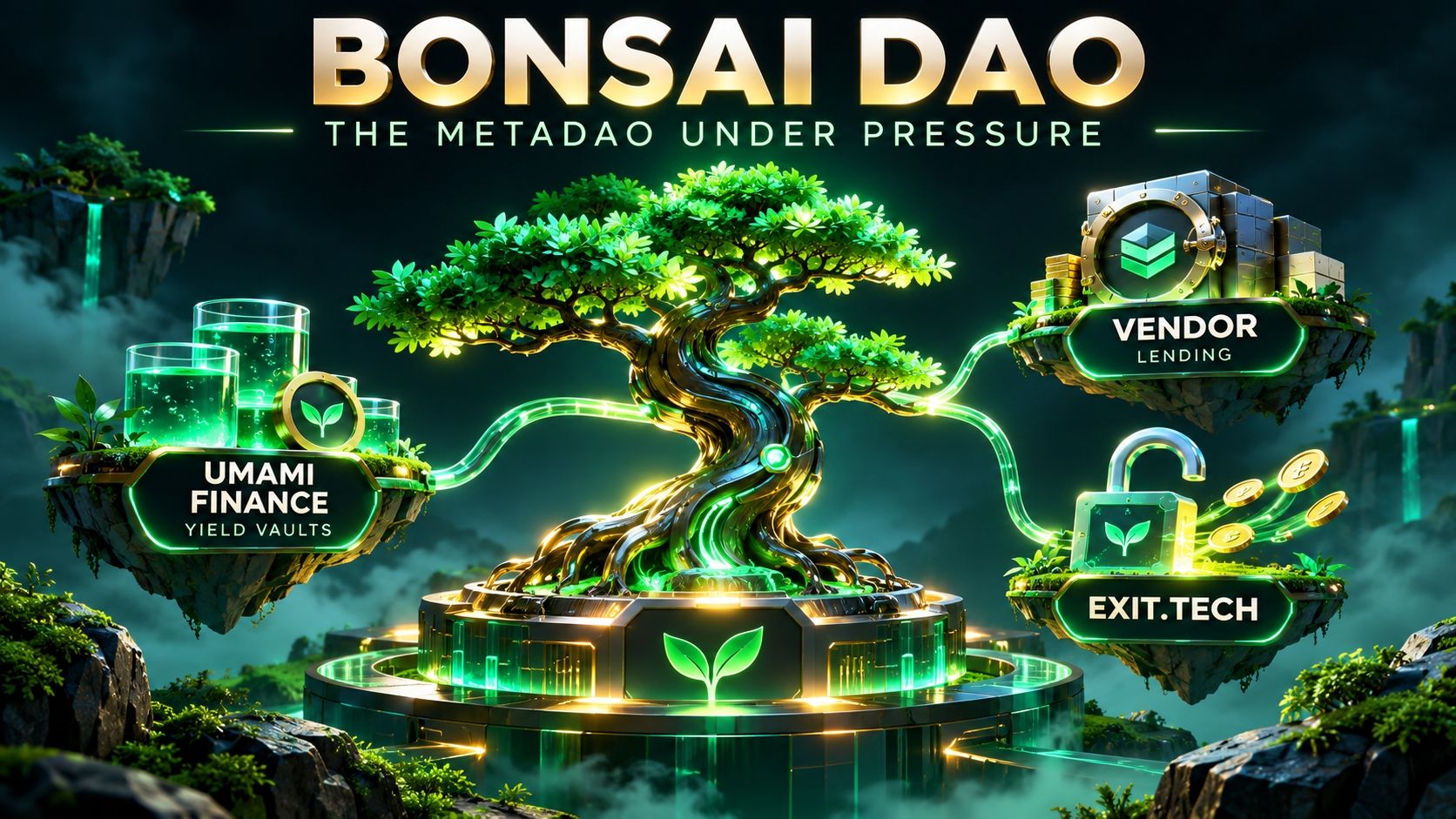
The core distinction between the projects is their economic purpose. Umami focuses on packaged on-chain yield strategies. Vendor addresses fixed-term credit. Exit.tech addresses liquidity for positions whose underlying assets are locked or vesting. These services involve different customers and risks, which is precisely the rationale for the Leaf structure. DeFiLlama identifies all three in its BonsaiDAO Ecosystem tracking, although inclusion in a dashboard should not be mistaken for proof of comparable usage or profitability.
| Product | Main use | Important risk |
|---|---|---|
| Umami Finance | Managed DeFi vaults and yield strategies, including GMX-related positions | Strategy, smart-contract, liquidity and counterparty dependencies |
| Vendor Finance / Vendor V2 | Configurable fixed-term lending markets backed by collateral | Default, collateral valuation and limited exit options |
| Exit.tech | Liquidity solutions for locked or vesting crypto positions | Vesting mechanics, underlying assets and contract integration |
Umami Finance: simplifying access to complex yield strategies
Umami is the foundational product line and the clearest example of a practical use case. Its documentation describes non-custodial vaults for assets such as USDC, BTC and ETH, with strategies built around DeFi liquidity and hedging. Instead of requiring users to perform each step manually, a vault packages deposits, position management and withdrawals behind an interface. The GM vault architecture has relied on GMX V2 infrastructure, where trading-liquidity positions can generate fees and other strategy returns.
Convenience is valuable. A person who does not want to monitor the relative weights of an index, hedge exposures manually or manage several transaction sequences may prefer a strategy vault. But convenience does not remove the underlying risks. The vault still interacts with contracts, market positions and third-party infrastructure. A single deposit interface can conceal several layers of exposure that a user needs to understand before allocating capital.
The term hedged also deserves care. Hedging seeks to reduce a specific market exposure, often the impact of asset-price movements on a liquidity strategy. It cannot promise that every loss will be neutralized. Funding costs, sudden market gaps, oracle behavior, liquidity constraints and operational decisions can all affect results. A reported annual percentage yield is backward-looking or estimated, not a contractual interest rate.
For a useful comparison, consider a traditional savings account. The depositor generally has a contractual claim against a regulated bank and may benefit from a deposit-protection regime, depending on jurisdiction. A DeFi vault instead relies on the behavior of smart contracts and the economics of the underlying strategy. The user may have on-chain visibility and greater flexibility, but there is usually no equivalent guarantee against exploit losses or strategy failure.
Umami’s relevance to the wider ecosystem is therefore twofold. It demonstrates that Bonsai’s model is tied to an identifiable financial product rather than only a future roadmap. And it offers a route through which economic activity, fees or specific incentives might connect back to the parent structure. The strength of that connection must be evaluated from current disclosures and actual treasury transactions, not simply from the existence of a vault.
Vendor Finance: lending without perpetual liquidation pressure
Vendor Finance approaches DeFi credit from a different angle. Its model emphasizes fixed-term loans with conditions established when a lending pool is created. Borrowers pledge collateral and obtain financing; lenders choose exposure to defined terms, collateral assets and rates. Unlike many continuously monitored lending markets, the basic fixed-term design is intended to avoid automatic mid-loan liquidation caused solely by a changing market quotation.
That feature can make cash-flow planning easier for a borrower who knows the maturity date. However, the absence of continuous liquidation is not the absence of credit risk. If a borrower does not repay at maturity, the lender may depend on collateral whose market value has changed substantially. A loan backed by a volatile token can suffer economic losses even when contract rules execute exactly as designed.
It is also important not to use the phrase oracle-free as an absolute description of every possible Vendor deployment. The core architecture has been described as minimizing reliance on continuing price feeds, while later designs may allow configurable oracle functionality. Actual risks depend on the particular pool, contract version, collateral asset and enforcement rules. Before participating, users should inspect the individual market rather than assuming all pools operate identically.
From the MetaDAO’s perspective, a credit product broadens the potential business mix beyond yield aggregation. But the economic contribution depends on loan demand, completed repayments, sustainable fees and prudent defaults. A protocol can advertise attractive fixed rates while having almost no borrowers or very little usable lender liquidity. Those figures should be evaluated alongside any claim of innovation.
Exit.tech: turning locked positions into usable liquidity
Exit.tech addresses a problem often overlooked in token discussions: some crypto positions have economic value but cannot be transferred or sold freely today. Examples include vesting rewards, escrowed positions or rights to receive assets gradually. An application that connects holders of these positions with users willing to commit capital may create an alternative to simply waiting for the vesting period to end.
In the model described for Exit.tech, a holder can arrange a transaction involving future unlocks, while participants on the other side supply capital or backing assets and receive specified incentives from the unlocking stream. The details vary with the integrated protocol. Such arrangements can improve capital efficiency when participants have different liquidity needs and time horizons, but they introduce complexity that ordinary spot trading does not have.
For the holder, the cost of obtaining earlier liquidity may be substantial. For the capital provider, the apparent reward must be compared with lock-up duration, smart-contract risk and changes in the value of the underlying token. A quoted return is not necessarily a realized return when part of the position remains inaccessible for months. Interface availability and the depth of an individual market also matter.
Exit.tech’s strategic value to Bonsai is the possibility of serving users outside the original Umami community. Still, success cannot be judged by the number of potential protocol integrations listed in a presentation. Actual deposits, settled positions, fees collected and user retention provide much stronger evidence of a functioning marketplace.
Can multiple Leaves really reduce ecosystem risk?
Diversification can reduce dependence on a single product, but DeFi risks are often correlated. A sharp decline in crypto prices can affect vault liquidity, lending collateral and the willingness of users to finance locked assets at the same time. Similarly, multiple Leaves may share underlying chains, governance administrators, dependencies or treasury resources. A failure in one shared component can therefore affect more than one product.
A sound ecosystem analysis should map these connections. Which contracts are shared? Can treasury funds from one activity cover losses elsewhere? Who controls upgrades? Are fees collected in volatile tokens or stable assets? Does a supposed independent SubDAO genuinely have separate operations? These questions are more revealing than a simple count of projects under one umbrella.
BONSAI Token: Utility, Supply, Migration and Tokenomics
The BONSAI token is associated with the parent MetaDAO rather than with a single Umami vault. Its proposed role combines community participation, economic alignment and access to mechanisms linked to ecosystem development. Those functions should be separated carefully. A token may offer voting rights or eligibility for a program without providing a legal equity interest, a fixed claim on treasury assets or a guaranteed future distribution.
What does holding BONSAI actually provide?
The original MetaDAO thesis emphasized shared upside from new Leaves: once an incubated project reached maturity, some portion of a new project’s tokens could be allocated to the Bonsai treasury or community. That was a proposed way to reward long-term participants for helping the wider network grow. However, an announced airdrop philosophy is not equivalent to a permanent contractual right to receive every future token.
Holders should therefore distinguish three layers of value. First is governance participation, where voting power may influence protocol choices subject to the current governance system. Second is the potential benefit from treasury management and mechanisms approved by the DAO. Third is eligibility for specific initiatives such as staking, rewards or Leaf-related allocations. Each layer has its own rules and dependencies, and none automatically gives holders a cash redemption entitlement.
The connection between product revenue and token demand is especially important. If revenues remain inside a treasury, holders may see no direct distributions. If fees are directed toward token purchases, the effect depends on the size, regularity and execution of those purchases relative to market selling. If new tokens are distributed, their market value depends on the liquidity and health of the newly launched projects. One should never add all these hypothetical benefits together as though they were already realized income.
From UMAMI to BONSAI: understanding the original migration
The transition announced in 2024 converted the previous UMAMI economic unit into a broader BONSAI structure. The headline ratio was one UMAMI for ten BONSAI. A tenfold increase in units does not, by itself, mean a holder’s economic stake becomes ten times more valuable. It is a denomination change: the meaningful comparison is the share of the total supply and the rights attached to that share.
Official Bonsai documentation includes migration guidance for historical UMAMI holders. That is useful background, but a tutorial’s continued online presence is not proof that every conversion route remains appropriate for every wallet in 2026. Anyone handling an old position should first determine which token version is held, whether a migration remains supported, and which verified contract the official project currently recognizes.
There is an additional complication: market-data services flag a subsequent BONSAI token-contract migration. This must not be confused with the original UMAMI-to-BONSAI transition. Old token listings, copied contract addresses and unofficial swap links may refer to different instruments. Never identify a token by its ticker alone; several unrelated assets use similar names across blockchains. Confirm the network and full contract address through official documentation and a reputable block explorer before approving a transaction.
How many BONSAI tokens exist?
At the time of this review, CoinGecko lists a total and maximum supply of 10 million BONSAI for its tracked Arbitrum asset. That provides a reference for discussing fully diluted valuation. It should not be treated as a complete audit of every bridge, treasury balance, lock-up arrangement or future governance possibility. Supply numbers displayed by aggregators can lag migrations and may not reflect all relevant restrictions.
A particularly significant limitation is that CoinGecko does not provide a dependable circulating-supply figure on the consulted listing. A missing value should not be interpreted as zero tokens circulating. It means the market capitalization calculated from verified circulating supply cannot be established with confidence from that field. For this reason, fully diluted valuation is more informative than a misleadingly precise market-cap ranking.
Investors should verify where tokens are held, how many are controlled by multisignature wallets, whether team or treasury holdings are locked, and whether any emissions or incentive budgets could add selling pressure. It is also worth checking whether circulating supply, bridge supply and token-contract permissions are reconciled in public reports. A small nominal maximum supply is not enough to determine how scarce an asset is in practice.
What does a BONSAI buyback really mean?
Buybacks are often presented as a simple bullish mechanism, but their economic significance is conditional. A protocol may use some of its resources to purchase tokens on the market; those tokens might subsequently be held in treasury, distributed, recycled into incentives or permanently destroyed. These outcomes are not interchangeable. Only a verifiable burn reduces the supply permanently under the applicable contract rules.
Documentation for Umami’s SEED redemption program states that ETH paid through the discounted-purchase mechanism is intended to support protocol buybacks. That is an operational description, not proof that a particular value of BONSAI has been bought, burned or removed from sale. A careful reader would look for treasury transaction records, executed trades and the destination of purchased assets. Without them, it is safer to describe the buyback pathway as a documented mechanism, not an established source of price support.
Scale matters as well. A relatively small amount of recurring purchases might have a visible effect in a thin market, but it does not solve weak end-user demand or guarantee a sustainable price. Conversely, even modest sales can move quotations sharply when order-book or pool depth is limited. That is why tokenomics and market microstructure need to be analyzed together rather than in separate promotional sections.
SEED Rewards and Umami Vaults: How the Incentive Mechanism Works
SEED is an incentive instrument described in Umami’s Double-Dip documentation. It is distinct from the BONSAI governance token. The program was designed to reward eligible vault users who do more than merely deposit assets: qualifying users must also stake the relevant vault position. SEED then gives access to a mechanism for purchasing BONSAI at a discount, subject to conditions and available allocation.
Why the name Double-Dip?
The phrase refers to two possible economic components for an eligible participant. The first is the ordinary performance of the underlying DeFi vault strategy, which can be positive or negative depending on market and protocol outcomes. The second is a token-based incentive accrued while the deposit is staked under campaign rules. These are different sources of value and should be accounted for separately.
For instance, a vault might report strategy yield over a particular observation window while the user also accumulates SEED units. The displayed combined return can look more attractive than the vault strategy alone. But the incentive component does not have the same certainty as cash interest. It may depend on a redemption discount, access to enough BONSAI liquidity, vesting conditions and the market value of the token when a transaction is eventually completed.
SEED redemption is not a free BONSAI airdrop
The program’s documented mechanics are more specific than the marketing name suggests. The official guide describes a process in which one SEED is paired with one BONSAI, the pair is vested for one week, and the participant may then purchase BONSAI using ETH at a variable discount described as approximately 10%. The ETH payment is part of the process. Earning SEED does not mean that a user simply receives an unrestricted BONSAI token for no additional consideration.
That distinction changes how returns should be evaluated. A nominal 10% discount may be outweighed by changes in the token’s price during the vesting period, trading fees, gas costs or difficulty selling a position later. Suppose an asset quoted at a given reference price falls significantly before a participant can complete the transaction. The percentage discount alone may not compensate for that change. Equally, the discount’s exact value and conditions can be revised by the program.
Umami documents an initial redemption-pool allocation of two million BONSAI and explains that redemptions depend on available supply. The campaign is described as limited and its duration is tied to that pool. An old documentation page cannot confirm whether the same amount remains available at the moment a reader opens the article. Pool status, eligibility and terms must be checked in the current interface before making decisions.
Staking, withdrawals and the real cost of incentives
According to the published rules, unstaking stops SEED accrual and may trigger a reduction in the user’s incentive boost. That creates an additional consideration for someone who values immediate access to funds. The underlying vault might allow withdrawals under certain conditions, but the reward program can impose its own consequences for changing a position. Liquidity at the strategy level and eligibility at the incentive level are not the same thing.
One should also separate promotional APR from realized profit. A high incentive APR may be calculated using assumptions about token prices and uninterrupted participation. If the quoted token has limited trading depth, converting the accumulated incentive into another asset can become expensive or impractical. Before depositing, assess the base strategy on its own merits. Treat any reward token as uncertain additional value rather than the primary justification for accepting risk.
SEED illustrates a broader tension in decentralized finance. Incentives can attract early users and help a protocol develop a market. But they can also pull capital that disappears when emissions decline. Sustainable growth is demonstrated when users remain because the underlying service is useful at ordinary fee levels. That is more important for the long-run MetaDAO thesis than a temporary increase in reward percentages.
BONSAI Price, Market Liquidity and TVL: November 2026 Snapshot
Market data provides a necessary reality check on the venture-studio narrative. During this November 4, 2026 review, the BONSAI listing consulted on CoinGecko showed a price in the area of $0.018, compared with a historical peak near $0.428. That places the quoted token approximately 96% below its reported all-time high. Such a decline does not by itself establish why the market changed, but it is a material fact that an educational article should not conceal.
The more revealing metric may be activity rather than price. The consulted CoinGecko observations showed trading volume ranging from very small dollar amounts to around one hundred dollars over 24 hours, depending on refresh time. Those figures are exceptionally low for an asset that readers might assume can be bought or sold at the displayed quote. A price tick is not a promise of executable liquidity for a meaningful position.
| Indicator | Indicative observation | How to interpret it |
|---|---|---|
| BONSAI quoted price | Around $0.018 | Indicative reference; executable price may differ |
| Historical high | About $0.428 | Historical observation, not a realistic price target |
| Reported 24-hour trading | Often only tens of dollars | Severe liquidity and slippage warning |
| Tracked ecosystem TVL | Roughly $0.5 million | Assets in tracked contracts; not annual revenue |
| Reported maximum token supply | 10 million BONSAI | Check migration, actual circulation and contract controls |
| Circulating market capitalization | Not reliably available | Do not equate missing supply data with zero circulation |
Data note: Approximate values observed from CoinGecko and DeFiLlama during the November 4 review, rounded deliberately because snapshots and methodologies differ. Refresh the linked dashboards before publication or any financial decision. TVL and token price can change quickly; no live feed is embedded in this article.
Why does low trading volume matter so much?
A quoted market price usually refers to a recent trade or a pool-based estimate. If only a tiny amount of capital is available near that quote, a larger transaction may move the price substantially. This is called slippage. On a decentralized exchange, a swap can also encounter poor routing, price impact, unfavorable MEV conditions or a failed transaction. A wallet can show an attractive nominal balance while the amount that can actually be sold is far lower.
There is also a difference between daily volume and depth. Daily volume measures reported transactions over time; depth measures how much can be traded close to the current price. A pool can record occasional trades and still offer almost no practical exit liquidity. For illiquid tokens, a reader should examine both metrics, along with pool ownership, token concentration and whether a displayed market is genuinely active.
These concerns apply even if someone is interested in the protocol primarily for governance rather than short-term speculation. Market conditions can affect the cost of acquiring voting power and the ability to reallocate capital later. For a holder receiving rewards or future Leaf allocations, apparent dollar values should not be confused with realizable proceeds until there is a liquid and operational market.
What does approximately $0.5 million of TVL tell us?
Total value locked is the estimated value of assets held in contracts included by a data provider’s methodology. DeFiLlama’s BonsaiDAO Ecosystem dashboard tracks Umami Finance, Vendor V2 and Exit.tech, and its consulted observations placed the combined TVL in the broad neighborhood of half a million dollars. This is a relatively small base for a group of protocols seeking to support several distinct DeFi businesses.
TVL can be informative, but it is not turnover, profit, number of customers or valuation. Two systems with the same amount locked might generate very different fees. Some deposits may be temporary incentives or recycled liquidity rather than stable external demand. Prices of collateral tokens can also change the dollar value of TVL even when nobody adds or withdraws an asset.
To understand operating traction, the TVL number should be paired with fees collected, repeat users, retention, expenses, realized losses and the concentration of deposits. Ideally, readers would be able to attribute these metrics to each Leaf individually. Without that breakdown, a combined number can hide whether one established product is supporting nearly all of the activity while newer initiatives have negligible adoption.
How should we interpret the treasury?
A treasury can finance audits, development, market-making, partnerships and incentive programs. It may also contain volatile assets or the project’s own tokens. DeFiLlama displays a treasury breakdown, but its mark-to-market total must not be interpreted as immediately spendable cash. If a large portion consists of thinly traded assets, selling it could depress market prices and realize less than the screen value.
The analysis should distinguish liquid stablecoins, major cryptocurrencies, locked assets and native tokens. It should then compare readily available resources with expected operating costs and commitments. A treasury that looks adequate under one asset-price assumption could become restrictive after a sustained decline. Likewise, the mere presence of treasury assets is not sufficient to conclude that token holders have an enforceable claim on them.
Bonsai DAO Risks, Due Diligence and the Questions That Matter Next
The most balanced assessment is that the architecture deserves examination while the market data calls for restraint. The ecosystem has recognizable DeFi components, and the MetaDAO framework can be understood without relying on speculative language. Nevertheless, the combination of limited token liquidity, reduced reported TVL, incomplete circulating-supply information and complex product dependencies creates a high-risk profile.
Smart-contract and governance risk
Every participating user should know which contracts custody assets, whether they are upgradeable, who can pause operations and which external services they require. An audit can improve confidence in a particular code version but cannot guarantee protection from all future vulnerabilities. Changes to strategy parameters, bridges or integrations after an audit can introduce new risks. The relevant audit report must match the deployed version and scope.
Governance risk is equally material. A token-holder vote may not control all urgent decisions, especially if multisignature signers retain broad administrative powers. Concentrated voting rights can also limit the practical influence of smaller holders. Before assuming decentralized control, inspect the governance process, voting history, quorum, treasury signers and any emergency permissions.
Economic and liquidity risk
On the protocol side, returns may depend on fluctuating trading volumes, lending demand or demand for vesting-liquidity services. On the token side, thin trading can produce extreme price moves that have little to do with fundamental news. These risks compound when incentive rewards are paid in assets whose liquidity is poor or when a strategy depends on collateral that can fall sharply in value.
The existence of a treasury-buyback mechanism should not be used to promise a price floor. Treasury resources may be needed for development and incident response, and governance can change allocation priorities. Even executed buybacks do not guarantee that enough willing buyers will exist later. Investors should be particularly skeptical of claims based on the token returning to its former all-time high: that is a historical reference, not an objective valuation.
Token identity, migration and operational risk
A holder can lose funds by interacting with the wrong token, an outdated contract or a fraudulent migration interface. BONSAI is not a globally unique ticker, and past contract changes increase the need for verification. Official navigation should begin from a verified project address or its documentation, not from unsolicited messages, promoted search results or social-media replies offering a migration shortcut.
Wallet approvals should be limited to what is necessary. Review the exact spender, network and requested permissions. If an interface displays a token balance but a block explorer or reputable market-data source references a different contract, stop and reconcile the discrepancy before signing. Hardware wallets protect private keys but cannot determine whether a malicious approval is economically safe.
What should users verify before depositing in a Leaf?
Start with the activity, not the headline yield. For a vault, identify the strategy’s underlying pools, withdrawal conditions, current fee schedule, hedging assumptions and last contract review. For a lending market, inspect accepted collateral, the duration of the loan, default handling and available lenders. For a vesting-liquidity product, confirm how the unlock is enforced and whether the advertised claim can actually be transferred or redeemed.
Then assess dependencies. A product operating on Arbitrum can rely on other networks, bridges, price feeds or automation providers. Each additional dependency introduces a possible failure mode. A strategy that appears to have a single risk exposure may in fact rely on multiple smart contracts and service operators. Understand what happens if one of them becomes unavailable during market stress.
Finally, evaluate the amount at risk using realistic exit scenarios. If the market for an incentive token is nearly inactive, a nominal reward should not drive a large deposit. If funds are locked until maturity, consider whether that period fits the user’s needs. And if a product requires active monitoring, do not treat it as a bank-like passive savings substitute simply because the interface shows an APR.
What would indicate that the MetaDAO thesis is strengthening?
There are several credible signals. One would be sustained growth in identifiable user deposits accompanied by fee revenue, rather than a short-lived incentive campaign. Another would be transparent accounting showing how each Leaf contributes to the treasury after expenses. A third would be verifiable contract security work, including published findings and timely remediation. Clear reporting of token circulation, treasury holdings and executed reward mechanisms would also improve the quality of analysis.
On the token-market side, material improvements would include deeper trading liquidity across reliable markets, more consistent turnover and clearer disclosures about holders and supply. These measurements are not interchangeable with bullish price movement. A sudden rally on negligible volume could even reinforce concerns about unstable price discovery. Stronger evidence would be a sustained improvement in the market’s ability to absorb ordinary transactions without extreme price impact.
Three scenarios for the ecosystem’s development
Constructive scenario: Umami retains a core user base, Vendor and Exit.tech attract repeat demand, and the treasury publishes clear evidence of growing net fees. Governance channels a portion of that value into sustainable operations and transparent token programs. In this case, the MetaDAO concept would have evidence beyond its organizational design. It would still face competition and market risk, but analysts could begin comparing real financial outputs.
Mixed scenario: One or two applications remain useful at a limited scale while the parent token continues to trade sparsely. Products could survive without strong BONSAI market performance. This is an important distinction: an application might serve a narrow niche even when its governance asset fails to attract significant secondary-market liquidity. A reader focused on using a vault would evaluate a different opportunity from someone seeking exposure to the token.
Adverse scenario: Deposits and fees continue to weaken, token liquidity remains insufficient, and ongoing development or administration becomes difficult to fund. An incident, failed migration or declining engagement could accelerate withdrawals. Under those conditions, additional planned Leaves or incentive programs might offer little protection. These scenarios are analytical possibilities, not forecasts with assigned probabilities or price targets.
Frequently Asked Questions About Bonsai DAO
Is Bonsai DAO the same project as Umami Finance?
They are closely related but not identical concepts. Umami is the original product line associated with managed DeFi strategies and yield vaults. Bonsai is the broader MetaDAO framework that grew out of Umami’s organizational and token transition. The parent structure also encompasses other tracked initiatives with different purposes.
What is a Leaf in the Bonsai ecosystem?
A Leaf is a specialized DeFi initiative supported by the parent organization. It may begin in an incubation phase and can potentially develop into a more independent SubDAO. That possible progression does not mean every Leaf already has its own tradable token, operating revenue or a confirmed airdrop schedule.
What blockchain is the BONSAI token on?
The BONSAI listing consulted for this article identifies the asset on Arbitrum. Some ecosystem activity and incentive documentation also reference other networks, including Base. Because related or similarly named assets may exist on multiple chains, verify the specific token’s full contract address and deployment before using any bridge, DEX or migration service.
Is the BONSAI token backed by the DAO treasury?
Treasury assets and token-holder entitlements are different concepts. A treasury may support operations, governance-approved incentives or purchases, but its existence alone does not establish a redeemable claim for every token. The precise rights, if any, depend on the actual governance rules, documentation and contracts, which should be checked rather than inferred from promotional language.
Does SEED automatically pay holders a 10% return?
No. The documented discount relates to a conditional process for purchasing BONSAI, involving staking eligibility, pairing, vesting, an ETH payment and pool availability. It is not a guaranteed 10% investment return. A change in BONSAI market price, fees or lack of trading liquidity can eliminate the apparent benefit.
Can BONSAI recover its historical high?
No historical price provides a reliable recovery target. A return would depend on demand, token circulation, protocol activity and sufficient trading liquidity. With extremely low reported daily volume, short-term price changes may be unusually volatile. Any numerical price forecast would be highly speculative under these conditions.
Does the reported TVL measure the value of Bonsai DAO?
No. TVL is the estimated value of assets in tracked smart contracts, not an equity valuation, annual profit or guaranteed treasury balance. It can move with deposits, withdrawals and market prices. The health of the ecosystem is better assessed alongside fees, users, expenses, risk controls and liquidity.
Where can I find the official Bonsai website and documents?
The project’s website is bonsaidao.xyz, and its published documentation is linked in the sources below. Always navigate from independently verified addresses, especially when connecting a wallet or checking an old token migration.
Bonsai DAO Outlook: An Interesting Design Facing a Difficult Market Test
Bonsai DAO presents a recognizable attempt to organize decentralized finance around a portfolio of specialized products. The evolution from Umami Finance, the Leaf incubation model and the presence of distinct yield, credit and vesting-liquidity applications make it more than an empty slogan. In principle, that structure can help builders concentrate on products while the parent organization handles capital allocation and shared governance.
But an organizational idea and a successful token economy are not the same achievement. The current evidence points to a modest reported TVL, exceptionally thin BONSAI trading, uncertainty over circulating-supply reporting and the need for careful verification after token migration. Those weaknesses deserve prominence rather than being relegated to a generic disclaimer at the bottom of an article.
The next useful questions are concrete: Are individual Leaves attracting repeat users? Do they generate sustainable fees after expenses? Can the treasury and token mechanisms be audited independently? Is BONSAI liquid enough for ordinary participants to enter and exit without disproportionate slippage? Until the answers improve, this ecosystem is best treated as a high-risk DeFi case study rather than a demonstrated investment opportunity.
Risk notice. This article is educational and does not constitute investment advice. DeFi vaults, lending protocols, vesting markets and governance tokens can involve permanent capital loss, contract exploits, defaults, failed transactions and severe illiquidity. Market data is approximate and time-sensitive. Check current primary documentation and on-chain information before interacting with any protocol.
For the wider context on on-chain markets, liquidity and decentralized protocols, continue with our DeFi news hub.
Sources and Further Reading
For transparency, the review relies primarily on the project’s published documentation and two independent market-data trackers. Official materials explain intended mechanisms; market aggregators report estimates that can differ by timestamp or methodology.

