
The USDe stablecoin has become one of the most closely watched assets in decentralized finance. If you follow crypto news, you have probably noticed how quickly Ethena’s synthetic dollar has moved from a niche DeFi experiment to a major topic for investors, protocols and stablecoin analysts.
At first glance, it may look like another dollar-pegged crypto asset. But Ethena’s USDe is not a traditional stablecoin backed only by cash, Treasury bills or bank deposits. It is a synthetic dollar built around crypto-native collateral, hedging strategies and the perpetual futures market.
That is why the USDe stablecoin matters. It sits at the intersection of several major DeFi trends: yield-bearing stablecoins, delta-neutral strategies, real-world asset tokenization, institutional liquidity, derivatives, and the growing demand for on-chain dollars that can do more than simply sit idle in a wallet.
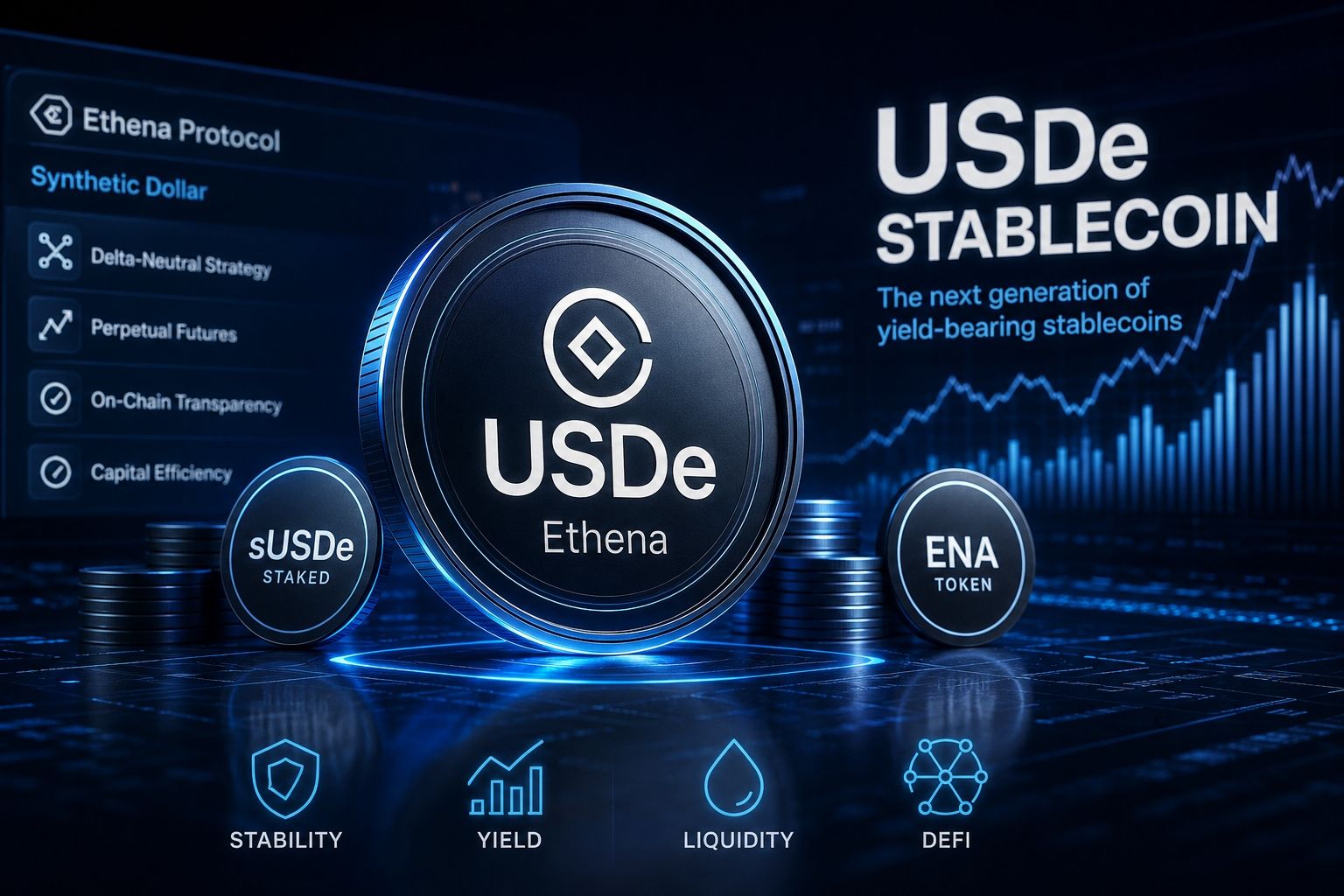
The Ethena protocol has attracted attention because it offers two products that are easy to confuse but very different in practice: USDe, the synthetic dollar, and sUSDe, the staked version designed to accrue variable yield. Around them sits ENA, the governance and ecosystem token, which gives investors a more volatile and speculative exposure to the growth of Ethena.
This article explains how the USDe stablecoin works, why Ethena has become so popular in DeFi, what role sUSDe plays, how the ENA token fits into the ecosystem, and why this innovation should be analyzed with both interest and caution.
Key takeaway
The USDe stablecoin is one of the most important DeFi experiments of the current cycle. It offers a crypto-native synthetic dollar and a yield-bearing version through sUSDe, but its model depends on derivatives markets, funding rates, liquidity, counterparties and risk management. In other words, USDe is innovative, but it is not risk-free.
What Is the USDe Stablecoin?
The USDe stablecoin is a synthetic dollar issued through the Ethena protocol. Its goal is to maintain a value close to one US dollar while remaining native to the crypto ecosystem.
Unlike fiat-backed stablecoins such as USDT or USDC, USDe does not rely only on traditional dollar reserves. Instead, Ethena uses crypto assets and hedging positions to create a synthetic dollar exposure. The protocol is designed to neutralize the directional price risk of the assets used in its backing.
In simple terms, Ethena may hold crypto assets and hedge that exposure through short positions on futures or perpetual markets. If the spot asset rises, the long position gains value while the short hedge loses value. If the spot asset falls, the long position loses value while the short hedge gains value. The objective is to reduce directional exposure and create a more stable dollar-like asset.
This is why USDe is often described as a synthetic dollar rather than a traditional stablecoin. It is designed to behave like a dollar, but the mechanics behind it are more complex than a standard cash-backed reserve model.
Why the Ethena Protocol Is Getting So Much Attention
The Ethena protocol has become popular because it answers one of the biggest questions in DeFi: can a stablecoin be liquid, composable and yield-bearing at the same time?
Stablecoins are already the backbone of the crypto market. Traders use them to move in and out of positions. DeFi users use them to lend, borrow, provide liquidity and preserve purchasing power. Exchanges use them as core trading pairs. Institutions increasingly view stablecoins as a critical layer of digital dollar infrastructure.
But most stablecoins do not directly pass yield to the user. If the issuer earns income on reserves, that income usually stays with the issuer or is distributed through a separate mechanism. Ethena takes a different approach. With sUSDe, users can access a reward-accruing version of the USDe stablecoin.
This is the core reason why Ethena has become one of the most discussed DeFi projects. It does not simply offer another digital dollar. It offers a dollar-like asset with a yield component, built around crypto-native market structure.
That combination is powerful. It also requires serious risk analysis.
USDe, sUSDe and ENA: Three Assets, Three Different Roles
To understand the Ethena ecosystem, it is important to separate three elements:
- USDe: the synthetic dollar designed to track the value of the US dollar;
- sUSDe: the staked version of USDe, designed to accrue variable yield;
- ENA: the governance and ecosystem token linked to the Ethena protocol.
This distinction matters because these assets do not carry the same risk.
USDe is designed to be stable. It is the asset users may hold, trade or use across DeFi as a dollar-like instrument. The main question around USDe is whether the protocol can maintain its peg and manage its backing during normal and stressed market conditions.
sUSDe is different. It represents a staked version of USDe that can earn variable rewards. The yield is not fixed. It depends on market conditions, funding rates, basis opportunities and the broader mechanics of the Ethena strategy.
ENA is different again. It is not a stablecoin. It is a volatile crypto token linked to governance, incentives and market expectations around the Ethena ecosystem. Buying ENA is not the same thing as holding USDe or staking into sUSDe.
Simple distinction
USDe is the synthetic dollar. sUSDe is the yield-bearing version. ENA is the volatile token linked to the Ethena protocol. Confusing these three assets is one of the biggest mistakes investors can make when analyzing Ethena.
How the USDe Stablecoin Works
The USDe stablecoin is built around a delta-neutral model. In finance, a delta-neutral strategy aims to reduce exposure to the price movement of an underlying asset.
For example, if a protocol holds ETH, it has positive exposure to the price of ETH. If ETH falls, the value of that asset falls. Ethena can offset this directional exposure by opening a short position of similar size through futures or perpetual contracts. The result is a portfolio designed to be less sensitive to the price movement of the underlying crypto asset.
The goal is not to make a simple bullish bet on ETH or BTC. The goal is to construct a synthetic dollar-like position while capturing sources of return that may come from funding rates, basis spreads or asset rewards depending on the composition of the backing.
This is what makes Ethena different from most stablecoin issuers. The protocol’s stability and yield depend on active financial mechanics rather than only on passive reserve holdings.
That does not make the model automatically dangerous. But it does make it more complex. A user analyzing USDe must think not only about reserves, but also about hedges, derivatives venues, liquidity, execution, funding rates and counterparty exposure.
Why sUSDe Attracts DeFi Investors
The main reason many DeFi users look at Ethena is not only USDe. It is sUSDe.
sUSDe is the staked version of the USDe stablecoin. Users who stake USDe into sUSDe can receive variable rewards. This has made sUSDe attractive for investors who want to remain in a dollar-like asset while still earning yield.
However, the word “yield” must be used carefully. The sUSDe yield is not guaranteed. It can rise when market conditions are favorable, and it can fall when funding rates compress or when the opportunity set becomes less attractive.
This is one of the most important points to understand about the Ethena protocol. sUSDe does not behave like a bank savings account. It is a DeFi product linked to market structure. Its return depends on the health and pricing of crypto derivatives markets.
When speculative demand is strong and traders are willing to pay funding to maintain leveraged long positions, strategies like Ethena’s can benefit. When markets cool down or funding rates turn less favorable, the yield can decline significantly.
Important: sUSDe yield is variable
The yield on sUSDe should not be treated as fixed income. It is a variable DeFi yield linked to market conditions. This can make it attractive during favorable periods, but it also means users must understand where the return comes from and what can cause it to fall.
Why Yield-Bearing Stablecoins Are Becoming a Major DeFi Trend
The rise of the USDe stablecoin is part of a broader trend: the market wants stablecoins that can do more than provide liquidity.
In previous crypto cycles, users were often satisfied with holding stablecoins because they offered an easy way to avoid volatility. Today, expectations are changing. If interest rates exist in traditional finance, if tokenized money market funds are growing, and if DeFi protocols can generate on-chain yield, many users naturally ask why their stablecoins should remain unproductive.
This is the opportunity that Ethena is trying to capture.
The idea of a yield-bearing stablecoin is powerful because it combines three things investors want: stability, liquidity and return. But combining these three elements is difficult. Stability requires conservative risk management. Liquidity requires deep markets. Yield requires taking some form of risk or capturing some market inefficiency.
That is why yield-bearing stablecoins are not all the same. A stablecoin backed by Treasury bills does not carry the same risk as a synthetic dollar backed by crypto assets and hedged through derivatives. A savings-rate mechanism governed by a DAO is different from a basis-trade model. A regulated tokenized fund is different from a DeFi-native synthetic dollar.
Ethena is important because it has forced the market to think more carefully about where stablecoin yield comes from.
USDe Stablecoin vs USDT, USDC and DAI
To understand USDe, it is useful to compare it with the main stablecoin categories.
USDT is the dominant liquidity stablecoin. It benefits from deep exchange integration, global usage and strong network effects. Its main strength is liquidity. Its main debates usually concern transparency, regulation and reserve composition.
USDC is generally viewed as more institutional and regulatory-oriented. It is widely used in DeFi and by companies seeking a more compliant dollar stablecoin. Its key risk is its connection to the traditional banking and regulatory system.
DAI represents the historical DeFi stablecoin model, although its backing and structure have evolved over time. It remains important because it showed how decentralized collateral and on-chain governance could support a dollar-pegged asset.
USDe is different. It is a synthetic dollar built through a crypto-native hedging mechanism. It is not simply a tokenized bank dollar, and it is not a classic overcollateralized DeFi stablecoin. Its value proposition comes from a combination of dollar stability, derivatives-based hedging and yield potential through sUSDe.
This difference is exactly why the USDe stablecoin is so interesting. It also explains why it cannot be analyzed with the same framework as USDT or USDC.
The Role of the ENA Token
The ENA token plays an important role in the Ethena ecosystem, but it should not be confused with the USDe stablecoin.
ENA is a governance and ecosystem token. It gives the market a way to speculate on the future growth of Ethena, the expansion of USDe, the adoption of sUSDe and the broader economics of the protocol.
That makes ENA potentially attractive, but also much riskier than USDe. If the Ethena protocol grows, if USDe adoption increases, and if the market believes the protocol can become a core DeFi infrastructure layer, ENA may benefit from positive sentiment.
But the reverse is also true. ENA can fall sharply if the market becomes concerned about the sustainability of the yield, the stability of USDe, token unlocks, dilution, regulatory risk or declining DeFi appetite.
Investors should therefore separate the analysis of USDe from the analysis of ENA. Holding USDe is a stablecoin strategy. Staking into sUSDe is a yield strategy. Buying ENA is a speculative token strategy.
Does ENA Benefit From the Growth of USDe?
ENA may benefit indirectly from the growth of USDe, but the relationship is not automatic.
If USDe supply grows, Ethena becomes more visible. If sUSDe attracts more users, the protocol becomes more important in DeFi. If institutional partnerships expand, the market may assign a higher value to the Ethena ecosystem. All of this can support demand for ENA.
However, token prices are not driven only by protocol adoption. They are also driven by token supply, unlock schedules, liquidity, market sentiment, governance rights, revenue expectations and speculation.
This means ENA can underperform even if USDe remains successful. It also means ENA can rally aggressively on news, even before the long-term economics are fully clear.
For this reason, ENA should be discussed in any serious article about Ethena, but it should not become the main subject if the focus is the USDe stablecoin.
Why BlackRock, BUIDL and Institutional Liquidity Matter
One of the reasons Ethena has attracted even more attention is its growing connection to institutional tokenization, especially around BlackRock’s BUIDL fund and the broader trend of tokenized money market products.
This matters because it changes the way investors perceive Ethena. The protocol is no longer only seen as a DeFi yield experiment. It is increasingly discussed in the context of institutional digital dollar infrastructure, tokenized real-world assets and on-chain liquidity products.
The connection between USDe, sUSDe, BUIDL and institutional risk-management infrastructure suggests that DeFi may be entering a new phase. Instead of being isolated from traditional finance, some protocols are becoming bridges between crypto-native strategies and institutional capital markets.
This does not remove the risks of the Ethena protocol. But it does make the project more strategically important.
Why this matters
Ethena is not only about a yield-bearing stablecoin. It is also about the convergence of DeFi, derivatives, tokenized real-world assets and institutional liquidity. That combination could become one of the most important themes in the next phase of crypto markets.
The Main Advantages of the USDe Stablecoin
1. A crypto-native synthetic dollar
The USDe stablecoin was designed for the crypto economy. It is not simply a tokenized bank deposit. It uses crypto-native collateral and hedging mechanics to create a synthetic dollar asset.
This makes it attractive to DeFi users who want a dollar-like asset that is deeply integrated with on-chain markets.
2. Yield potential through sUSDe
sUSDe is one of the strongest reasons users pay attention to Ethena. It allows users to remain exposed to a dollar-like asset while potentially earning yield.
In a market where DeFi yields have become more competitive and less aggressive than in previous cycles, a liquid yield-bearing stablecoin is naturally attractive.
3. Composability across DeFi
The more USDe and sUSDe are integrated into lending markets, liquidity pools, collateral systems and structured strategies, the more useful they become.
In DeFi, composability is a major source of value. An asset becomes more important when it can be used in many protocols at the same time.
4. Exposure to the tokenization trend
Ethena’s links with institutional tokenization narratives also give it exposure to one of the strongest themes in crypto: real-world assets. As tokenized money market funds and on-chain financial products grow, protocols like Ethena may become increasingly relevant.
The Main Risks of the USDe Stablecoin
The USDe stablecoin is innovative, but it also carries risks that users must understand.
1. Funding rate risk
Ethena’s yield depends partly on funding rates and basis opportunities in derivatives markets. If funding rates remain favorable, the strategy can generate attractive returns. If funding rates compress or become negative, the yield can decline or the strategy can become more difficult to manage.
This is one of the most important risks. The return is not guaranteed because the market conditions that create the return are not guaranteed.
2. Liquidity risk
Ethena relies on deep and functioning derivatives markets. If liquidity deteriorates during a crisis, hedges can become harder to maintain or more expensive to adjust.
Liquidity is usually available when markets are calm. The real question is what happens during extreme volatility, sudden deleveraging or exchange-level stress.
3. Counterparty risk
The Ethena protocol interacts with exchanges, custodians, derivatives venues and other infrastructure providers. Even with diversification, counterparty risk cannot be eliminated entirely.
This is a key difference between a simple idea of “holding a stablecoin” and the reality of a synthetic dollar strategy. The asset depends on a broader operational and financial architecture.
4. Peg risk
Like any stablecoin, USDe can face pressure around its peg. A temporary deviation may not be catastrophic, but a prolonged depeg could damage confidence and trigger liquidity stress.
This risk becomes more important as USDe grows and becomes integrated into more DeFi protocols.
5. Regulatory risk
Stablecoins are already under regulatory scrutiny. Yield-bearing stablecoins may attract even more attention because they sit between payments, investment products, derivatives and DeFi infrastructure.
As the Ethena protocol grows, regulators may pay closer attention to how USDe is issued, how yield is generated and how risks are disclosed to users.
Risk reminder
The USDe stablecoin should not be treated as a simple equivalent of USDC or USDT. sUSDe should not be treated as a risk-free savings product. ENA should not be treated as a stablecoin. Each part of the Ethena ecosystem has a different function and a different risk profile.
Could USDe Become a Systemic Risk for DeFi?
The bigger USDe becomes, the more important this question becomes.
A small stablecoin can fail without major market impact. A large stablecoin used across many protocols is different. If it becomes collateral in lending markets, liquidity in pools, backing for structured products and a core asset in yield strategies, its stability matters for the entire ecosystem.
This is not a prediction that USDe will fail. It is simply how systemic importance works. Growth creates relevance. Relevance creates dependence. Dependence creates systemic risk.
Ethena could become a major DeFi infrastructure layer if USDe continues to grow. But that also means the protocol must prove it can manage stress, redemptions, liquidity shocks, funding-rate reversals and counterparty problems.
The DeFi market should therefore watch Ethena closely, not because the project is weak, but because it is becoming important.
What Could Make Ethena More Resilient?
For the Ethena protocol to remain credible over the long term, several elements will matter.
1. Transparent risk reporting
Users need clear information about backing, hedging venues, counterparties, reserve funds, funding exposure and stress scenarios. The more transparent the system becomes, the easier it is for the market to price the risk correctly.
2. Diversified liquidity sources
A synthetic stablecoin model benefits from diversified liquidity. The more Ethena can reduce dependency on any single exchange, venue or counterparty, the stronger the system becomes.
3. Conservative growth
Rapid growth can be attractive, but it can also create fragility. If USDe supply grows faster than the available market liquidity to support hedging, the risk profile may change.
4. Realistic yield expectations
Users must understand that sUSDe yield is variable. If the market expects very high yield forever, disappointment can become a risk. A more realistic view of returns would make the ecosystem healthier.
Is the USDe Stablecoin a Good Innovation?
Yes, the USDe stablecoin is a serious innovation. It brings a different model to the stablecoin market and forces DeFi users to think more deeply about dollar liquidity, yield and market structure.
But good innovation does not mean low risk. Some of the most important DeFi products are also the most complex. Ethena belongs in that category.
The best way to analyze USDe is not to call it either a miracle product or a disaster waiting to happen. The better approach is to recognize that it is a powerful financial structure with real use cases and real risks.
For sophisticated DeFi users, USDe and sUSDe can be useful tools. For investors looking at ENA, the opportunity is more speculative. For the broader market, Ethena is a signal that stablecoins are evolving beyond simple dollar wrappers.
What to Watch in 2026
Several indicators will help determine whether Ethena continues to strengthen or begins to face pressure.
- USDe supply: continued growth would show demand, but very fast growth should be analyzed carefully;
- sUSDe yield: falling yield could reduce attractiveness, while unsustainably high yield could signal market imbalance;
- peg stability: USDe must remain close to one dollar through volatile market conditions;
- ENA token performance: ENA can reflect market confidence, but it can also move based on speculation;
- institutional integrations: partnerships and RWA connections could strengthen Ethena’s positioning;
- regulatory developments: rules around stablecoins and yield products could affect the protocol;
- stress events: the real test for any DeFi stablecoin is how it performs during market panic.
USDe Stablecoin: Opportunity or Risk?
The honest answer is that the USDe stablecoin is both.
It is an opportunity because Ethena addresses a real market need. Crypto users want stable liquidity. DeFi investors want yield. Protocols want composable assets. Institutions are increasingly exploring tokenized liquidity. USDe sits at the center of these trends.
But it is also a risk because its model depends on financial engineering. The yield does not come from nowhere. It comes from funding markets, basis spreads, collateral strategies and execution across derivatives venues. These mechanisms can work well, but they can also become stressed when markets move violently.
That is why USDe should be analyzed with discipline. It is one of the most interesting stablecoin projects in DeFi, but it is not a product to understand superficially.
Conclusion: Why the USDe Stablecoin Matters
The USDe stablecoin is one of the most important DeFi assets to watch because it represents a new phase in the stablecoin market.
Stablecoins are no longer only about holding a digital dollar. They are becoming yield products, collateral instruments, liquidity engines and bridges between DeFi and institutional finance.
The Ethena protocol is at the center of this shift. By combining a synthetic dollar, a yield-bearing version through sUSDe and a governance token through ENA, Ethena has created one of the most ambitious stablecoin ecosystems in crypto.
But ambition brings complexity. USDe depends on hedging. sUSDe depends on variable yield. ENA depends on market expectations. The entire model depends on liquidity, derivatives markets, counterparties and risk management.
That is why Ethena deserves attention. Not because it is risk-free, but because it helps explain where DeFi is heading: toward more sophisticated products, deeper institutional connections, more advanced yield strategies and a greater need for serious risk analysis.
For investors and DeFi users, the key lesson is simple: the USDe stablecoin may be one of the most innovative assets in decentralized finance, but its yield and stability must always be understood before being used.
In summary
- USDe is a synthetic dollar issued through the Ethena protocol.
- sUSDe is the staked, yield-bearing version of USDe.
- ENA is the volatile governance and ecosystem token.
- The model relies on delta-neutral hedging and derivatives markets.
- The yield can be attractive, but it is variable and market-dependent.
- Ethena is an important DeFi innovation, but it also carries liquidity, counterparty, peg and regulatory risks.
FAQ About the USDe Stablecoin
What is the USDe stablecoin?
The USDe stablecoin is a synthetic dollar created by the Ethena protocol. It is designed to maintain a value close to one US dollar through crypto-native collateral and hedging strategies.
Is USDe the same as USDT or USDC?
No. USDT and USDC are primarily fiat-backed stablecoins. USDe is a synthetic dollar that relies on crypto assets, derivatives and delta-neutral hedging mechanics.
What is the Ethena protocol?
The Ethena protocol is a DeFi protocol that issues USDe, a synthetic dollar, and sUSDe, a reward-accruing version of USDe. It uses crypto-native market strategies to create dollar-like liquidity and yield opportunities.
What is sUSDe?
sUSDe is the staked version of USDe. It allows users to receive variable yield generated by the Ethena protocol’s strategy, depending on market conditions.
Is sUSDe yield guaranteed?
No. sUSDe yield is variable. It can rise or fall depending on funding rates, market demand, basis spreads and broader crypto market conditions.
What is the ENA token?
ENA is the governance and ecosystem token of Ethena. It is not a stablecoin. It is a volatile crypto asset linked to the growth, perception and governance of the Ethena protocol.
Can USDe lose its peg?
Like any stablecoin, USDe can face peg pressure. The risk depends on liquidity, hedging effectiveness, market stress, counterparty exposure and user confidence.
Why is Ethena important for DeFi?
Ethena is important because it combines stablecoin liquidity, yield, derivatives, DeFi composability and institutional tokenization narratives. It is one of the clearest examples of how stablecoins are evolving.
Is USDe suitable for beginners?
USDe is more complex than a traditional stablecoin. Beginners should understand how synthetic dollars, sUSDe yield, funding rates and protocol risks work before using it.
Is ENA a way to invest in the success of USDe?
ENA can provide speculative exposure to the Ethena ecosystem, but it is not the same as holding USDe. ENA is volatile and depends on many factors, including tokenomics, market sentiment, adoption and risk perception.
Disclaimer: This article is for informational and educational purposes only. It is not financial advice. Stablecoins, DeFi protocols, synthetic dollars, yield-bearing assets and governance tokens involve significant risks, including loss of capital, peg instability, smart contract risk, liquidity risk, counterparty risk and regulatory uncertainty. Always do your own research before making any financial decision.


Trader, investor and author specializing in cryptocurrencies, DeFi and Web3.
On Mediasnet, I share my market analysis, practical guides and research on crypto markets, decentralized protocols and emerging trends across the ecosystem.
Follow me on: Facebook – X (Twitter)