
The SOL price remains one of the most closely watched indicators in the crypto market. After an explosive rise, a deep correction and several recovery phases, Solana’s native token has entered another decisive stage in 2026.
As of 3 September 2026, SOL is trading around the $100–$101 area. The token has managed to recover the psychological $100 threshold after starting August much closer to the $70–$80 zone.
The situation has therefore changed significantly. The question is no longer simply whether SOL can recover toward $100, but whether buyers can now turn the $100 area into sustainable support.
The recent recovery has been supported by stronger crypto liquidity, growing institutional access to SOL, substantial activity across the Solana ecosystem and continued development of the network.
At the same time, momentum has begun to cool after the rapid August rally. This creates an important technical confrontation between improving fundamentals and a market that still needs to confirm its breakout.
For that reason, any realistic SOL price prediction must consider both the possibility of another bullish expansion and the risk of a deeper consolidation.
In this article, we examine SOL’s historical performance, current technical structure, fundamental drivers and three possible price scenarios for the rest of 2026.
Historical SOL Price Overview
If you regularly follow the DeFi news, you will know that SOL’s evolution has closely reflected the extreme cycles of the cryptocurrency market.
The 2021 Bull Run
During the 2021 bull market, the SOL price surged from just a few dollars to nearly $260.
This rapid growth was fueled by massive capital inflows into altcoins and growing interest in alternative blockchain ecosystems.
Solana positioned itself as one of Ethereum’s most serious competitors thanks to:
- high transaction throughput
- very low transaction fees
- a rapidly expanding developer ecosystem
- strong retail adoption
- growing DeFi activity
The 2022 Market Crash
In 2022, the crypto market experienced a major correction and the SOL price collapsed below $10 at its lowest point.
Several factors contributed to the decline:
- global crypto market weakness
- the collapse of speculative liquidity
- loss of investor confidence
- ecosystem-related concerns
- the impact of the FTX collapse
At that stage, many investors questioned whether Solana could recover.
Recovery Phase: 2023–2025
Between 2023 and 2025, the SOL price recovered dramatically.
Network activity returned, liquidity increased and Solana became particularly important for decentralized trading, memecoins and consumer-oriented crypto applications.
SOL ultimately reached a new historical peak close to $295 in January 2025.
The move demonstrated an important characteristic of SOL: when market liquidity improves, the token can reprice extremely quickly.
However, the opposite is also true.
SOL remains a high-beta crypto asset and therefore tends to experience much larger movements than Bitcoin during both bullish and bearish phases.
Current SOL Price Structure in September 2026
The SOL price is currently trading close to $100–$101 after recovering strongly during August.
This represents an important technical improvement.
Earlier in the summer, SOL was struggling around substantially lower levels. The recovery toward $100 has therefore changed the short-term market structure.
$100 Is Now the Main Battlefield
The psychological importance of $100 cannot be ignored.
SOL has already demonstrated that buyers are capable of pushing above this level.
The challenge is now different:
Can SOL remain above $100 long enough to establish it as support?
If buyers succeed, the market could begin targeting the next resistance areas around $104–$106, followed by approximately $110–$115.
If $100 fails, SOL could retreat toward the $95 area before testing deeper structural support.
Several factors currently support the SOL price:
- strong on-chain activity
- continued institutional demand
- regulated Solana investment products
- large stablecoin liquidity on Solana
- active decentralized exchanges
- network upgrades
- strong developer activity
The current environment is therefore more constructive than it was earlier in 2026.
However, the market still needs confirmation.
SOL Technical Analysis – September 2026
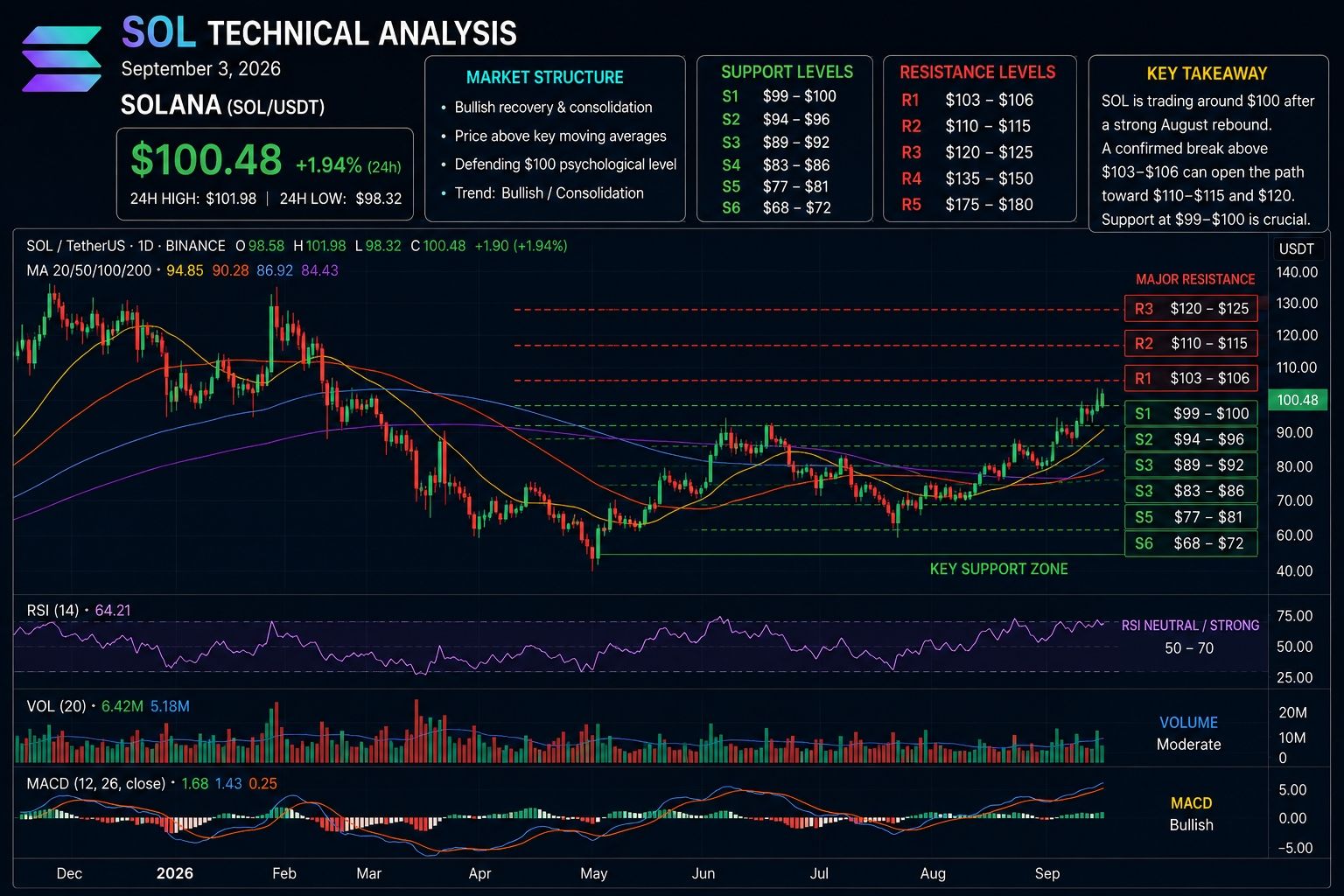
👉 This section is updated regularly to reflect the latest market conditions.
The SOL price on the daily timeframe remains in a bullish recovery structure, although momentum has cooled compared with the strongest phase of the August rally.
SOL is currently trading around $100–$101.
The important development is that the token has not immediately collapsed after testing the psychological $100 area.
Instead, the market is attempting to consolidate around this level.
📊 Current Market Structure
The short-term structure can currently be summarized as follows:
- Short-term trend: bullish but consolidating
- Medium-term structure: improving
- Momentum: positive but weaker than during the initial breakout
- Volatility: still elevated
- Critical level: approximately $100
The price remains above its short-term daily moving averages.
The 20-day exponential moving average is currently located close to the $94–$95 area, while longer-term averages remain lower.
This gives buyers an advantage as long as SOL continues trading above these levels.
However, momentum indicators suggest the market is no longer accelerating vertically.
That is not necessarily negative.
After the powerful August recovery, some consolidation could actually strengthen the technical structure.
🟢 Key Support Levels
The most important support areas are now:
- $99–$100 → immediate psychological support
- $94–$96 → important short-term support and moving-average zone
- $89–$92 → major structural support
- $83–$86 → secondary support if the recovery weakens substantially
- $77–$81 → deeper medium-term support
- $68–$72 → major bearish support during a severe market correction
👉 Holding approximately $99–$100 would be the strongest short-term signal.
However, even a correction toward $94–$96 would not automatically invalidate the broader recovery.
The more important structural zone remains approximately $89–$92.
🔴 Key Resistance Levels
The main resistance areas are:
- $103–$106 → immediate breakout zone
- $110–$115 → next important upside objective
- $120 → major psychological resistance
- $135–$150 → stronger medium-term bullish extension zone
- $175–$180 → possible target during a much stronger altcoin expansion
👉 A confirmed daily breakout above approximately $104–$106 would materially improve the bullish SOL price outlook.
Such a move could open the way toward $110–$115 and potentially $120.
📉 RSI: Momentum Has Cooled
One of the most important changes since the previous update concerns the RSI.
During the strongest phase of the August rally, the daily RSI moved into heavily overbought territory.
That situation has now changed.
The daily RSI has returned toward approximately 64–65.
This is important because it means:
- momentum remains positive
- SOL is no longer extremely overbought
- the technical structure has had time to cool
- there is potentially more room for another bullish move
- buyers nevertheless need to defend the current breakout
👉 A cooling RSI combined with a stable SOL price is generally healthier than a price continuing to rise while RSI remains above 80.
MACD Shows Some Loss of Momentum
The MACD currently provides a more cautious signal.
After the powerful recovery, the daily MACD histogram has weakened and recently moved slightly negative.
This does not automatically imply a bearish reversal.
Instead, it suggests that the explosive momentum responsible for the August rally has slowed.
The current technical situation is therefore more balanced:
price structure remains constructive, but momentum needs another catalyst.
Moving Averages
SOL remains above its short-term moving averages.
The approximate daily structure currently places:
- the 20-day EMA around the mid-$90s
- the 50-day EMA around the upper-$80s
- the 200-day EMA around the high-$80s to approximately $90
The fact that SOL trades above these averages supports the bullish recovery thesis.
However, the medium-term moving averages still need time to fully align into a classical bullish structure.
🔎 Short-Term SOL Price Scenarios
🟢 Bullish Scenario
- SOL holds approximately $99–$100
- buyers reclaim $103–$106
- daily momentum begins accelerating again
- trading volume confirms the breakout
- SOL targets $110–$115
- $120 becomes the next major objective
👉 This would confirm that the consolidation around $100 was accumulation rather than distribution.
🟡 Neutral Scenario
- SOL remains broadly between $94 and $106
- the $100 area continues changing between support and resistance
- RSI remains approximately between 50 and 70
- institutional flows remain positive but irregular
- the market waits for another macro or crypto liquidity catalyst
👉 This would represent a healthy consolidation after the August recovery.
🔴 Bearish Scenario
- SOL loses $99–$100
- the $94–$96 area fails to attract buyers
- price returns toward $89–$92
- a broader crypto correction increases selling pressure
A sustained break below approximately $89 would represent a much more important deterioration in the medium-term structure.
⚠️ Technical Conclusion
SOL currently remains in a constructive technical recovery.
The most important levels are now:
- $99–$100 → immediate support and psychological pivot
- $94–$96 → first significant support
- $89–$92 → major structural support
- $103–$106 → immediate resistance
- $110–$115 → next bullish target
- $120 → major medium-term threshold
The next important question for the SOL price is therefore simple:
Does $100 become support?
If it does, another expansion becomes increasingly credible.
SOL Fundamental Analysis: What Supports the SOL Price?
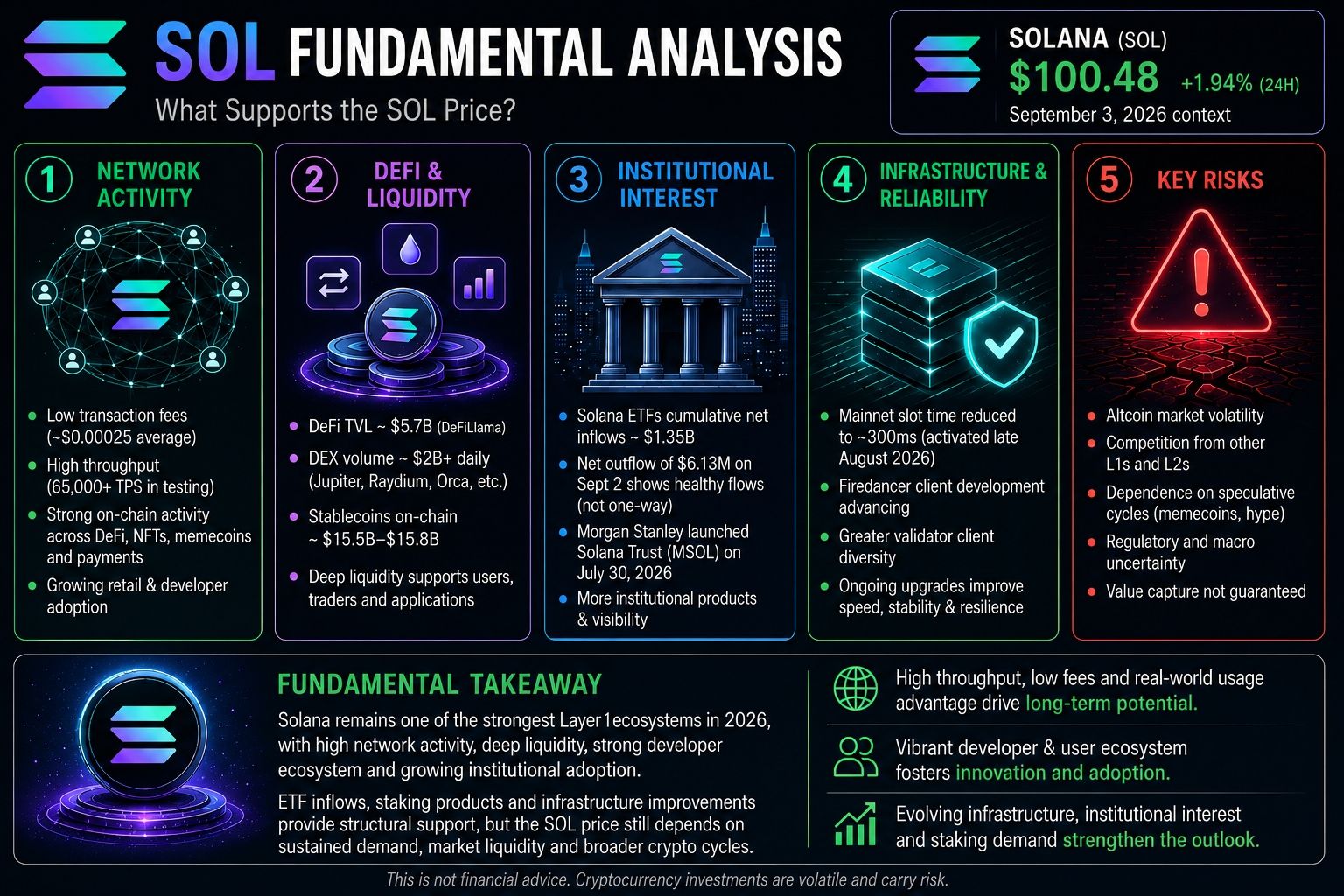
Technical analysis determines where traders are positioned.
Fundamental analysis helps explain why investors may continue allocating capital to Solana over a longer period.
In September 2026, Solana remains one of the most active Layer 1 blockchain ecosystems.
Its fundamental position is supported by:
- large transaction volumes
- very low fees
- a significant stablecoin ecosystem
- high decentralized exchange activity
- strong retail visibility
- institutional investment products
- staking
- continued technical development
Solana DeFi TVL Remains Significant
According to DeFiLlama, Solana currently has approximately $5.7 billion in DeFi total value locked.
This is important because it demonstrates that Solana is not simply a blockchain used for speculative token trading.
A substantial amount of capital remains deployed across lending, liquid staking, decentralized exchanges and other DeFi applications.
The SOL price does not mechanically follow TVL.
However, stronger capital deployment tends to strengthen network effects and improve the economic relevance of the ecosystem.
More Than $15 Billion in Stablecoin Liquidity
Another important metric is stablecoin liquidity.
The value of stablecoins on Solana currently stands at approximately $15.5–$15.8 billion.
Stablecoins represent some of the most important liquidity infrastructure in DeFi.
They are used for:
- trading
- payments
- lending
- market making
- yield strategies
- cross-border transfers
- tokenized financial markets
Large stablecoin balances give the ecosystem deeper liquidity and make it easier for capital to circulate between applications.
For any long-term SOL price prediction, this is an important metric to monitor.
DEX Volume Remains Extremely High
Solana also remains one of the world’s largest environments for decentralized trading.
Current DeFiLlama figures show daily Solana DEX volume around $2 billion or more, although daily figures naturally fluctuate substantially.
Jupiter, Raydium, PumpSwap, Meteora, Orca and other platforms contribute to a highly active trading ecosystem.
The network also ended August with particularly strong activity.
This matters because decentralized trading generates:
- transaction demand
- fees
- validator activity
- liquidity demand
- application revenue
A network capable of maintaining high economic activity has a stronger fundamental foundation than one relying exclusively on token speculation.
Solana Applications Generate Significant Revenue
Solana’s application economy has also become increasingly important.
During August 2026, Solana-based applications collectively generated well above $100 million in application revenue.
Trading applications were particularly important contributors.
This demonstrates that the ecosystem increasingly generates measurable economic activity rather than simply high transaction counts.
That distinction is essential for the long-term SOL investment thesis.
Institutional Interest Continues to Expand
Institutional adoption remains one of the strongest fundamental developments affecting the SOL price in 2026.
U.S. Solana investment products have accumulated approximately $1.35 billion in cumulative net inflows.
However, the flows are not permanently positive.
On 2 September, SOL spot ETFs recorded approximately $6.1 million in net outflows.
This is actually useful information for investors.
It demonstrates that institutional participation has become meaningful, while also reminding the market that ETF demand can fluctuate from one session to another.
The long-term trend remains much more important than a single daily flow.
Morgan Stanley Has Entered the Solana Market
Institutional adoption expanded further when Morgan Stanley Investment Management launched the Morgan Stanley Solana Trust (MSOL) in July 2026.
The development is significant because it gives traditional investors another regulated way to gain exposure to SOL.
Morgan Stanley’s entry also illustrates how Solana is gradually moving from a crypto-native investment toward an asset accessible through traditional financial infrastructure.
Staking Becomes Part of the Institutional Story
Staking is becoming another important element of institutional SOL products.
Several regulated products now incorporate or are developing structures linked to SOL staking.
Grayscale has also updated the structure of its Solana Staking ETF to facilitate distributions generated from staking rewards.
This creates an unusual characteristic compared with non-yield-producing crypto assets.
SOL potentially combines:
- crypto market exposure
- network utility
- staking rewards
If institutional demand for staking products expands, this could become another structural source of demand for SOL.
Network Performance Continues to Improve
Solana’s technical infrastructure has continued to evolve rapidly.
One of the most important developments concerns block production speed.
During August 2026, mainnet slot times were progressively reduced.
By late August, a feature gate reducing mainnet slot times to approximately 300 milliseconds had been activated.
Further reductions are part of Solana’s development roadmap.
These improvements could increase:
- transaction responsiveness
- trading efficiency
- application performance
- the attractiveness of Solana for financial applications
For applications such as trading, payments and tokenized markets, latency matters.
Firedancer Strengthens Validator Diversity
Firedancer remains another major infrastructure development.
The independent Solana validator client continues to receive mainnet and testnet releases.
Validator-client diversity is important because it reduces dependence on a single implementation.
Over the long term, increased client diversity could improve:
- network resilience
- performance
- operational security
- institutional confidence
For a long-term SOL price prediction, reliability remains just as important as speed.
Tokenization and Stablecoin Payments
Solana is also positioning itself as infrastructure for tokenized financial assets and payments.
According to the Solana Foundation, more than $4.7 trillion in stablecoin transfers have moved across Solana over the previous year.
That does not mean $4.7 trillion is stored on Solana.
It represents transaction volume.
Nevertheless, it illustrates the scale at which stablecoins are now being transferred through the network.
The tokenization of financial assets could eventually become one of the ecosystem’s most important narratives.
SOL Supply and Governance
Token economics remain another factor to monitor.
Proposals have been discussed within the Solana ecosystem to accelerate the reduction of SOL inflation.
Reducing future issuance could theoretically improve supply dynamics.
However, investors should distinguish between:
- proposals
- governance votes
- implemented protocol changes
A proposed reduction in inflation should therefore not automatically be treated as guaranteed future scarcity.
What Could Push the SOL Price Higher?
The future SOL price prediction depends on several identifiable catalysts.
1. A Sustainable Break Above $100
Technical structure matters.
If $100 becomes a confirmed support level rather than temporary resistance, market psychology could change significantly.
A breakout above $104–$106 would further strengthen this thesis.
2. Continued ETF Inflows
SOL now has a regulated institutional distribution channel.
Persistent net inflows into Solana investment products could gradually remove available supply from the market while increasing institutional participation.
This would become particularly important during a broader altcoin expansion.
3. More Stablecoin Liquidity
Stablecoin liquidity remains one of the strongest indicators of available crypto capital.
If Solana’s stablecoin supply continues growing above its current level, more capital would be available for:
- DEX trading
- DeFi lending
- tokenized assets
- payments
- investment applications
4. Growth in Real Economic Activity
High transaction numbers alone are not sufficient.
What ultimately matters is whether applications generate sustainable economic activity.
Growing fees and application revenue would therefore strengthen the long-term Solana thesis.
5. A Broader Altcoin Liquidity Rotation
SOL remains highly sensitive to global crypto liquidity.
If Bitcoin stabilizes after a strong move and investors begin increasing exposure to higher-beta assets, Solana could be one of the primary beneficiaries.
Historically, this type of capital rotation has produced extremely rapid SOL price movements.
6. Network Improvements
Faster slot times, Firedancer development, improved validator diversity and future consensus upgrades could strengthen Solana’s competitive position.
These improvements matter particularly if the network wants to attract:
- institutional trading
- payments
- tokenized securities
- consumer financial applications
Risks to the SOL Price
No serious SOL price prediction should ignore potential downside factors.
Bitcoin and Global Crypto Liquidity
SOL remains strongly correlated with the broader crypto market.
Even excellent Solana fundamentals may not prevent a major correction if Bitcoin falls sharply or global liquidity deteriorates.
The SOL price remains a high-beta asset.
This means SOL can outperform strongly during bullish markets but can also fall considerably faster when risk appetite disappears.
Institutional Flows Can Reverse
ETF inflows are a bullish structural development.
However, investment products also make institutional selling easier.
The small net outflow recorded on 2 September illustrates that flows will not move in only one direction.
Persistent ETF outflows would therefore become a warning signal.
Competition Remains Intense
Solana competes with:
- Ethereum
- Ethereum Layer 2 networks
- Base
- Sui
- Avalanche
- Aptos
- other emerging high-performance blockchains
The network must continue attracting both developers and liquidity.
Speculative Activity
Memecoins and speculative trading generate large amounts of network activity.
However, not all activity creates sustainable economic value.
If Solana becomes excessively dependent on temporary speculative cycles, network metrics could decline quickly during periods of lower market interest.
Volatility
SOL remains highly volatile.
Daily moves of several percentage points are normal and corrections of 10% to 20% can develop rapidly.
Investors should therefore distinguish between long-term ecosystem growth and short-term token price behavior.
SOL Price Prediction: 3 Scenarios for the Rest of 2026
Predicting an exact future price is impossible.
A more useful approach is to identify the market conditions that could produce different outcomes.
🟢 Bullish SOL Price Prediction
In the bullish scenario:
- $100 becomes sustainable support
- SOL breaks $104–$106
- ETF inflows continue
- Bitcoin remains structurally stable
- altcoin liquidity improves
- Solana activity remains high
- stablecoin liquidity continues expanding
The first price objectives would be approximately:
- $110–$115
- $120
- $135–$150
If the broader crypto market enters a much stronger bullish phase, SOL could potentially extend toward approximately $150–$220 during 2026.
A return toward approximately $250–$300 remains possible only under a much more aggressive scenario involving:
- a powerful broad crypto bull market
- large institutional inflows
- significant altcoin rotation
- continued Solana ecosystem growth
- strong global liquidity conditions
Such a move should therefore be considered an aggressive bullish scenario rather than a base-case forecast.
🟡 Neutral SOL Price Prediction
The neutral scenario assumes that fundamentals remain constructive but broader crypto liquidity does not accelerate substantially.
In this case, SOL could trade broadly between approximately $90 and $120.
This scenario could involve:
- continued institutional adoption
- moderate ETF inflows
- strong Solana activity
- high Bitcoin dominance
- limited altcoin rotation
- repeated attempts to establish $100 as support
This would not necessarily be negative.
A prolonged consolidation could allow medium-term moving averages to catch up with the SOL price and create a healthier base for a future expansion.
🔴 Bearish SOL Price Prediction
The bearish scenario would become more likely if:
- SOL loses $99–$100
- $94–$96 fails as support
- ETF outflows accelerate
- Bitcoin enters another significant correction
- global risk appetite deteriorates
- altcoin liquidity contracts
The first important downside target would then be approximately $89–$92.
Below this level, SOL could expose:
- $83–$86
- $77–$81
- $68–$72 during a more severe crypto correction
A sustained move below $89 would materially weaken the current bullish recovery thesis.
Is SOL a Good Investment in 2026?
The SOL price remains well below its historical high despite the strong August recovery.
For long-term investors, the fundamental case is supported by several tangible developments:
- high network usage
- approximately $5.7 billion in DeFi TVL
- more than $15 billion in stablecoin liquidity
- large decentralized trading volumes
- strong application revenue
- institutional investment products
- staking
- network performance improvements
- growing tokenization activity
However, SOL remains a high-risk asset.
Investors should understand that:
- market timing remains uncertain
- ETF flows can reverse
- crypto liquidity remains critical
- SOL can experience sharp corrections
- strong network activity does not guarantee a rising token price
A structured investment strategy such as dollar-cost averaging may reduce the risk associated with attempting to identify a perfect entry point.
Ultimately, the long-term SOL price prediction will depend on whether Solana can convert its high level of activity into sustainable economic demand for SOL.
Conclusion
The SOL price has entered a new technical phase.
At the beginning of September 2026, SOL is trading around $100–$101 after recovering strongly from the much lower levels seen earlier in the summer.
The psychological $100 level is now the central point of the analysis.
The most important levels to monitor are:
- $99–$100 → immediate support
- $94–$96 → important short-term support
- $89–$92 → major structural support
- $103–$106 → immediate resistance
- $110–$115 → next upside objective
- $120 → major medium-term resistance
The fundamental environment remains particularly interesting.
Solana currently combines:
- large DeFi activity
- deep stablecoin liquidity
- strong decentralized trading
- institutional investment products
- staking
- network upgrades
- an expanding application economy
At the same time, the market has become less technically overheated than it was during the strongest phase of the August rally.
The daily RSI has returned toward approximately 64–65, while SOL continues trading near $100.
This makes the next breakout particularly important.
If $100 becomes support and SOL breaks $104–$106, the SOL price prediction becomes significantly more bullish.
If buyers fail to defend $94–$96, the market could instead revisit the $89–$92 structural zone.
Understanding this balance between improving fundamentals and technical confirmation remains essential when evaluating SOL.
📊 Long-Term SOL Price Outlook – Speculative Scenarios
These ranges illustrate possible market scenarios rather than fixed price targets.
- 2026: $70 – $220
- 2027: $100 – $300
- 2030: $250 – $700
- 2040+: too uncertain for a meaningful numerical forecast
These ranges depend heavily on global crypto adoption, liquidity, Solana’s competitive position and the evolution of the broader digital asset market.
👉 They are speculative scenarios, not guarantees.
This is not financial advice.
FAQ: SOL Price and SOL Price Prediction
What is the current SOL price trend?
The SOL price is currently in a bullish recovery and consolidation phase.
SOL is trading around the $100–$101 area after recovering strongly during August.
The most important development is whether $100 can become a durable support level.
Immediate resistance is located around $103–$106, while the first significant downside support is approximately $94–$96.
👉 The current trend can therefore be described as constructive but awaiting breakout confirmation.
What influences the SOL price?
The SOL price is influenced by several major factors:
- Bitcoin and the broader crypto market
- global liquidity
- institutional investment flows
- Solana ETF flows
- network adoption
- DeFi activity
- stablecoin liquidity
- staking demand
- investor sentiment
Solana’s network fundamentals can improve while the SOL price falls temporarily.
Token price and blockchain activity should therefore be analyzed separately.
What is the most important SOL price level right now?
The most important short-term level is approximately $100.
If SOL can consistently remain above this level, the market could begin targeting approximately $104–$106 followed by $110–$115.
If $100 fails, the $94–$96 zone becomes the first important support.
Can SOL reach $150 in 2026?
Yes, $150 remains possible, but it would require another substantial bullish expansion.
SOL would first need to break:
- $104–$106
- $110–$115
- $120
- the $135–$150 resistance area
A move toward $150 would become more credible if ETF inflows strengthen and broader altcoin liquidity improves.
Can SOL return to its previous all-time high?
SOL reached a historical high close to $295 in January 2025.
Returning to this area would require a very strong crypto market environment.
If a new bull market develops and Solana continues attracting users, developers and institutional capital, another attempt toward historical highs cannot be excluded.
However, SOL would first need to sustainably overcome several major resistance areas.
A return toward $250–$300 should therefore be considered an aggressive bullish scenario rather than the most likely short-term outcome.
Is SOL a good long-term investment?
Solana remains one of the strongest large-cap blockchain ecosystems.
Its investment thesis is supported by:
- high network activity
- large stablecoin liquidity
- strong decentralized trading
- institutional adoption
- staking
- developer activity
- continued technical upgrades
However, SOL remains highly volatile.
Its price can fall substantially even when its fundamental ecosystem continues to grow.
Investors should therefore consider both potential upside and the possibility of large drawdowns.
What is the best strategy for investing in SOL?
There is no single strategy suitable for every investor.
Dollar-cost averaging is commonly used to gradually build exposure while reducing dependence on a single entry price.
Investors following the current SOL price structure may also monitor:
- $99–$100 → immediate pivot
- $94–$96 → short-term support
- $89–$92 → major structural support
- $103–$106 → breakout resistance
- $110–$115 → next bullish objective
- $120 → important medium-term resistance
Cryptocurrencies are volatile assets. This article is provided for informational purposes only and does not constitute financial advice.
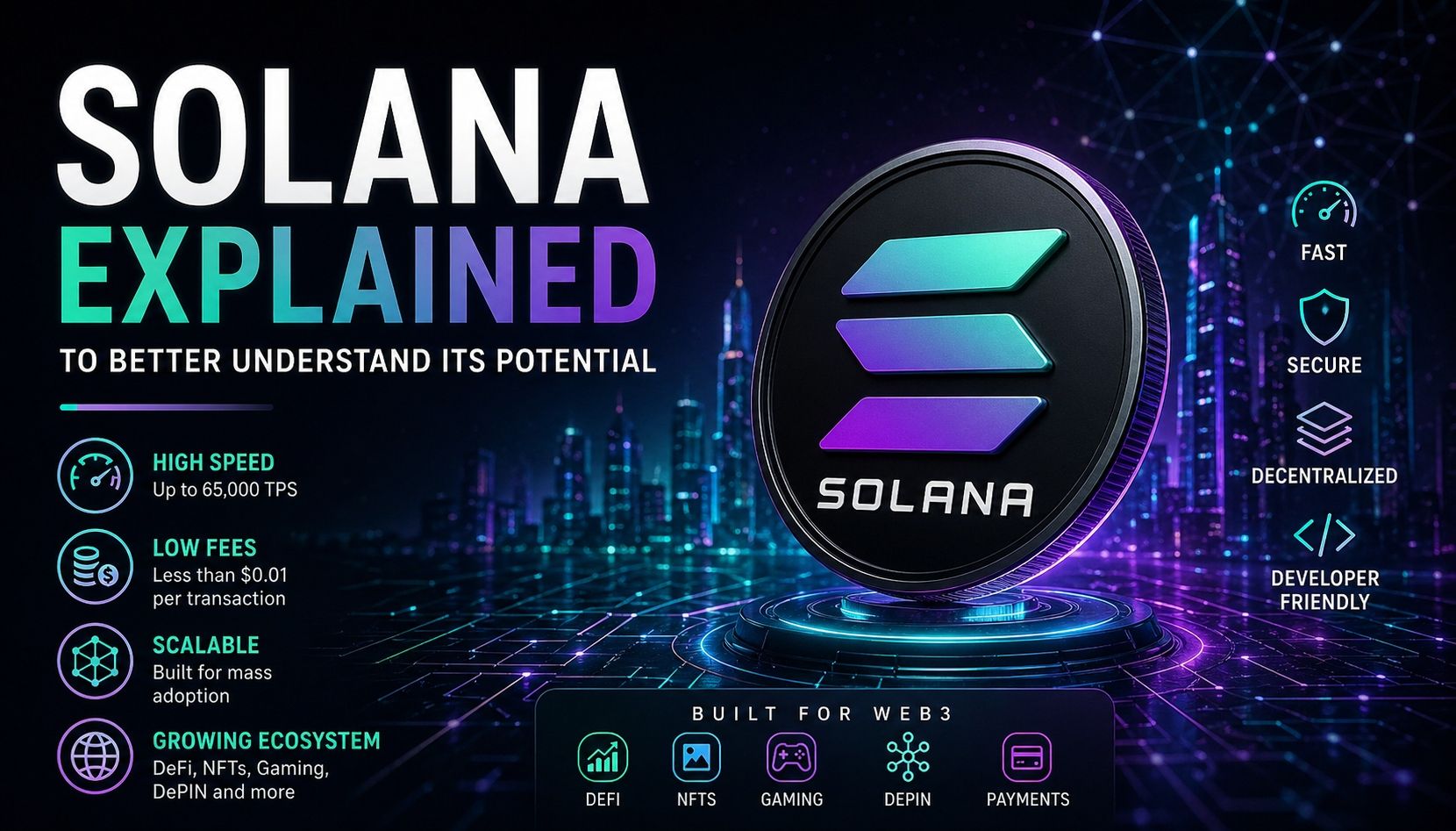
👉 To go further: If you want to better understand the ecosystem behind SOL and how it works, read our complete guide:


Thortrading brings together two cryptocurrency traders with around five years of active market experience. Their work focuses on Bitcoin, altcoins, DeFi and crypto market trends, with an approach based on technical analysis, market cycles and risk management. Through their articles, they aim to help readers better understand both the opportunities and risks of crypto trading