
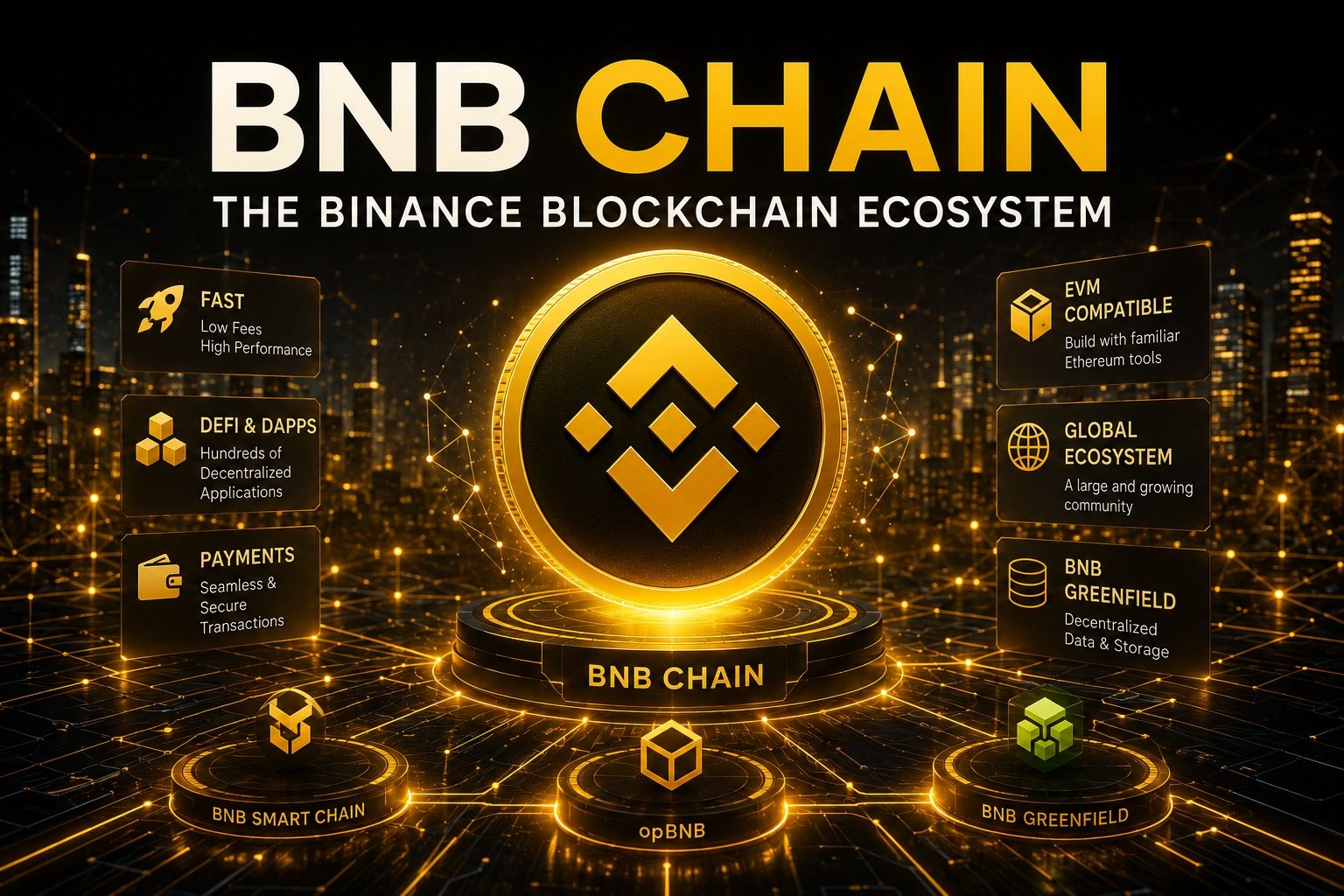
BNB Chain is one of the most widely known blockchain ecosystems in the crypto market. It is closely associated with Binance, the global cryptocurrency exchange, but it should not be confused with Binance itself.
In simple terms, BNB Chain is the blockchain ecosystem powered by the BNB token. Its most important network for smart contracts is BNB Smart Chain, an Ethereum-compatible blockchain used for decentralized finance, payments, NFT applications, gaming, decentralized apps and Web3 infrastructure.
For many users, BNB Chain is still described as the Binance blockchain. That expression is useful because it explains the historical connection between Binance, BNB and the blockchain ecosystem. But the full picture is more nuanced. Binance is a centralized exchange. BNB Chain is a public blockchain ecosystem. The two are linked by history, branding and market perception, but they are not the same thing.
This distinction matters. As crypto infrastructure becomes more competitive, investors and users need to understand what BNB Chain actually does, why it became popular, what risks it carries and how its roadmap could shape its future.
Related reading: to compare BNB Chain with another major blockchain ecosystem, read our guide: What is the Avalanche blockchain and how does it work?
What is BNB Chain?
BNB Chain is a blockchain ecosystem designed to support smart contracts, decentralized applications, token transfers, DeFi protocols, data infrastructure and Web3 products.
The ecosystem is powered by BNB, the native crypto asset used to pay transaction fees, participate in staking, support network activity and contribute to governance mechanisms. BNB is therefore not just a token linked to Binance. It is also the economic asset that helps power the BNB Chain ecosystem.
BNB Chain is best known for BNB Smart Chain, also called BSC. This is the Ethereum-compatible blockchain where most decentralized applications, DeFi protocols and smart contracts operate.
Because BNB Smart Chain is compatible with the Ethereum Virtual Machine, developers can build or deploy applications using tools that are already familiar in the Ethereum ecosystem. This compatibility helped BNB Chain attract projects quickly, especially during periods when Ethereum transaction fees were high.
BNB Chain, BNB Smart Chain and Binance Smart Chain: what is the difference?
The terminology around BNB Chain can be confusing, especially for new readers.
Binance Chain was the original blockchain linked to the Binance ecosystem. It was mainly designed for fast token transfers and trading-related activity.
Binance Smart Chain, launched officially on September 1, 2020, introduced smart contract functionality. This was the major turning point. It allowed developers to build DeFi platforms, NFT marketplaces, games and decentralized applications on a network that was faster and cheaper than Ethereum at the time.
Later, the ecosystem was rebranded as BNB Chain. The goal was to move the focus away from the Binance exchange brand and toward a broader blockchain ecosystem powered by BNB.
Today, BNB Chain includes several core components:
- BNB Smart Chain, the EVM-compatible blockchain used for smart contracts and decentralized applications;
- opBNB, a Layer 2 scaling solution designed to increase throughput and reduce costs;
- BNB Greenfield, a decentralized storage and data infrastructure layer.
In everyday language, when people talk about the Binance blockchain, they usually mean BNB Chain. More specifically, when they talk about DeFi, smart contracts or dApps, they are usually referring to BNB Smart Chain.
Why was BNB Smart Chain launched?
BNB Smart Chain was launched during a critical period for crypto. In 2020, Ethereum was already the leading smart contract blockchain, but it was also facing major congestion and high transaction fees.
For small users, Ethereum could become expensive. Swapping tokens, interacting with DeFi protocols or minting NFTs sometimes required fees that were too high for everyday transactions.
BNB Smart Chain offered a different value proposition: lower fees, faster transactions and compatibility with Ethereum tools.
This combination helped the network grow quickly. Developers could build applications using familiar EVM infrastructure, while users could access DeFi and token trading with much lower transaction costs than on Ethereum during peak congestion periods.
That is why BNB Chain became especially popular among retail crypto users. It was not only a technical alternative. It was also a more affordable gateway into decentralized finance.
How does BNB Chain work?
BNB Smart Chain uses a consensus mechanism known as Proof of Staked Authority, or PoSA. This model combines elements of proof of stake and authority-based validation.
Validators produce blocks, confirm transactions and help secure the network. BNB holders can also delegate tokens to validators, which allows them to participate indirectly in network security and staking rewards.
This design allows BNB Chain to process transactions quickly and keep fees relatively low. But it also creates an important trade-off. BNB Smart Chain is often considered more centralized than Ethereum because it relies on a smaller validator set.
This is one of the central debates around the network. BNB Chain is fast and accessible, but users who prioritize maximum decentralization may see its validator structure as a limitation.
What is BNB Chain used for?
BNB Chain supports a wide range of crypto use cases. Its strongest areas are DeFi, payments, dApps, gaming, NFTs and Web3 infrastructure.
Decentralized finance
DeFi is one of the most important use cases on BNB Chain. Platforms such as PancakeSwap helped make the network popular by offering token swaps, liquidity pools, yield farming and other decentralized trading features.
If you follow DeFi News, BNB Chain is still an important ecosystem to watch, because its activity reflects several key trends in decentralized finance: low-cost trading, stablecoin transfers, liquidity competition, cross-chain bridges and the growing role of automated on-chain applications.
BNB Chain became attractive for DeFi users because transactions were fast and inexpensive. This allowed smaller users to participate in on-chain finance without paying the high fees often seen on Ethereum during periods of congestion.
Crypto payments
BNB Chain can also be used for crypto payments. Low fees and quick settlement make it useful for stablecoin transfers, wallet-to-wallet payments and certain commercial use cases.
In many regions, stablecoins are increasingly used as digital dollars. They help users move value, save in dollar-denominated assets or access financial tools without relying entirely on traditional banking systems. BNB Chain is one of the networks competing for this activity.
NFTs and gaming
BNB Chain has also hosted NFT projects, gaming platforms and Web3 entertainment applications. Although the NFT market cooled down after the 2021 boom, gaming and digital ownership remain important parts of the broader Web3 narrative.
Decentralized applications
Like Ethereum, BNB Smart Chain allows developers to build decentralized applications. These can include financial protocols, marketplaces, identity tools, social applications, automation tools and blockchain-based infrastructure products.
Why is BNB Chain important?
BNB Chain matters because it is one of the largest and most recognized blockchain ecosystems in crypto.
Its importance comes from several factors. First, it made DeFi more accessible to users who could not afford high Ethereum fees. Second, it benefited from the visibility of Binance and the BNB token. Third, it built a large ecosystem of applications, wallets, bridges, tools and protocols.
BNB Chain also represents a specific approach to blockchain design. It prioritizes speed, low costs and accessibility, even if that means accepting a more centralized structure than Ethereum.
For investors, this makes BNB Chain important to study. It is not just another blockchain. It is a major example of the trade-offs between performance, decentralization, adoption and regulatory perception.
Is BNB Chain decentralized?
BNB Chain is a public blockchain, but its level of decentralization is often debated.
Compared with Ethereum, BNB Smart Chain uses a smaller group of validators. This helps the network remain fast and efficient, but it can also concentrate power among fewer participants.
Supporters argue that BNB Chain provides a practical user experience, with low fees and fast transactions. Critics argue that the network sacrifices too much decentralization compared with Ethereum or other more distributed blockchain ecosystems.
The most balanced view is that BNB Chain sits somewhere in the middle. It is more open than a centralized exchange database, but less decentralized than Ethereum.
This does not necessarily make it useless. It simply means users should understand the trade-off before using the network or investing in assets linked to it.
BNB Chain vs Ethereum
BNB Chain and Ethereum compete in several areas, including smart contracts, DeFi, dApps and token infrastructure.
Ethereum remains the leading smart contract platform in terms of security, developer activity, liquidity and institutional credibility. It is widely seen as the most important settlement layer for decentralized finance.
BNB Chain, on the other hand, focuses more on affordability, speed and user accessibility. Its EVM compatibility makes it easier for Ethereum-based developers to deploy applications on BNB Smart Chain.
The two networks therefore serve overlapping but different markets. Ethereum is often preferred for high-value settlement and deeper liquidity. BNB Chain is often used by retail users looking for lower fees and faster execution.
BNB Chain vs Solana, Base and Avalanche
The blockchain market is far more competitive today than it was in 2020. BNB Chain no longer competes only with Ethereum.
Solana has become a major competitor thanks to fast transactions, low fees and a strong retail user experience. Base has gained momentum because of its connection to Coinbase and the growing interest in consumer crypto applications. Avalanche focuses on customizable blockchain networks and institutional-grade infrastructure.
This means BNB Chain must continue evolving. Its early advantage as a low-fee Ethereum alternative is no longer enough. Many networks now offer low-cost transactions and improved performance.
To stay relevant, BNB Chain needs strong applications, developer activity, liquidity, security and a clear technological roadmap.
BNB Chain’s 2026 roadmap: speed, AI agents and new infrastructure
One of the most important developments for BNB Chain is its 2026 roadmap.
The ecosystem is working on performance upgrades, lower latency, improved user experience, account abstraction, MEV protection, faster execution and new infrastructure for automated applications.
The most ambitious part of the roadmap is a next-generation Layer 1 architecture. This new blockchain is not expected to immediately replace BNB Smart Chain. Instead, it is designed to run in parallel and support more demanding use cases.
The targets are aggressive: more than 100,000 transactions per second, sub-50 millisecond pre-confirmations and sub-second finality. The roadmap also points to features such as no public mempool, reserved blockspace for critical flows and better infrastructure for high-speed financial applications.
This is important because the next phase of crypto may not be limited to human users clicking buttons in wallets. It may also involve automated systems, trading bots, payment agents and AI-driven applications that need fast, low-cost and programmable execution.
Why AI agents matter for BNB Chain
AI is not the original purpose of BNB Chain. The network was mainly built around smart contracts, DeFi, payments and decentralized applications.
However, AI agents are becoming an important part of the roadmap. In crypto, an AI agent could be a software program that analyzes data, sends payments, manages positions, interacts with DeFi protocols or executes transactions automatically.
For these agents to work at scale, blockchain infrastructure must be fast, cheap and programmable. If every transaction is slow or expensive, autonomous agents cannot operate efficiently.
This is why BNB Chain’s focus on speed and low latency matters. A blockchain designed for high-frequency activity could become more attractive for agent-based finance, automated payments and machine-to-machine transactions.
Still, it is important not to reduce BNB Chain to an AI blockchain. AI agents are one possible growth area, but the network’s core use cases remain DeFi, payments, smart contracts, dApps and Web3 infrastructure.
Advantages of BNB Chain
Low transaction fees
The network is known for relatively low transaction costs. This has made it attractive to retail users, especially during periods when Ethereum fees were high.
Fast transactions
It is designed for quick execution. This makes it useful for token swaps, payments, DeFi interactions and applications that require a smoother user experience.
EVM compatibility
Its smart contract layer is compatible with Ethereum’s development environment. This makes it easier for developers to deploy applications and for users to interact with familiar tools.
Large ecosystem
The ecosystem includes applications, wallets, DeFi protocols, bridges, games and infrastructure tools. This gives it an advantage over newer networks that still need to build liquidity and developer activity.
Strong market visibility
The historical connection with Binance gives the project high visibility. Many crypto users know the BNB token, even if they do not fully understand the technical structure behind the blockchain ecosystem.
Risks of BNB Chain
Centralization concerns
The main criticism is centralization. Its validator structure is more limited than Ethereum’s, which can raise concerns about censorship resistance and network governance.
Regulatory risk
This ecosystem is not the Binance exchange, but the two are closely linked in market perception. Regulatory pressure on Binance can therefore affect how users and investors view the network and the BNB token.
Security risks
Like all smart contract ecosystems, it faces risks from hacks, bridge vulnerabilities, bugs, malicious contracts and economic attacks. Low fees and high activity can attract both legitimate developers and opportunistic attackers.
Competition
The blockchain market is extremely competitive. Ethereum, Solana, Base, Avalanche, Arbitrum and other networks are all competing for users, developers and liquidity.
Dependence on ecosystem momentum
Its long-term success depends on continued activity across applications, DeFi protocols and the user base. If liquidity or developer interest declines, the network could lose relevance over time.
Is BNB Chain good for developers?
BNB Chain can be attractive for developers because of its EVM compatibility, low transaction costs and established user base.
Developers who already understand Ethereum tooling can often adapt more easily to BNB Smart Chain. This reduces friction and makes multi-chain deployment more practical.
However, developers must also consider the trade-offs. Building on BNB Chain may provide access to a large retail audience, but it may also expose projects to a network with stronger centralization concerns and a different reputation profile from Ethereum.
For some applications, BNB Chain can be a practical choice. For others, especially those prioritizing maximum decentralization or institutional credibility, Ethereum or certain Layer 2 networks may be more appropriate.
Is BNB Chain good for investors?
BNB Chain is relevant for investors because it is closely connected to the utility of BNB.
If BNB Chain continues to attract users, applications and transaction activity, this can support the broader narrative around BNB. However, investors should not assume that network activity automatically guarantees token performance.
BNB is influenced by many factors: crypto market cycles, Binance-related news, regulation, token burns, liquidity, investor sentiment and competition from other blockchains.
Understanding BNB Chain is therefore useful, but it is only one part of analyzing BNB as an asset.
Can BNB Chain remain a major blockchain?
BNB Chain has already survived multiple crypto cycles. It has built a recognizable brand, a large ecosystem and a strong retail user base.
But the next phase will be more difficult. The market now has many fast and low-cost blockchains. Users have more options. Developers can choose between Ethereum Layer 2s, Solana, Base, Avalanche, Aptos, Sui and other ecosystems.
To remain important, BNB Chain must prove that it can offer more than cheap transactions. It needs useful applications, reliable infrastructure, strong security, developer momentum and real adoption beyond speculative activity.
The 2026 roadmap shows that BNB Chain is trying to move in that direction. The focus on high-performance infrastructure, AI agents, faster execution and improved user experience suggests that the ecosystem wants to compete for the next generation of on-chain applications.
Conclusion: BNB Chain is more than the Binance blockchain
BNB Chain is often described as the Binance blockchain, but that description is incomplete. It is better understood as a broad blockchain ecosystem powered by BNB, with BNB Smart Chain serving as its main smart contract network.
Its strengths are clear: low fees, fast transactions, EVM compatibility, strong market visibility and a large ecosystem of applications. Its weaknesses are also clear: centralization concerns, regulatory perception, security risks and intense competition.
For US and UK readers, BNB Chain is important because it represents one of the biggest examples of a performance-focused blockchain ecosystem linked to a major crypto brand. It also shows how the industry is evolving from simple token trading toward infrastructure for DeFi, payments, automated finance and possibly AI agents.
The key question is not whether BNB Chain was important in the last crypto cycle. It was. The real question is whether it can stay relevant in the next one.
FAQ
What is BNB Chain?
It is a blockchain ecosystem powered by the BNB token. It includes BNB Smart Chain, opBNB and BNB Greenfield, and supports smart contracts, DeFi, payments, decentralized apps and Web3 infrastructure.
Is it the same as Binance?
No. Binance is a centralized crypto exchange, while this ecosystem is a public blockchain infrastructure. The two are historically connected, but they are not the same thing.
What is BNB Smart Chain?
It is the EVM-compatible smart contract network within the broader BNB ecosystem. It is used for DeFi, dApps, token transfers, gaming, NFTs and Web3 applications.
When was BNB Smart Chain launched?
It was officially launched on September 1, 2020. This launch introduced smart contract functionality to the BNB ecosystem.
What is BNB used for?
BNB is used to pay transaction fees, support staking, participate in network activity and contribute to governance functions across the ecosystem.
Is the network compatible with Ethereum?
Yes. Its smart contract layer is compatible with the Ethereum Virtual Machine, which allows developers to use Ethereum-style tools and smart contracts.
Is the network decentralized?
It is a public blockchain, but its decentralization is debated. The network is generally considered more centralized than Ethereum because it relies on a smaller validator set.
Is it cheaper than Ethereum?
In most cases, transaction fees are lower than on Ethereum mainnet, especially during periods of high network congestion. However, fees and performance can change over time.
What are the main risks?
The main risks include centralization concerns, regulatory pressure linked to Binance’s market perception, smart contract vulnerabilities, bridge risks and competition from other blockchains.
Is it focused on AI?
Not exclusively. The 2026 roadmap includes infrastructure for AI agents and automated applications, but the core use cases remain DeFi, payments, smart contracts and decentralized applications.
Disclaimer
This article is for informational and educational purposes only. It is not financial advice, investment advice or a recommendation to buy or sell any cryptocurrency. Digital assets are volatile and involve significant risk. Always do your own research and consult a qualified professional if needed.

