

Updated on September 28, 2026. Price references are dated observations, not a live quote. U.S. ETF flow data cover completed sessions through September 25.
Bitcoin price analysis: buyers face another support test as the pace of ETF inflows slows
This Bitcoin price analysis examines a market that has retained much of its September recovery but has yet to regain its breakout momentum. An early September 28 market report placed BTC just below $84,000, around $83,999. That leaves the recovery zone above the market and puts the recent lows back in focus. Source: dated market snapshot.
The latest Bitcoin technical analysis centres on whether buyers can defend the lower part of the recent range. The Bitcoin fundamental analysis presents a different question: can continuing investment demand absorb selling without requiring prices to fall further?
The distinction matters. Positive demand through one investment channel does not eliminate supply elsewhere. Equally, a correction after a sharp advance does not, by itself, establish a new bearish trend.
Our interpretation is therefore conditional: the recovery remains viable, but a convincing bullish continuation requires reclaimed resistance and evidence that buyers can maintain those gains.
Bitcoin price analysis: the levels that matter
- Near-term pivot: $84,000, an area of negotiation rather than reliable support.
- Recent-low support: approximately $82,900–$83,200.
- Broader decision zone: $82,000–$83,000.
- First recovery hurdle: $84,900–$85,300.
- Further resistance: $86,000, then $87,300–$88,000.
- Conditional upside reference: $90,000, only after a confirmed breakout.
- Fundamental question: whether fresh demand can absorb profit-taking.
These zones are our interpretation of recent price action. They are not guaranteed turning points or automatic trade instructions.
What changed in the Bitcoin price analysis?
The previous update focused on the September 23 reversal. The following sessions provided a more useful support test: the historical BRTI series records a low near $82,901 on September 24 and approximately $83,157 on September 25. Friday also reached roughly $85,248 before ending near $84,044. The September 21 high in that series was approximately $87,374. Prices vary slightly between feeds. Source: BRTI historical prices.
This changes the interpretation of the earlier $83,500–$84,000 support band. Price has already moved below it. Treating that entire area as untouched support would give readers an outdated picture.
For this Bitcoin price analysis, the more useful distinction is between a central pivot, the recent lows and the broader breakout region. A pivot can be crossed repeatedly. A support zone becomes more persuasive when buying there produces sustained recovery, rather than a brief bounce followed by renewed selling.
Why the rebound is still incomplete
Buyers have shown an ability to respond to weakness, but the market has not established a sustained recovery above the first resistance band. That combination is consistent with consolidation. It offers less confirmation than a sequence of rising lows followed by a decisive break above the range.
A rebound should therefore be judged by what happens after resistance is reached. Does price remain above it? Does a pullback attract buyers? Or does the market quickly return to its previous range? Those questions are more useful than assuming every green session marks the beginning of another acceleration.
Bitcoin technical analysis: support, resistance and confirmation
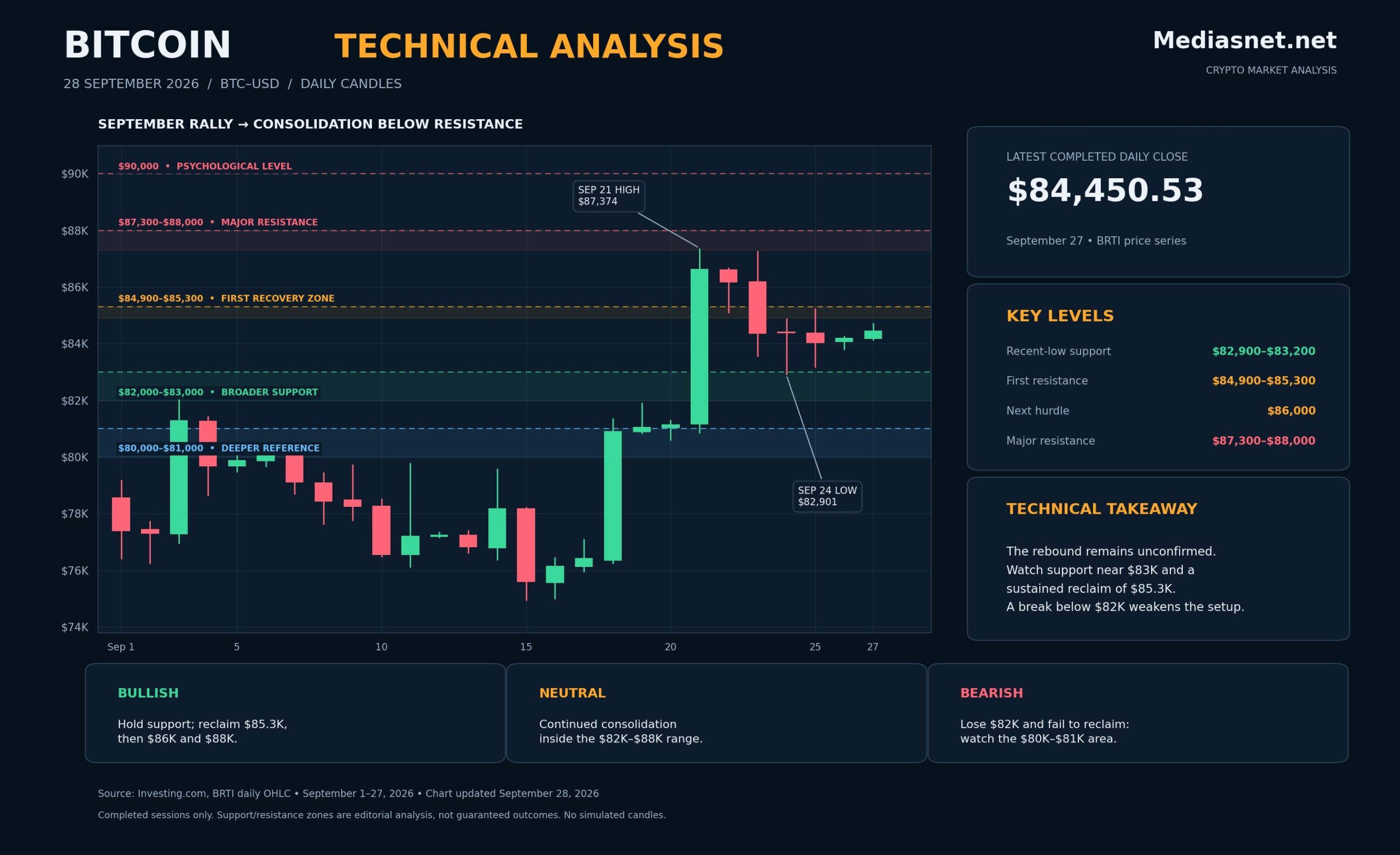
Illustration retained from the previous edition. The dated levels and discussion below take precedence over any figures embedded in the image.
This Bitcoin technical analysis uses zones rather than single-dollar levels. Bitcoin trades across several venues, and short-lived price differences are normal. A zone also helps distinguish a marginal intraday breach from a sustained change in market structure.
| Zone | Role | What would matter |
|---|---|---|
| $82,900–$83,200 | Recent-low support | A rebound that holds on a subsequent retest. |
| $82,000–$83,000 | Broader decision zone | Sustained trading below it would weaken the recovery scenario. |
| $80,000–$81,000 | Deeper reference area | Relevant if the broader decision zone fails. |
| $84,900–$85,300 | First resistance | A close above the zone followed by a successful retest. |
| $86,000 | Intermediate hurdle | Whether buying persists after the initial rebound. |
| $87,300–$88,000 | Upper breakout zone | Acceptance above the recent high area. |
| $90,000 | Psychological reference | A conditional extension, not a confirmed destination. |
Bitcoin technical analysis: what would strengthen support?
A long lower wick can show that buyers responded, but it is only the first part of the evidence. A more convincing defence would combine a rebound, a higher subsequent low and recovery above nearby resistance. The sequence matters because it demonstrates that buying extends beyond one isolated reaction.
Repeated tests are ambiguous. They can indicate persistent demand, or they can gradually exhaust available buyers. For the current Bitcoin technical analysis, the quality of each rebound matters more than simply counting how many times a price has been touched.
What would make a breakdown more convincing?
A brief move below a widely watched level can reverse quickly. More persuasive bearish evidence would be a daily close beneath support, followed by an unsuccessful attempt to reclaim it. That would suggest the former buying area is beginning to attract selling.
In that situation, the Bitcoin price analysis would shift from defending a breakout to evaluating a deeper retracement. The next lower reference is not a promised floor: it is where the market would need to produce fresh evidence of demand.
Why a breakout needs follow-through
A move above resistance can attract momentum traders and trigger short covering. Both may lift price quickly, but neither guarantees lasting demand. A successful retest, sustained spot activity and a less aggressive build-up of leverage would make the move more convincing.
This approach accepts that confirmation may arrive after the exact low. Its purpose is to distinguish a stronger structure from an attractive-looking price. Technical levels organise uncertainty; they do not remove it.
RSI and MACD: avoid carrying stale readings forward
The previous edition quoted an RSI around 65 and described MACD as positive. Those observations should not be relabelled as current without recalculating them on a specified market, timeframe and closing-price series. This update does not present an unverified RSI or MACD value as a September 28 reading.
For a consistent Bitcoin technical analysis, a daily RSI should be compared with daily price structure. A four-hour indicator may describe a rebound even while the daily trend is deteriorating. Conversely, a strong daily structure can contain several weak intraday sessions.
As general interpretation, an RSI holding above its midpoint during consolidation can support a constructive momentum assessment. A loss of that midpoint alongside a price breakdown would be less encouraging. Neither condition should override the evidence from price itself.
MACD also requires context. Being above zero and being above its signal line are different statements. A positive MACD can coexist with declining momentum. The best use of these tools is to test whether momentum supports the price scenario, rather than to manufacture certainty from a single number.
Bitcoin fundamental analysis: ETF buying continues, but slows

Illustration retained from the previous edition; dated figures are provided in the text.
The clearest flow update for the Bitcoin fundamental analysis comes from Farside Investors. Its table shows the following net subscriptions across U.S. spot Bitcoin ETFs. These are completed trading sessions, not weekend flows.
| Session | Net flow, USD millions |
|---|---|
| September 21 | +999.0 |
| September 22 | +714.7 |
| September 23 | +346.9 |
| September 24 | +190.7 |
| September 25 | +134.5 |
| Weekly total | +2,385.8 |
Source: Farside Investors. The total is calculated from the displayed daily figures, which may be revised.
Including September 17 and 18, the positive streak reached seven sessions and approximately $2.978 billion. The weekly total is strong, but daily inflows declined through the week. That distinction is central to the latest Bitcoin price analysis.
Bitcoin fundamental analysis: why inflows do not set the price alone
ETF demand is one part of a global market. Existing holders, miners, trading firms and other investors can supply coins at the same time that funds accumulate them. A positive flow reading therefore describes a channel of demand, not the balance of every buyer and seller.
ETF ownership also does not automatically mean an unhedged long-term position. Some participants may offset exposure using derivatives or other instruments. This does not make fund flows irrelevant; it limits how much directional conviction can be inferred from them.
Our Bitcoin fundamental analysis consequently treats flows as supporting evidence. The stronger combination would be persistent buying and an improving price response. If substantial buying produces little progress, sellers may still be willing to meet that demand.
Corporate accumulation supports the thesis, not a guaranteed floor
Strategy’s September 21 SEC filing reported 846,000 BTC held as of September 20, following a purchase of 950 BTC. The aggregate acquisition cost was approximately $63.80 billion, with an average purchase price of $75,416 including fees and expenses. These are dated disclosed holdings, not an independently verified September 28 balance. Source: Strategy Form 8-K.
For the Bitcoin fundamental analysis, corporate purchases show that treasury allocation remains a relevant source of demand. They should nevertheless be assessed alongside the financing used, the buyer’s obligations and the sustainability of additional purchases.
An acquisition price is an accounting reference. It is not a standing commitment to buy every coin offered at that level. Using a company’s average cost as guaranteed technical support would confuse ownership history with future market liquidity.
Bitcoin fundamental analysis: monetary policy and regulation
The Federal Reserve remains relevant
The Federal Reserve’s September 16 statement raised its target range by a quarter percentage point to 3.75%–4.00%, citing elevated inflation. Source: Federal Reserve statement.
Higher financing costs can discourage leveraged risk-taking. Treasury yields and the dollar are therefore useful context for this Bitcoin price analysis. Their influence is not mechanical: markets also respond to expectations, positioning and how new information differs from what investors already anticipated.
The U.S. reserve already has an executive-order foundation
The March 6, 2025 executive order established the Strategic Bitcoin Reserve framework, initially capitalised with eligible forfeited government BTC. It also directed officials to develop budget-neutral acquisition strategies. This is distinct from proof that additional open-market purchases have occurred. Source: White House executive order.
A useful Bitcoin fundamental analysis separates a policy framework, subsequent legislation and actual transactions. A proposal can influence expectations before any demand reaches the market. The previous edition’s suggestion that no reserve had been approved was too broad.
Market structure legislation and tokenisation remain separate issues
Reuters reported that the CLARITY Act failed to advance in the Senate on September 15. That procedural setback should not be presented as final enactment or a permanent rejection. Source: Reuters.
The SEC has also announced an innovation exemption concerning tokenized stock trading. Such developments concern financial-market infrastructure; they do not, by themselves, create purchases of BTC. Regulatory progress needs to be connected to its actual economic effect before it becomes part of a price thesis.
Leverage remains a risk in the Bitcoin price analysis
Derivatives can amplify both rallies and declines. When leveraged positions are forcibly closed, selling or buying can become less sensitive to valuation. A modest initial move may then become larger because it triggers additional liquidations.
This update does not recycle the previous edition’s open-interest or liquidation totals as current data. Both require a timestamp, an exchange universe and a clear definition. Bitcoin-only liquidations should also be distinguished from liquidations across the entire crypto market.
For the Bitcoin technical analysis, the useful question is how leverage changes alongside price. Rising open interest indicates additional outstanding contracts, but every contract has both a long and a short. The figure alone cannot reveal that traders are collectively bullish.
A price rebound accompanied by excessive funding costs may be more vulnerable than one supported by broader spot participation. Conversely, falling open interest during a correction can indicate positions being closed, although it does not prove that all downside risk has been removed.
Three scenarios for the Bitcoin price analysis
Bullish scenario: support holds and resistance becomes support
The constructive sequence would begin with buyers defending the recent-low area, then recovering the first resistance band. A higher low on the next pullback would strengthen the case that demand is becoming more persistent.
Above the intermediate hurdle, attention would return to the upper breakout zone. Only after a sustained break there would the round-number upside reference become more relevant. This Bitcoin price analysis assigns no numerical probability or guaranteed deadline to that sequence.
Neutral scenario: the market continues to consolidate
Bitcoin could remain in a broad range while participants reassess the recent advance. In that setting, strength near the middle of the range may offer little information about its eventual direction.
The neutral interpretation would remain reasonable while support attracts buyers but rallies fail to establish acceptance above resistance. The Bitcoin technical analysis would then favour patience in interpretation, rather than repeatedly declaring a new trend after each intraday move.
Bearish scenario: a failed recovery follows a support break
The more concerning sequence would combine a sustained loss of the broader decision zone with a rebound that fails beneath it. That would make the deeper reference area relevant and reduce confidence in the earlier breakout.
A deterioration in demand would reinforce that interpretation, but price does not need a negative headline to fall. Sellers may simply be more urgent than buyers at prevailing levels. The bearish case should weaken again if the market rapidly reclaims support and holds it.
What to watch next
- Price response: can a rebound produce a higher low?
- Resistance: does a breakout survive a retest?
- Demand: do fresh fund subscriptions coincide with stronger price action?
- Leverage: is speculative positioning growing faster than spot participation?
- Macro conditions: do yields and the dollar add pressure?
- Policy: distinguish announcements from implemented measures and completed purchases.
Bitcoin price analysis FAQ
What does the current Bitcoin price analysis show?
It shows a recovery undergoing consolidation and renewed support tests. A sustained move back above resistance would strengthen the bullish interpretation; a failed rebound after a support break would weaken it.
What are the main levels in the Bitcoin technical analysis?
The recent-low area is around $82,900–$83,200, within a broader $82,000–$83,000 decision zone. The first recovery hurdle is approximately $84,900–$85,300, followed by $86,000 and the $87,300–$88,000 region.
What is the main signal in the Bitcoin fundamental analysis?
Continued ETF subscriptions remain a supportive demand signal, but their pace slowed toward the end of the completed trading week. Fundamentals must be assessed alongside available supply and the price response.
Does positive ETF demand guarantee that Bitcoin will rise?
No. Other investors can sell more aggressively, while derivatives and macroeconomic developments can affect short-term price formation. Fund flows are informative, but incomplete.
Is Bitcoin currently overbought?
This edition does not assert a current RSI reading. An overbought assessment requires a fresh calculation with an identified timeframe and data source. Earlier readings should not be reused as live indicators.
Can Bitcoin still reach $90,000?
That remains a possible bullish extension, conditional on clearing and holding the intervening resistance zones. It is not a forecast with an established probability or timetable.
Could Bitcoin revisit $80,000?
That area becomes more relevant if the broader support zone fails and recovery attempts are rejected. The scenario would need to be reassessed if buyers instead reclaim the broken levels.
Why combine Bitcoin technical analysis and Bitcoin fundamental analysis?
The first helps identify how price is behaving and where a scenario loses credibility. The second examines demand, ownership and the economic environment. Agreement between them can improve a thesis, but neither eliminates uncertainty.
Final Bitcoin price analysis: confirmation matters more than the headline
This Bitcoin price analysis describes a market with continuing investment demand and an incomplete technical recovery. Those conditions can coexist. Buyers may absorb supply for several sessions before price advances, or selling may eventually overwhelm that demand.
The Bitcoin technical analysis therefore remains conditional on the behaviour around support and the ability to reclaim resistance. The Bitcoin fundamental analysis should track the persistence of demand, financing conditions and implemented policy developments.
The practical question is whether each new session strengthens or weakens the evidence. A defended low, a successful breakout and a held retest would build a stronger recovery case. A broken support zone and a failed reclaim would call for a more cautious interpretation.
This article provides information and market commentary, not personalised financial advice. Bitcoin is volatile; scenario levels can fail and market conditions can change quickly.
Want to go further? Read our guide on

How to invest in crypto in 2026.


Thortrading brings together two cryptocurrency traders with around five years of active market experience. Their work focuses on Bitcoin, altcoins, DeFi and crypto market trends, with an approach based on technical analysis, market cycles and risk management. Through their articles, they aim to help readers better understand both the opportunities and risks of crypto trading
2 thoughts on “Bitcoin price analysis 2026”
Comments are closed.