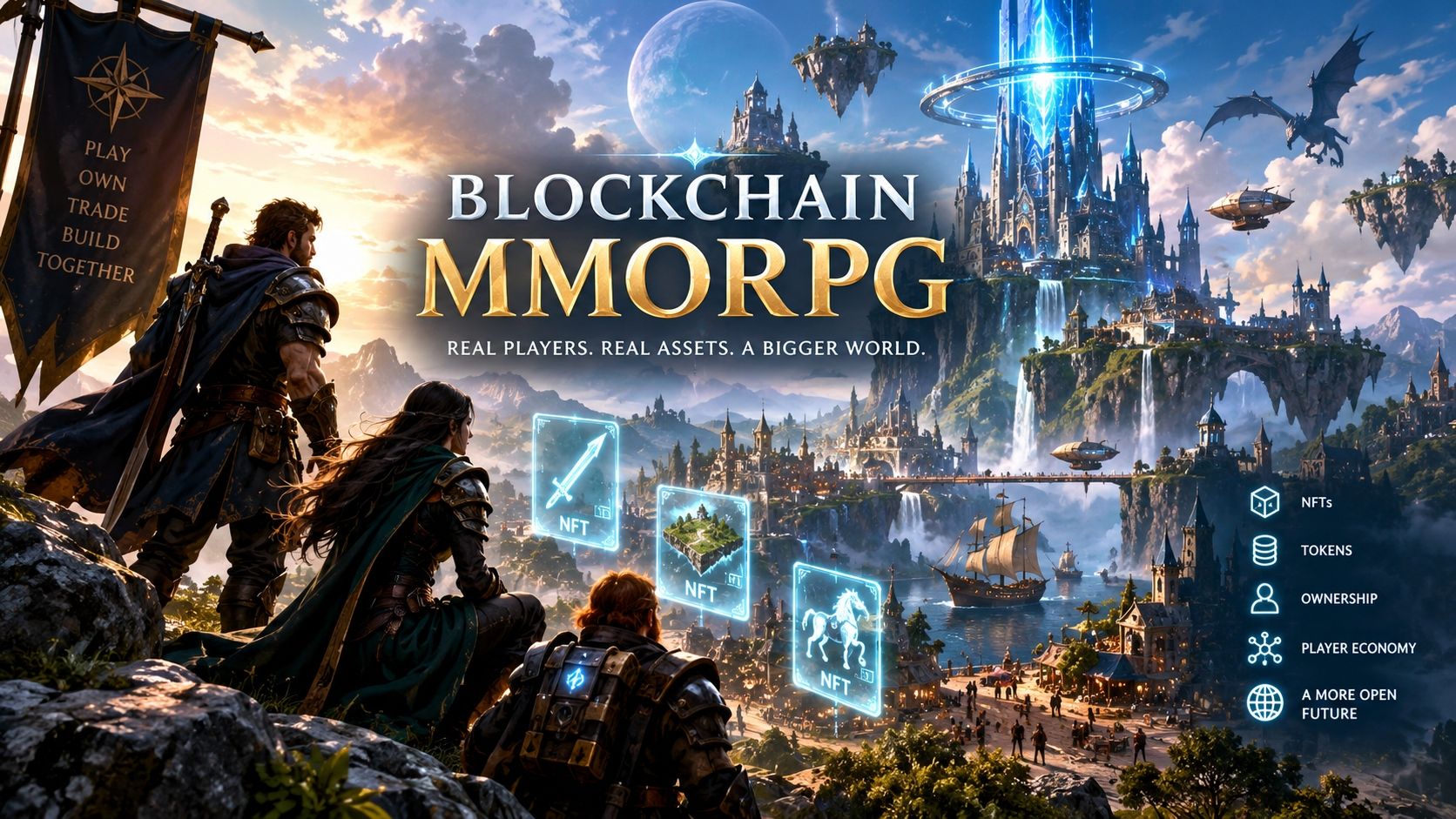
 Massively multiplayer online games have created virtual economies for decades, allowing players to accumulate characters, equipment, resources, land and digital currencies. With the emergence of blockchain technology, a new category of games is attempting to take this concept further: the Blockchain MMORPG.
The basic idea is to combine the traditional mechanics of an MMORPG — persistent worlds, character progression, exploration, economies and interactions between players — with Web3 technologies such as tokens, NFTs, blockchain wallets and smart contracts.
This approach can allow players to own certain digital assets outside the traditional databases controlled by game developers. A weapon, a piece of land or a rare item can, for example, be represented by a blockchain token and transferred between compatible wallets.
However, not every blockchain MMORPG follows the same model. Some rely heavily on NFTs and cryptocurrencies, while others are moving toward an approach where the blockchain becomes almost invisible to the player.
So what exactly is a Blockchain MMORPG? How does its economy work? What role do NFTs and tokens play? And more importantly, does blockchain technology genuinely improve MMORPGs, or does it simply add a speculative layer to games that could function perfectly well without it?
What Is a Blockchain MMORPG?
The term Blockchain MMORPG combines two different concepts: traditional massively multiplayer online role-playing games and blockchain technology.
MMORPG stands for Massively Multiplayer Online Role-Playing Game. These games take place in persistent virtual worlds where large numbers of players can interact, explore and progress simultaneously.
Players typically develop characters, complete quests, collect resources, acquire or craft equipment and interact with other participants.
Games such as World of Warcraft, Final Fantasy XIV and RuneScape demonstrated long ago that MMORPGs could support sophisticated virtual economies.
However, these economies remain controlled by the companies operating the games.
Items obtained by players are normally recorded in the developer’s databases. Even when an item is extremely rare or difficult to obtain, the player does not own it in the same way that a transferable digital asset can be controlled through a blockchain wallet.
A blockchain MMORPG attempts to change part of this architecture.
Certain in-game assets can be recorded on a blockchain and associated with the player’s wallet. Depending on the game’s design, these assets may then be transferred, sold or exchanged without every transaction being confined to a closed in-game database.
This concept of digital ownership is one of the most important ideas behind blockchain gaming.
How Does a Blockchain MMORPG Work?
A Blockchain MMORPG remains, first and foremost, a video game.
One common misconception is that the entire game needs to operate directly on a blockchain. In most cases, this would be technically inefficient and unnecessary.
Graphics, character movement, artificial intelligence, combat systems and most real-time interactions are generally still managed using traditional gaming infrastructure.
Blockchain technology is instead used for specific functions.
Depending on the project, it can be used to:
- record ownership of certain digital items;
- mint or burn NFTs;
- manage tokens used within the game’s economy;
- transfer assets between wallets;
- operate marketplaces;
- record certain transactions;
- support governance mechanisms;
- or automate specific functions through smart contracts.
The objective is therefore not necessarily to decentralize the entire MMORPG. Instead, blockchain can make selected parts of its economy more open, transferable and verifiable.
The Wallet: Connecting the Player to the Blockchain
The crypto wallet has historically been one of the biggest obstacles to mainstream Web3 gaming.
Early blockchain games often required players to install an external wallet, secure a recovery phrase, select the correct blockchain network, acquire cryptocurrency and sometimes pay transaction fees before they could fully interact with the game.
These steps may seem relatively straightforward to experienced crypto users, but they create significant friction for traditional gamers.
Blockchain gaming infrastructure is therefore moving toward a much simpler model.
Embedded wallets can allow a wallet to be created automatically alongside a conventional user account. Players may be able to sign in using an email address or familiar social login without constantly interacting with the technical components of a cryptocurrency wallet.
This development could be particularly important for future Web3 MMORPGs.
If blockchain gaming is ever going to reach a genuinely mainstream audience, the underlying technology will probably need to operate in the background rather than becoming an additional task for the player.
What Are NFTs Used for in a Blockchain MMORPG?
NFTs can be particularly suitable for role-playing games because MMORPGs naturally contain large numbers of identifiable and sometimes unique digital items.
An NFT could theoretically represent:
- a character;
- a weapon;
- armor;
- a vehicle;
- a pet or companion;
- virtual land;
- a building;
- a rare resource;
- a cosmetic item;
- or certain rights within the game world.
The fundamental difference between an NFT and an item stored exclusively in a conventional gaming database lies in how ownership is represented.
A blockchain asset can be associated with an address controlled by the player. The wallet can therefore provide cryptographic evidence that it controls the token representing that asset.
Potentially Verifiable Scarcity
Blockchain technology can also make certain characteristics of digital assets independently verifiable.
If a collection of items is created with a predefined maximum supply through a smart contract, users may be able to verify the circulating supply and transaction history directly on the blockchain.
This can introduce greater transparency into certain virtual economies.
However, verifiable scarcity does not guarantee value.
An NFT can be technically rare while attracting virtually no demand. As with other digital assets, economic value ultimately depends on whether people actually want it.
Owning the NFT Does Not Mean Owning the Game
There is also an important distinction when discussing digital ownership.
Holding an NFT in a personal wallet does not guarantee that the associated game will continue to exist.
If the developer closes its servers, abandons the project or changes the rules governing how the asset can be used, the NFT may continue to exist on the blockchain while losing most or all of its utility.
What Role Do Cryptocurrencies Play in a Blockchain MMORPG?
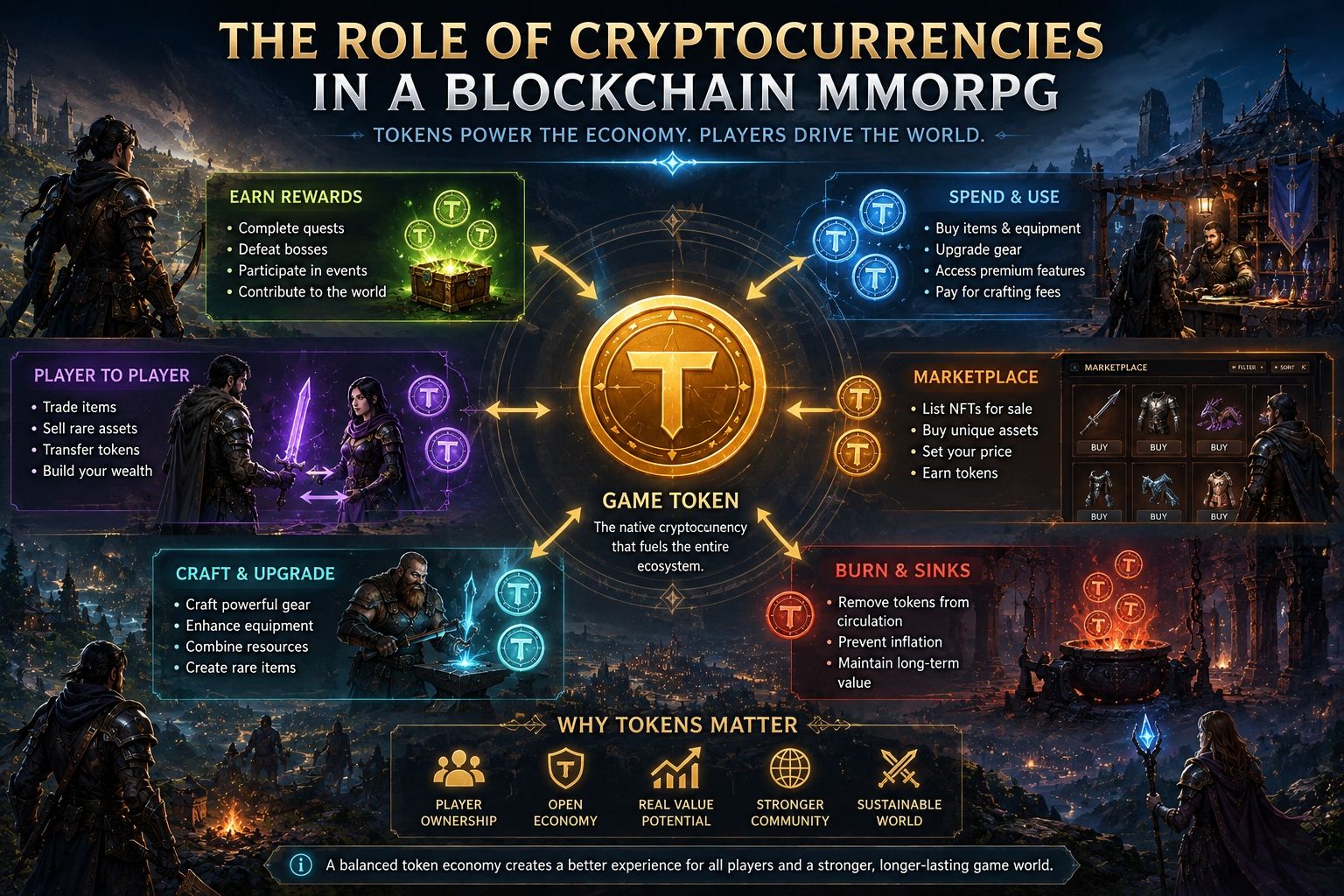
Cryptocurrencies are another common component of Blockchain MMORPG economies.
A project may create its own token to perform several functions within the ecosystem.
The token might be used to purchase certain items, pay for upgrades, craft equipment, access particular features or participate in governance mechanisms.
Some tokens may also be distributed to players as rewards.
This architecture can create a more open economy than that of a traditional MMORPG, but it also introduces additional risks.
The Problem of Token Inflation
One of the biggest challenges facing GameFi economies is creating a sustainable balance between token issuance and token utility.
If players constantly receive tokens but have few reasons to spend them within the game, supply can increase much faster than demand.
The result can be persistent selling pressure.
Developers therefore need mechanisms that encourage tokens to be reused or removed from circulation.
Traditional virtual economies already use a similar concept through economic sources and sinks: some activities create currency while others consume it.
The difference is that when the currency is a publicly traded crypto asset, economic imbalances can quickly become visible through the market price.
Blockchain MMORPG vs GameFi vs Play-to-Earn
The terms Blockchain MMORPG, GameFi and Play-to-Earn are sometimes used interchangeably, but they describe different concepts.
Blockchain MMORPG
Blockchain MMORPG primarily describes a gaming genre combined with a technological architecture.
The game needs to contain MMORPG characteristics while using blockchain technology for certain functions.
GameFi
GameFi is a much broader category.
It generally refers to projects combining video games, blockchain technology and economic or financial mechanisms.
A card game, strategy game, RPG, virtual world or MMORPG can therefore all belong to the wider GameFi ecosystem.
Play-to-Earn
Play-to-Earn describes an economic model in which players can potentially receive assets with market value in exchange for participating in a game.
An MMORPG can use blockchain technology without building its entire experience around Play-to-Earn.
This distinction is important.
Some early blockchain games placed greater emphasis on financial rewards than on gameplay. When token prices declined, users who had primarily joined for economic incentives often had little reason to remain.
A more sustainable approach is to create a game that players genuinely want to play even without the promise of financial rewards.
Why Use Blockchain in an MMORPG?
A traditional MMORPG can function perfectly well without blockchain technology. The important question is therefore not whether blockchain can be added to a game, but whether it provides a meaningful advantage.
Several potential applications can justify its use.
1. Giving Players More Control Over Certain Assets
In a conventional game, digital items are tied to an account controlled by the game’s operator.
A blockchain architecture can allow selected assets to be held in a wallet controlled by the player.
2. Creating More Open Player-to-Player Markets
MMORPGs have supported player trading systems for decades.
Blockchain can potentially open these economies further by allowing selected assets to be transferred or traded through compatible marketplaces.
3. Verifying Digital Assets
A public blockchain can make it possible to verify the existence, history and supply of certain digital assets.
This transparency may be useful in games where scarcity is an important component of the economy.
4. Connecting Different Applications
A blockchain asset can theoretically be recognized by multiple applications using compatible technical standards.
This creates the possibility of more interconnected digital ecosystems.
However, claims about interoperability should be treated carefully.
Owning a sword as an NFT does not automatically mean that the sword can be used in another game. Developers of the second game would need to deliberately recognize the asset and determine how it functions within their own environment.
Potential Advantages of Blockchain MMORPGs
When implemented effectively, blockchain technology can provide several potential advantages to an MMORPG.
A More Open Economy
The ability to transfer certain assets outside the game can create an economy that is less dependent on a completely closed marketplace.
Greater Traceability
The history of certain assets can potentially be viewed on-chain, making it easier to verify their provenance, supply or transaction history.
New Economic Models
Developers can experiment with economies combining tokens, crafting systems, marketplaces and transferable digital assets.
Greater Community Participation
Some projects also use governance tokens to allow their communities to participate in specific decisions.
This does not mean that the MMORPG itself becomes fully decentralized. Game development, balancing decisions and server infrastructure generally remain under the control of a development team or company.
What Are the Risks and Limitations of Blockchain MMORPGs?
Integrating blockchain technology also introduces problems that do not necessarily exist in traditional MMORPGs.
Speculation Can Become More Important Than Gameplay
When characters, virtual land and items become tradable assets, some users may enter the ecosystem primarily because they expect their assets to increase in value.
This dynamic can artificially increase prices and make the game more expensive for new players.
If speculative demand disappears, the virtual economy can then contract rapidly.
The Token Can Collapse
A game can continue to operate even while its associated token loses a substantial percentage of its market value.
Investors should therefore distinguish between the quality of a game and the financial performance of its token.
A good game does not automatically make its token a good investment. Conversely, a rapidly appreciating token does not guarantee that the underlying game will achieve long-term success.
Smart Contracts Introduce Additional Risks
Blockchain assets rely on software and smart contracts that may contain vulnerabilities.
The traditional risks associated with online gaming are therefore combined with crypto-specific risks such as phishing, wallet compromise, smart contract exploits, bridge vulnerabilities and transaction errors.
Complexity Can Damage the User Experience
A game that requires players to understand gas fees, blockchain networks, cryptographic signatures and bridges is unlikely to appeal to the entire traditional gaming market.
This is why newer Web3 infrastructure increasingly attempts to hide these technical complexities from the end user.
Blockchain MMORPGs and Digital Ownership: A Revolution?
Digital ownership is arguably one of the most interesting concepts behind blockchain gaming.
In a traditional MMORPG, players can spend thousands of hours developing characters and collecting rare items while having very limited control over those assets outside the game.
Blockchain technology can partially change this relationship.
However, the word “ownership” needs to be used carefully.
A player may own or control the token representing an item while still depending on the developer for that item to remain useful inside the MMORPG.
The real innovation is therefore not necessarily complete independence from game publishers. It is the possibility of creating digital assets that can be more transferable, independently verifiable and connected to infrastructure outside the game’s proprietary database.
Cryptopia: An Example of a Blockchain MMORPG
Cryptopia provides an interesting example of this approach.
The project is developing a virtual world based around a fictional maritime society where players can participate in different economic and social activities.
Blockchain technology is integrated into several parts of the ecosystem, including certain digital assets and economic mechanisms.
Cryptopia therefore attempts to combine the characteristics of a persistent online world with an economy built partly around Web3 infrastructure.
The project is also useful for understanding how difficult this category of game is to develop.
Building an MMORPG is already an enormous challenge. Developers need to create a sufficiently large world, maintain infrastructure, balance the economy, produce new content and retain an active community.
Adding blockchain technology introduces another layer of complexity involving tokenomics, smart contracts, wallets, liquidity and secondary markets.
Not Every Blockchain RPG Is an MMORPG
It would be misleading to automatically classify every blockchain-based RPG as a Blockchain MMORPG.
Web3 gaming encompasses many different formats, from card games and strategy titles to action RPGs, metaverse projects and persistent multiplayer worlds.
This distinction matters because the term MMORPG traditionally implies more than the presence of role-playing mechanics and online multiplayer.
A true MMORPG generally involves a persistent shared world designed to accommodate a significant number of simultaneous players.
Other blockchain games may incorporate similar economic systems without meeting that definition.
This illustrates an important point: Blockchain MMORPG and Web3 gaming are not synonyms.
Does a Blockchain MMORPG Really Need a Token?
Not necessarily.
Blockchain technology can be used to represent digital assets without placing a speculative cryptocurrency at the center of the experience.
A developer could, for example, use blockchain-based assets for certain rare items while retaining a conventional in-game currency for most everyday transactions.
This approach may even provide some advantages.
The more important a tradable token becomes to everyday gameplay, the more fluctuations in its market price can influence the player experience.
A dramatic price increase could make certain activities or assets prohibitively expensive. A major decline could destabilize rewards and undermine economic incentives.
One of the major challenges for future Blockchain MMORPGs will therefore be finding the right balance between an open economy and stable gameplay.
Do Blockchain MMORPGs Need NFTs?
Again, not necessarily.
Blockchain gaming and NFTs are frequently associated with each other, but NFTs represent only one possible use of blockchain infrastructure.
A game could use smart contracts, tokens or other blockchain systems without converting every digital item into an NFT.
In fact, recording every potion, common resource or ordinary item from a large MMORPG on a blockchain could be unnecessary and inefficient.
The technology makes more sense when it is applied selectively to assets where ownership, scarcity, provenance or transferability provides a genuine benefit to the player.
Will the Future Blockchain MMORPG Make Blockchain Invisible?
This could become one of the most important trends in Web3 gaming.
Early blockchain games frequently placed crypto technology at the center of their marketing. Wallets, NFTs, token rewards and Play-to-Earn mechanics were often presented as primary features.
That approach naturally appealed to cryptocurrency users, but it also created a barrier for mainstream gamers.
A different philosophy is gradually emerging: make the blockchain almost invisible.
A player creates an account, enters the game, earns or acquires items and can potentially transfer or trade selected assets without needing to understand the technical infrastructure operating behind the interface.
Web3 would then become infrastructure rather than the main marketing argument.
The comparison with the evolution of the internet is useful. Users do not need to understand TCP/IP, DNS or server architecture to use an online application.
In the same way, the long-term success of a Web3 MMORPG may depend on its ability to make players forget that blockchain technology is operating behind the scenes.
Can Blockchain MMORPGs Become Mainstream?
Blockchain technology alone will not be enough.
For a Blockchain MMORPG to attract millions of players, it must first meet the same requirements as any successful traditional MMORPG: compelling gameplay, a coherent universe, regular content, balanced progression, reliable infrastructure and an active community.
Digital ownership can then become an additional feature rather than the sole reason to play.
The market could therefore evolve away from the idea of “playing because the game uses blockchain” toward a much more natural proposition: “playing because the game is good, with the additional ability to control certain digital assets.”
Such a shift would likely represent a healthier development for the broader GameFi industry.
Blockchain MMORPG: Promising Technology, but Still Experimental
The Blockchain MMORPG ultimately attempts to combine two particularly complex systems: massively multiplayer virtual worlds and blockchain-based economies.
The potential is significant.
Blockchain technology can provide greater transparency for certain digital assets, more control for players, more open marketplaces and new models for virtual economies.
But blockchain does not solve the fundamental challenges involved in developing a successful MMORPG.
A game without compelling content, an active community or enjoyable gameplay will not suddenly become successful because its items are NFTs.
Similarly, a poorly designed token economy can weaken a project rather than strengthen it.
The most promising projects may therefore be those that use blockchain only where it provides a clear practical benefit while maintaining an experience simple enough for players who have no interest in cryptocurrencies.
From this perspective, the future of the blockchain MMORPG may paradoxically depend on making blockchain itself increasingly invisible.
FAQ About Blockchain MMORPGs
What is a Blockchain MMORPG?
A Blockchain MMORPG is a massively multiplayer online role-playing game that uses blockchain technology for certain functions such as digital asset ownership, NFTs, tokens, player-to-player transactions or economic mechanisms.
What is the difference between a blockchain MMORPG and a traditional MMORPG?
In a traditional MMORPG, items and currencies are primarily stored in databases controlled by the game operator. In a blockchain MMORPG, selected assets can be represented by blockchain tokens that may be controlled through a player’s wallet and potentially transferred outside the game’s proprietary environment.
Is a Blockchain MMORPG always Play-to-Earn?
No. An MMORPG can use blockchain technology without adopting a Play-to-Earn model. Blockchain can simply provide infrastructure for digital ownership, asset transfers or specific economic functions.
What is the difference between GameFi and Blockchain MMORPG?
GameFi describes the broader sector combining gaming, blockchain technology and economic mechanisms. Blockchain MMORPG is a more specific category focused on massively multiplayer online role-playing games using blockchain infrastructure.
Do players really own items in a blockchain MMORPG?
A player can control the token or NFT representing an item through a blockchain wallet. However, the item’s usefulness inside the game still depends on the developer and the continued operation of the project.
Do all Blockchain MMORPGs use NFTs?
No. NFTs are one possible application of blockchain technology, but they are not mandatory. Games can use tokens, smart contracts or other blockchain infrastructure without representing every item as an NFT.
Can you make money from a Blockchain MMORPG?
Some games allow players to obtain tokens or tradable digital assets, but their market value can fluctuate significantly. Blockchain MMORPGs should not be considered a guaranteed source of income, and their associated assets can lose substantial value.
What is the future of Web3 MMORPGs?
Their adoption will probably depend more on game quality than on NFTs or tokens. Embedded wallets and simplified blockchain infrastructure could eventually make Web3 technology largely invisible to mainstream players.
Blockchain gaming is evolving rapidly, with new MMORPGs, Web
Blockchain gaming is still evolving rapidly, and the next generation of Web3 MMORPGs will help determine whether digital ownership, tokenized economies and blockchain-based assets can become lasting features of mainstream gaming.
To follow the latest projects, developments and trends shaping this ecosystem, visit our GameFi News section for the latest news and analysis from the world of blockchain gaming.