
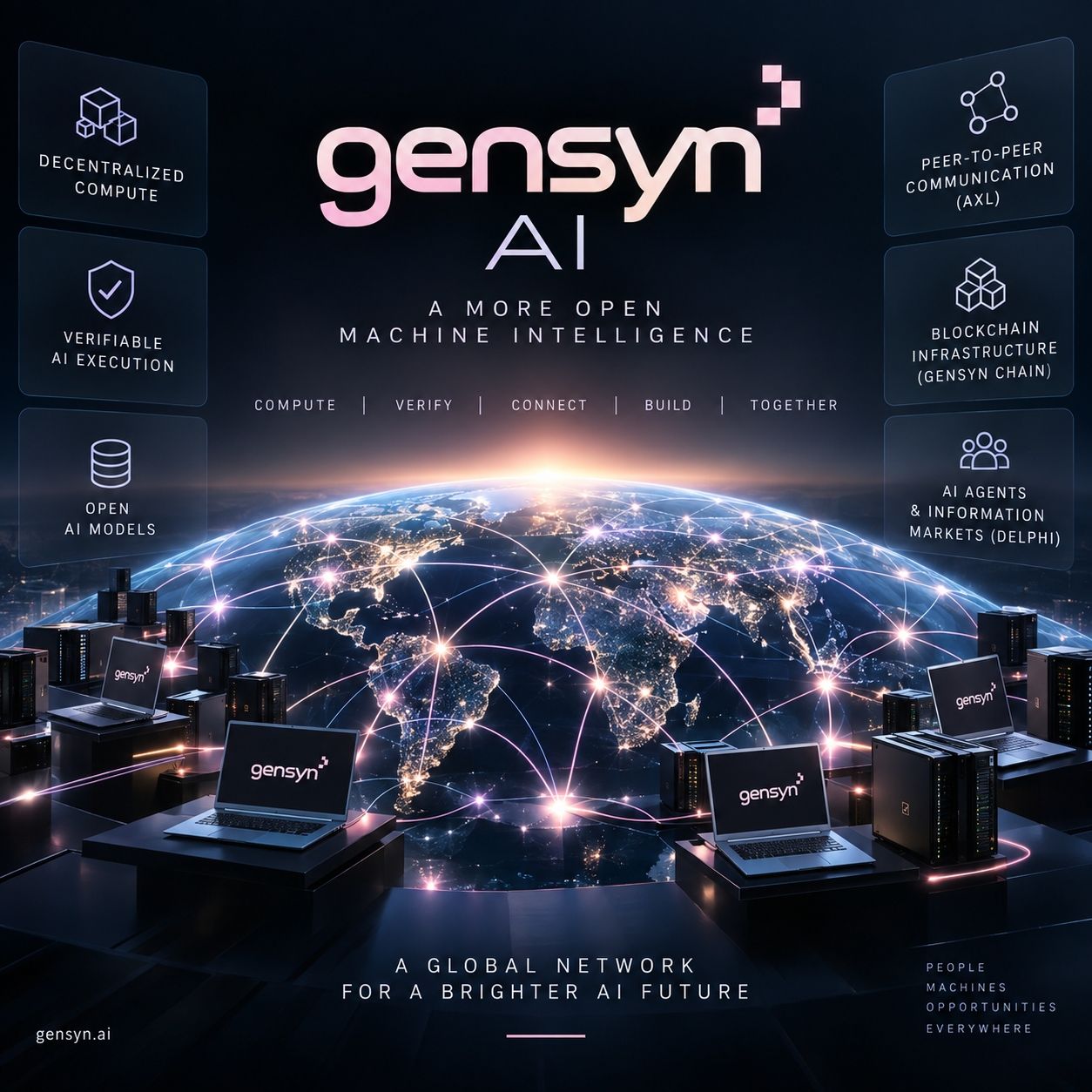
Gensyn AI is building an open infrastructure for machine intelligence, combining decentralized computing, verifiable AI execution, peer-to-peer communication and blockchain-based coordination. Here is how the Gensyn protocol and its $AI token work in 2026.
Updated on September 19, 2026
Gensyn AI has evolved considerably since its first ambition of creating a global marketplace for deep learning computation. The project is now building a much broader infrastructure for decentralized and verifiable machine intelligence.
The objective of the Gensyn protocol is no longer simply to connect unused GPUs. Gensyn is developing an open network where AI models, agents, developers and computing resources can communicate, verify computations, establish on-chain identities and exchange economic value without depending entirely on centralized AI infrastructure.
This puts Gensyn at the intersection of several important sectors: decentralized AI, blockchain infrastructure, machine learning, AI agents and crypto-economic coordination.
The project has also moved beyond the purely experimental stage. Gensyn now has its own EVM-compatible Layer 2 infrastructure, the native $AI token, the Delphi information-market application, its AXL peer-to-peer communication system and the REE reproducible execution environment.
For readers following this emerging market, you can also explore our dedicated AI crypto section, where we analyze projects combining artificial intelligence with blockchain and decentralized infrastructure.
What is Gensyn AI?
Gensyn AI is an open infrastructure network designed to allow machines and humans to coordinate around artificial intelligence without relying entirely on centralized computing providers or AI laboratories.
Its original thesis was relatively straightforward: the world contains an enormous amount of computing capacity, but much of it is fragmented across individual computers, independent GPU operators, data centers and other infrastructure.
If these resources can be connected into one permissionless network, developers could theoretically access a much larger pool of computing power.
However, distributed computing creates another problem: how can a user know that an unknown machine actually performed the requested machine-learning computation correctly?
This verification problem has been at the center of the Gensyn protocol since its early development.
Gensyn’s current architecture therefore goes significantly beyond a decentralized GPU marketplace. It combines communication, identity, reproducible execution, verification and blockchain settlement.
Gensyn in 2026: the project has changed substantially
The original Gensyn documentation frequently described the project as a protocol specifically designed for decentralized deep learning computation.
The current project is broader.
Gensyn now describes itself as an infrastructure layer for machine intelligence capable of supporting compute, data and information exchange.
This distinction is important because the potential market is no longer limited to decentralized deep learning training. The infrastructure could also be used for AI inference, model evaluation, agent communication, information markets and other machine-to-machine applications.
How the Gensyn protocol works
The current Gensyn protocol can be understood through several interconnected layers.
| Component | Function | Why it matters |
|---|---|---|
| AXL | Peer-to-peer communication between machines | Allows AI agents and ML nodes to exchange data without a centralized server |
| Gensyn Chain | Identity, payments, staking and settlement | Provides persistent on-chain identities and economic coordination |
| REE | Reproducible AI execution | Makes independently verifiable AI computation possible |
| Delphi | Decentralized information markets | Demonstrates how Gensyn infrastructure can support a real application |
AXL: peer-to-peer communication for AI
AXL, or Agent eXchange Layer, is the communication layer developed by Gensyn.
One problem with decentralized AI networks is that models and agents still need a reliable mechanism for finding each other and exchanging information.
AXL allows machines to communicate directly through a peer-to-peer architecture instead of routing every interaction through a centralized cloud server.
Models can exchange signals, weights, gradients or structured messages across the network.
Gensyn has also designed AXL to interact with emerging AI communication standards, including MCP and agent-to-agent communication systems.
This component could become particularly relevant if autonomous AI agents become significant economic participants. Those agents will require communication, identity and payment infrastructure that does not depend on a single centralized provider.
The Gensyn Chain: blockchain infrastructure for machines
The blockchain architecture of Gensyn AI has also evolved.
The current Gensyn Chain is an EVM-compatible Layer 2 built using the OP Stack. It provides settlement for payments, stake, reputation and interactions between humans, AI models and agents.
This is an important correction to older descriptions of Gensyn as a simple Layer 1 blockchain for machine-learning computation.
Because the network is EVM compatible, developers can use familiar Ethereum tooling and smart contracts while building AI-native applications.
The blockchain therefore acts primarily as a coordination and settlement layer. Heavy AI computation does not need to be performed directly on-chain.
This architecture is more realistic because training or running large AI models directly inside a blockchain would be prohibitively expensive and inefficient.
REE: why reproducible AI execution matters
One of the most technically interesting components of the Gensyn protocol is the Reproducible Execution Environment, or REE.
AI calculations performed on different GPUs do not necessarily produce perfectly identical results. Differences in hardware architecture, mathematical implementation and execution order can introduce tiny variations.
For conventional centralized AI services, this is usually manageable.
For decentralized AI, however, it becomes a fundamental problem.
If one unknown machine performs an AI task and another machine needs to verify that task, both systems need a reliable way to determine whether the computation was correctly executed.
RepOps and bitwise reproducibility
Gensyn’s approach uses reproducible operators, known as RepOps, designed so that supported machines can independently execute the same operation and obtain bitwise-identical results.
This creates a foundation for trustless verification.
Instead of simply trusting the operator providing the computing resources, another participant can reproduce and verify the execution.
For Gensyn AI, this is potentially more strategically important than simply creating another marketplace for GPUs.
Decentralized compute already exists in several forms. Making AI computation verifiable across heterogeneous hardware is a considerably more difficult technical challenge.
Gensyn open-1b: verifiable AI becomes more concrete
A particularly important development arrived on September 15, 2026, when Gensyn introduced open-1b.
Rather than merely publishing another language model, Gensyn released a model together with cryptographic and reproducible evidence of how it was trained.
Training steps can be fingerprinted, published and independently replayed.
The objective is to allow external participants to verify that a model was actually trained according to the published process.
Why open-1b matters for Gensyn AI
This represents an interesting evolution in the Gensyn AI thesis.
The project originally focused strongly on performing distributed training itself. Gensyn now also emphasizes something potentially easier to deploy at scale: decentralized verification of AI computations.
A model can therefore be trained using concentrated computing infrastructure while independent machines verify that its training history is genuine.
This reduces some of the communication and coordination problems associated with attempting to decentralize every individual training operation.
It also gives Gensyn a clearer technological differentiation from networks whose principal proposition is simply renting decentralized GPU capacity.
IR3DE-AXL and decentralized AI inference
Another recent development illustrates how the project is expanding beyond training.
On September 8, 2026, Gensyn presented IR3DE-AXL, a prototype collective inference network.
The concept allows participants to contribute specialist AI models while also using models provided by other participants.
IR3DE acts as a routing mechanism that identifies which expert model is most appropriate for a particular prompt, while AXL handles direct communication between participating machines.
A network of specialized AI models
This creates an alternative architecture to centralized AI platforms where one company controls the gateway and determines which models users can access.
Within a decentralized model, hundreds or eventually thousands of specialized models could theoretically coexist.
A routing system could select the most relevant model for each task while the network provides communication and settlement.
This remains experimental, but it shows that Gensyn AI is moving toward a broader machine-intelligence network rather than remaining focused exclusively on deep learning training.
RL Swarm and decentralized model training
RL Swarm was one of Gensyn’s most visible experiments.
The system allowed multiple reinforcement-learning agents running on different machines to collaborate over the internet.
Each node could train locally while exchanging information with other participants.
Contributions were connected to on-chain identities, creating a persistent record of participation.
Gensyn-hosted RL Swarms are currently paused, although community-operated swarms can still exist. The experiment nevertheless demonstrated an important element of the original decentralized deep learning training thesis.
It showed that geographically distributed machines could cooperate in a shared machine-learning process rather than requiring every GPU to operate inside the same data center.
Delphi: a real application built on Gensyn AI
Infrastructure projects need applications that demonstrate why the underlying network is useful.
For Gensyn, one of the most important applications is now Delphi.
Delphi allows users to create decentralized information markets whose results can be settled using AI and on-chain mechanisms.
Markets can process information generated by humans and machines while prices evolve according to participants’ positions.
The broader Gensyn thesis is that markets themselves can eventually become a feedback mechanism for AI systems.
Markets as an AI learning mechanism
If an AI model makes accurate predictions, it can potentially earn economic rewards.
If its outputs are poor, it can lose economic value.
This creates an objective feedback mechanism that could be used to improve machine intelligence over time.
The concept is significantly more ambitious than a conventional crypto prediction market because Gensyn sees these markets as infrastructure through which machines can obtain information, assess uncertainty and improve their outputs.
The $AI token and the Gensyn crypto economy
The introduction of the $AI token transforms Gensyn from a purely technological decentralized AI project into a genuine AI crypto ecosystem.
$AI is the native asset of the Gensyn network.
| $AI token characteristic | Current specification |
|---|---|
| Token | $AI |
| Total supply | 10 billion $AI |
| Network | Gensyn EVM Layer 2 |
| Initial distribution | April 2026 |
| Main utilities | Staking, verification, payments and governance |
$AI token allocation
The official allocation currently distributes the 10 billion $AI supply as follows:
| Allocation | Share | Approximate tokens |
|---|---|---|
| Community Treasury | 40.4% | 4.04 billion |
| Investors | 29.6% | 2.96 billion |
| Team | 25% | 2.50 billion |
| Community Sale | 3% | 300 million |
| Testnet Rewards | 2% | 200 million |
The allocation deserves attention from investors because the combined team and investor share represents 54.6% of the maximum supply.
Those tokens are subject to lockups and progressive unlocking schedules, but future circulating supply remains an important metric to monitor.
How the $AI buy-and-burn mechanism works
One particularly interesting element of the Gensyn crypto model is the attempt to connect actual network activity with the $AI token.
According to the Gensyn Foundation documentation, on-chain revenues generated by Gensyn products can be accumulated by a protocol-controlled vault.
USDC revenues can then be exchanged for $AI through a permissionless buyback mechanism.
The purchased tokens are currently distributed as follows:
- 70% are permanently burned;
- 29% return to the Community Treasury;
- 1% rewards the address executing the buyback.
This mechanism is notable because many AI crypto projects have tokens whose economic relationship with the underlying product remains weak.
Gensyn is attempting to create a direct connection between protocol usage, revenues and token supply.
That does not guarantee appreciation of the $AI token. The effect will ultimately depend on the scale of revenue, token emissions, unlocks, market valuation and demand for the network.
Why Gensyn belongs in the AI crypto sector
Not every project using the word “AI” should automatically be considered a serious AI infrastructure project.
Gensyn AI has a clearer connection between blockchain and artificial intelligence than many speculative AI tokens.
The blockchain component is used for coordination, economic incentives, identity and settlement, while the artificial-intelligence infrastructure handles execution, communication and verification.
This places Gensyn alongside the infrastructure segment of the AI crypto market rather than among projects whose principal utility is an AI chatbot or marketing narrative.
Where Gensyn differs from decentralized GPU networks
Projects such as decentralized GPU marketplaces primarily attempt to match users requiring computing resources with operators possessing GPUs.
Gensyn’s proposition is broader.
Compute remains relevant, but the Gensyn protocol is increasingly focused on the infrastructure required for machines to interact reliably:
- verifiable AI execution;
- peer-to-peer model and agent communication;
- persistent machine identity;
- blockchain-based payments and staking;
- open information markets;
- distributed inference;
- collaborative model training.
This makes the project technically ambitious, but also considerably harder to execute.
Gensyn AI: a credible opportunity, but not a guaranteed one
Gensyn has several characteristics that make it worth monitoring within the decentralized AI sector.
Unlike many early-stage AI crypto projects, it now combines research publications, open-source software, working applications, blockchain infrastructure and a defined token economy.
Recent releases such as REE, AXL, IR3DE-AXL and open-1b also provide tangible evidence of ongoing technical development.
Potential catalysts
- Growing demand for verifiable AI computation;
- adoption of decentralized AI agents;
- greater usage of Delphi and other Gensyn applications;
- growth of machine-to-machine payments;
- expansion of decentralized inference networks;
- integration of AXL into third-party applications;
- increasing revenue flowing through the $AI buy-and-burn mechanism.
Main risks
The project nevertheless faces considerable execution risk.
- Technical complexity: decentralized machine learning remains substantially more difficult than conventional blockchain computation.
- Competition: centralized hyperscalers and specialized AI infrastructure companies have enormous financial and technological resources.
- Network adoption: impressive technology does not automatically create sufficient developers, applications or paying users.
- Token dilution: investors and the team control a substantial percentage of the maximum $AI supply, with future unlocks to monitor.
- Revenue scale: the token buyback mechanism only becomes economically meaningful if applications generate significant recurring activity.
- Rapid technological change: AI infrastructure evolves so quickly that today’s architecture can be challenged by new approaches within a relatively short period.
What should investors monitor?
For anyone assessing Gensyn AI as an AI crypto investment rather than simply as a technical project, several indicators are more useful than social-media activity.
Actual Gensyn network usage
The number of active applications, machines, agents and developers using the infrastructure will be crucial.
Protocol revenue
The buy-and-burn mechanism makes revenue particularly important. Increasing protocol fees could create measurable demand for $AI, whereas a network generating very little economic activity would make the mechanism far less significant.
$AI circulating supply
Investors should monitor token unlocks rather than looking only at maximum supply or market capitalization.
Adoption of REE and AXL
Third-party adoption would strengthen the argument that Gensyn is building general-purpose decentralized AI infrastructure rather than technology used only inside its own ecosystem.
Development beyond Delphi
Delphi provides an initial use case, but the long-term thesis becomes much stronger if independent developers build new applications using the Gensyn protocol.
Interested in AI + blockchain projects?
Gensyn is part of a much broader sector combining decentralized computing, AI models, data infrastructure and crypto-economic incentives. Discover the other projects we follow in our AI crypto section.
FAQ – Gensyn AI and the Gensyn protocol
What is Gensyn AI?
Gensyn AI is an open infrastructure network designed for decentralized machine intelligence. It combines peer-to-peer communication, verifiable AI execution, blockchain identity, payments and economic coordination.
What is the Gensyn protocol?
The Gensyn protocol provides infrastructure allowing humans, AI models and autonomous agents to interact through an open network. Its architecture combines the Gensyn Chain, AXL communication infrastructure and reproducible AI execution technologies such as REE.
Is Gensyn still focused on deep learning training?
Yes, distributed and decentralized deep learning training remains part of the technological foundation, but Gensyn has expanded considerably. Its current ecosystem also addresses AI inference, verification, agent communication, information markets, identity and blockchain settlement.
Does Gensyn have a crypto token?
Yes. $AI is the native token of the Gensyn network. The official maximum supply is 10 billion tokens. Its functions include staking, verification, payments and progressively introduced governance.
What makes Gensyn different from a decentralized GPU marketplace?
A GPU marketplace primarily connects computing demand with available hardware. Gensyn AI also attempts to solve verification, communication, identity, payments and coordination between independent machines, models and agents.
What is Gensyn REE?
REE stands for Reproducible Execution Environment. It is designed to allow supported hardware to reproduce AI computations consistently, helping independent participants verify that machine-learning tasks were performed correctly.
What is AXL?
AXL is Gensyn’s peer-to-peer communication layer. It allows AI agents, models and machine-learning applications to communicate directly between machines without requiring a centralized communication server.
Is Gensyn an AI crypto project?
Yes. The combination of decentralized artificial-intelligence infrastructure, blockchain settlement and the native $AI token places Gensyn directly within the AI crypto infrastructure sector.
Conclusion: Gensyn is becoming much more than a decentralized compute project
The original vision behind Gensyn was already ambitious: connect distributed computing resources and make decentralized machine-learning computation economically viable.
In 2026, the project has moved considerably further.
Gensyn AI is now building infrastructure for verifiable execution, decentralized communication, AI agents, information markets, machine identity and economic settlement.
The introduction of the $AI token also gives the ecosystem a clearly defined crypto-economic layer, including staking, payments, governance and a revenue-linked buy-and-burn mechanism.
Projects such as open-1b, REE, AXL and IR3DE-AXL provide concrete technological developments to follow rather than relying solely on a future roadmap.
The challenge remains enormous. Gensyn must demonstrate that decentralized infrastructure can offer enough technical and economic advantages to compete with highly optimized centralized AI systems.
For that reason, the most important indicators are not the AI narrative or the price of the $AI token alone. Network usage, developer adoption, protocol revenue, token unlocks and real demand for verifiable machine intelligence will determine whether the Gensyn protocol becomes significant infrastructure for decentralized AI.
Suggested reading – Render Network and decentralized AI infrastructure
Gensyn is not the only project exploring decentralized computing for artificial intelligence.
Discover how Render Network is using distributed GPU resources and why AI could become an important part of its future growth.
Crypto assets and early-stage decentralized AI projects involve substantial risk. This article is provided for informational purposes and does not constitute investment advice.


Trader, investor and author specializing in cryptocurrencies, DeFi and Web3.
On Mediasnet, I share my market analysis, practical guides and research on crypto markets, decentralized protocols and emerging trends across the ecosystem.
Follow me on: Facebook – X (Twitter)