
Decentralized Bitcoin Trading: How to Trade BTC in DeFi
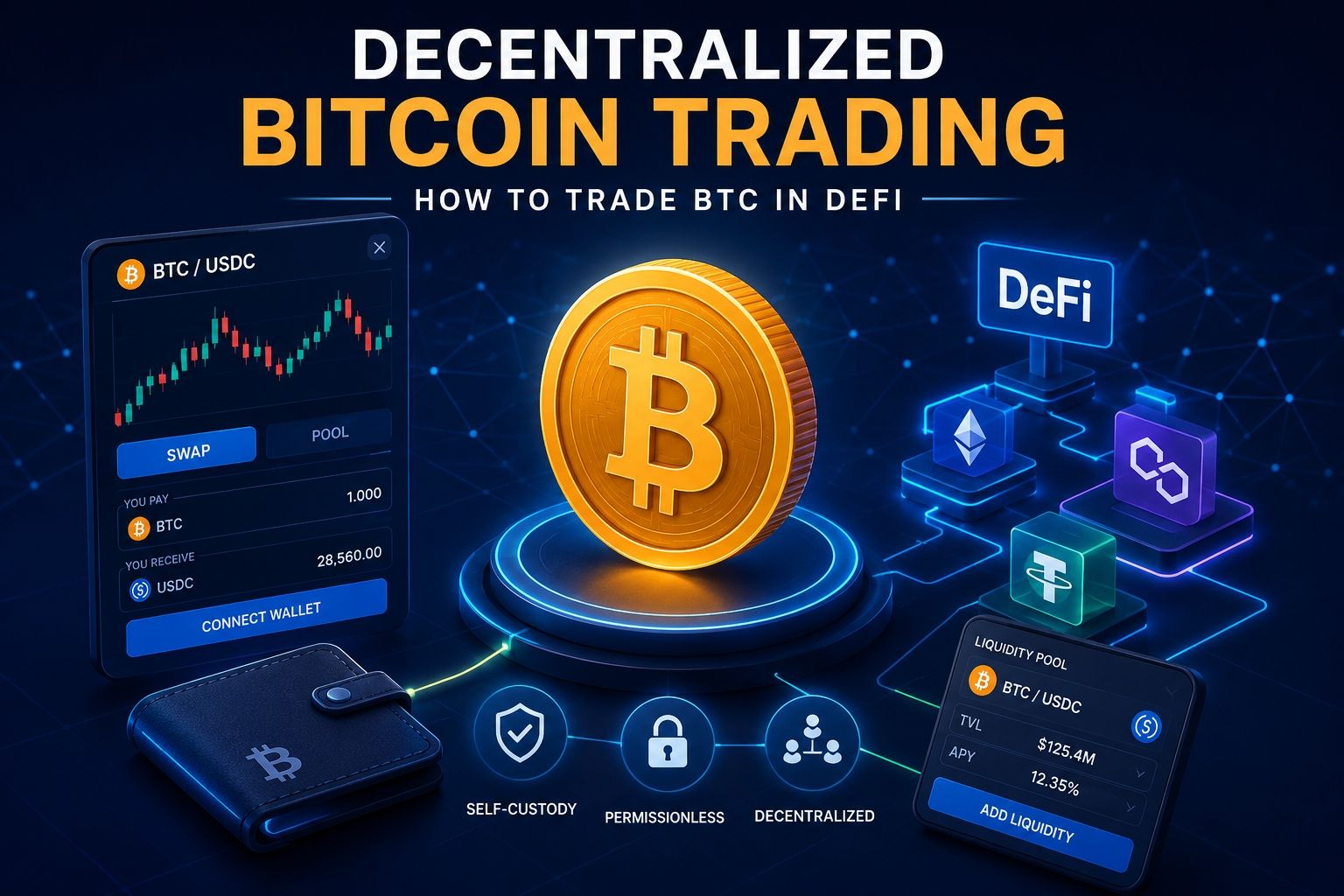
Decentralized Bitcoin Trading is becoming an increasingly important topic for crypto investors who want exposure to BTC without relying entirely on centralized exchanges. For years, Bitcoin was mainly traded through platforms such as Binance, Coinbase, Kraken or other centralized services. These exchanges remain widely used, but they also require users to trust a third party with custody, liquidity, execution and account access.
DeFi changes this model. Instead of depositing Bitcoin on a centralized exchange, users can trade BTC or Bitcoin-backed assets through decentralized protocols, liquidity pools, wallets and cross-chain infrastructures. This opens the door to a more self-custodial way of trading Bitcoin, where users remain closer to the original crypto principle: not your keys, not your coins.
However, decentralized Bitcoin trading is not as simple as trading ETH or stablecoins on Ethereum. Bitcoin was not originally designed for smart contracts in the same way as Ethereum, Solana or other DeFi-oriented blockchains. As a result, trading BTC in DeFi usually requires one of three approaches: native cross-chain swaps, wrapped Bitcoin assets, or Bitcoin DeFi infrastructure.
However, decentralized Bitcoin trading is not as simple as trading ETH or stablecoins on Ethereum. Bitcoin was not originally designed for smart contracts in the same way as Ethereum, Solana or other DeFi-oriented blockchains. As a result, trading BTC in DeFi usually requires one of three approaches: native cross-chain swaps, wrapped Bitcoin assets, or Bitcoin DeFi infrastructure.
Before Trading BTC in DeFi, Check the Bitcoin Market Structure
Decentralized Bitcoin trading can offer more control and self-custody, but it does not remove market risk.
Before using BTC in DeFi, it is important to understand the current Bitcoin trend, key support levels, resistance zones
and possible short-term scenarios. You can read our latest

Bitcoin price analysis
to better evaluate the market context before making any trading decision.
What Is Decentralized Bitcoin Trading?
Decentralized Bitcoin Trading refers to the process of buying, selling or swapping Bitcoin without using a traditional centralized exchange as the main intermediary. Instead of placing an order on a company-controlled platform, users interact with decentralized protocols, wallets, liquidity pools or cross-chain networks.
The goal is simple: trade Bitcoin while keeping more control over custody and execution. In practice, this can take several forms. Some users swap native BTC directly through cross-chain protocols. Others use wrapped Bitcoin, such as WBTC, on Ethereum or other smart contract networks. More advanced users may interact with Bitcoin DeFi protocols, BTC-backed synthetic assets or emerging Bitcoin Layer 2 ecosystems.
This approach is especially relevant for users who care about self-custody, transparency and censorship resistance. It can also be useful for investors who want to use Bitcoin inside DeFi strategies, such as lending, collateralized borrowing, liquidity provision or on-chain portfolio management.
Why Trade Bitcoin in DeFi?
There are several reasons why traders are increasingly interested in decentralized Bitcoin trading.
1. Self-custody
The biggest advantage is custody. On a centralized exchange, users deposit their BTC and trust the platform to manage withdrawals, solvency and security. In DeFi, users can often keep control of their own wallet and sign transactions directly.
This does not remove all risks, but it changes the nature of the risk. Instead of trusting a centralized company, users must understand smart contract risk, bridge risk, liquidity risk and wallet security.
2. Access to DeFi liquidity
Bitcoin is the largest crypto asset by market value, but much of DeFi was built outside the Bitcoin base layer. By using wrapped BTC, cross-chain swaps or BTCFi protocols, Bitcoin holders can access decentralized liquidity pools, lending markets and on-chain trading opportunities.
This allows BTC to become more than a passive asset. It can be used as collateral, traded against stablecoins, swapped into other assets or integrated into more advanced DeFi strategies.
3. No traditional exchange account required
Decentralized trading can be useful for users who do not want to depend entirely on an exchange account. A wallet can interact directly with a protocol, which may reduce reliance on account approvals, withdrawal limits or exchange downtime.
However, users should always respect their local laws and understand that decentralized access does not mean risk-free access.
4. Better alignment with Bitcoin’s philosophy
Bitcoin was created as a peer-to-peer monetary network. Many long-term Bitcoin users prefer systems that reduce reliance on centralized intermediaries. Decentralized trading is not perfect, but it is more aligned with the idea of financial sovereignty than leaving BTC on a centralized platform.
The Main Ways to Trade Bitcoin in DeFi
1. Native BTC swaps through cross-chain protocols
The most direct form of decentralized Bitcoin trading is native BTC swapping. In this model, users can swap BTC with other assets without wrapping Bitcoin first. Protocols such as THORChain are designed to support native cross-chain swaps between Bitcoin and other assets.
This is one of the most interesting models because it avoids some of the risks linked to wrapped assets. Instead of converting BTC into a tokenized version on another chain, users trade native assets across chains through decentralized liquidity infrastructure.
The advantage is clear: users can move between BTC, ETH, stablecoins or other supported assets without relying on a centralized exchange. The downside is that cross-chain liquidity, fees, slippage and protocol-specific risks still need to be carefully monitored.
2. Wrapped Bitcoin on Ethereum and other chains
The most common way to use Bitcoin in DeFi is through wrapped BTC assets. The best-known example is WBTC, an ERC-20 token designed to represent Bitcoin on Ethereum and other networks.
Wrapped Bitcoin allows BTC liquidity to enter smart contract ecosystems. Once users hold WBTC, they can trade it on decentralized exchanges, use it as collateral, provide liquidity or interact with DeFi protocols.
This model is powerful because Ethereum and other smart contract chains already have deep DeFi infrastructure. The trade-off is trust. Wrapped assets usually depend on custodians, bridges or minting mechanisms. Users must understand how the wrapped asset is backed, who controls reserves, and what happens if the bridge or custodian fails.
3. Trust-minimized Bitcoin bridges such as tBTC
Another approach is to use more decentralized Bitcoin bridge systems. tBTC, built around Threshold Network infrastructure, is designed to bring Bitcoin into DeFi with a more decentralized and permissionless model than traditional custodian-based wrapping.
The idea is to reduce reliance on a single centralized custodian by using distributed cryptographic infrastructure. This can make Bitcoin more usable in DeFi while remaining closer to the values of decentralization.
However, trust-minimized does not mean risk-free. Users still need to understand bridge mechanics, smart contract risk, redemption conditions and liquidity availability.
4. Bitcoin Layer 2 and BTCFi ecosystems
A growing part of the market is now focused on BTCFi, or Bitcoin DeFi. This includes Bitcoin Layer 2 networks, sidechains, rollup-style systems, collateral protocols and applications that aim to bring more financial utility to BTC.
These ecosystems are still evolving, but the long-term direction is clear: more developers want to make Bitcoin usable in lending, trading, yield, stablecoins and decentralized markets.
For traders, this could eventually create more native Bitcoin-based DeFi opportunities. But many BTCFi projects remain young, and users should be especially careful with security assumptions, liquidity depth and protocol maturity.
How to Trade Bitcoin in DeFi Step by Step

Step 1: Choose your trading method
The first decision is whether you want to trade native BTC or a Bitcoin-backed asset.
- Native BTC swaps: useful if you want to avoid wrapped assets.
- WBTC or similar assets: useful if you want access to Ethereum DeFi liquidity.
- tBTC or decentralized bridges: useful if you prefer a more trust-minimized Bitcoin bridge.
- BTCFi protocols: useful for advanced users exploring Bitcoin-based DeFi ecosystems.
There is no perfect option. Each method has different trade-offs between liquidity, decentralization, cost, speed and risk.
Step 2: Use a secure wallet
Decentralized Bitcoin trading requires strong wallet security. Users should never connect unknown wallets to random protocols. For larger amounts, using a hardware wallet is usually safer than relying only on a browser wallet.
Before signing any transaction, users should check the protocol URL, verify transaction details and avoid suspicious approvals. Many losses in DeFi come not from market movements, but from phishing, fake interfaces and malicious permissions.
Step 3: Check liquidity and slippage
Liquidity is critical. A decentralized swap can be technically possible but still expensive if liquidity is thin. Before trading BTC in DeFi, users should check slippage, route quality, fees and expected execution price.
This is especially important for larger trades. A small BTC swap may execute smoothly, while a larger swap can move the market or suffer from poor pricing.
Step 4: Understand the asset you are using
Not all Bitcoin-backed assets are equal. WBTC, tBTC and other BTC representations may all track Bitcoin’s price, but they do not have the same trust model.
Before using any BTC-backed token, traders should ask:
- Is the asset backed 1:1 by BTC?
- Who controls the reserves?
- Can users redeem it for native BTC?
- What smart contracts or bridges are involved?
- How deep is the liquidity?
This is one of the most important parts of decentralized Bitcoin trading. The price may look like BTC, but the risk profile can be very different.
Step 5: Manage risk before chasing returns
DeFi offers opportunities, but it also increases complexity. Users should avoid putting all their BTC into one protocol, one bridge or one liquidity pool. Diversification, position sizing and conservative risk management are essential.
Bitcoin itself is volatile. DeFi adds additional layers of risk. Combining both without a clear plan can be dangerous.
Advantages of Decentralized Bitcoin Trading
- Greater control: users can trade directly from their own wallets.
- Reduced exchange dependency: fewer risks linked to centralized withdrawal freezes or exchange failures.
- DeFi access: BTC can be used in lending, swaps, liquidity pools and collateral markets.
- Transparency: many DeFi transactions and pools can be monitored on-chain.
- Global accessibility: users can interact with protocols without relying on a traditional exchange interface.
Main Risks of Decentralized Bitcoin Trading
Smart contract risk
Every DeFi protocol depends on code. Even audited protocols can contain bugs or vulnerabilities. A smart contract exploit can lead to major losses.
Bridge risk
Bridges are one of the most sensitive parts of crypto infrastructure. When Bitcoin is moved into another ecosystem, users must understand the mechanism that secures the bridge or wrapped asset.
Liquidity risk
Some decentralized markets do not have enough liquidity for large BTC trades. Low liquidity can cause high slippage and poor execution.
Custody and key management risk
Self-custody gives users more control, but it also gives them more responsibility. Losing a seed phrase, signing a malicious transaction or using a compromised wallet can result in permanent loss.
Regulatory risk
DeFi regulation is still evolving. Users should understand the legal and tax implications of trading crypto in their own jurisdiction.
Decentralized Bitcoin Trading vs Centralized Exchanges
Centralized exchanges are usually easier to use. They often provide order books, advanced charting tools, fiat ramps, customer support and deep liquidity. For beginners, they may still be more convenient.
Decentralized Bitcoin trading is different. It gives users more control, but it also requires more knowledge. There is no customer support team that can reverse a bad transaction. There is no password reset if the wallet is lost. There is no guarantee that a DeFi protocol will remain secure forever.
The choice depends on the user’s profile. Active traders who need speed, leverage and deep order books may still prefer centralized exchanges. Long-term Bitcoin holders who want self-custody and occasional swaps may prefer decentralized options. Advanced DeFi users may combine both approaches.
Best Practices for Trading BTC in DeFi
- Start with small test transactions before moving larger amounts.
- Use official protocol links and avoid sponsored phishing pages.
- Check slippage and fees before confirming a swap.
- Understand whether you are trading native BTC or wrapped BTC.
- Use a hardware wallet for larger balances.
- Avoid unknown bridges and unaudited protocols.
- Do not chase unrealistic yields on Bitcoin deposits.
- Keep part of your BTC in cold storage if you are a long-term holder.
Is Decentralized Bitcoin Trading the Future?
Decentralized Bitcoin trading is still early compared with centralized BTC trading. Most Bitcoin volume still happens on large exchanges, ETFs, institutional platforms and OTC desks. However, the DeFi side of Bitcoin is growing because users want more ways to use BTC without giving up control.
The development of native cross-chain swaps, wrapped Bitcoin assets, trust-minimized bridges and BTCFi ecosystems suggests that Bitcoin will become increasingly connected to decentralized finance.
This does not mean every user should immediately move their BTC into DeFi. In fact, caution is essential. But it does mean that Bitcoin is no longer limited to simply being held in cold storage or traded on centralized exchanges. It can now participate in a broader on-chain financial system.
Conclusion: Decentralized Bitcoin Trading Gives BTC More Utility
Decentralized Bitcoin Trading allows users to trade BTC in a more open, self-custodial and DeFi-native way. Instead of relying entirely on centralized platforms, traders can use native swaps, wrapped Bitcoin, trust-minimized bridges and emerging BTCFi protocols.
The opportunity is clear: Bitcoin can become more liquid, more programmable and more useful across DeFi. But the risks are equally real. Smart contracts, bridges, wrapped assets, liquidity pools and wallet security all require serious attention.
For beginners, the best approach is to start small, understand the tools and avoid complex strategies. For experienced users, decentralized Bitcoin trading can become a powerful way to combine BTC exposure with DeFi flexibility.
Ultimately, the future of Bitcoin trading may not be purely centralized or purely decentralized. It will likely be hybrid. Centralized exchanges will continue to serve many users, while decentralized protocols will attract those who value self-custody, transparency and financial sovereignty.
FAQ: Decentralized Bitcoin Trading
What is Decentralized Bitcoin Trading?
Decentralized Bitcoin Trading means trading BTC or Bitcoin-backed assets through decentralized protocols, wallets, liquidity pools or cross-chain systems instead of relying entirely on centralized exchanges.
Can Bitcoin be traded directly in DeFi?
Yes, but it depends on the infrastructure used. Some protocols support native BTC swaps, while others require wrapped Bitcoin assets such as WBTC or trust-minimized bridge assets such as tBTC.
Is WBTC the same as Bitcoin?
WBTC is not native Bitcoin. It is a tokenized version of Bitcoin designed for smart contract networks. It usually tracks BTC’s price, but it has a different trust and custody model.
Is decentralized Bitcoin trading safe?
It can be useful, but it is not risk-free. Users must understand smart contract risk, bridge risk, liquidity risk, wallet security and the mechanics of the BTC-backed asset they are using.
What is the best way to trade Bitcoin in DeFi?
There is no single best method. Native cross-chain swaps may suit users who want to avoid wrapped assets, while WBTC or tBTC may suit users who want access to Ethereum-based DeFi liquidity.
Can I earn yield with Bitcoin in DeFi?
Yes, some DeFi protocols allow users to lend BTC-backed assets, provide liquidity or use BTC as collateral. However, higher yield usually comes with higher risk, especially when bridges or smart contracts are involved.
This article is not financial advice. It is an educational guide to help readers better understand Decentralized Bitcoin Trading and the risks involved. Before making any trading decision, always review the broader Bitcoin market context and never invest or trade more than you can afford to lose.


Thortrading brings together two cryptocurrency traders with around five years of active market experience. Their work focuses on Bitcoin, altcoins, DeFi and crypto market trends, with an approach based on technical analysis, market cycles and risk management. Through their articles, they aim to help readers better understand both the opportunities and risks of crypto trading
6 thoughts on “Decentralized Bitcoin trading, How to Trade BTC in DeFi”
Comments are closed.