
Dogecoin in 2026: Is DOGE Still Just a Meme or a Real Crypto Asset?
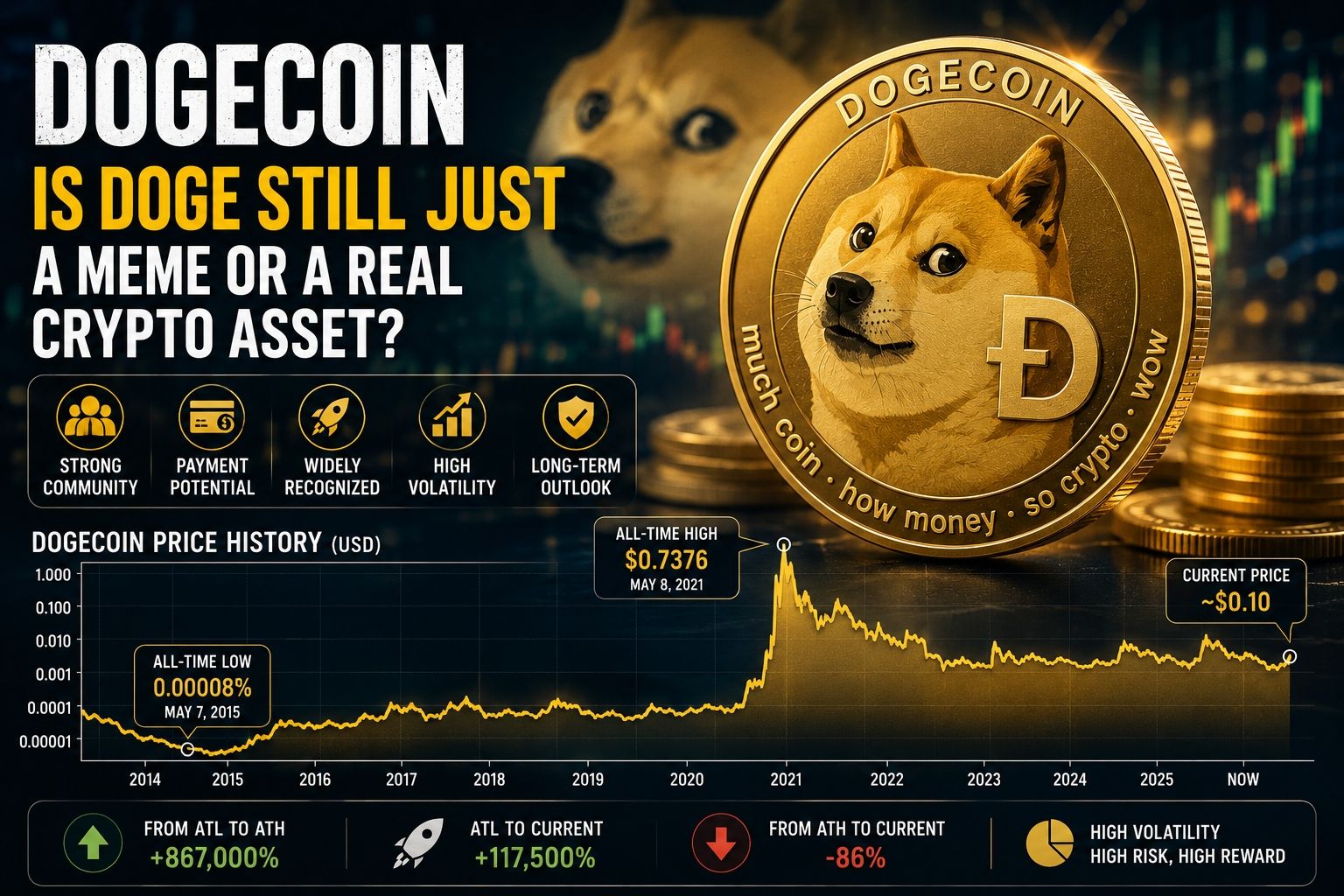
Dogecoin, often known by its ticker DOGE, remains one of the most recognizable cryptocurrencies in the world. Created as a joke in 2013, it has survived multiple market cycles, brutal bear markets, speculative bubbles and endless criticism from analysts who believed it would eventually disappear.
Yet more than a decade later, DOGE is still here. It remains one of the most traded meme coins, one of the strongest crypto brands, and one of the few digital assets that can still move markets simply through social media attention, community enthusiasm or speculation around payments.
For anyone following the latest crypto news, Dogecoin remains a fascinating case: an asset born from internet culture that still manages to influence market sentiment more than a decade after its launch.
This is what makes Dogecoin so unusual. It is not the most technologically advanced blockchain. It does not dominate decentralized finance. It does not offer the same smart contract ecosystem as Ethereum, Solana or other major networks. But it has something many crypto projects never manage to build: cultural relevance, liquidity, simplicity and a community that refuses to let it fade away.
So the real question in 2026 is no longer whether Dogecoin started as a joke. Everyone knows it did. The real question is whether DOGE can continue evolving from a meme coin into a more serious crypto asset with real market relevance.
Dogecoin, the Meme Coin That Refuses to Disappear
Dogecoin was launched in December 2013 by software engineers Billy Markus and Jackson Palmer. At the time, the crypto market was still young, highly experimental and often extremely technical. Bitcoin was already gaining attention, but the industry was still mostly dominated by developers, early adopters and online communities.
Instead of creating another serious Bitcoin alternative, the founders built something intentionally absurd: a cryptocurrency inspired by the famous Doge meme, featuring a Shiba Inu dog and a humorous internet culture. The idea was not to compete with Bitcoin as digital gold, but to make crypto more accessible, fun and less intimidating.
Ironically, that unserious origin became one of its greatest strengths. While thousands of more ambitious crypto projects disappeared, Dogecoin built a loyal community around humor, tipping, donations and online engagement. The project was never only about technology. It became a social phenomenon.
That cultural dimension still matters today. In crypto, narratives can be as powerful as fundamentals, especially during speculative phases. DOGE is proof that a strong brand and a committed community can sometimes keep an asset relevant for far longer than traditional financial logic would suggest.
Why DOGE Still Matters in the Crypto Market
There are many meme coins today, but Dogecoin remains different from most of them. It is the original meme coin, and that gives it a historical position that newer competitors cannot easily replicate.
Most meme coins depend almost entirely on short-term hype. They rise quickly, attract retail attention, and then often collapse when liquidity moves elsewhere. DOGE is also speculative, but it has shown unusual resilience across several cycles. Its brand is instantly recognizable, its ticker is widely known, and its market liquidity remains much deeper than that of most meme tokens.
This liquidity matters. For traders, DOGE often acts as a high-beta crypto asset. When market sentiment improves, it can move faster than more conservative assets. When retail speculation returns, it is often one of the first meme coins investors start watching again.
However, this does not make Dogecoin safe. It simply means that it occupies a special position in the market. It is not just another short-lived meme token. It is a highly speculative asset with one of the strongest communities in crypto history.
From Internet Joke to Multi-Billion-Dollar Crypto Asset
The rise of Dogecoin is one of the most surprising stories in digital assets. For years, DOGE traded at fractions of a cent and was mostly used for tipping, community rewards and fun online transactions. It was not seen as a serious investment by most of the financial world.
That changed dramatically during the 2021 crypto bull market. Dogecoin became one of the symbols of retail speculation, social media trading and meme-driven investing. Its price exploded, driven by a combination of market liquidity, viral attention, online communities and repeated public comments from Elon Musk.
The 2021 rally pushed DOGE into mainstream financial headlines. Suddenly, a cryptocurrency originally created as a joke had become a multi-billion-dollar asset. This created both opportunity and controversy.
Supporters saw Dogecoin as a people’s cryptocurrency: simple, fun, fast enough for small payments and backed by a loyal global community. Critics argued that the rally was mostly speculative and disconnected from real utility. Both views contain part of the truth.
DOGE showed that crypto markets are not only driven by technology. They are also driven by attention, culture, liquidity and belief. But the same forces that can push a meme coin higher can also make it extremely volatile when sentiment turns negative.
The Elon Musk and X Payment Narrative
No discussion of Dogecoin is complete without mentioning Elon Musk. His public comments, memes and repeated references to DOGE have played a major role in shaping the asset’s image.
For years, speculation has surrounded the possibility that Dogecoin could be integrated into X, formerly Twitter, as part of a broader payment system. This narrative has not fully materialized in the way some investors expected, but it continues to influence market sentiment.
The reason is simple: if DOGE were ever integrated into a major social or payment platform, it would immediately strengthen the argument that the asset has real-world utility beyond speculation. Even the possibility of such an integration is enough to attract attention from traders.
However, investors should separate speculation from confirmation. A narrative can move prices in the short term, but long-term value depends on actual adoption. If Dogecoin remains mostly dependent on hints, rumors and social media excitement, its price will likely remain highly unstable.
That said, the Musk-related narrative is still part of the asset’s identity. It keeps DOGE visible, especially among retail investors. Visibility alone is not a complete investment thesis, but in the crypto market, it can be a powerful driver during periods of renewed risk appetite.
Dogecoin as a Payment Coin: Real Use Case or Marketing Story?
One of the strongest arguments in favor of Dogecoin is its simplicity. Unlike many crypto projects focused on complex DeFi ecosystems, artificial intelligence narratives or tokenized finance, DOGE is easy to understand. It is a digital currency designed for simple transactions.
Its low unit price, strong brand recognition and community-driven culture make it attractive for tipping, small transfers and online payments. This was part of its original appeal, and it remains one of the few practical narratives around the asset.
In recent years, there have also been renewed attempts to position the token as a payment-focused crypto. Initiatives linked to its ecosystem, including projects around payments and self-custodial wallets, suggest that some developers and organizations want to move it beyond pure speculation.
This is important because the original meme coin needs more than nostalgia to remain relevant over the long term. If it becomes easier to use for payments, merchants, communities and simple wallet transfers, its utility narrative becomes stronger.
Still, there are challenges. Crypto payments remain a difficult market. Many users prefer stablecoins for transactions because they avoid volatility. Bitcoin has a stronger store-of-value narrative, while Ethereum and Solana dominate more advanced on-chain activity. This asset must therefore prove that its simplicity and culture are enough to create meaningful adoption.
The DOGE ETF: A Symbolic Step Toward Institutional Recognition
One of the most important developments for Dogecoin was the launch of a U.S.-listed ETF offering exposure to DOGE. This was a symbolic moment for the meme coin sector because it showed that even assets born from internet culture can enter regulated financial products.
The ETF does not change the project’s fundamentals overnight. It does not automatically make the asset less volatile, nor does it guarantee long-term demand. But it does make DOGE more accessible to certain investors who prefer traditional brokerage accounts rather than direct crypto custody.
This matters because crypto ETFs have become an important bridge between digital assets and traditional finance. Bitcoin and Ethereum ETFs helped normalize institutional access to crypto. A DOGE-related ETF shows how far the market has evolved since the early days when meme coins were dismissed as pure jokes.
However, this development should be interpreted carefully. Institutional access does not automatically mean institutional conviction. Some products exist because there is demand for speculation, not because the underlying asset has strong fundamentals. For the original meme coin, the ETF is a major sign of market recognition, but not a guarantee of future performance.
Dogecoin Price History: What It Tells Investors
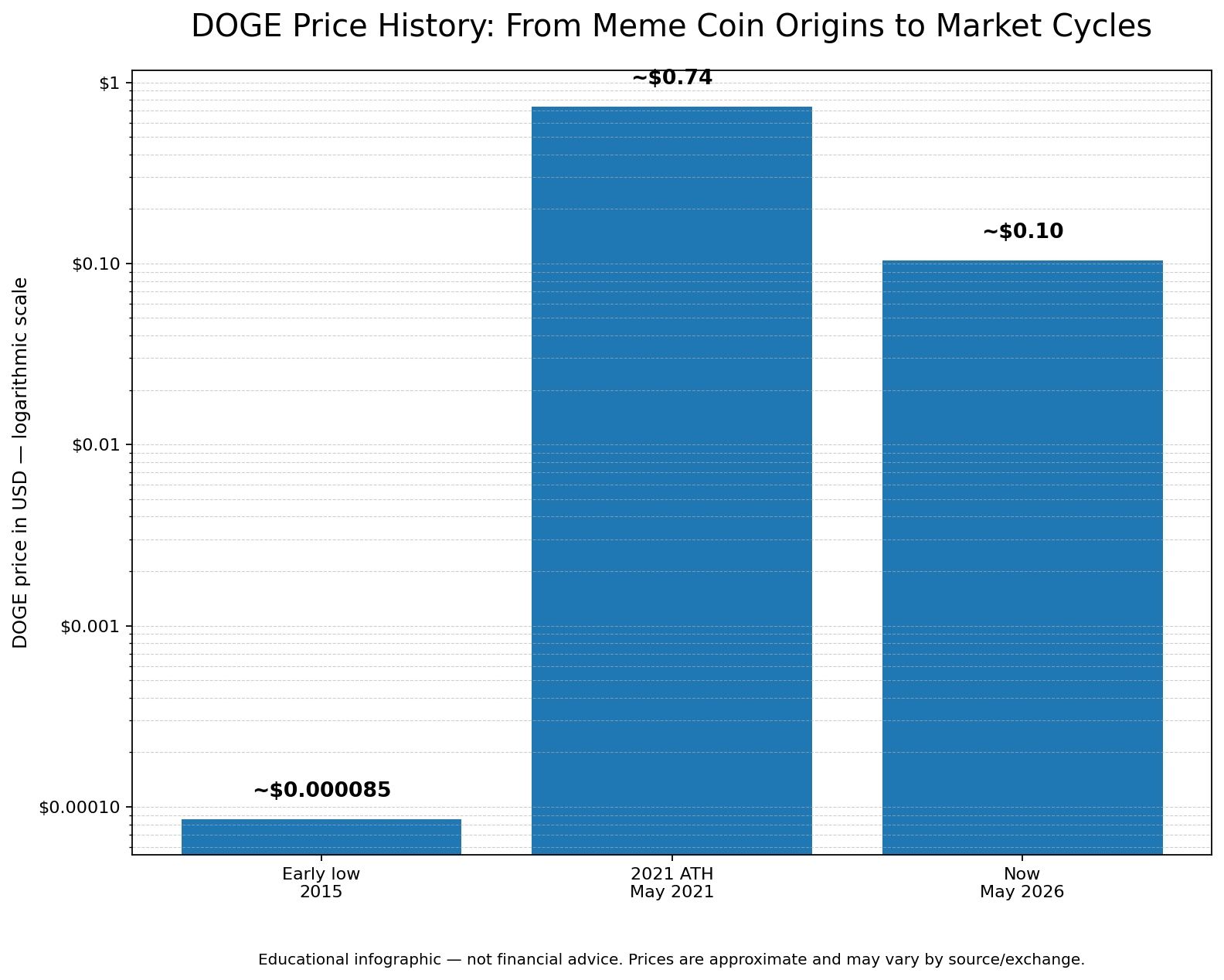
The price history of Dogecoin is a lesson in crypto volatility. For many years, DOGE was almost invisible to mainstream investors. Then, during the 2021 bull market, it became one of the most explosive assets in the entire market.
That rise created enormous gains for early holders, but it also attracted late buyers near the top. Like many speculative assets, the token corrected sharply after the hype faded. This pattern is important for investors to understand.
The meme coin tends to perform best when market liquidity is strong, retail speculation is high and meme narratives are trending. It tends to struggle when the market becomes more risk-averse, when Bitcoin dominance rises, or when investors rotate toward assets with stronger fundamentals.
This does not mean the asset cannot rally again. It means that its performance is heavily linked to sentiment. Unlike a protocol generating fees, revenue or DeFi activity, it is harder to value using traditional crypto metrics. Its price depends largely on demand, attention, liquidity and belief.
For traders, this can create opportunities. For long-term investors, it creates uncertainty. DOGE can rise quickly, but it can also lose momentum just as fast when enthusiasm disappears.
What Could Drive DOGE Higher Again?
Several factors could support Dogecoin in a future bull market. The first is a broad return of retail speculation. Meme coins usually perform well when new investors enter the market, risk appetite increases and social media activity accelerates.
The second factor is renewed attention around payments. If the asset becomes easier to use through dedicated wallets, merchant tools or payment applications, it could strengthen its utility narrative. Even modest real-world adoption could help DOGE stand out from meme coins with no use case beyond speculation.
The third factor is visibility. This cryptocurrency remains one of the few digital assets that can attract mainstream attention very quickly. Any major announcement involving payments, a large brand, a public figure or a new financial product can trigger renewed interest.
The fourth factor is market structure. Because DOGE is widely known and liquid, it is often easier for traders to access than smaller meme coins. This can make it a preferred vehicle when investors want exposure to the meme coin sector without taking the extreme risks associated with very small tokens.
Finally, the original meme coin could benefit from the broader normalization of crypto. As digital assets become more integrated into traditional finance, payment systems and consumer applications, older and more recognizable crypto brands may remain relevant simply because people know them.
The Main Risks Behind Dogecoin
Despite its popularity, Dogecoin remains risky. The first major risk is volatility. DOGE can move sharply in both directions, often without a clear fundamental reason. This makes it attractive for traders but dangerous for investors who underestimate downside risk.
The second risk is dependence on hype. The project has a strong community, but its price often reacts more to narratives than to measurable adoption. If social media interest fades or market liquidity dries up, the asset can underperform for long periods.
The third risk is competition. The meme coin sector has expanded dramatically. Shiba Inu, Pepe and many newer tokens have attracted large communities and speculative capital. While the original meme coin still has a powerful brand, it is no longer alone.
The fourth risk is limited technological differentiation. DOGE is simple and recognizable, but it does not offer the same ecosystem depth as major smart contract platforms. Without stronger payment adoption, its long-term utility case remains limited.
The fifth risk is concentration and market behavior. Like many older cryptocurrencies, a significant amount of supply may be held by large wallets or custodial entities. This can create uncertainty around liquidity, selling pressure and market manipulation concerns.
For these reasons, this asset should not be treated as low risk. It may have staying power, but it remains speculative by nature.
Dogecoin vs New Meme Coins: Can the Original Still Compete?
New meme coins often move faster than Dogecoin because they start from smaller market capitalizations. This can make them attractive to traders searching for extreme upside. However, they also carry much higher risks. Many disappear quickly after their initial hype cycle.
This asset has a different profile. It may not offer the same explosive early-stage potential as a tiny meme coin, but it has deeper liquidity, broader recognition and a longer track record. In a market where many tokens vanish, survival itself becomes a form of strength.
The real question is whether the original meme coin can remain culturally relevant. So far, DOGE has managed to do that. Its brand is simple, memorable and widely understood. Even people who know very little about crypto often recognize the Dogecoin name or the Shiba Inu logo.
This gives DOGE a powerful advantage. Crypto markets move fast, but brands that enter popular culture can last much longer than technical narratives. The challenge is turning that recognition into real usage.
Dogecoin Outlook: Hype, Community and Utility
The outlook for this token depends on three forces: hype, community and utility.
Hype will always be part of the DOGE story. It is impossible to separate the asset from internet culture, memes and speculative excitement. This is both a strength and a weakness. Hype can bring attention and liquidity, but it can also create bubbles and painful corrections.
The community remains one of Dogecoin’s most important assets. Unlike many crypto projects that rely heavily on venture capital, roadmaps or technical promises, DOGE is sustained by a grassroots culture that has existed for more than a decade. That community gives the asset resilience.
Utility is the missing piece. If Dogecoin can become more widely used for payments, tipping, merchant tools or simple crypto transfers, its investment case becomes stronger. If it fails to move beyond speculation, it may remain relevant but highly cyclical.
In other words, Dogecoin does not need to become Ethereum to survive. It does not need to dominate DeFi or tokenization. But it does need a credible reason to exist beyond nostalgia and social media attention.
Is DOGE a Serious Crypto Asset?
This meme coin is serious in one sense and not serious in another.
It is serious because it has survived for more than a decade, built a global brand, maintained liquidity, inspired financial products and remained one of the most recognizable assets in crypto. Very few cryptocurrencies have achieved that.
But it is not serious in the same way as Bitcoin, Ethereum or major infrastructure projects. Its value is not primarily based on network revenue, developer activity, smart contract usage or institutional adoption of its technology. It is based on culture, attention, community and speculative demand.
That does not make it worthless. In crypto, attention is a real market force. But it does mean investors should understand what they are buying. DOGE is not a traditional fundamental asset. It is a cultural crypto asset with payment ambitions and high volatility.
Conclusion: Dogecoin Is No Longer Just a Joke, But It Remains Highly Speculative
This meme coin started as a joke, but its story has become much bigger than that. It is now one of the most famous cryptocurrencies in the world, a symbol of meme coin culture and a reminder that markets are not driven only by technology or fundamentals.
DOGE has survived because it combines simplicity, community, liquidity and cultural relevance. It remains one of the few meme coins with a long-term track record and a brand strong enough to return to the spotlight whenever market sentiment improves.
At the same time, Dogecoin remains risky. Its price is highly sensitive to speculation, social media narratives and broader crypto liquidity. Its real-world utility is still developing, and its long-term success depends on whether it can move beyond hype toward more practical adoption.
For traders, DOGE can offer volatility and opportunity. For investors, it requires caution, patience and a clear understanding of risk. This asset may no longer be just a meme, but it is still far from a low-risk crypto asset.
The most balanced view is this: Dogecoin is a serious market phenomenon, but not a fundamentally strong asset in the traditional sense. Its future will depend on whether its community, payment narrative and cultural power can continue to keep it relevant in an increasingly competitive crypto market.
This article is for educational purposes only and does not constitute financial advice. Cryptocurrencies are volatile assets, and investors should always do their own research before making any decision.


Trader, investor and author specializing in cryptocurrencies, DeFi and Web3.
On Mediasnet, I share my market analysis, practical guides and research on crypto markets, decentralized protocols and emerging trends across the ecosystem.
Follow me on: Facebook – X (Twitter)
2 thoughts on “Dogecoin in 2026: DOGE Meme Coin or Real Crypto Asset?”
Comments are closed.