
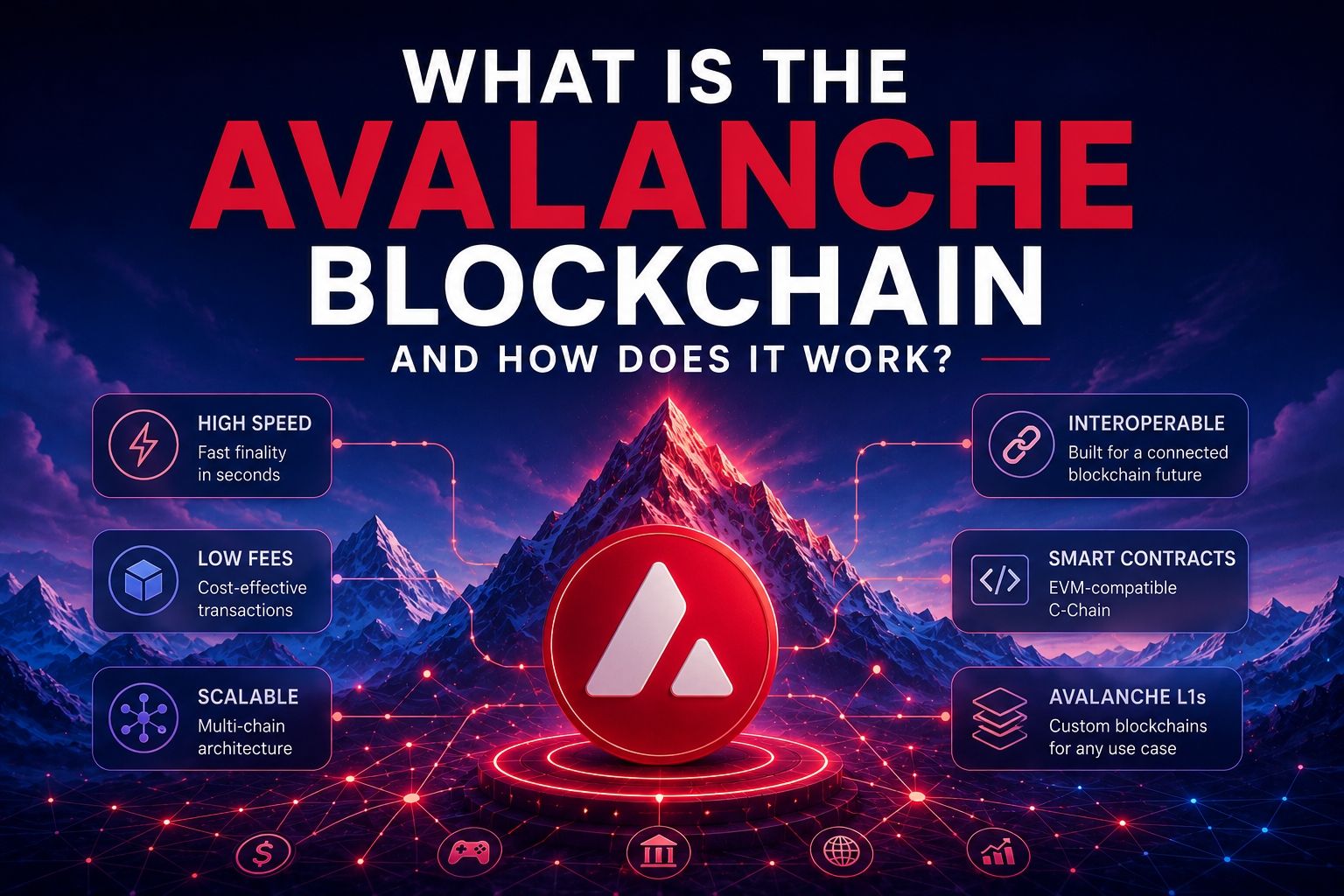
What Is the Avalanche Blockchain and How Does It Work?
The Avalanche blockchain is one of the most important Layer 1 networks in the crypto market. It was designed to offer fast transactions, flexible blockchain infrastructure, Ethereum compatibility and a multi-chain architecture capable of supporting decentralized finance, gaming, real-world assets, enterprise use cases and custom application-specific blockchains.
Unlike Bitcoin, which mainly focuses on decentralized money, Avalanche is a smart contract platform. It allows developers to build decentralized applications, launch tokens, create DeFi protocols, deploy gaming economies, tokenize real-world assets and even build their own sovereign blockchains inside the Avalanche ecosystem.
This makes the Avalanche blockchain more than a simple alternative to Ethereum. Its main value proposition is not only speed or lower fees. Avalanche is trying to become a flexible infrastructure layer where different applications, institutions and developers can create their own blockchain environments while remaining connected to a broader network.
To understand Avalanche properly, it is important to separate three concepts: the Avalanche blockchain infrastructure, the Avalanche ecosystem and the AVAX token. Avalanche is the network and technology. The ecosystem includes all the applications and projects built around it. AVAX is the native token used for fees, staking and network security.
This article focuses on the Avalanche blockchain itself: how it works, why its architecture is different, what the C-Chain is, what Avalanche L1s are, and why this network still matters in the broader crypto market.
What Is the Avalanche Blockchain?
The Avalanche blockchain is a Layer 1 blockchain platform built to support smart contracts, decentralized applications and custom blockchain networks. It aims to combine high performance, low transaction costs, interoperability and flexibility.
In simple terms, Avalanche is not just one blockchain used for every purpose. It is a network architecture that can support multiple chains with different roles. This is one of its most important differences compared with many traditional blockchain systems.
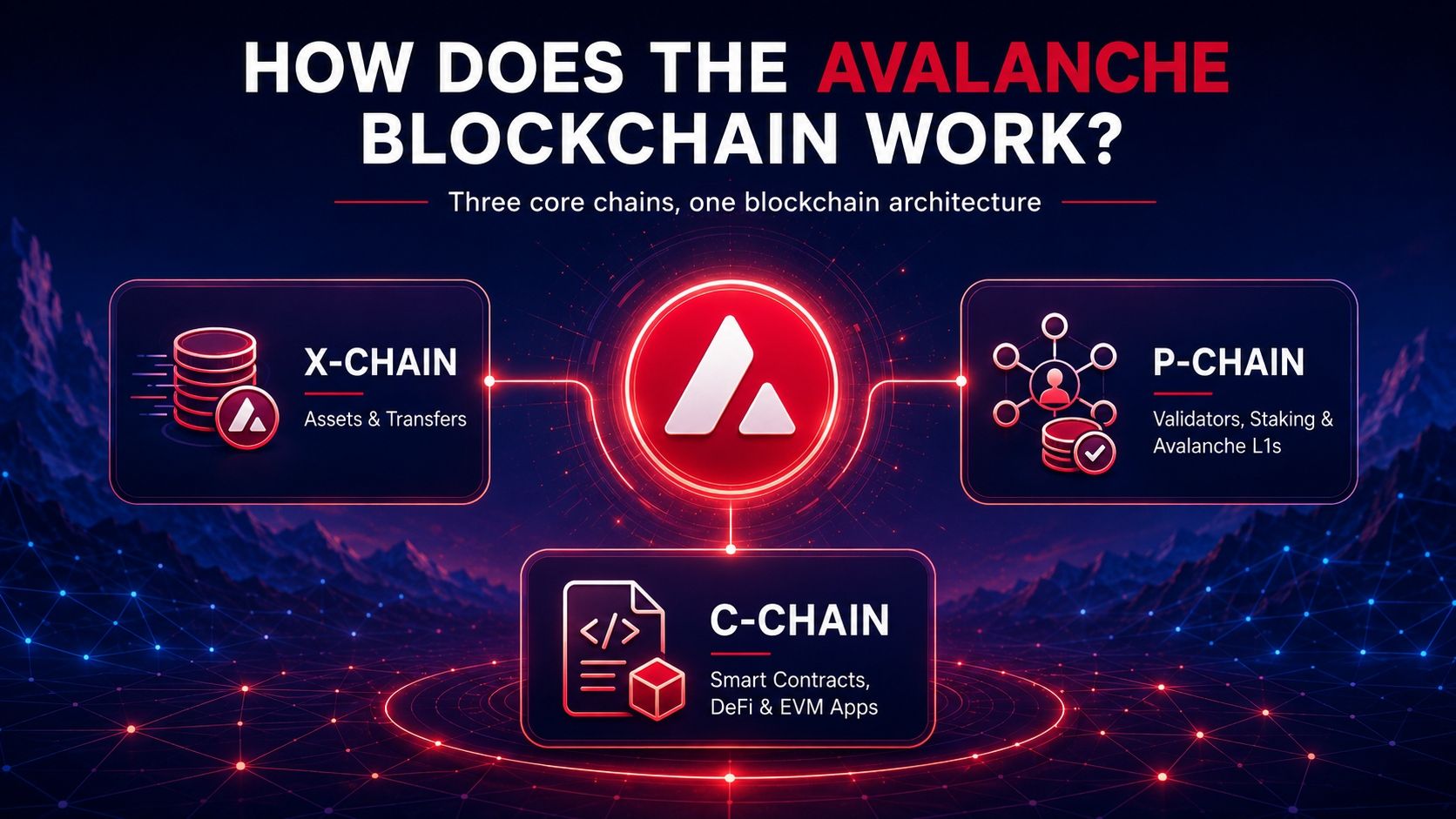
The Avalanche Primary Network includes three main chains: the X-Chain, the P-Chain and the C-Chain. Each chain has a specific function. This design allows Avalanche to separate asset transfers, validator coordination and smart contract activity instead of forcing everything onto a single chain.
For most users, the most visible part of Avalanche is the C-Chain. This is the Ethereum-compatible chain where many DeFi applications, wallets and smart contracts operate. If someone uses MetaMask or another EVM-compatible wallet on Avalanche, they are usually interacting with the C-Chain.
However, Avalanche’s long-term strategy goes beyond the C-Chain. The network is increasingly focused on Avalanche L1s, formerly known as subnets. These are customizable blockchains that can be launched by projects, institutions or developers for specific use cases.
Why Was Avalanche Created?
Avalanche was created to address some of the major limitations of earlier blockchain systems. Ethereum proved that smart contracts could support decentralized finance, NFTs and Web3 applications, but it also showed the limits of a single, heavily used blockchain: congestion, high gas fees and scaling challenges.
Avalanche was designed with a different approach. Instead of relying only on one chain, it uses a multi-chain architecture. This allows different functions to be separated and gives developers more flexibility.
The goal is to offer a blockchain infrastructure that can scale horizontally. Instead of forcing every application to compete for space on the same network, Avalanche allows projects to launch their own chains while still benefiting from the broader Avalanche environment.
This is especially relevant for applications that need specific technical or regulatory conditions. A game, a DeFi protocol, a payment network and an institutional tokenization platform do not have the same requirements. Avalanche tries to give each of them more control over their infrastructure.
How Does the Avalanche Blockchain Work?
The Avalanche blockchain works through a multi-chain structure and a consensus mechanism designed for fast finality. Finality means that once a transaction is confirmed, it becomes extremely difficult to reverse. In crypto, fast finality is important because users and applications need certainty.
Avalanche does not rely on proof-of-work mining like Bitcoin. It uses a proof-of-stake system where validators participate in securing the network. Validators stake AVAX and help process transactions. This model is more energy-efficient than mining and allows the network to operate with faster confirmation times.
The network’s architecture separates key functions into different chains. This makes Avalanche easier to scale and gives it more flexibility than a simple single-chain model.
The three main chains of the Avalanche Primary Network are:
- X-Chain: used for creating and transferring digital assets.
- P-Chain: used for validators, staking and platform-level coordination.
- C-Chain: used for smart contracts and Ethereum-compatible applications.
This structure is one of the reasons why Avalanche is often described as a high-performance blockchain network rather than a single traditional blockchain.
The C-Chain: Avalanche’s Ethereum-Compatible Layer
The C-Chain is the most important part of the Avalanche blockchain for everyday DeFi users. It is compatible with the Ethereum Virtual Machine, usually called the EVM. This means that developers can deploy Ethereum-style smart contracts on Avalanche and users can interact with applications through familiar wallets.
This compatibility is one of Avalanche’s strongest advantages. Developers who already understand Ethereum can build on Avalanche without learning an entirely new environment. Users can also connect with wallets such as MetaMask, Core or other EVM-compatible tools.
The C-Chain is where many Avalanche DeFi protocols operate. Swaps, lending markets, liquidity pools, stablecoins, decentralized exchanges and yield strategies are usually found on the C-Chain.
In practical terms, the C-Chain made Avalanche accessible to the broader Ethereum community. Without it, Avalanche would have had a much harder time attracting DeFi users and developers.
However, the C-Chain also places Avalanche in direct competition with other EVM networks such as Ethereum, Arbitrum, Optimism, Base, Polygon, BNB Chain and Mantle. This means Avalanche cannot rely only on EVM compatibility. It needs additional differentiation.
X-Chain and P-Chain: The Less Visible Parts of Avalanche
While the C-Chain receives most of the attention, the X-Chain and P-Chain are also important to understand the Avalanche blockchain.
The X-Chain, or Exchange Chain, is designed for creating and transferring digital assets. It plays a role in Avalanche’s asset layer, although most retail users interact more frequently with the C-Chain.
The P-Chain, or Platform Chain, coordinates validators and network-level operations. It is important for staking, validator management and the creation of Avalanche L1s. In other words, the P-Chain is part of the infrastructure that helps Avalanche support a multi-chain environment.
For beginners, this can seem complicated. But the key idea is simple: Avalanche separates different blockchain functions into different chains to improve flexibility and scalability.
What Are Avalanche L1s?
One of the most important concepts in the current Avalanche strategy is the rise of Avalanche L1s. These were previously known as subnets, but Avalanche now increasingly presents them as sovereign Layer 1 blockchains built within the Avalanche ecosystem.
An Avalanche L1 is a custom blockchain that can be designed for a specific use case. A gaming studio, a DeFi protocol, an enterprise, a payment platform or an institution can launch its own chain with its own technical parameters.
This is very different from deploying a simple smart contract on a shared blockchain. With an Avalanche L1, a project can customize fees, validator rules, governance, compliance features and sometimes even the gas token used by the chain.
This flexibility is important because not every application has the same needs. A game may need very low fees and fast transaction processing. An institution may need compliance controls. A DeFi project may need strong liquidity and interoperability. A consumer app may need an experience where users barely notice the blockchain.
Avalanche L1s allow the network to target these different markets without forcing all applications to live on the same chain.
From Subnets to Avalanche L1s
The term “subnet” was historically used to describe custom networks built on Avalanche. A subnet allowed a project to create a dedicated blockchain environment with its own validators and rules.
However, the word subnet was not always easy for the broader market to understand. It sounded technical and secondary, as if these networks were smaller extensions of the main chain.
With Avalanche9000 and the Etna upgrade, Avalanche shifted the narrative toward Avalanche L1s. This is more than a branding change. It reflects a broader strategy: Avalanche wants to be seen as an infrastructure for launching sovereign, application-specific Layer 1 blockchains.
This could become a major advantage if the crypto market moves toward specialized chains. Instead of one chain serving all applications, different projects could launch their own optimized blockchains while remaining part of the Avalanche ecosystem.
The success of this strategy depends on adoption. If developers, companies and institutions actually use Avalanche L1s at scale, the Avalanche blockchain could regain strong relevance. If not, the concept may remain technically impressive but commercially limited.
Why Avalanche Matters for DeFi
DeFi has always been one of the most important sectors for the Avalanche blockchain. During previous crypto cycles, Avalanche attracted users with faster transactions, lower fees and strong liquidity incentives.
Protocols such as Trader Joe, BENQI, Aave, GMX, Yield Yak and other applications helped build Avalanche’s DeFi identity. Some of these projects are native to Avalanche, while others are multi-chain protocols that expanded to the network.
The DeFi opportunity for Avalanche is still real, but the environment is much more competitive than before. Ethereum remains the dominant DeFi settlement layer. Arbitrum and Base have attracted significant EVM activity. Solana has regained momentum with a fast user experience and strong retail attention.
For Avalanche, the challenge is to offer something more than lower fees. It needs differentiated applications, stronger liquidity, better user experience and clear reasons for users to choose Avalanche instead of other chains.
Still, Avalanche has one advantage: its multi-chain structure can support specialized DeFi environments. In the future, certain DeFi applications may prefer their own Avalanche L1 rather than competing for space on a shared chain.
Avalanche and Gaming
Gaming is one of the strongest use cases for Avalanche’s multi-chain architecture. A blockchain game may need thousands or even millions of low-cost interactions. It may also need a custom economy, its own assets and a user experience that feels smooth enough for mainstream players.
This is difficult on a crowded general-purpose blockchain. If transaction costs rise or confirmations feel slow, players will not care about the technical reasons. They will simply leave.
Avalanche L1s can give gaming projects dedicated infrastructure. A game can have its own blockchain with rules designed for in-game assets, NFT items, player activity and digital economies.
This is why Avalanche has been active in the Web3 gaming sector. Projects such as Off The Grid, GUNZ and Shrapnel have helped bring attention to Avalanche as a gaming infrastructure.
The opportunity is significant, but the risk is also clear. Web3 gaming has disappointed many investors in the past. The most successful blockchain games will probably not be the ones that talk most about tokens, but the ones that are actually fun to play.
Avalanche and Real-World Assets
Real-world assets, or RWA, are another important opportunity for the Avalanche blockchain. RWA refers to the tokenization of traditional assets such as funds, bonds, credit products, real estate, invoices or other financial instruments.
Avalanche’s architecture may be attractive for RWA because institutions often need more control than public DeFi users. They may require permissioning, compliance rules, identity features, privacy controls or dedicated infrastructure.
An Avalanche L1 can theoretically offer a more tailored environment for regulated financial applications. Instead of using a fully open public chain for everything, an institution could deploy or use a blockchain designed for its own requirements.
This does not mean that Avalanche will dominate RWA. Ethereum, Polygon, Stellar, Canton Network, Solana and other systems are also competing for tokenized finance. But Avalanche has a clear argument: customizable blockchain infrastructure for specific institutional use cases.
If tokenization becomes one of the next major growth areas in crypto, Avalanche could benefit from this trend.
Avalanche vs Ethereum
Ethereum is still the most important smart contract platform in crypto. It has the deepest liquidity, the strongest developer network, the largest DeFi ecosystem and the most recognized institutional position.
The Avalanche blockchain competes with Ethereum in some areas, especially through its C-Chain. Since the C-Chain is EVM-compatible, many Ethereum-style applications can also exist on Avalanche.
However, Avalanche’s strategy is not simply to be a cheaper Ethereum. Its broader differentiation comes from Avalanche L1s and custom blockchain infrastructure.
Ethereum is scaling mainly through Layer 2 networks such as Arbitrum, Optimism, Base and zkSync. Avalanche is scaling through a multi-chain architecture where applications can launch their own chains.
Both models have strengths. Ethereum has unmatched network effects. Avalanche offers more customization at the blockchain level. The market may ultimately use both approaches for different needs.
Avalanche vs Solana
Solana and Avalanche represent two different visions of blockchain scalability. Solana focuses on a fast, unified, high-performance chain. Avalanche focuses on a flexible, multi-chain architecture.
Solana’s strength is user experience. Transactions are fast, applications feel smooth and liquidity is concentrated on one major network. This makes it attractive for retail users, memecoins, trading and consumer applications.
Avalanche’s strength is customization. It allows different projects to build dedicated blockchain environments. This may be more useful for gaming, enterprise, RWA and applications that need specific rules.
The question is not necessarily which model is better. The real question is which use cases will dominate the next phase of crypto adoption. If the market favors unified consumer experiences, Solana may have an advantage. If the market favors custom application chains and institutional infrastructure, Avalanche may become more relevant again.
Avalanche vs Cosmos
Cosmos has long promoted the idea of sovereign, application-specific blockchains. In that sense, Avalanche shares part of the same vision. Both ecosystems believe that the future may not belong to one chain, but to many specialized chains.
The difference is in execution. Cosmos has its own ecosystem, tooling and interoperability model. Avalanche has its own consensus, EVM compatibility and L1 architecture.
Avalanche may be easier for Ethereum developers to approach because of the C-Chain and EVM compatibility. Cosmos has a longer history of sovereign app chains and its own technical culture.
Both ecosystems are betting on a multi-chain future. Avalanche’s challenge is to prove that Avalanche L1s can attract meaningful adoption and liquidity.
The Role of the AVAX Token
The AVAX token is the native asset of the Avalanche blockchain. It is used for transaction fees, staking and network security. Validators and delegators use AVAX to participate in securing the network and earning rewards.
AVAX also plays a role in the economic identity of Avalanche. If the network grows, users may need AVAX for fees and staking-related activity. If the network becomes less active, demand for the token may weaken.
It is important to analyze AVAX separately from the Avalanche blockchain. A strong ecosystem does not automatically mean the token price will rise. Token performance depends on supply, demand, market cycles, liquidity, investor psychology and broader crypto conditions.
For this reason, a separate article should focus specifically on the AVAX token, its price action, tokenomics and trading opportunities. This article focuses mainly on the blockchain infrastructure.
Strengths of the Avalanche Blockchain
The first major strength of the Avalanche blockchain is its flexibility. Avalanche can support general-purpose smart contracts through the C-Chain and custom blockchain networks through Avalanche L1s.
The second strength is Ethereum compatibility. The C-Chain allows developers and users to interact with Avalanche through familiar EVM tools.
The third strength is its multi-chain architecture. Instead of forcing all use cases onto one blockchain, Avalanche can support different chains for different applications.
The fourth strength is its relevance for multiple narratives: DeFi, gaming, real-world assets, enterprise infrastructure and custom Layer 1 networks.
The fifth strength is that Avalanche is already a mature crypto project. It is not an experimental new chain with no history. It has survived several market phases and continues to evolve.
Risks and Weaknesses of Avalanche
The biggest risk for Avalanche is competition. Ethereum, Solana, Base, Arbitrum, Sui, Aptos, BNB Chain, Cosmos and other networks are all competing for users, developers and liquidity.
The second risk is fragmentation. A multi-chain architecture can be powerful, but it can also become confusing. If users must constantly bridge assets, switch chains or understand technical details, adoption may suffer.
The third risk is liquidity. DeFi ecosystems need deep liquidity to attract users. If liquidity concentrates elsewhere, Avalanche may struggle to regain momentum.
The fourth risk is narrative fatigue. Avalanche was one of the strongest Layer 1 narratives in a previous cycle. To attract new capital, it needs to show that it is not just an old cycle winner, but a network with renewed relevance.
The fifth risk is token value capture. Even if the Avalanche blockchain grows, investors still need to analyze whether that growth creates sustainable demand for AVAX.
Why the Avalanche Blockchain Still Matters
The Avalanche blockchain still matters because it addresses a real question in crypto: should all applications use the same chain, or should different applications have their own optimized blockchain environments?
If the future of crypto is dominated by one or two general-purpose chains, Avalanche may face strong pressure. But if the future is multi-chain, application-specific and institutional, Avalanche could become increasingly relevant.
Its focus on Avalanche L1s gives it a clear strategy. Rather than only competing for DeFi users on the C-Chain, Avalanche is trying to become infrastructure for custom blockchains.
This makes Avalanche especially interesting for sectors such as gaming, real-world assets, institutional finance and enterprise blockchain applications.
The network still has to prove that this strategy can generate sustained adoption. But the thesis is clear: Avalanche wants to be the blockchain infrastructure layer for projects that need more than a simple smart contract on a shared network.
Avalanche Blockchain: Key Takeaways
- Avalanche is a Layer 1 blockchain platform built for smart contracts and custom blockchains.
- The Avalanche blockchain includes the C-Chain, X-Chain and P-Chain.
- The C-Chain is compatible with Ethereum’s EVM and hosts many DeFi applications.
- Avalanche L1s allow projects to launch custom, sovereign blockchains.
- Avalanche is active in DeFi, gaming, real-world assets and enterprise blockchain infrastructure.
- The AVAX token should be analyzed separately from the Avalanche blockchain itself.
Conclusion: Is Avalanche Still a Relevant Blockchain?
The Avalanche blockchain remains one of the most interesting Layer 1 infrastructures in crypto. Its combination of EVM compatibility, fast finality, multi-chain architecture and customizable Avalanche L1s gives it a clear position in the market.
Avalanche is not simply trying to be another Ethereum competitor. It is trying to become a platform where applications, companies, games and institutions can launch their own blockchain environments.
This strategy could be powerful if the next phase of crypto adoption favors application-specific chains, tokenized real-world assets, gaming economies and institutional blockchain systems.
However, Avalanche also faces serious challenges. Competition is intense, liquidity is fragmented and the market has become more selective. To regain strong momentum, Avalanche must show real adoption, not just technical potential.
For now, Avalanche remains a blockchain worth watching closely. Its success will depend on whether Avalanche L1s, DeFi, gaming and RWA use cases can turn its flexible architecture into sustained network activity.
FAQ About the Avalanche Blockchain
What is the Avalanche blockchain?
The Avalanche blockchain is a Layer 1 smart contract platform designed for fast transactions, low costs, decentralized applications and custom blockchain networks called Avalanche L1s.
What is the C-Chain on Avalanche?
The C-Chain is Avalanche’s Ethereum-compatible chain. It supports smart contracts and allows users to interact with DeFi applications through EVM-compatible wallets.
What are Avalanche L1s?
Avalanche L1s are custom blockchains built within the Avalanche ecosystem. They allow projects to create dedicated blockchain environments with their own rules, fees, validators and use cases.
Is Avalanche a competitor to Ethereum?
Yes, partly. Avalanche competes with Ethereum and Ethereum Layer 2 networks for DeFi and smart contract activity. However, Avalanche also differentiates itself through custom Avalanche L1s.
Is Avalanche better than Solana?
Avalanche and Solana have different designs. Solana focuses on one fast, unified chain, while Avalanche focuses on a multi-chain architecture with customizable blockchains. The better choice depends on the use case.
What is AVAX used for?
AVAX is the native token of Avalanche. It is used for transaction fees, staking, validator rewards and network security.
Is the Avalanche blockchain still active?
Yes. Avalanche remains active in DeFi, gaming, real-world assets, enterprise infrastructure and custom Layer 1 blockchain development.
Disclaimer
This article about the Avalanche blockchain is for informational purposes only. It is not financial advice. Cryptocurrencies are volatile and risky assets. Before investing in AVAX or using any blockchain application, always do your own research and consider your personal risk tolerance.
To put the Avalanche blockchain in perspective, it can be useful to compare it with other major Layer 1 networks, especially Solana.
Want to Compare Avalanche With Solana?
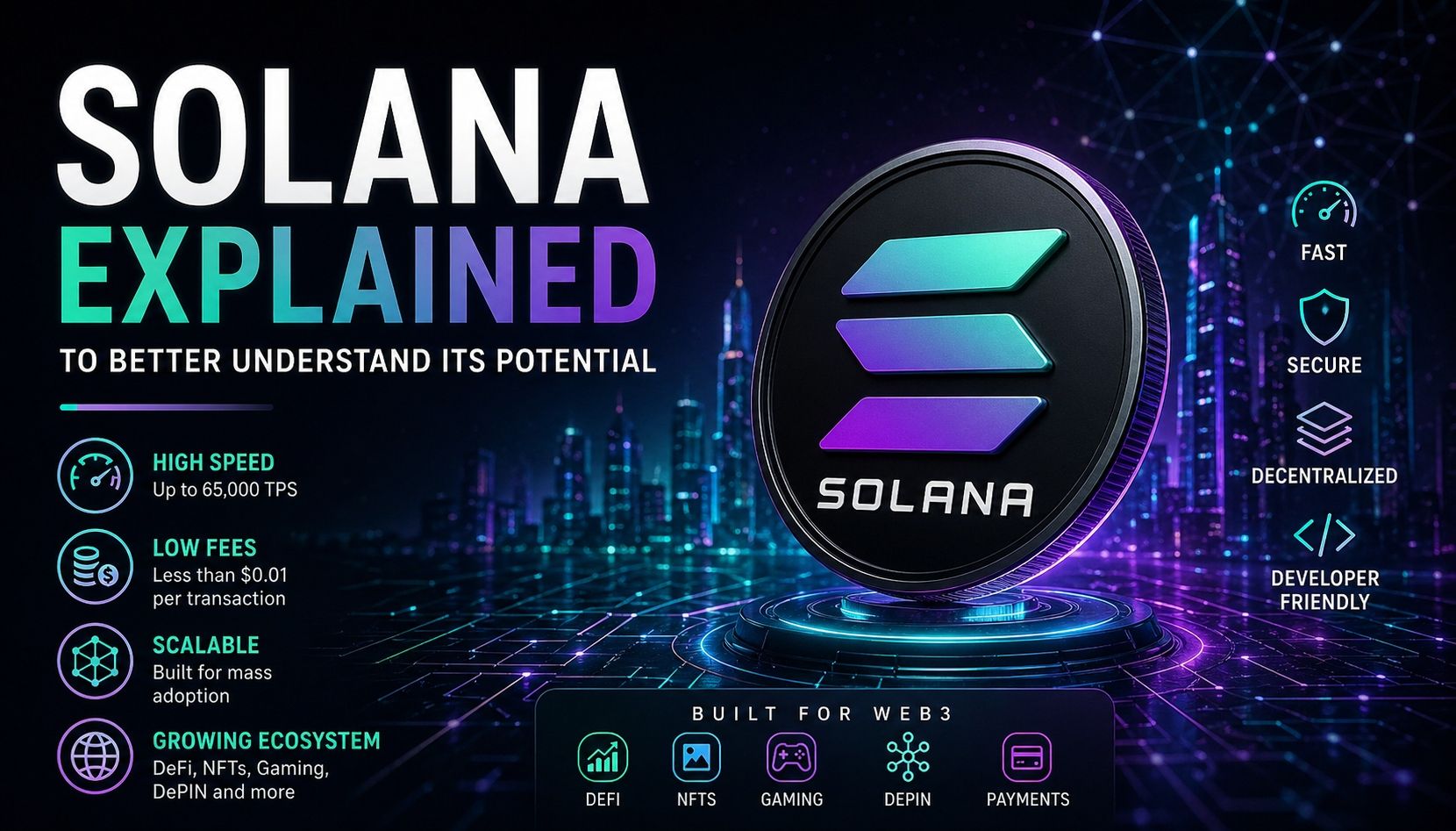
Avalanche is not the only high-performance blockchain trying to reshape DeFi, gaming and Web3 applications. Solana follows a very different approach, with a fast unified chain rather than a multi-chain architecture.
To better understand the differences between these two major Layer 1 networks, you can also read our guide: Solana Explained: What Is Solana and How Does It Work?

