
Quant Network occupies an unusual position within the blockchain industry. Instead of trying to build another blockchain that competes directly with Ethereum, Solana or other major networks, Quant focuses on a different problem: how to make blockchains, distributed ledgers and traditional financial systems work together.
This challenge is becoming increasingly important as banks, financial institutions and central banks experiment with tokenized securities, digital money, tokenized deposits and distributed ledger technology.
These developments increasingly overlap with the evolution of decentralized markets, tokenized assets and on-chain finance. Follow our latest DeFi News for broader coverage of the technologies and financial trends shaping this transition.
At the center of Quant’s ecosystem is Overledger, an interoperability platform designed to connect different networks and existing enterprise systems. More recently, Quant Fusion has expanded that vision toward multi-ledger infrastructure capable of supporting interoperability across public and private networks.
Quant has also gained a degree of institutional exposure that remains relatively uncommon among blockchain companies. It was part of the vendor team for Project Rosalind, an experiment led by the BIS Innovation Hub London Centre in collaboration with the Bank of England. Quant has also remained involved in discussions surrounding interoperability and synchronized settlement in the UK’s evolving tokenized financial infrastructure.
But what is Quant Network exactly? How do Overledger and Quant Fusion work? What role does the QNT token play, and could Quant become an important infrastructure provider as traditional finance moves toward tokenization?
What Is Quant Network?
Quant Network is a UK-based technology company focused primarily on blockchain and distributed ledger interoperability.
The basic idea behind Quant is relatively straightforward.
The future financial system is unlikely to operate on a single blockchain.
Public blockchains, private distributed ledgers, banking systems, payment networks, tokenized deposits, stablecoins and potentially central bank digital currencies can all use different technologies.
This creates fragmentation.
Moving information and digital assets between these environments can become complicated, particularly for regulated institutions that cannot simply replace their existing infrastructure every time a new blockchain technology emerges.
Quant Network aims to provide a layer capable of connecting these different systems.
Rather than asking financial institutions to migrate everything onto one blockchain, Quant’s approach is essentially:
keep the existing infrastructure, but make different systems interoperable.
This concept is at the heart of Overledger.
What Is Overledger?
Overledger is Quant Network’s core interoperability platform.
It is designed to allow developers, enterprises and financial institutions to interact with multiple blockchains and distributed ledger technologies through a common infrastructure.
Quant provides access to Overledger through APIs, making the technology easier to integrate into existing enterprise applications and financial systems.
This approach is particularly important for institutional adoption.
A bank does not necessarily want to rebuild its entire technology stack around Ethereum, another public blockchain or a specific private DLT.
Instead, it may want its existing infrastructure to interact with several networks.
Overledger is designed to provide that connectivity.
Why does blockchain interoperability matter?
The blockchain ecosystem has become increasingly fragmented.
Different networks offer different characteristics in terms of security, privacy, performance, governance and regulatory compliance.
This fragmentation becomes even more significant when traditional financial institutions enter the market.
A bank could issue tokenized deposits on one infrastructure while a tokenized bond exists on another network. Settlement could potentially involve central bank money operating on yet another system.
For these assets to interact efficiently, the underlying networks need a way to communicate.
This is the market Quant Network is attempting to address.
Quant Network Is Not Another Layer 1 Blockchain
One of the most important things to understand about Quant Network is that it should not be viewed simply as another Layer 1 blockchain.
Quant does not need to replace Ethereum or become the dominant smart contract network to succeed.
In theory, the opposite could be true.
The more blockchains and distributed ledger infrastructures exist, the greater the potential need for interoperability.
This gives Quant a very different strategic position from projects competing directly for users, developers and applications on their own blockchain.
Its opportunity depends instead on whether institutions increasingly require a neutral infrastructure capable of connecting multiple networks.
Quant Fusion: The Next Stage of Quant Network
Overledger is no longer the entire Quant story.
Quant Fusion represents an important expansion of the company’s interoperability strategy.
Quant describes Fusion as a multi-ledger architecture designed to allow assets and applications to operate across multiple networks while supporting institutional requirements such as privacy, compliance and controlled access.
The Fusion Rollup went live on mainnet on June 2, 2026, marking an important milestone for the project.
Unlike conventional rollups that are primarily designed to scale a single blockchain, Quant positions Fusion as infrastructure capable of connecting multiple ledgers.
This distinction matters.
If the model succeeds, Quant could evolve from an interoperability platform into a broader multi-network infrastructure layer for digital finance.
Moving beyond traditional blockchain bridges
Cross-chain bridges have historically created significant security and operational risks within the crypto ecosystem.
Many rely on wrapped assets or mechanisms that introduce additional layers of trust and complexity.
Quant’s broader vision is to allow different networks to interact without requiring institutions to rely entirely on the conventional bridge model.
This could become particularly relevant as regulated financial assets move onto blockchain-based infrastructure.
What Is the QNT Token?
The QNT token is the utility token associated with the Quant ecosystem.
It is important, however, to separate two different concepts:
- the adoption and commercial success of Quant Network’s technology;
- the economic value captured by the QNT token.
These concepts are connected, but they are not necessarily identical.
Quant currently states that Overledger platform fees can be paid in US dollars or through QNT subscriptions.
This makes the infrastructure easier for traditional enterprises to use, since a financial institution does not necessarily need to manage cryptocurrency directly simply to access Quant’s technology.
From an investment perspective, however, it creates an important question:
how much demand for QNT will be generated as Quant Network adoption increases?
QNT Token Supply and Scarcity
Another characteristic that attracts attention to the QNT token is its relatively limited supply.
Compared with many cryptocurrencies whose supplies reach hundreds of millions or billions of tokens, QNT has a much smaller maximum supply.
Scarcity can theoretically become important when demand increases while available supply remains limited.
However, limited supply alone does not create sustainable value.
For scarcity to become economically meaningful, Quant Network would also need to expand its usage and create sufficient demand around its ecosystem and token.
Quant Network and the Bank of England
Quant’s involvement with the Bank of England is one of the most interesting parts of the project — and also one of the areas where crypto commentary can become misleading.
Quant genuinely participated in Project Rosalind.
The project was conducted by the BIS Innovation Hub London Centre in collaboration with the Bank of England and explored how an API layer could support a retail central bank digital currency ecosystem.
The official BIS Project Rosalind report identifies UST and Quant as the project’s vendor team.
The experiment developed 33 API functionalities and explored more than 30 retail CBDC use cases.
For a company originating from the blockchain sector, participation in a project involving both the BIS Innovation Hub and the Bank of England represents a significant institutional reference.
Did the Bank of England choose Quant for the digital pound?
No.
This distinction is extremely important.
Project Rosalind was an experimental research project. It was not a contract awarding the future UK digital pound infrastructure to Quant Network.
The BIS explicitly stated that the experiment was not intended to prejudge decisions about the design or potential launch of a UK CBDC.
It would therefore be inaccurate to claim that the Bank of England has selected Quant or QNT to operate the digital pound.
The accurate statement is much more interesting from a credibility perspective: Quant was selected as part of the technology vendor team for a major CBDC experiment conducted by the BIS Innovation Hub and the Bank of England.
Why the Bank of England Connection Still Matters in 2026
Project Rosalind concluded several years ago, so its relevance would be more limited if Quant had completely disappeared from subsequent institutional discussions.
That is not entirely the case.
In April 2026, Quant Network was still listed among the members of the Bank of England’s Synchronisation Thematic Engagement Working Group, alongside organizations including Barclays, HSBC, Swift, LSEG, ClearBank and Chainlink.
Quant was recorded as an apology for that particular meeting, but its inclusion in the official membership list shows continued participation in the broader discussion.
The subject itself is strategically important.
Synchronisation explores ways to coordinate movements of central bank money with transactions occurring on external asset ledgers.
This becomes particularly relevant when securities and other financial assets are tokenized.
The UK Is Moving Toward Tokenized Financial Markets
The wider regulatory environment makes Quant’s positioning particularly interesting.
In May 2026, the Bank of England and the Financial Conduct Authority set out a shared vision for accelerating tokenization in UK wholesale financial markets.
The initiative covers areas including tokenized securities, tokenized collateral, distributed ledger infrastructure and new forms of digital settlement.
The Bank of England has also been developing infrastructure intended to support settlement of transactions involving tokenized securities in central bank money.
This does not mean that Quant Network will automatically become the infrastructure used by the UK financial system.
It does, however, mean that the problem Quant has spent years attempting to solve is becoming increasingly relevant to major financial institutions.
Quant Network and Financial Tokenization
Tokenization could fundamentally change the infrastructure underlying financial markets.
Bonds, funds, deposits, collateral and other traditional financial assets can potentially be represented and transferred through distributed ledgers.
But tokenizing an asset is only part of the problem.
The different networks on which these assets exist must also communicate with payment and settlement infrastructure.
Imagine a tokenized bond issued on one ledger, tokenized commercial bank money on another and central bank settlement infrastructure operating elsewhere.
Without interoperability, digital finance risks recreating the same silos blockchain technology was originally supposed to eliminate.
This is why Quant Network’s interoperability strategy could become increasingly relevant as asset tokenization grows.
Quant Network and Murex
Another important institutional development arrived in March 2026 when Quant Network announced a partnership with Murex.
Murex develops MX.3, a major platform used by financial institutions for trading, risk management and post-trade operations.
The partnership is designed to integrate Quant technology into MX.3 workflows and support financial institutions dealing with tokenized deposits and digital bonds.
The architecture involves Quant Flow and Overledger connecting different public and private systems.
This is strategically significant because institutional tokenization is unlikely to succeed if banks are required to abandon their existing infrastructure entirely.
Integrating blockchain functionality into established capital-market systems could therefore be more realistic than trying to replace those systems overnight.
Why Quant Network Could Have Long-Term Potential ?
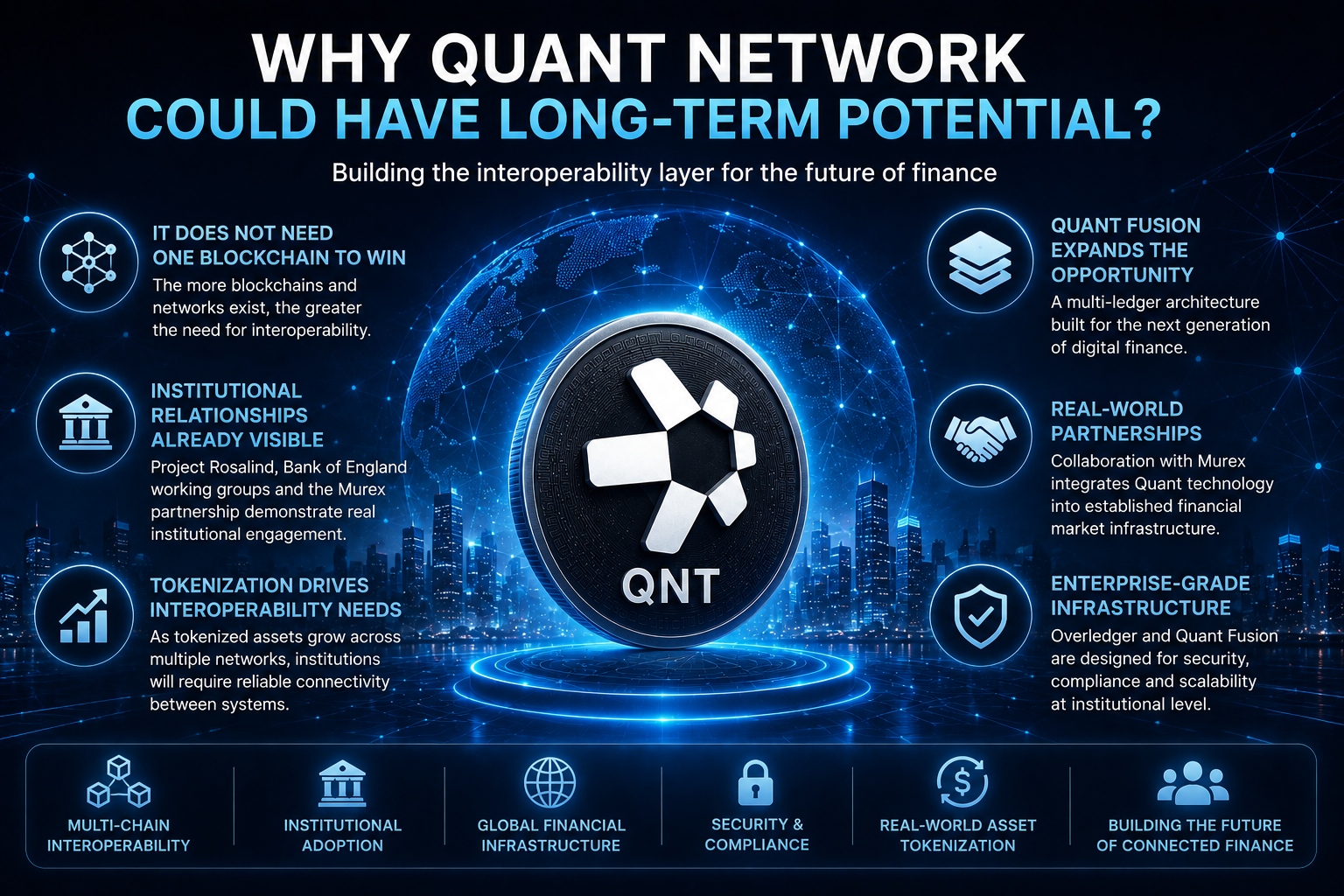
Several factors make Quant Network particularly interesting within the institutional blockchain sector.
It does not need one blockchain to win
Quant’s interoperability model potentially benefits from a fragmented blockchain environment.
Ethereum, private DLT networks, institutional blockchains and other infrastructures can coexist while creating demand for technology capable of connecting them.
Institutional relationships are already visible
Project Rosalind, the Bank of England working groups and the Murex partnership provide tangible examples of Quant operating within institutional financial environments.
This does not guarantee commercial dominance, but it gives the company a stronger institutional track record than many blockchain projects.
Tokenization could dramatically increase interoperability requirements
If tokenized securities, deposits and collateral expand significantly, institutions may need to connect a growing number of networks.
This is precisely the infrastructure problem Quant is targeting.
Quant Fusion expands the opportunity
Quant Fusion potentially broadens the project beyond API-based blockchain connectivity toward more comprehensive multi-ledger infrastructure.
The 2026 mainnet launch therefore represents an important development to monitor.
What Are the Main Risks for Quant Network?
The institutional narrative surrounding Quant is compelling, but there are several important risks.
Institutional experiments do not guarantee commercial adoption
Financial institutions regularly test new technologies.
A proof of concept, working group or pilot project should never be treated as equivalent to a large-scale production deployment.
Project Rosalind is a strong institutional reference, but it does not mean Quant will operate a future digital pound.
Interoperability is highly competitive
Quant is not the only company or protocol attempting to connect different networks.
Blockchain interoperability protocols, financial messaging networks, institutional DLT providers and technology developed internally by major banks all represent potential competition.
The market may also support several interoperability standards rather than one dominant provider.
Institutional adoption can be slow
Banking and capital-market infrastructure changes over years rather than months.
Regulatory approvals, security requirements and integration with legacy systems can dramatically extend deployment timelines.
Quant Network success does not automatically mean QNT token success
This remains the most important distinction for crypto investors.
Quant could theoretically become a successful enterprise technology company without every dollar of commercial activity translating directly into buying pressure for QNT.
Investors therefore need to understand not only whether Quant Network is growing, but how that growth creates economic demand for the QNT token.
Quant Network vs Traditional Blockchain Projects
Quant’s investment thesis is fundamentally different from that of many cryptocurrencies.
Traditional Layer 1 projects generally compete for developers, users, applications, liquidity and transaction activity.
Quant instead focuses on connectivity between systems.
This means its success could potentially depend less on consumer crypto adoption and more on the modernization of financial infrastructure.
That makes Quant particularly exposed to trends such as:
- institutional blockchain adoption;
- tokenized securities;
- tokenized bank deposits;
- digital settlement infrastructure;
- central bank digital money;
- interoperability between public and private networks;
- real-world asset tokenization.
Could Quant Network Benefit From the RWA Market?
The growth of real-world assets (RWA) is particularly relevant to Quant.
Tokenized bonds, funds, money-market instruments and other traditional assets are increasingly being explored by financial institutions.
If these assets are issued across multiple networks, interoperability becomes essential.
An institution may need to transfer an asset from one infrastructure, use collateral from another and settle the transaction using money represented on a third system.
Quant Network could therefore provide indirect exposure to the growth of tokenization infrastructure without needing to become the issuer of every tokenized asset itself.
Again, however, investors evaluating the QNT token need to determine how much of that economic activity would ultimately be captured by QNT.
What Should Investors Watch Next?
Rather than focusing exclusively on QNT’s short-term price movements, several fundamental developments could provide a better indication of Quant Network’s long-term progress:
- real-world institutional adoption of Overledger;
- usage and development of Quant Fusion;
- new deployments involving tokenized deposits and securities;
- progress in the Murex partnership;
- continued involvement in UK tokenization infrastructure;
- commercial deployments rather than experimental pilots;
- changes in the economic utility of the QNT token;
- competition from other interoperability technologies.
These indicators could ultimately matter more than short-term crypto market narratives.
Does the QNT Token Have Potential?
The QNT token has an unusual investment thesis.
Its potential is linked to a company attempting to solve a genuine infrastructure problem that could become increasingly important as traditional finance adopts distributed ledger technology.
Quant Network has already demonstrated that it can participate in serious institutional environments.
Overledger provides the established interoperability platform, Quant Fusion expands the technological vision, Project Rosalind provides an important institutional reference, and the Murex partnership connects Quant directly with existing capital-market infrastructure.
However, none of these developments guarantees QNT price appreciation.
The key question is not simply:
“Will Quant Network become more widely adopted?”
It is:
“If Quant Network becomes widely adopted, how much of that value will ultimately be captured by the QNT token?”
That distinction may determine whether QNT becomes merely the token associated with a successful technology company or an asset that directly benefits from the growth of institutional tokenization.
Conclusion
Quant Network is one of the more distinctive blockchain infrastructure projects because it is not primarily trying to create another isolated ecosystem.
Its ambition is to connect ecosystems.
As banks, central banks and financial markets experiment with tokenized assets and distributed ledgers, interoperability could become one of the most important infrastructure challenges in digital finance.
Quant’s involvement in Project Rosalind, continued presence in UK institutional discussions, development of Overledger and Quant Fusion, and partnership with Murex give the project a credible position within this emerging market.
The opportunity is significant, but so are the uncertainties.
For Quant Network, the challenge is turning institutional interest into large-scale commercial adoption. For the QNT token, the challenge goes one step further: proving that this adoption translates into sustainable economic demand for the token itself.
FAQ About Quant Network and QNT
What is Quant Network?
Quant Network is a UK-based technology company developing interoperability infrastructure that allows different blockchains, distributed ledgers and traditional financial systems to communicate. Its main technologies include Overledger and Quant Fusion.
What is Overledger?
Overledger is Quant Network’s interoperability platform. It provides APIs and infrastructure designed to help developers, enterprises and financial institutions connect applications with multiple blockchains and distributed ledger networks.
What is the QNT token used for?
QNT is the utility token associated with the Quant ecosystem. It can be used within Quant’s platform and for subscriptions, although Quant also allows certain platform fees to be paid in traditional currency. Investors should therefore distinguish between adoption of Quant’s technology and direct demand for QNT.
What is Quant Fusion?
Quant Fusion is Quant’s multi-ledger infrastructure designed to enable interoperability between different networks and support institutional digital assets. The Fusion Rollup launched on mainnet in June 2026.
Does Quant Network work with the Bank of England?
Quant participated in Project Rosalind, an experiment conducted by the BIS Innovation Hub London Centre in collaboration with the Bank of England. Quant and UST were identified as the project’s vendor team. Quant has also appeared among participants in a Bank of England working group focused on synchronisation and tokenized settlement.
Did the Bank of England choose Quant for the digital pound?
No. Project Rosalind was an experimental CBDC research project and did not represent the selection of Quant as the technology provider for a future UK digital pound.
Why could Quant Network benefit from tokenization?
As securities, deposits and other financial assets move onto different blockchain and DLT infrastructures, institutions may increasingly require interoperability between those networks. Connecting different financial systems is precisely the problem Quant Network is designed to address.
Is QNT a good investment?
QNT has potential exposure to institutional blockchain adoption, interoperability and financial tokenization, but it remains a volatile crypto asset. A critical factor is whether increased adoption of Quant Network creates sustainable demand for the QNT token itself.
What is the biggest risk for QNT?
One important risk is that Quant Network’s technology could achieve commercial adoption without the QNT token capturing a proportional amount of that economic value. Competition, regulation and the slow pace of institutional blockchain adoption are additional risks.
Conclusion
Quant Network stands out because it is not simply trying to build another isolated blockchain ecosystem. Through Overledger and Quant Fusion, its ambition is to connect different blockchains, distributed ledgers and traditional financial infrastructure at a time when banks and capital markets are increasingly exploring tokenized assets.
The long-term opportunity is therefore substantial, but the key question remains whether growing institutional adoption of Quant’s technology will translate into sustainable demand for the QNT token. That relationship between technological adoption and token value capture will be one of the most important factors to monitor.
Want to understand the bigger tokenization trend?
Quant Network’s interoperability strategy is closely linked to the growth of digital assets and tokenized financial markets. Discover
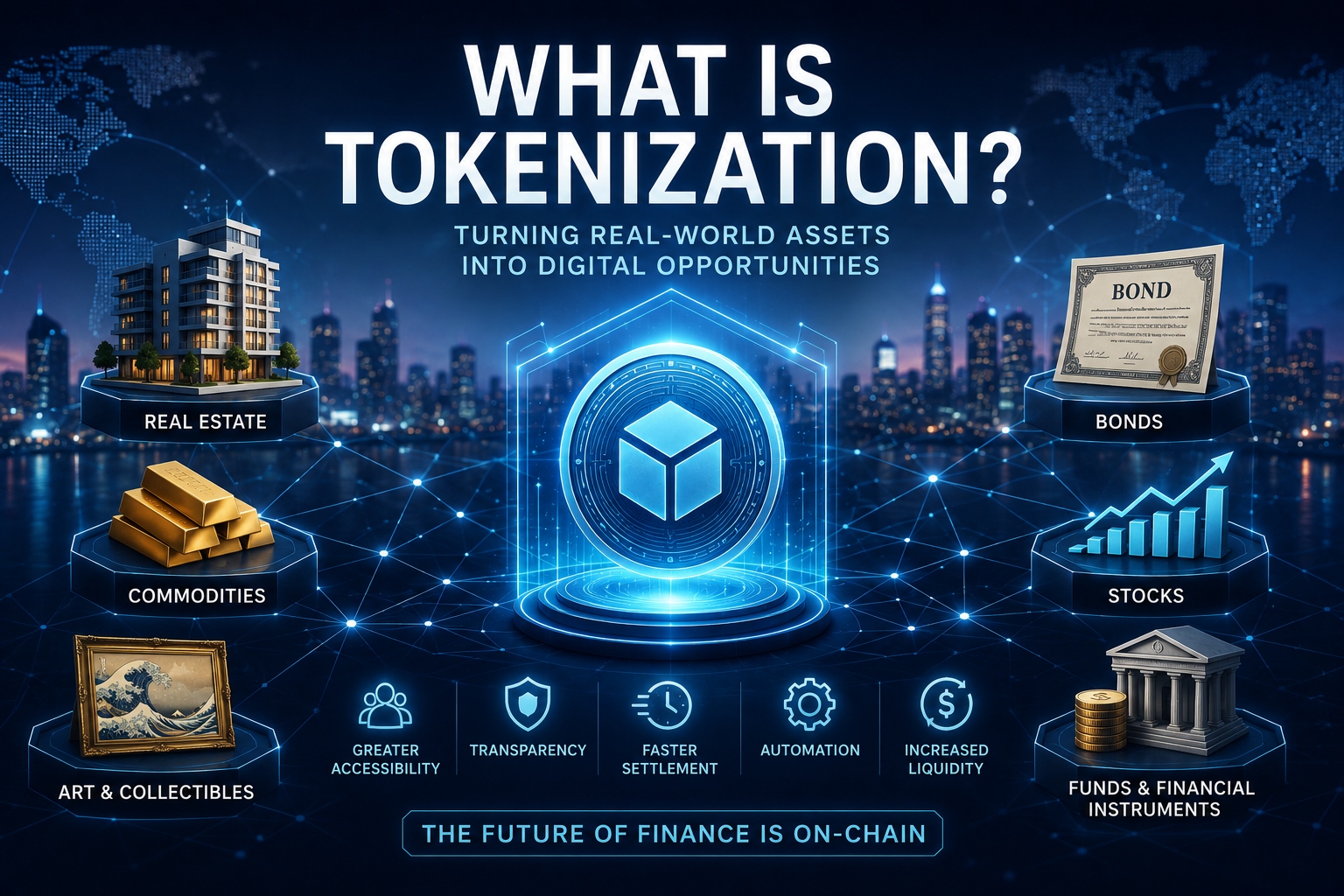
what tokenization is, how it works and why it could reshape finance.
Disclaimer: This article is provided for informational purposes only and does not constitute investment advice. Cryptocurrencies, including the QNT token, are volatile and high-risk assets. Always conduct your own research and never invest more than you can afford to lose.

