
Last updated: October 1, 2026
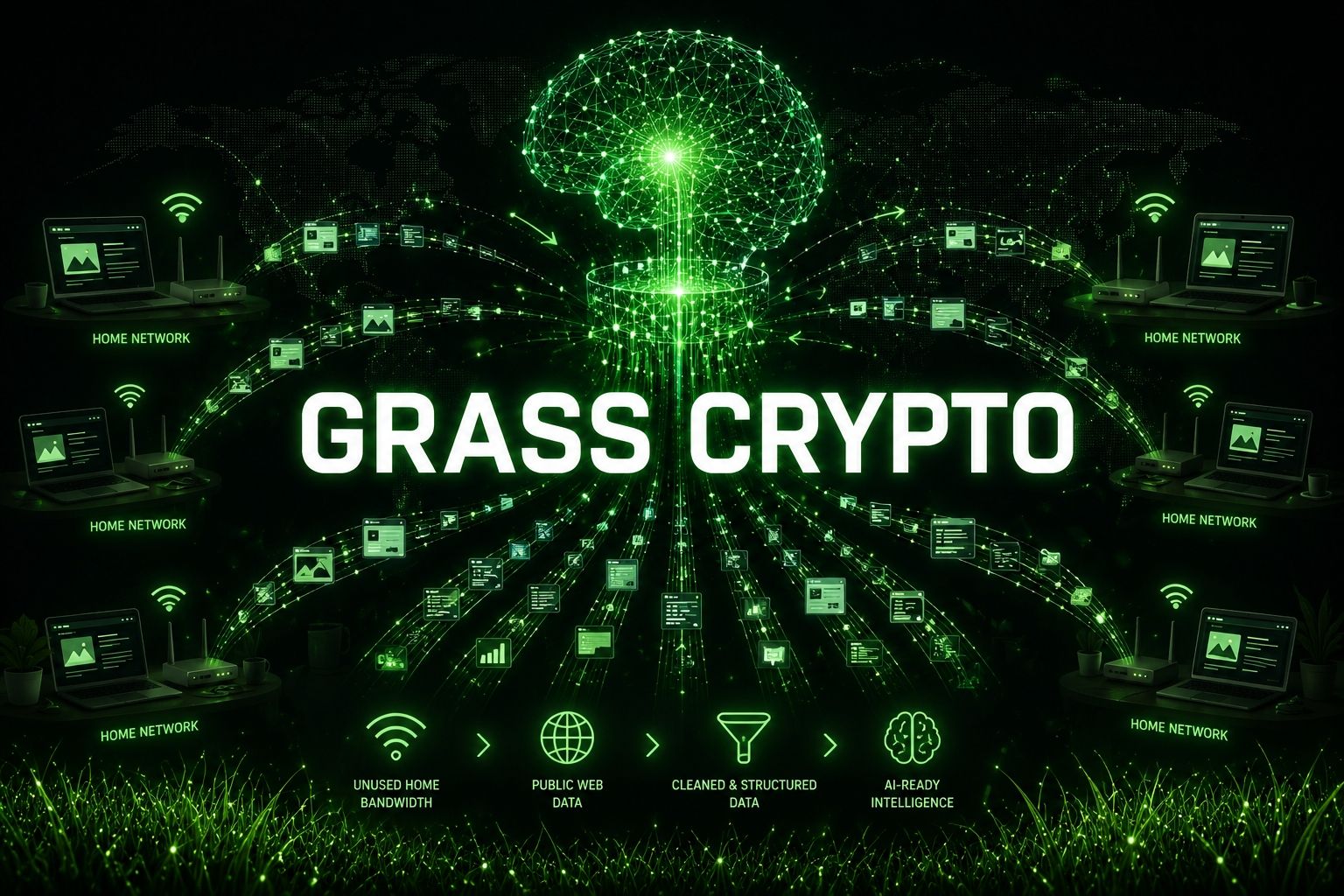
Grass crypto occupies a distinctive position at the intersection of artificial intelligence, decentralized physical infrastructure and web data. Instead of competing directly with AI model developers, the Grass Network supplies something every artificial intelligence system needs: large quantities of current, structured and usable information.
The Grass Network allows participants to share unused internet bandwidth. That distributed capacity can be used by verified organizations to retrieve publicly available information from the web. Grass then processes this raw material into datasets and is working toward live data products designed for artificial intelligence applications. This gives Grass crypto a concrete purpose beyond the AI narrative alone.
The fundamentals have also strengthened. Grass reported $18 million of revenue during the first half of 2026, compared with $17 million during the whole of 2025. In July, the project said it was targeting approximately $65 million to $75 million of 2026 revenue from training data. These are company projections rather than guaranteed results, but they materially change the valuation discussion around the GRASS token.
The token has changed just as dramatically. By October 1, 2026, GRASS was trading around $0.72, more than twice its early-September level. The fundamental story has improved, but the market has already repriced part of that improvement.
The decisive questions are therefore no longer simply whether Grass can generate revenue. Investors must determine whether growth can continue, whether Live Context Retrieval can become commercially significant, how much value ultimately accrues to the GRASS token, and whether demand can absorb future token supply.
The performance of Grass crypto will also depend on broader crypto liquidity and investor interest in AI infrastructure. Follow our DeFi News to understand the market trends that could influence the GRASS token and other decentralized infrastructure projects.
Grass crypto in brief — October 2026
Grass is a decentralized network that uses participants’ unused bandwidth to retrieve public web data for artificial intelligence. Grass reported $18 million of revenue in H1 2026 and projected roughly $65–75 million of 2026 revenue from training data. The GRASS token trades around $0.72, with a maximum supply of 1 billion tokens. The business is growing rapidly, but token value capture, dilution and execution of Live Context Retrieval remain essential variables.
What is Grass crypto?
Grass crypto combines a decentralized bandwidth network with an AI data business and the GRASS token. Participants install an application or run supported software that makes part of their unused internet connection available to the network. Grass can then route authorized public-web requests through this distributed infrastructure.
The economic idea is relatively simple. Households already pay for internet connections that are rarely used at full capacity. Grass aggregates a fraction of this idle bandwidth and transforms it into an infrastructure resource that organizations can purchase.
Participants receive Grass Points and can become eligible for network rewards. Grass has also used USDC for certain distributions, meaning participation does not necessarily result in newly issued GRASS tokens.
Grass describes itself as a data layer for artificial intelligence because its objective extends beyond bandwidth resale. The Grass Network retrieves public-web information, processes it and transforms it into datasets that AI developers can use for model training and potentially real-time inference.
This distinguishes Grass from decentralized computing projects. Akash Network, for example, primarily creates a decentralized market for cloud computing resources. Render coordinates GPU resources for rendering and computing workloads. Grass concentrates primarily on the data entering AI systems.
Why artificial intelligence needs a network like Grass
AI models need enormous quantities of fresh, diverse and high-quality data, not only computing power. A model trained on incomplete or outdated information will produce weaker results regardless of how much computing capacity was used to train it.
Obtaining web data at scale has also become increasingly difficult. Websites use geographic restrictions, rate limits and anti-bot systems, while results can vary depending on geographic location and connection type.
A distributed network of residential internet connections can provide broader geographic coverage than a limited group of centralized data centers.
The Grass Network therefore seeks to solve three connected problems:
- accessing publicly available information across many geographic locations;
- turning unstructured web content into datasets suitable for artificial intelligence;
- sharing part of the economic value with participants supplying network resources.
The Grass crypto thesis is compelling, but residential bandwidth represents only the collection layer. Grass must also deliver reliable data, respect legal and contractual restrictions, filter poor-quality information and offer products that AI developers are willing to purchase repeatedly.
How does the Grass Network work?
Participants supply unused bandwidth
A user downloads the Grass application and connects a compatible device. The software operates in the background and makes unused bandwidth available to the Grass Network.
Grass states that its application cannot access users’ browsing history, passwords, personal files, messages or contacts. In a September 2026 transparency update, the project specified the categories of application data it does collect, including information such as IP address, wallet address, operating system and application identifiers.
Requests are routed through distributed connections
Verified institutions can use the network to retrieve publicly available information. Distributed residential connections make it possible to obtain geographically localized results while reducing dependence on a limited number of centralized IP ranges.
This gives Grass characteristics of a DePIN network because real-world resources—connections, devices and bandwidth—are coordinated through software and economic incentives.
Raw information is converted into AI-ready data
Raw web pages are not automatically useful to an AI model. Data must be collected, cleaned, structured, deduplicated and potentially converted into specific formats.
Grass has therefore invested in its own computing and storage infrastructure.
Its competitive advantage will depend not merely on the number of connected devices but on its ability to transform this distributed access into reliable commercial data products.
Contributors receive rewards
Grass now distinguishes between Uptime Points and Network Points. Uptime Points reward connection availability, while Network Points reflect bandwidth that the network actually uses for data requests.
This distinction is economically important because actual network usage is more directly connected with customer demand than simply leaving a device online.
Users should nevertheless avoid assuming that each Grass Point has a fixed monetary value. Reward mechanisms, eligibility criteria and distribution formats can change.
What is Live Context Retrieval?
Live Context Retrieval, or LCR, is Grass’s attempt to give AI systems access to current web information rather than relying exclusively on historical training datasets.
This could become one of the most important developments for the Grass Network.
Traditional models have a knowledge cutoff. Retrieval technologies can supplement them with information obtained after their original training period.
An AI agent might, for example, require current product availability, recently published information, changing prices or another piece of information that did not exist when the underlying model was trained.
Grass announced in July 2026 that it intended to begin publicly launching products under its LCR umbrella. In late September, Wynd Labs CEO Andrej stated that training data represented Grass’s first product while the longer-term ambition was to give artificial intelligence a live connection to the world’s information.
That distinction matters.
Training datasets can generate large contracts, but live retrieval could potentially create much more frequent usage. Every AI query requiring external context can theoretically generate new data demand.
However, investors should distinguish strategic potential from proven revenue. Grass has demonstrated meaningful revenue from training data, while the commercial contribution of LCR still needs to be measured over time.
Does Grass have real users and revenue?
Yes. Grass reports meaningful commercial revenue and says the network is already profitable.
During its July 2026 network update, Grass disclosed:
- $2.7 million of revenue in the first half of 2025;
- $14.3 million in the second half of 2025;
- approximately $17 million for the whole of 2025;
- approximately $18 million during the first half of 2026;
- a company projection of approximately $65–75 million in 2026 revenue from training data.
The increase from $2.7 million in H1 2025 to approximately $18 million in H1 2026 represents growth of more than 560% year over year.
Grass also stated that the operation had become profitable. Ongoing cash expenses were approximately $2–3 million per month, primarily related to infrastructure, while compute and storage investments made during 2025 were said to have reduced operating expenses by more than $1 million per month.
These figures materially strengthen the fundamental case for Grass crypto. They demonstrate that organizations are paying for products supplied through the network rather than the project relying exclusively on token incentives.
There remains one important limitation: individual AI customers and their contribution to total revenue are not publicly disclosed.
In September 2026, Wynd Labs CEO Andrej stated that Grass supplies data to most of the world’s leading AI laboratories. That is an important claim from the company, but outsiders still cannot independently determine customer concentration or revenue generated by each customer.
The key fundamental question
Grass has already demonstrated that its infrastructure can generate meaningful revenue. The next test is whether it can approach its projected $65–75 million of 2026 training-data revenue, diversify its customer base and establish a measurable connection between commercial growth and value created for the GRASS token.
What is the GRASS token used for?
The GRASS token is the native crypto asset associated with the Grass Network and is issued on Solana.
Its principal functions include contributor incentives, staking, governance and participation in the broader Grass ecosystem.
Rewards for network contributions
GRASS can be used to compensate network contributors. However, Grass has demonstrated that contributor compensation does not necessarily require additional GRASS issuance.
Its Stage 2 participant rewards were distributed in USDC, and Grass specifically stated that this distribution created no new GRASS emissions and did not increase circulating supply.
This is a positive development from the perspective of token dilution.
Staking and network security
GRASS holders can stake tokens within the ecosystem. Staking can produce rewards, but investors must compare those returns with token inflation and market volatility.
A nominal staking yield does not guarantee a positive return measured in dollars.
Governance
GRASS is also intended to provide governance rights.
Governance becomes economically meaningful when token holders control important network parameters, treasury decisions or mechanisms affecting value distribution. The practical authority given to token voting should therefore be monitored over time.
Does the GRASS token capture the network’s revenue?
Grass revenue and GRASS token value are related, but they are not the same thing.
This remains the most important distinction when analyzing Grass crypto.
Grass has stated that its intellectual property, customer contracts and commercial relationships remain within the network structure rather than being transferred into a separate equity-funded company. Wynd Labs operates as a service provider.
Grass has also said that it has not raised conventional equity capital.
This alignment is potentially favorable for token holders compared with a structure where adoption occurs through a token while most commercial value accumulates inside a separate private company.
Nevertheless, network revenue does not automatically become cash distributed to GRASS holders.
Revenue is currently used partly to operate and expand the infrastructure. The value of GRASS will ultimately depend on mechanisms connecting network activity to staking demand, incentives, governance, treasury assets or token supply.
The GRASS token should therefore not be valued exactly like company equity. Token holders do not automatically possess shareholder rights, and network revenue is not a dividend.
GRASS tokenomics and dilution
GRASS has a maximum supply of 1 billion tokens, making future supply an important part of the investment analysis.
The original token allocation consists of:
- 30% for the community, including incentives, airdrops and router rewards;
- 25.2% for early investors;
- 22.8% for the foundation and ecosystem growth;
- 22% for contributors.
The community receives a substantial allocation, but investors and contributors together represent 47.2% of maximum supply. Unlock schedules therefore continue to matter.
As of October 1, 2026, CoinGecko reported approximately 699.5 million GRASS in circulating supply, against a maximum supply of 1 billion.
This means approximately 70% of maximum supply was counted as circulating by CoinGecko.
Investors should note that circulating-supply figures can differ substantially between market-data providers depending on how unlocked, vested or foundation-controlled tokens are classified. For valuation consistency, the market figures used in this article are based on CoinGecko.
The use of USDC for Stage 2 rewards is particularly relevant because Grass stated that this distribution did not create additional GRASS emissions.
Future incentive programs will be positive for token holders only if the economic activity they create is sufficient to offset the effect of additional supply becoming liquid.
Grass crypto price in October 2026
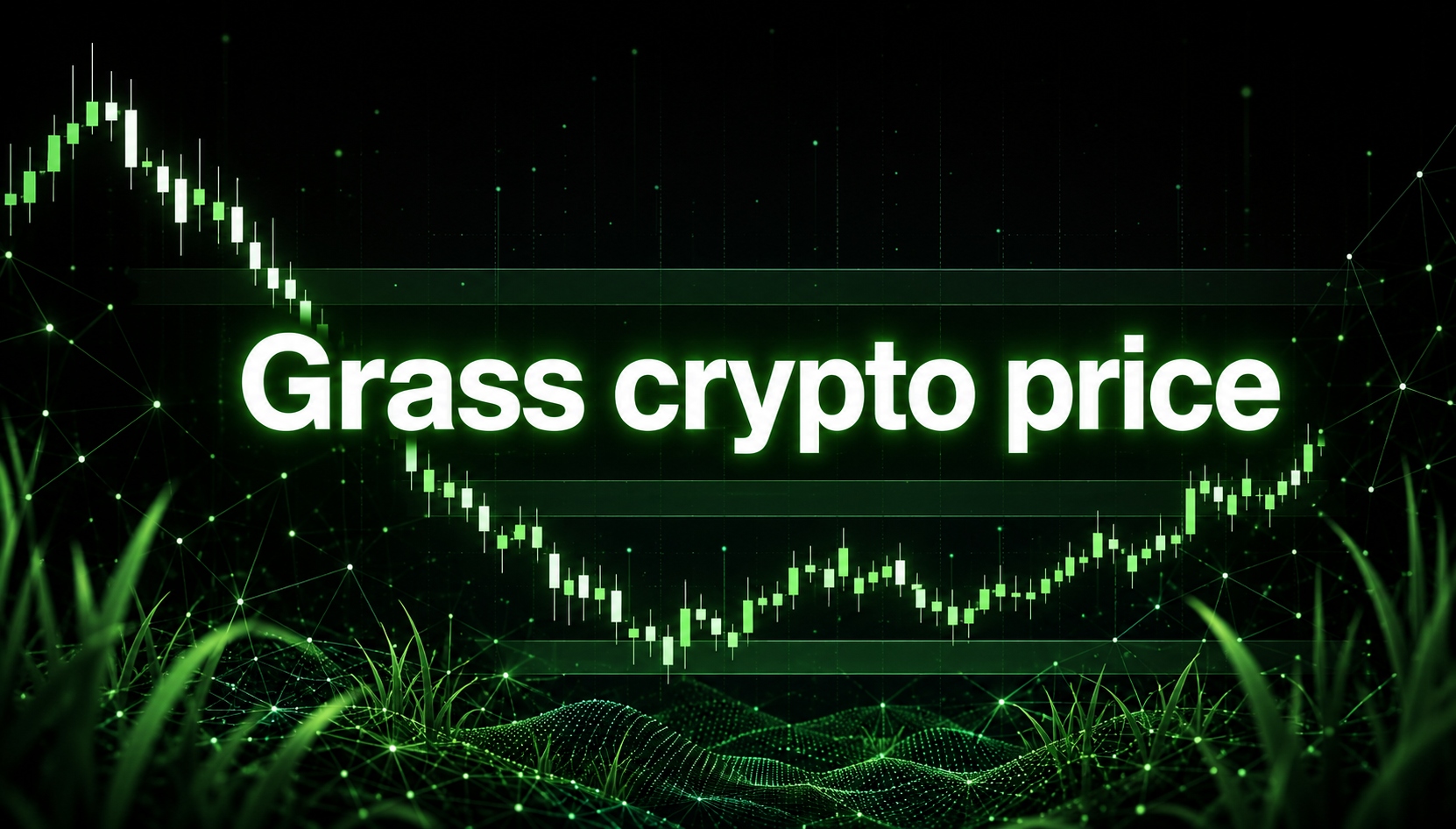
GRASS experienced a major repricing during September 2026.
Around October 1, the Grass crypto price was approximately $0.72. CoinGecko reported:
- price around $0.72;
- market capitalization around $504 million;
- fully diluted valuation around $721 million;
- 24-hour trading volume around $101 million;
- circulating supply around 699.5 million GRASS;
- maximum supply of 1 billion GRASS.
The change from early September has been substantial. GRASS traded around $0.34–$0.35 during the first days of September before accelerating sharply during the final third of the month.
CoinGecko’s recent data showed an increase of more than 100% over 30 days.
GRASS reached a previous all-time high of approximately $3.90 in November 2024 and an all-time low around $0.166 in February 2026.
At approximately $0.72, GRASS remains roughly 81% below its former record, but it is already more than four times its 2026 low.
The former all-time high should not be interpreted automatically as a price target. More GRASS is now circulating than during the early life of the token, meaning the same nominal token price would correspond to a much larger overall valuation.
GRASS price analysis: is there still an opportunity after the rally?
Market assessment — updated October 1, 2026
At approximately $0.72, the fundamental case for the GRASS token is stronger than it was at the beginning of September, but the valuation is also considerably higher.
Grass generated approximately $18 million in H1 2026. Simply annualizing that figure produces about $36 million of revenue. With a market capitalization near $504 million and a fully diluted valuation around $721 million, GRASS trades at approximately 14 times annualized H1 revenue on market capitalization and around 20 times annualized H1 revenue on FDV.
The picture is different if Grass achieves its own 2026 training-data revenue target of $65–75 million. Using that range, the current market capitalization represents roughly 6.7–7.8 times projected 2026 revenue, while FDV corresponds to approximately 9.6–11.1 times projected revenue.
These ratios can help compare valuation with commercial activity, but GRASS is not company equity. Network revenue does not represent earnings attributable directly to token holders.
Technically, the rapid September advance has changed the risk profile. The first support area now lies around $0.68–$0.70. Below it, the former breakout region around $0.60–$0.65 becomes more important, followed by approximately $0.50–$0.52.
The nearest significant resistance is around $0.77–$0.81, corresponding to the late-September highs. A sustained breakout above that region could bring the psychological $0.90–$1.00 zone into focus.
Current conclusion: GRASS now combines rapidly improving fundamentals with much stronger price momentum, but buying conditions are less favorable than they were near $0.30–$0.35 because the token has already repriced sharply. Consolidation above $0.60–$0.70 would strengthen the medium-term structure, while failure to hold the breakout zone would increase correction risk.
GRASS valuation scenarios based on market capitalization
Valuation scenarios are more informative than assigning an arbitrary future price target to GRASS. With a maximum supply of 1 billion tokens, the relationship between fully diluted valuation and token price is particularly simple.
| Fully diluted valuation | Implied GRASS price | Interpretation |
|---|---|---|
| $500 million | $0.50 | Below the October 2026 valuation and compatible with a significant market correction. |
| $750 million | $0.75 | Close to the current fully diluted valuation. |
| $1 billion | $1.00 | Would require continued commercial growth and confidence in token value capture. |
| $3 billion | $3.00 | Would require Grass to become a major AI data infrastructure provider. |
These are valuation illustrations rather than GRASS price predictions. Crypto markets frequently trade significantly above or below levels implied by fundamental metrics.
What could drive the GRASS token higher?
Reaching the 2026 revenue target
Grass’s own projection of $65–75 million in 2026 training-data revenue represents a substantial acceleration from $17 million in 2025.
Confirmation that revenue is approaching this range would provide stronger evidence that the rapid growth recorded in H1 was sustainable.
Commercial adoption of Live Context Retrieval
LCR could expand Grass from training datasets toward recurring AI inference demand.
If AI systems query Grass continuously for current information, the commercial opportunity could become significantly larger and more recurring.
Stronger token value capture
Clearer mechanisms connecting commercial activity with staking, governance, treasury value or token demand would reduce one of the principal uncertainties surrounding GRASS.
Growth in productive network usage
The number of registered users is less important than actual economic usage.
Investors should increasingly watch data volume, Network Points, paying customers, customer retention and repeat usage rather than downloads or referrals alone.
Continued demand for independent AI data
AI laboratories increasingly need large volumes of diverse and continuously refreshed public information. If this demand continues growing, infrastructure capable of collecting data at global scale could become strategically valuable.
Principal risks of investing in Grass crypto
Valuation after the September rally
GRASS has more than doubled from its early-September levels. Strong price appreciation reduces the margin of safety available to new investors and increases the possibility of sharp corrections.
Token dilution
The maximum supply remains 1 billion GRASS. Future unlocks and incentive allocations can place pressure on the market if demand does not grow at a comparable rate.
Uncertain value capture
The Grass Network can potentially become commercially successful without the GRASS token appreciating proportionally.
Investors should therefore monitor how revenue, staking, incentives, governance and treasury value interact.
Customer concentration and limited disclosure
Grass does not publicly disclose the individual AI laboratories buying its datasets or the proportion of revenue generated by each customer.
The company says it supplies many leading AI laboratories, but customer concentration cannot currently be verified independently.
Execution risk for LCR
Live Context Retrieval is strategically attractive, but commercial adoption still needs to be demonstrated.
A promising product roadmap should not be treated as equivalent to recurring revenue.
Legal and regulatory questions
Large-scale collection of public web information can involve copyright, database rights, contractual restrictions and data-protection legislation.
Legal frameworks surrounding web scraping and AI training data continue to evolve.
Privacy and network-abuse concerns
Grass states that users’ browsing history, passwords and private files are inaccessible and that institutional customers are verified.
Nevertheless, any infrastructure using residential IP addresses must maintain rigorous screening, monitoring and abuse-prevention systems.
Competition
Grass competes with centralized web-data companies, proxy networks, specialized data providers and other decentralized infrastructure networks.
Large AI laboratories can also develop internal collection infrastructure or negotiate directly with content providers.
Dependence on the AI crypto narrative
GRASS remains a cryptocurrency. Its price can decline sharply even while operational metrics improve if crypto liquidity contracts or investor attention moves away from AI-related tokens.
Grass compared with other AI crypto projects
Grass occupies the data layer of the decentralized AI infrastructure stack rather than competing directly with every AI token.
- Bittensor creates decentralized markets in which specialized subnets compete to supply forms of machine intelligence.
- Render coordinates distributed GPU resources for rendering and computing workloads.
- Akash Network offers a decentralized cloud computing marketplace.
- Artificial Superintelligence Alliance develops decentralized AI services, agents and infrastructure through the FET ecosystem.
- Grass Network concentrates primarily on public-web data collection, processing and eventually live contextual retrieval.
These projects therefore occupy different parts of the AI infrastructure stack.
Readers interested in the broader sector can explore our analysis of crypto AI opportunities.
Is Grass crypto a good investment?
Grass crypto combines stronger fundamentals than many AI tokens with substantial crypto-market risk.
The project has several measurable advantages: a working product, millions of participants, paying customers, rapidly growing reported revenue and a clear strategic role in supplying data to artificial intelligence systems.
Grass reported approximately $18 million in H1 2026 revenue and has projected $65–75 million of full-year training-data revenue.
That commercial progress differentiates it from AI crypto projects that depend mainly on future promises.
However, the GRASS token has already undergone a significant repricing. Around $0.72, valuation is materially higher than it was when GRASS traded around $0.30–$0.35.
Investors must also accept uncertainty surrounding token value capture, future supply, customer concentration and LCR execution.
The most useful indicators to follow are therefore:
- 2026 and 2027 revenue growth;
- progress toward the $65–75 million 2026 revenue projection;
- commercial adoption of Live Context Retrieval;
- customer diversification;
- actual bandwidth and data usage;
- token unlocks and circulating supply;
- changes connecting network revenue more directly with GRASS.
Our assessment — October 2026
Grass now has one of the more substantial fundamental cases among smaller AI infrastructure tokens. Revenue is real, growth has accelerated sharply and the project is targeting a strategically important market: supplying fresh web data to AI systems.
The investment case has nevertheless become more demanding after GRASS more than doubled during September. The next phase must demonstrate that revenue can continue growing and, crucially, that commercial success creates durable economic value for the GRASS token.
FAQ about Grass crypto and the GRASS token
What is Grass crypto?
Grass crypto refers to the Grass Network and its associated GRASS token. The network uses distributed unused internet bandwidth to retrieve public-web information and transform it into data products for artificial intelligence.
What is the Grass crypto price?
As of October 1, 2026, GRASS trades around $0.72. Cryptocurrency prices can change rapidly, so current market data should always be checked before making financial decisions.
Is Grass an AI crypto project?
Yes. Grass does not build a general-purpose AI model itself. It supplies public-web data infrastructure used for training artificial intelligence and is developing Live Context Retrieval for real-time AI applications.
Does Grass have real revenue?
Yes. Grass reported approximately $17 million of revenue in 2025 and $18 million during the first half of 2026. In July 2026, it projected approximately $65–75 million of full-year revenue from training data.
What is Live Context Retrieval?
Live Context Retrieval, or LCR, is Grass’s planned infrastructure for providing AI systems with current web information at inference time rather than relying exclusively on historical training data.
What is the GRASS token used for?
GRASS is used for ecosystem incentives, staking and governance. Investors should monitor whether these functions create a stronger economic connection between network revenue and token demand.
What is the maximum GRASS supply?
The maximum supply is 1 billion GRASS. CoinGecko reported approximately 699.5 million tokens in circulating supply around October 1, 2026.
Does Grass issue new GRASS tokens for every contributor reward?
No. Grass distributed its Stage 2 participant rewards in USDC and stated that the distribution created no new GRASS emissions or increase in circulating supply.
Is the Grass application safe?
Grass states that its application cannot access browsing history, passwords, personal files, messages or contacts. Users should nevertheless download software only from official sources, review permissions and recognize that no networked software is completely free of security risk.
Can GRASS return to its all-time high?
GRASS previously traded around $3.90, but a return to that nominal price is not guaranteed. Because token circulation has changed substantially since 2024, investors should compare market capitalization and fully diluted valuation rather than relying solely on the former token price.
What are the key GRASS price levels in October 2026?
Around October 1, the first technical support is approximately $0.68–$0.70, followed by $0.60–$0.65. The principal near-term resistance lies around $0.77–$0.81. These zones can change rapidly as volatility and trading volume evolve.
Conclusion: Grass is becoming a measurable AI data business
Grass crypto has evolved from an experimental DePIN concept into a network reporting meaningful commercial activity.
Participants provide unused bandwidth, the Grass Network uses its distributed infrastructure to access public-web information, and Grass transforms that information into products designed for artificial intelligence.
The fundamental progression is significant. Revenue increased from approximately $17 million in 2025 to $18 million in the first half of 2026 alone, while Grass has projected $65–75 million of training-data revenue for the full year.
Its next strategic challenge is Live Context Retrieval. If Grass can extend its infrastructure from AI training datasets into continuous, real-time information retrieval, the potential addressable market could become considerably larger.
For the GRASS token, however, the central question remains value capture.
The network can grow quickly while token investors still face dilution, volatility and an imperfect connection between commercial revenue and token economics.
At approximately $0.72, the market is already assigning Grass a much higher valuation than it did only a few weeks earlier. Future performance will therefore depend increasingly on execution rather than narrative alone.
Grass crypto remains a project worth monitoring because its fundamental metrics can now be measured: revenue, operating costs, network usage, circulating supply and eventually LCR adoption.
Those metrics—not social-media enthusiasm—will determine whether the Grass Network can evolve into an important infrastructure layer for artificial intelligence and whether that success ultimately benefits the GRASS token.
Sources and data verification
Fundamental information in this article was cross-checked against Grass Network publications, including the July 2026 H1 network update and September 2026 updates from Wynd Labs. Market price, capitalization, volume and circulating-supply data were checked against CoinGecko on October 1, 2026.
Grass Network — H1 2026 network and token holder update
Grass / Wynd Labs — Abundant Intelligence, September 28, 2026
Grass — application access and privacy update, September 24, 2026
Important disclaimer
This article is provided for informational purposes only. It does not constitute investment advice, financial advice or a recommendation to buy or sell GRASS or any other cryptocurrency. Crypto assets are volatile and can result in a total loss of capital. Always conduct your own research and consider your financial situation and tolerance for risk.


Trader, investor and author specializing in cryptocurrencies, DeFi and Web3.
On Mediasnet, I share my market analysis, practical guides and research on crypto markets, decentralized protocols and emerging trends across the ecosystem.
Follow me on: Facebook – X (Twitter)