
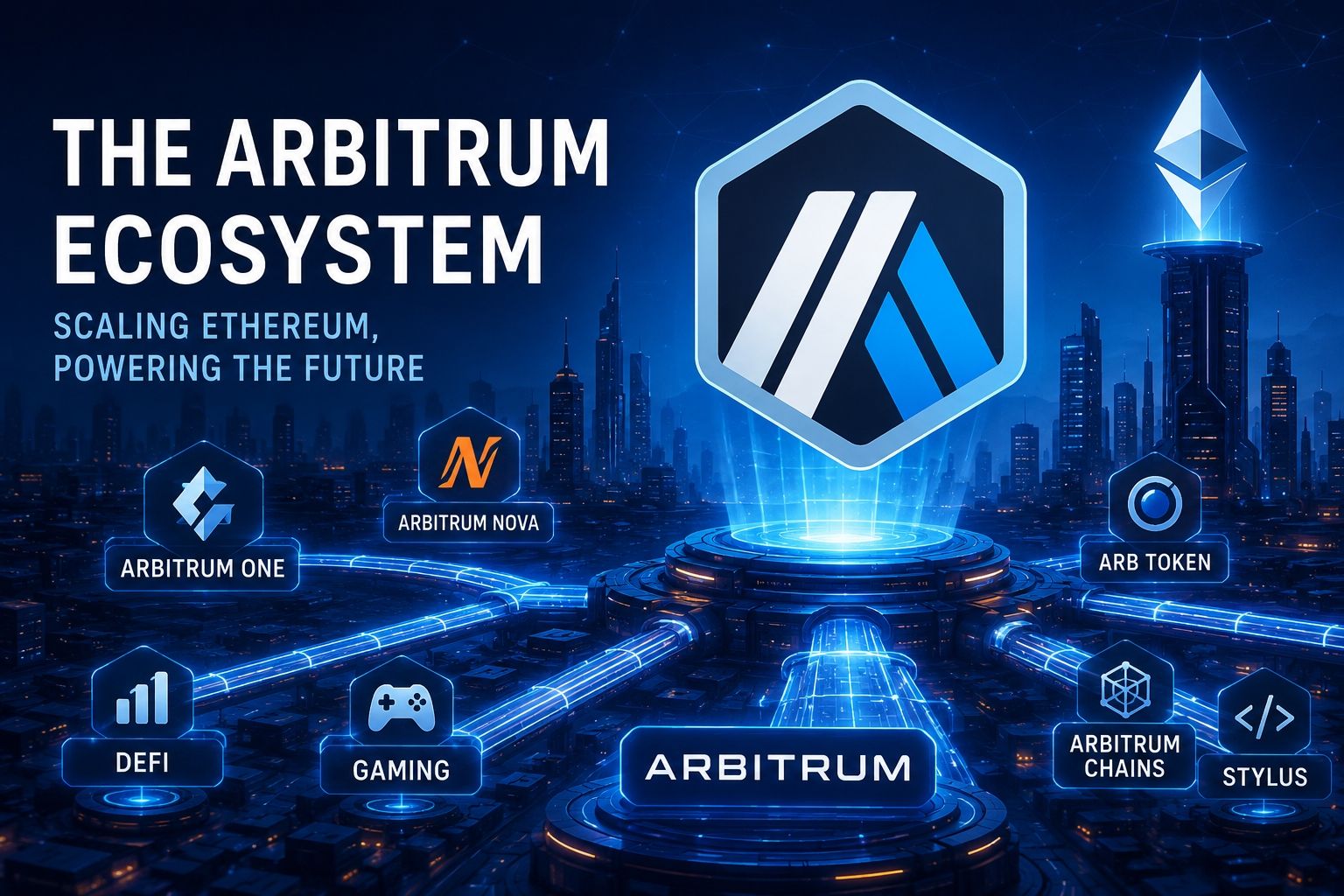
The Arbitrum ecosystem has become one of Ethereum’s most important scaling environments, designed to reduce transaction costs and increase throughput while continuing to rely on Ethereum for settlement and security. Ethereum remains the dominant infrastructure for smart contracts and decentralized applications, but scalability has long been one of its main challenges. The Arbitrum Layer 2 architecture addresses this problem by moving much of the transaction execution away from Ethereum’s base layer.
Today, Arbitrum has evolved far beyond a single scaling network. The platform includes Arbitrum One, Arbitrum Nova, the Nitro technology stack, Stylus, customizable Arbitrum Chains and the ARB governance token.
This makes Arbitrum one of the most comprehensive Ethereum scaling environments available to developers and users. Rather than competing directly with Ethereum, the Arbitrum Layer 2 architecture is designed to expand Ethereum’s capacity and make blockchain applications faster and less expensive to use.
But how does Arbitrum actually work, what makes its ecosystem different from other Ethereum Layer 2 networks, and what role does the ARB token play?
This guide explores the technology behind Arbitrum, its expanding blockchain ecosystem, its advantages and limitations, and the factors that could influence its long-term development.
What Is Arbitrum?
Arbitrum is a blockchain scaling platform designed primarily to increase the capacity of Ethereum. Instead of asking Ethereum’s Layer 1 network to execute every operation directly, Arbitrum processes transactions in a separate environment and ultimately settles the resulting data and state commitments through Ethereum.
This approach can significantly reduce transaction costs while allowing applications to retain a strong connection to Ethereum’s security and liquidity.
The best-known network within the Arbitrum ecosystem is Arbitrum One, an Ethereum Layer 2 blockchain based on optimistic rollup technology.
However, Arbitrum is no longer accurately described as simply one Layer 2 chain.
Its broader infrastructure now includes:
- Arbitrum One – the main general-purpose optimistic rollup;
- Arbitrum Nova – an AnyTrust chain optimized for applications requiring particularly low transaction costs;
- Arbitrum Nitro – the underlying technology stack powering Arbitrum networks;
- Stylus – a MultiVM execution environment expanding the programming languages developers can use;
- Arbitrum Chains – customizable blockchain networks built with Arbitrum technology;
- BoLD – a dispute protocol designed to support permissionless validation;
- and the ARB token, which plays a central role in governance through the Arbitrum DAO.
These different components explain why the term Arbitrum ecosystem has become increasingly appropriate. Arbitrum is developing into an infrastructure stack on which applications and even other blockchain networks can be built.
Why Does Ethereum Need Layer 2 Networks?
Ethereum offers a highly developed smart-contract ecosystem, but its base layer has finite block space. When demand increases, users compete to have their transactions included, which can result in higher transaction fees.
Simply increasing Layer 1 capacity indefinitely can introduce other problems. More demanding hardware requirements could make running infrastructure more difficult and potentially weaken decentralization.
Ethereum’s scaling strategy therefore relies heavily on Layer 2 networks.
A Layer 2 executes activity outside the main Ethereum execution layer while using Ethereum as an underlying settlement and security layer.
The objective is relatively simple:
- process more transactions;
- reduce the average cost per transaction;
- preserve compatibility with Ethereum;
- and allow Ethereum Layer 1 to remain the settlement foundation.
The Arbitrum Layer 2 architecture is one implementation of this broader scaling model.
How Does the Arbitrum Layer 2 Work?
Arbitrum One uses a technology known as an optimistic rollup.
Rather than executing every transaction directly on Ethereum, transactions are processed on Arbitrum. The resulting transaction information is then bundled and ultimately connected back to Ethereum.
The word “optimistic” refers to the way the protocol handles transaction validity. Results are generally accepted unless they are challenged through the protocol’s dispute mechanism.
Transactions are executed outside Ethereum Layer 1
Users interact directly with applications deployed on Arbitrum. Transactions can include token transfers, decentralized exchange trades, lending operations, smart-contract interactions, gaming transactions and many other blockchain activities.
Executing this activity on Arbitrum reduces the amount of computation that must be performed directly by Ethereum Layer 1.
Transactions are ordered by the sequencer
A sequencer provides users with rapid transaction ordering and confirmations.
This is one reason interacting with an Arbitrum Layer 2 application can feel considerably faster than waiting for conventional Layer 1 settlement.
The existence of sequencer infrastructure also represents an important aspect of Layer 2 design and decentralization. Arbitrum’s architecture continues to evolve as the project develops mechanisms aimed at improving resilience, validation and transaction ordering.
Data and state are ultimately connected to Ethereum
The rollup periodically publishes the information required by the protocol to Ethereum.
Ethereum therefore remains the underlying settlement layer rather than Arbitrum attempting to replace it with an entirely independent validator network.
This relationship is fundamental to understanding the Arbitrum ecosystem: its value proposition depends heavily on access to Ethereum’s established security, assets, infrastructure and developer community.
Incorrect claims can be challenged
Optimistic rollups require a dispute mechanism capable of identifying an invalid state transition.
Arbitrum has developed BoLD, or Bounded Liquidity Delay, as its modern dispute protocol. BoLD enables permissionless validation and is active on Arbitrum One and Arbitrum Nova.
This is an important evolution because the security of an optimistic rollup depends not only on processing transactions efficiently but also on maintaining a credible mechanism for challenging incorrect assertions.
What Is Arbitrum Nitro?
Nitro is the core technology stack behind modern Arbitrum networks.
It was developed as a more efficient generation of the Arbitrum architecture and provides an Ethereum-compatible execution environment while improving transaction throughput and rollup performance.
One of Nitro’s major characteristics is its close compatibility with Ethereum tooling.
This matters because developers do not necessarily need to rebuild an application from scratch simply because they want to deploy it on the Arbitrum Layer 2.
Ethereum developers can continue using familiar smart-contract languages, development frameworks, wallets and infrastructure.
Compatibility reduces one of the largest barriers facing alternative blockchains: convincing developers to abandon tools and expertise they already possess.
Nitro also forms the technological foundation used to create customized Arbitrum Chains, extending its importance beyond Arbitrum One itself.
Arbitrum One: The Core of the Arbitrum Ecosystem
Arbitrum One is the central general-purpose blockchain within the Arbitrum ecosystem.
It is an optimistic rollup that settles on Ethereum and is designed for applications seeking lower costs and greater throughput without moving to an entirely independent Layer 1 blockchain.
Arbitrum One supports the Ethereum Virtual Machine, meaning Ethereum smart contracts can be deployed in an environment that remains highly familiar to developers.
This has helped create an ecosystem spanning multiple blockchain sectors.
Decentralized finance
DeFi has historically been one of the most important use cases for Arbitrum.
Lower transaction costs can be particularly useful for decentralized finance because DeFi users often need to perform several separate on-chain actions, including deposits, swaps, collateral management, borrowing, repayments and liquidity operations.
Reducing the cost of each operation can make more complex financial applications practical for a broader group of users.
Decentralized exchanges and derivatives
Trading applications can benefit from faster transaction processing and lower fees.
Arbitrum has consequently attracted decentralized exchanges, perpetual trading protocols and other applications seeking an execution environment better suited to frequent financial transactions than Ethereum Layer 1 alone.
Stablecoins and payments
Stablecoins are another important component of the ecosystem.
Lower transaction costs make Layer 2 networks potentially more suitable for payments, transfers and settlement applications where paying a large fee relative to the transaction value would be impractical.
Gaming and consumer applications
Blockchain games and consumer applications can generate a very large number of relatively small transactions.
Such applications are difficult to operate efficiently when every interaction requires an expensive Layer 1 transaction. The scalability offered by Arbitrum can therefore support use cases extending beyond conventional DeFi.
What Is Arbitrum Nova?
Arbitrum Nova is another Ethereum Layer 2 network within the broader Arbitrum ecosystem, but it makes a different trade-off from Arbitrum One.
Instead of using the standard Arbitrum Rollup model for data availability, Nova uses a system called AnyTrust.
AnyTrust reduces costs by introducing an additional trust assumption involving a Data Availability Committee.
This distinction is important.
Arbitrum One is designed for applications prioritizing Ethereum’s trustless data-availability properties, while Nova can be attractive for applications where extremely low transaction costs are particularly important and the additional trust assumption is acceptable.
Potential use cases include:
- gaming;
- social applications;
- high-volume consumer applications;
- microtransactions;
- and other systems processing a very large number of low-value interactions.
Arbitrum One and Nova therefore should not necessarily be seen as direct competitors. They represent different configurations of Arbitrum technology for different requirements.
Arbitrum Chains: From Layer 2 to a Broader Blockchain Platform
One of the most important developments in understanding modern Arbitrum is the expansion of Arbitrum Chains.
Projects can use the Nitro codebase to build customized chains rather than deploying every application directly on Arbitrum One.
This creates a much broader vision for the Arbitrum ecosystem.
Instead of hosting only decentralized applications, Arbitrum technology can provide infrastructure for dedicated blockchain networks.
Why would a project launch its own Arbitrum Chain?
A dedicated chain can give developers greater control over how their blockchain operates.
Depending on its configuration, a team can customize elements such as:
- transaction fees;
- block times;
- data availability;
- sequencing;
- governance;
- permissioning;
- execution rules;
- and the token used to pay gas fees.
This flexibility can be useful for applications that eventually outgrow a shared blockchain environment or require specialized infrastructure.
Rollup or AnyTrust
An Arbitrum Chain can be configured around different data-availability and security models.
A project may choose a Rollup configuration when it wants data availability anchored directly to the parent chain, or an AnyTrust configuration when lower fees justify an additional data-availability trust assumption.
This allows developers to choose different points on the scalability, cost and trust spectrum instead of being forced into one universal blockchain design.
Custom gas tokens
Dedicated Arbitrum Chains can also support customized gas economics.
This means a project may be able to design its chain so users pay transaction fees using a selected ERC-20 token rather than requiring every application to follow exactly the same gas model.
For projects building their own economic ecosystems, this additional flexibility can become strategically important.
What Is Arbitrum Stylus?
Stylus expands the programming environment available within the Arbitrum ecosystem.
Traditional Ethereum development revolves primarily around the Ethereum Virtual Machine and smart-contract languages such as Solidity.
Stylus adds another virtual machine alongside the EVM rather than replacing it.
This approach is known as MultiVM.
Developers can use tools including Rust to build smart contracts that interact with the same blockchain state as conventional EVM contracts.
This has several potential advantages.
A larger developer base
Rust is widely used outside the traditional Ethereum development community.
Supporting additional programming environments can therefore make blockchain development accessible to developers who may not specialize in Solidity.
More complex applications
Different programming environments can be better suited to different computational workloads.
Expanding the available execution environment may make it easier for developers to experiment with applications that would be more difficult or expensive to implement using conventional EVM execution alone.
Compatibility rather than replacement
Importantly, Stylus does not require the Arbitrum ecosystem to abandon Ethereum compatibility.
EVM contracts continue to operate while Stylus adds another execution option alongside them.
This combination of compatibility and experimentation could become one of Arbitrum’s more important technological differentiators.
What Is BoLD and Why Does It Matter?
BoLD stands for Bounded Liquidity Delay.
It is Arbitrum’s dispute protocol for optimistic rollups and has been designed to make validation permissionless while ensuring that disputes can be resolved within bounded timeframes.
In simplified terms, validators can challenge an incorrect assertion about the state of an Arbitrum chain.
When participants disagree, the protocol progressively narrows the disagreement until the disputed computation can be verified.
For users, the technical details may appear distant from everyday transactions, but the mechanism is fundamental to the security model.
An optimistic rollup only works securely if incorrect state claims can reliably be detected and challenged.
BoLD therefore represents part of Arbitrum’s broader effort to strengthen the decentralized validation architecture supporting its networks.
What Is Timeboost?
Another component of Arbitrum’s evolving infrastructure is Timeboost, a transaction-ordering mechanism developed for Arbitrum Chains.
Blockchain transaction ordering can create opportunities for Maximal Extractable Value, commonly known as MEV.
Timeboost introduces an express-lane mechanism through which participants can bid for faster transaction inclusion while the network retains its underlying block-time structure.
The design is intended to help chain operators capture part of the economic value associated with transaction ordering while reducing certain forms of latency competition and harmful MEV behavior.
Timeboost is particularly relevant because it illustrates how the Arbitrum technology stack is becoming increasingly modular. A chain built using Arbitrum technology does not simply inherit a fixed set of parameters; operators can make choices about how parts of the blockchain should function.
What Is the ARB Token Used For?
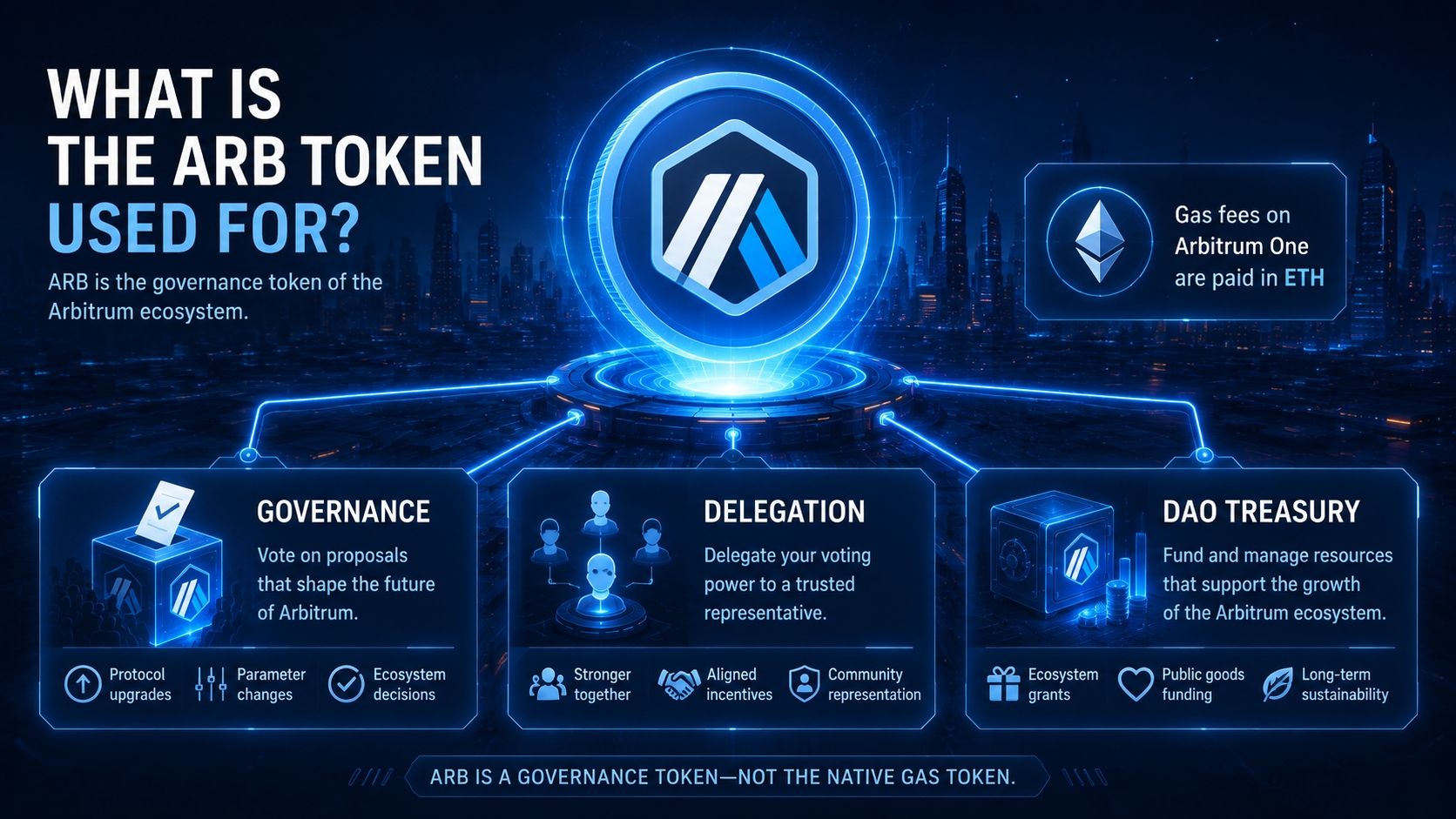
ARB is the governance token associated with the Arbitrum DAO.
This distinction is important because ARB should not automatically be treated as the equivalent of ETH within the network.
On Arbitrum One, ETH is used to pay transaction fees. ARB’s primary function is governance.
ARB holders can participate in decisions affecting the protocols and resources governed by the Arbitrum DAO.
Governance voting
ARB token holders can vote on Arbitrum Improvement Proposals and other governance decisions.
Voting power is token-weighted, meaning the amount of voting power represented by a wallet depends on the ARB delegated to it.
Delegation
Token holders do not necessarily need to participate personally in every governance decision.
Voting power can be delegated to representatives who actively participate in the Arbitrum DAO.
DAO treasury
The Arbitrum DAO controls treasury resources that can be allocated through governance decisions to ecosystem development and other initiatives.
This gives ARB an important role in determining how resources controlled by the DAO are deployed.
ARB is not the normal gas token on Arbitrum One
This is one of the most common misconceptions surrounding the token.
Users normally pay gas fees on Arbitrum One using ETH, not ARB.
Consequently, increased usage of Arbitrum does not automatically translate into direct ARB demand in the same way that activity on Ethereum creates demand for ETH to pay network fees.
This distinction should be considered when evaluating the relationship between growth of the Arbitrum ecosystem and the ARB token itself.
Arbitrum Ecosystem vs Ethereum
Arbitrum and Ethereum are not straightforward competitors.
Ethereum is the Layer 1 blockchain, while Arbitrum is designed to scale Ethereum by executing activity more efficiently above it.
The relationship can be summarized as follows:
| Feature | Ethereum | Arbitrum One |
|---|---|---|
| Blockchain layer | Layer 1 | Layer 2 |
| Main role | Settlement and base-layer security | Scalable execution |
| Smart contracts | Yes | Yes |
| EVM compatibility | Native EVM | Highly Ethereum compatible |
| Typical transaction cost | Generally higher | Generally lower |
| Gas token | ETH | ETH |
| Governance token | No equivalent protocol governance token | ARB for Arbitrum DAO governance |
| Settlement | Ethereum itself | Ethereum |
The success of the Arbitrum Layer 2 therefore does not require Ethereum to fail. In many respects, the opposite is true: stronger Ethereum adoption can increase the need for scalable execution environments.
Advantages of the Arbitrum Ecosystem
Arbitrum has several structural advantages that have helped it establish a major position within Ethereum’s scaling landscape.
Lower transaction costs
Moving execution away from Ethereum Layer 1 allows many operations to be performed at significantly lower costs.
This is especially relevant for DeFi, gaming and other applications requiring frequent smart-contract interactions.
Ethereum compatibility
Developers can use much of the tooling and knowledge already developed around Ethereum.
This reduces friction for projects seeking to expand onto a Layer 2 network.
Access to the Ethereum economy
Arbitrum exists within the broader Ethereum environment rather than attempting to create an entirely isolated blockchain economy.
That provides access to Ethereum users, assets, wallets, stablecoins and development infrastructure.
A broad technology stack
Arbitrum now extends beyond a single optimistic rollup.
Nitro, Stylus, AnyTrust, BoLD, Timeboost and customizable Arbitrum Chains give developers several infrastructure options inside the same technological family.
Customizable chains
Projects can build dedicated networks while retaining access to Arbitrum technology and the wider Ethereum ecosystem.
This gives Arbitrum an opportunity to participate not only in the Layer 2 market but also in the growing market for application-specific blockchain infrastructure.
Risks and Limitations of Arbitrum
Despite its strengths, Arbitrum is not without risks.
Strong competition between Ethereum Layer 2 networks
The Ethereum scaling sector is highly competitive.
Arbitrum must compete for developers, users and liquidity with other rollups and scaling platforms, including both optimistic and zero-knowledge technologies.
Being an established Layer 2 does not guarantee permanent dominance.
Complexity
The growing Arbitrum ecosystem creates additional flexibility, but it also creates complexity.
Users must distinguish between Arbitrum One, Nova and different Arbitrum Chains, each of which can have different security, data-availability and governance assumptions.
The fact that two chains use Arbitrum technology does not necessarily mean they have identical risk profiles.
Bridge and smart-contract risk
Moving assets between blockchains can introduce additional technical layers.
Users should understand which bridge they are using, how assets are represented and what smart contracts or external systems are involved.
As with all DeFi ecosystems, individual applications built on Arbitrum can also contain their own smart-contract, oracle, governance or economic risks independent of the security of Arbitrum itself.
Sequencer considerations
Fast Layer 2 transaction ordering depends on sequencer infrastructure.
Although rollups ultimately derive important security properties from their settlement layer, sequencing remains an area where Ethereum Layer 2 networks continue to work toward stronger decentralization and resilience.
ARB does not automatically capture all ecosystem growth
The success of an ecosystem and the performance of its governance token are two different questions.
ARB is primarily a governance asset, while ETH is used for gas on Arbitrum One.
A rapidly expanding Arbitrum ecosystem therefore does not mathematically guarantee an equivalent increase in ARB’s market value.
Investors should evaluate the token’s governance role, supply dynamics, DAO decisions and potential future utility separately from network adoption.
Does Arbitrum Have Long-Term Potential?
Arbitrum’s long-term potential depends on whether it can remain a major infrastructure layer as Ethereum scaling becomes increasingly competitive.
Several factors could support continued development.
Ethereum’s rollup-centered scaling strategy
If a growing proportion of Ethereum activity moves onto Layer 2 networks, platforms capable of attracting developers and liquidity could benefit substantially.
Arbitrum is positioned directly within this trend.
Expansion beyond Arbitrum One
The development of Arbitrum Chains significantly broadens the potential market.
Arbitrum no longer needs every project to deploy permanently on the same shared Layer 2. It can also provide the infrastructure used by projects to create dedicated blockchains.
Developer flexibility through Stylus
Supporting programming environments beyond conventional EVM development could expand the number and type of developers capable of building within the ecosystem.
Growing demand for specialized blockchains
Applications increasingly differ in their technical requirements.
A financial trading platform, blockchain game, payment network and institutional application may require very different levels of throughput, privacy, permissioning, data availability and transaction ordering.
Arbitrum’s ability to offer customizable chains could become increasingly valuable if blockchain infrastructure continues to move toward application-specific architectures.
However, significant uncertainty remains.
Ethereum Layer 2 technology is evolving rapidly, zero-knowledge rollups continue to improve, competing blockchain ecosystems remain active, and users may increasingly expect interoperability between multiple networks.
Arbitrum’s future therefore depends on continuous technological development and its ability to maintain a strong network of developers, applications and users.
Arbitrum Ecosystem FAQ
What is the Arbitrum ecosystem?
The Arbitrum ecosystem is the collection of blockchain networks, protocols, applications and technologies built around the Arbitrum scaling stack. It includes Arbitrum One, Arbitrum Nova, Nitro, Stylus, Arbitrum Chains, the Arbitrum DAO and the ARB governance token.
Is Arbitrum a Layer 2?
Yes. Arbitrum One is an Ethereum Layer 2 optimistic rollup. Arbitrum Nova is also an Ethereum Layer 2 but uses the AnyTrust protocol for data availability. The broader Arbitrum technology stack can additionally be used to build customized Arbitrum Chains.
How does the Arbitrum Layer 2 work?
The Arbitrum Layer 2 processes transactions outside Ethereum’s main execution layer and settles the resulting state through Ethereum. Arbitrum One uses optimistic rollup technology, meaning transaction results can be challenged through a dispute protocol if an invalid state assertion is submitted.
What is the difference between Arbitrum One and Arbitrum Nova?
Arbitrum One uses the Arbitrum Rollup protocol and relies on Ethereum for trustless data availability. Arbitrum Nova uses AnyTrust and a Data Availability Committee to reduce costs in exchange for an additional trust assumption.
What is Arbitrum Nitro?
Nitro is the core technology stack powering Arbitrum One, Nova and customizable Arbitrum Chains. It provides an Ethereum-compatible execution environment and forms the technical foundation of modern Arbitrum infrastructure.
What is Arbitrum Stylus?
Stylus expands Arbitrum’s execution environment by adding a WebAssembly-based virtual machine alongside the EVM. It allows developers to build compatible smart contracts using languages including Rust while maintaining interoperability with conventional EVM contracts.
What is the ARB token used for?
ARB is primarily a governance token. Holders can participate directly or through delegation in Arbitrum DAO governance and vote on proposals affecting DAO-controlled technologies and resources.
Is ARB used to pay Arbitrum gas fees?
No. Users normally pay transaction fees on Arbitrum One using ETH. ARB primarily serves as the governance token of the Arbitrum DAO.
Is Arbitrum built on Ethereum?
Arbitrum One operates as a Layer 2 above Ethereum and settles its results to Ethereum. The architecture is designed to scale Ethereum rather than replace it with an independent Layer 1 network.
Is Arbitrum safe?
Arbitrum One inherits important security properties from Ethereum and uses an optimistic rollup architecture with a dispute mechanism. However, no blockchain system is risk-free. Users must also consider bridge risk, application smart-contract risk, sequencer infrastructure and the particular security assumptions of any Arbitrum Chain they use.
Conclusion: Arbitrum Is Becoming More Than an Ethereum Layer 2
The Arbitrum ecosystem began with a relatively straightforward objective: scale Ethereum by making smart-contract transactions faster and less expensive.
That objective remains central, but the project has expanded considerably.
Arbitrum One provides general-purpose Layer 2 execution, Nova offers an alternative model optimized for lower-cost applications, Nitro supplies the underlying rollup infrastructure, Stylus expands the development environment and Arbitrum Chains allow projects to build customized blockchain networks.
Meanwhile, innovations such as BoLD and Timeboost show that development is continuing across validation, decentralization and transaction-ordering infrastructure.
This broader architecture means Arbitrum should increasingly be viewed not simply as another Ethereum scaling network, but as a blockchain infrastructure ecosystem built around Ethereum.
For users and developers, its main appeal remains the combination of lower transaction costs, Ethereum compatibility and access to a mature on-chain economy.
For investors, however, an important distinction remains: growth of the Arbitrum Layer 2 and growth in the value of ARB are not necessarily the same thing. ARB remains primarily a governance token, while ETH continues to play the core role in transaction fees on Arbitrum One.
Whether Arbitrum maintains its position over the long term will depend on its ability to attract applications, developers and specialized chains while continuing to improve the security and scalability of its technology.
Explore another major blockchain ecosystem
Arbitrum is focused on scaling Ethereum, while Avalanche follows a different architecture built around high-performance networks and customizable blockchains. To compare these approaches, discover our complete guide to the Avalanche blockchain ecosystem.