
NEAR AI has changed considerably during 2026. What began as an attempt to combine blockchain infrastructure with user-owned artificial intelligence has developed into a more concrete stack built around confidential inference, autonomous agents, on-chain payments and cross-chain execution.
The most important change is that NEAR is no longer presenting artificial intelligence as an additional feature of its blockchain. Its 2026 roadmap places NEAR AI alongside NEAR Intents as one of the two central components of what the project calls the agent economy: AI agents capable not only of generating information, but also of holding permissions, using tools, paying for services and executing economic actions.
Several products now support that thesis. IronClaw provides a secure runtime for autonomous agents. NEAR AI Cloud offers verifiable private AI inference inside Trusted Execution Environments. Agent Market creates a marketplace where agents can compete for tasks and receive payments. And since July 2026, users can stake NEAR to obtain credits for AI inference or agent hosting rather than relying exclusively on conventional subscription payments.
The result is an ecosystem that is increasingly different from the typical “AI crypto” narrative. The relevant question is no longer whether blockchain and artificial intelligence can theoretically work together. It is whether the infrastructure being built by NEAR can support AI agents that perform useful economic activity at scale.
Key point
NEAR AI is attempting to connect three layers that are usually separate: private artificial intelligence, autonomous agents and blockchain-based financial execution. NEAR AI provides the intelligence and secure runtime, while NEAR Intents gives agents access to assets and liquidity across multiple blockchains.
NEAR AI in 2026: from concept to working infrastructure
The first half of 2026 produced a series of launches that clarified what the NEAR AI strategy actually consists of.
| Date | Development | Why it matters |
|---|---|---|
| February 2026 | NEAR AI Agent Market | Agents can bid for tasks, execute work and receive payments. |
| February 2026 | IronClaw and Confidential GPU Marketplace | Secure agent execution and confidential computing become core products. |
| April 2026 | Abound integration | Financial agents begin moving into real cross-border payment applications. |
| May 2026 | Private USDC payments | Stablecoin payments are integrated into the agent economy through Confidential Intents. |
| July 2026 | IronClaw 1.0 | Persistent memory, security checkpoints and multi-channel agents move into a production-oriented architecture. |
| July 2026 | Staking for NEAR AI | NEAR staking can generate credits for inference and agent hosting. |
| August 2026 | Intel Trust Authority integration | Confidential inference gains independent hardware-backed attestation. |
This sequence matters because it transforms the NEAR AI thesis from a collection of research objectives into several products that can already be used by developers, businesses and individual users.
What is NEAR AI actually building?
The current architecture can be understood as several connected layers rather than a single AI product.
At the model level, NEAR AI Cloud provides confidential inference. Applications can send prompts to AI models while the processing occurs inside hardware-isolated environments designed to prevent infrastructure operators from reading the data.
Above that sits IronClaw, the agent runtime. It allows an AI model to do more than answer questions: an agent can use tools, access external services, remember previous work and perform actions while keeping sensitive credentials separated from the model itself.
The next layer is economic. Agent Market allows agents to offer services, compete for jobs and receive payment. NEAR Intents can then give these agents access to cross-chain assets and financial execution.
This is why the phrase agent economy has become central to NEAR’s strategy. An autonomous AI that cannot securely hold credentials, call services or make payments remains essentially an advanced chatbot. An agent capable of performing those functions becomes an economic participant.
Private AI: why confidential inference is central to NEAR
Privacy is one of the clearest differentiators in the current NEAR AI strategy.
Standard cloud-based AI inference normally requires a user or application to send its prompt and associated data to infrastructure operated by a third party. For ordinary consumer questions, that may be acceptable. It becomes much more problematic when the input contains financial information, corporate data, personal records, API credentials or proprietary research.
NEAR AI Cloud attempts to address this through Trusted Execution Environments, commonly abbreviated as TEEs.
A TEE creates an isolated portion of hardware in which code and data can be processed separately from the host operating system. NEAR AI states that its confidential inference infrastructure uses technologies including Intel TDX and NVIDIA Confidential Computing to isolate workloads.
The important difference is not simply encryption while data is stored or transmitted. The objective is to keep information protected while it is actually being processed by the AI model.
Verifiable private AI rather than privacy by promise
NEAR AI also focuses heavily on attestation.
An attestation provides evidence that a workload executed within an expected secure environment. Instead of simply trusting a cloud operator’s statement that a prompt was processed privately, software can verify cryptographic information generated by the underlying hardware.
In August 2026, NEAR AI Cloud integrated Intel Trust Authority as an independent attestation verifier. This adds another layer between the infrastructure operator and the application relying on the security guarantee.
For businesses, the distinction is significant. A financial institution or enterprise does not necessarily want to rely exclusively on an AI provider’s own declaration that a workload was isolated. Independent, machine-verifiable attestation can instead become part of access-control, key-management and auditing systems.
Private AI does not mean zero risk
Trusted Execution Environments improve the security model, but they should not be confused with perfect security.
The infrastructure still depends on hardware implementations, firmware, attestation systems and correctly written software. TEEs have historically been subject to implementation flaws and side-channel research, and future vulnerabilities can never be ruled out.
There is therefore an important distinction between private AI and absolutely trustless AI.
NEAR AI reduces the amount of trust users must place in cloud and infrastructure operators by replacing some organizational assurances with hardware-backed verification. It does not eliminate every possible dependency.
This is particularly relevant when evaluating NEAR AI for financial, enterprise or government applications. The technology should be judged by the security assumptions it reduces and the remaining assumptions it requires.
IronClaw: the secure runtime behind NEAR AI agents
NEAR AI agents require more than access to a language model. They need a framework capable of deciding what to do, calling external tools, storing state, managing credentials and controlling sensitive actions.
IronClaw is NEAR AI’s answer to that problem.
The project describes IronClaw as an open-source agent runtime designed around separation between reasoning and execution. Rather than giving a model unrestricted access to every connected tool, actions pass through a separate control layer.
Credentials can be stored outside the model context, while tools run in isolated environments. This is particularly important because autonomous agents create a new security problem: the model is simultaneously exposed to untrusted information from the internet and connected to services capable of performing real actions.
A malicious webpage, email or document could attempt to manipulate an agent through prompt injection. If the same model has unrestricted access to passwords, wallets or APIs, a successful injection becomes much more serious than a wrong chatbot response.
IronClaw 1.0 changes the architecture
IronClaw 1.0 was introduced on July 27, 2026 with a redesigned structure built around a single checkpoint for agent actions.
The system keeps persistent state so an agent can continue a task after interruption. Sensitive actions can require explicit approval, while credentials can be issued only when they are needed and removed from subsequent logs and reports.
IronClaw also supports multiple interfaces including command line, web, Slack and Telegram while maintaining the same agent state and security rules.
NEAR AI reported strong results for IronClaw 1.0 across several agent benchmarks. Using the same DeepSeek V4 Flash base model in its comparisons, NEAR reported scores of 93.5% on PinchBench and 88.6% on ClawBench, as well as leading performance on OfficeQA.
Those benchmark results are published by NEAR AI itself and should therefore be treated as project-reported performance rather than independent proof of superiority. Nevertheless, they provide measurable information about the direction of the product rather than relying only on general claims about autonomous agents.
From assistants to economically active NEAR AI agents
The more ambitious part of the NEAR strategy begins when an agent gains the ability to transact.
A conventional AI assistant can write an email, analyze a spreadsheet or search for information. An economically active agent could go further: purchase data, pay another agent for a specialized task, execute a cross-border transfer or initiate a blockchain transaction according to parameters defined by its user.
This requires a payment and settlement layer that machines can access programmatically.
Blockchain infrastructure is particularly relevant here because an agent does not need a conventional banking relationship to control a blockchain wallet. Transactions can be authorized through software and settled according to predefined rules.
The challenge then shifts from whether an AI can technically hold assets to whether it can do so securely, privately and within controlled permissions.
This is the problem that NEAR AI agents, IronClaw and NEAR Intents are attempting to solve together.
NEAR AI Agent Market: agents hiring and paying agents
The NEAR AI Agent Market, introduced in February 2026, is one of the clearest demonstrations of the agent economy concept.
A user can publish a task with requirements and a budget. Agents can identify jobs matching their capabilities, submit bids and perform the requested work. Payments can then be settled through the NEAR ecosystem.
The tasks are not restricted to artificial intelligence research. The marketplace has been designed around broader forms of digital work, including research, software development, data analysis and other services that an autonomous system can perform.
The important element is that an AI agent becomes both a service provider and potentially a customer.
A general-purpose agent may receive a complex assignment and discover that another specialized agent can perform one component more efficiently. In an open agent economy, the first agent could theoretically subcontract that work, pay for it and combine the result into its own task.
This creates a very different economic structure from today’s AI subscription model, where a human purchases access to a centralized application and all intelligence remains inside the same platform.
Why NEAR Intents matters to the agent economy
Agent Market provides a venue for digital work, but a larger agent economy requires access to assets beyond a single blockchain.
This is where NEAR Intents becomes strategically important.
An intent describes the result a user or agent wants to obtain rather than forcing it to manually define every intermediate blockchain operation. Solvers can compete to find an execution path for that requested outcome.
For a human user, this can simplify cross-chain swaps. For an AI agent, the implications are broader because the agent does not need to be programmed with a unique workflow for every bridge, liquidity pool and blockchain.
The agent can focus on an objective while the underlying execution infrastructure handles part of the complexity.
NEAR’s broader ecosystem currently presents Intents as cross-chain infrastructure spanning dozens of blockchains and more than one hundred assets. That means a NEAR AI agent does not necessarily need its economic activity to remain confined to the NEAR blockchain.
Confidential Intents adds another layer
Financial agents also create a privacy problem.
If an autonomous agent is managing a large portfolio and every intended transaction is visible before settlement, other market participants may be able to observe its strategy or attempt to extract value from its execution.
NEAR has therefore been developing Confidential Intents, using a private shard and TEE-based infrastructure to restrict visibility during cross-chain execution.
The combination is important: private inference protects the agent’s reasoning and data, while confidential execution attempts to protect the financial action produced by that reasoning.
Staking NEAR to pay for artificial intelligence
One of the most interesting developments came on July 30, 2026, when NEAR AI introduced staking-based payments for AI services.
Instead of necessarily paying a recurring subscription or continuously spending NEAR, users can stake tokens and receive credits that can be used for confidential inference and IronClaw hosting.
The underlying NEAR remains owned by the user and can eventually be unstaked. The economic mechanism differs according to the service.
For agent hosting, NEAR AI currently uses a stake-to-credit formula that determines the monthly computing budget. For confidential inference, staking yield can be redirected toward AI compute credits.
This creates a more direct relationship between ownership of the NEAR token and NEAR AI infrastructure.
Why this matters for NEAR
A crypto project integrating AI does not automatically create utility for its native token. Staking for NEAR AI is more significant because it establishes a concrete connection between the token and access to AI infrastructure: NEAR can be locked to obtain inference and agent-hosting capacity.
Can staking for AI create real NEAR token utility?
This mechanism deserves attention because token value capture remains one of the weakest areas of many crypto-AI projects.
A network can build useful artificial intelligence infrastructure while the token itself remains economically peripheral. In that situation, adoption of the technology does not necessarily translate into greater demand for the asset.
NEAR AI is trying to reduce that disconnect.
If developers and businesses choose to stake NEAR to finance inference or host autonomous agents, increased usage could create additional demand to hold or lock the token.
However, the effect should not be exaggerated.
The economic importance will depend on how many users adopt the staking model, how much NEAR must be committed relative to computing demand and whether alternative payment options remain more attractive.
The important metric is therefore not simply that staking for AI exists. It is whether the mechanism eventually causes meaningful quantities of NEAR to be locked because people genuinely need the underlying AI services.
NEAR AI and frontier models
NEAR AI is not attempting to build every large language model itself.
Its infrastructure can support open-weight models such as Qwen, DeepSeek, Llama and Mixtral while also providing access to major proprietary model providers through secure gateways.
This is an important strategic distinction.
Training frontier foundation models requires enormous amounts of capital, computing resources and data. Competing directly with companies such as OpenAI, Anthropic or Google would therefore place NEAR in one of the most capital-intensive markets in technology.
Instead, NEAR AI is concentrating on the infrastructure surrounding models: private inference, attestations, agents, credentials, execution and payments.
In other words, NEAR does not necessarily need to produce the world’s best model for the NEAR AI thesis to work. It needs applications to find value in running or accessing models through its privacy and agent infrastructure.
Real-world adoption: Abound and cross-border financial agents
The partnership with Abound provides one of the most concrete financial use cases announced in 2026.
Abound is a financial platform serving Indians living abroad. In April, NEAR AI announced a pilot using IronClaw-powered agents for cross-border financial workflows.
The proposed agents can monitor financial conditions, track bank accounts and fixed-deposit maturities and respond when exchange-rate conditions specified by a user are met.
According to the announcement, Abound served more than 800,000 non-resident Indians and had processed over $300 million in remittance volume at the time of the partnership.
This example is useful because it demonstrates why agent security matters.
A financial agent may interact with account information, payment systems and sensitive personal data. The value proposition is therefore not simply that AI can automate a task. It must be able to automate that task without exposing bank credentials or allowing arbitrary model output to trigger unrestricted transactions.
Enterprise and government use cases
NEAR AI has also been moving toward enterprise and public-sector deployments.
In May 2026, the Government of Bermuda and NEAR AI announced a partnership beginning with a secure AI assistant for public servants using confidential inference infrastructure.
In July, enterprise AI platform Corbits integrated NEAR AI private inference and IronClaw. The implementation uses Trusted Execution Environments to keep prompts sealed while agents execute enterprise workflows.
These deployments are important for a reason that has little to do with crypto speculation.
Organizations dealing with sensitive customer, financial or government information face much stricter constraints than consumer chatbot users. The ability to prove where a model executed and whether an operator could access the underlying data can therefore become commercially meaningful.
The NEAR AI investment thesis is different from a normal AI token
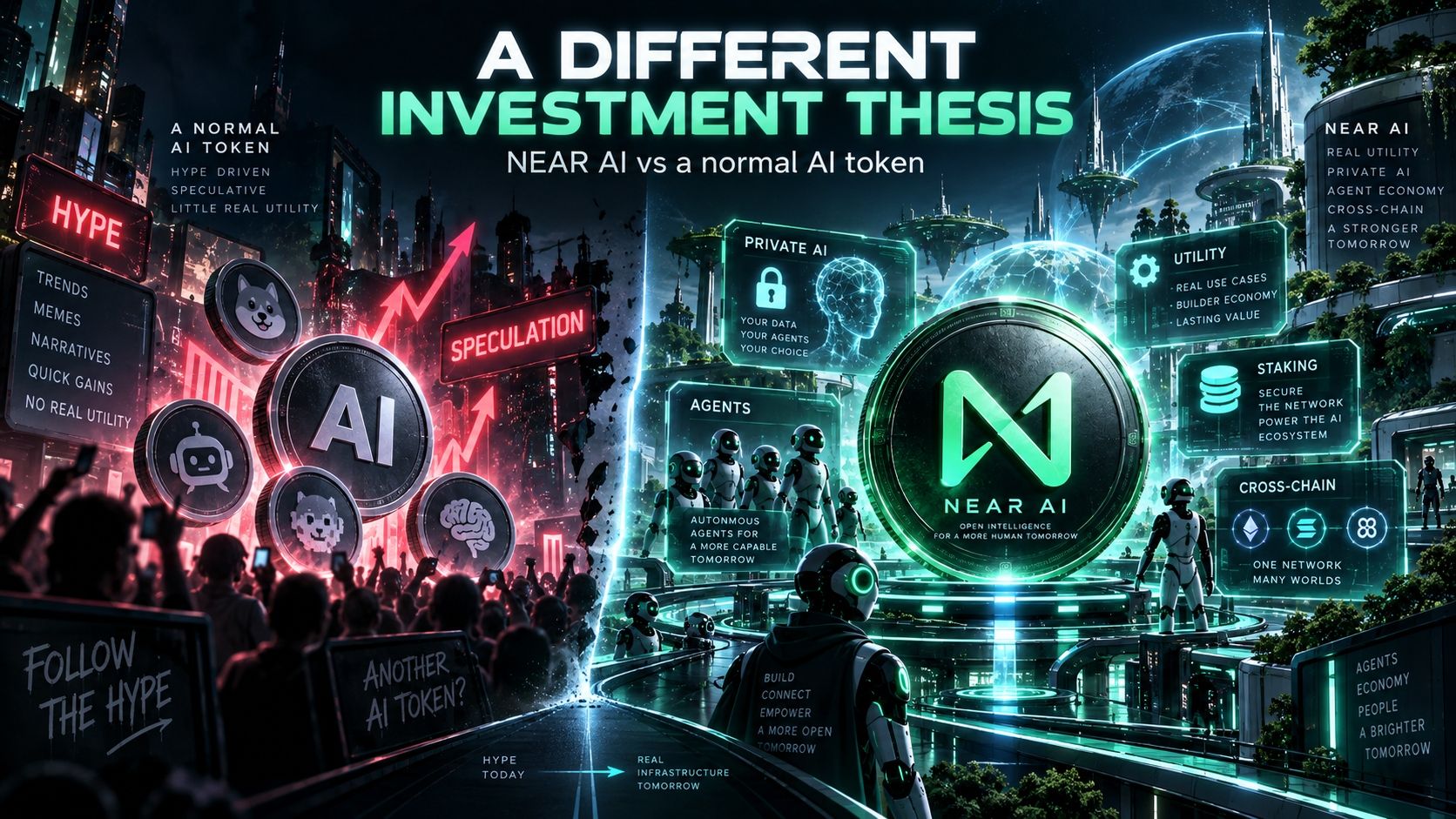
It is useful to separate the technology thesis from the token investment thesis.
The technological thesis is relatively straightforward: autonomous AI agents will require secure inference, protected credentials, persistent runtimes and payment infrastructure if they are to perform meaningful economic tasks.
NEAR is assembling these elements into one stack.
The investment thesis is harder.
Even if NEAR AI agents become successful, token holders still need to understand how that usage translates into demand for NEAR. Staking for AI improves this relationship, as does payment activity inside Agent Market, but adoption will ultimately determine whether the effect becomes economically significant.
The strongest evidence would not be another partnership announcement. It would be sustained growth in inference usage, hosted agents, fees, NEAR locked for AI credits and economic transactions initiated by agents.
NEAR AI versus the broader decentralized AI sector
The decentralized AI market contains projects attacking very different parts of the technology stack.
Some networks focus on GPU supply. Others provide decentralized model training, data acquisition, model marketplaces or autonomous agents.
NEAR’s strategy increasingly spans several layers but is most differentiated by the combination of private AI and financial execution.
| Layer | NEAR approach |
|---|---|
| AI inference | Hardware-isolated confidential inference with verification. |
| Agent runtime | IronClaw with credential isolation, tool controls and persistent state. |
| Compute | Confidential GPU infrastructure and marketplace. |
| Agent commerce | Agent Market for jobs, bidding and payments. |
| Cross-chain execution | NEAR Intents and Confidential Intents. |
| Token utility | Staking can fund inference and agent hosting. |
This breadth is an advantage if the components reinforce one another. It is also a risk because NEAR must execute successfully across several highly competitive markets.
Main risks facing NEAR AI
| Risk | What investors should monitor |
|---|---|
| Adoption risk | Whether developers and enterprises actually use NEAR AI rather than simply testing it. |
| Agent security | Prompt injection, tool misuse, credential handling and permission failures remain difficult industry-wide problems. |
| TEE dependency | Confidential computing still relies on hardware vendors, firmware and correct implementation. |
| Competition | Centralized AI clouds and decentralized AI protocols are improving quickly. |
| Token value capture | Growth in AI usage must translate into economically meaningful NEAR demand. |
| Agent economy maturity | Autonomous agent-to-agent commerce is still at an early stage and its eventual market size remains uncertain. |
What could make NEAR AI significantly more valuable?
The strongest long-term scenario would emerge if AI agents become a major interface for financial and digital services.
Today, users manually open applications, compare prices, authorize payments and move assets. A mature autonomous agent could instead continuously interpret a user’s objectives and execute permitted actions when conditions are met.
If this model expands, agents will require infrastructure for identity, permissions, private computation and payments.
NEAR already has several components positioned around that possible future.
IronClaw gives an agent a controlled runtime. Private inference protects sensitive reasoning. NEAR Intents can provide cross-chain execution. Agent Market allows agents to purchase and sell services. Staking for AI connects the native token with computing resources.
The opportunity is therefore substantial if these components become widely used together.
But the reverse is equally important: if autonomous agents remain primarily an experimental niche, NEAR may have built sophisticated infrastructure for a market that develops much more slowly than expected.
What to watch next for NEAR AI
The next phase should be evaluated primarily through usage rather than announcements.
The most useful indicators will be the amount of inference processed through NEAR AI Cloud, the number of production IronClaw deployments, enterprise integrations, activity on Agent Market and the quantity of NEAR committed to AI-related staking.
Another critical metric will be agent-generated transaction volume.
If agents increasingly use NEAR Intents to make payments, exchange assets or purchase services, the connection between NEAR’s artificial intelligence and blockchain infrastructure becomes much stronger.
That is ultimately what separates the current NEAR AI strategy from a marketing narrative. The technology has reached the point where its success can increasingly be measured through real activity.
FAQ – NEAR AI, private AI agents and the agent economy
What is NEAR AI?
NEAR AI is an artificial intelligence infrastructure ecosystem focused on private inference, secure autonomous agents and user-owned AI. Its current products include NEAR AI Cloud, IronClaw, Agent Market and confidential computing infrastructure.
Is NEAR AI the same as NEAR Protocol?
No. NEAR Protocol is the underlying blockchain infrastructure, while NEAR AI focuses on artificial intelligence and autonomous agents. The two are increasingly integrated through payments, staking, NEAR Intents and the broader agent-economy strategy.
What is IronClaw?
IronClaw is NEAR AI’s open-source secure agent runtime. It allows autonomous agents to use tools and maintain persistent state while separating sensitive credentials and actions from the AI model itself.
What is private AI on NEAR?
Private AI refers to AI inference executed inside hardware-isolated Trusted Execution Environments. NEAR AI uses confidential-computing technologies to prevent infrastructure operators from directly accessing prompts and model outputs while providing hardware-backed attestation.
Can NEAR AI use models such as DeepSeek or Llama?
Yes. NEAR AI supports several open-weight model families, including models such as DeepSeek, Qwen, Llama and Mixtral. Its infrastructure can also provide private gateway access to proprietary model providers.
What are NEAR AI agents?
NEAR AI agents are autonomous AI systems capable of performing tasks, using tools and potentially executing economic actions. IronClaw provides the secure runtime, while blockchain infrastructure can provide payments and settlement.
What is the NEAR AI Agent Market?
Agent Market is a marketplace where tasks can be posted and AI agents can compete to perform them. Agents can bid for work, provide services and receive blockchain-based payments.
How is NEAR Intents connected to NEAR AI?
NEAR Intents provides cross-chain execution infrastructure. An autonomous agent can therefore potentially request a financial outcome without having to manually manage every bridge, blockchain and intermediate transaction required to achieve it.
Can NEAR be staked to pay for AI?
Yes. Since July 2026, NEAR AI has allowed users to stake NEAR to obtain credits for services including confidential inference and IronClaw agent hosting. The exact mechanism differs according to the service.
Does staking for NEAR AI mean the tokens are spent?
Not necessarily. Under the current model, the underlying NEAR remains staked and can later be withdrawn. The stake or the yield generated by it determines the computing credits available, depending on the product.
Why could AI agents need blockchain payments?
Autonomous software needs payment infrastructure that can be accessed programmatically. Blockchain wallets and smart-contract systems allow agents to send, receive and authorize transactions without requiring a conventional bank account for every software agent.
Is NEAR AI decentralized?
The answer depends on the component being examined. NEAR combines decentralized blockchain infrastructure with confidential-computing hardware and services that still depend on infrastructure providers and hardware manufacturers. It is more accurate to analyze each layer separately than to describe the entire stack as completely decentralized.
What is the biggest challenge for the NEAR AI strategy?
The biggest challenge is converting advanced technology into sustained adoption. IronClaw, private inference and Agent Market can be technically functional without necessarily generating enough activity to create a large economic network. Usage and token value capture therefore matter more than the number of products launched.
Conclusion: NEAR AI is becoming an infrastructure play on autonomous agents
NEAR AI has developed into one of the more technically specific attempts to connect artificial intelligence with blockchain infrastructure.
The project is not relying on a single AI model or a generic claim that blockchain can decentralize artificial intelligence. Instead, it is building around identifiable infrastructure problems: keeping inference private, protecting credentials, controlling agent actions, enabling agents to pay for services and giving them access to cross-chain liquidity.
IronClaw addresses the agent runtime. NEAR AI Cloud provides confidential inference. Intel-backed attestation strengthens verification. Agent Market introduces agent-to-agent commerce. NEAR Intents provides financial execution across different blockchains. And the introduction of staking for AI creates a more direct connection between the NEAR token and demand for computing services.
The result is an increasingly coherent agent economy thesis.
But the next stage will be more demanding than the technology-building phase. NEAR now needs to demonstrate that businesses, developers and users want these products at scale.
The most important signals will therefore be measurable: active agents, inference workloads, enterprise deployments, agent payments, NEAR committed to AI services and transaction volume generated through NEAR Intents.
If these metrics grow, NEAR AI could evolve from an interesting intersection of crypto and artificial intelligence into infrastructure used by economically autonomous software. If they do not, the project may remain technologically sophisticated without capturing a correspondingly large market.
AI infrastructure extends beyond autonomous agents
NEAR focuses on private inference and economically active AI agents, while other decentralized networks are attacking different parts of the AI stack. Discover how Grass turns distributed internet bandwidth into a data infrastructure designed for artificial intelligence.
This article is provided for informational purposes only and does not constitute financial or investment advice. Digital assets remain highly volatile and can result in a partial or total loss of invested capital.