
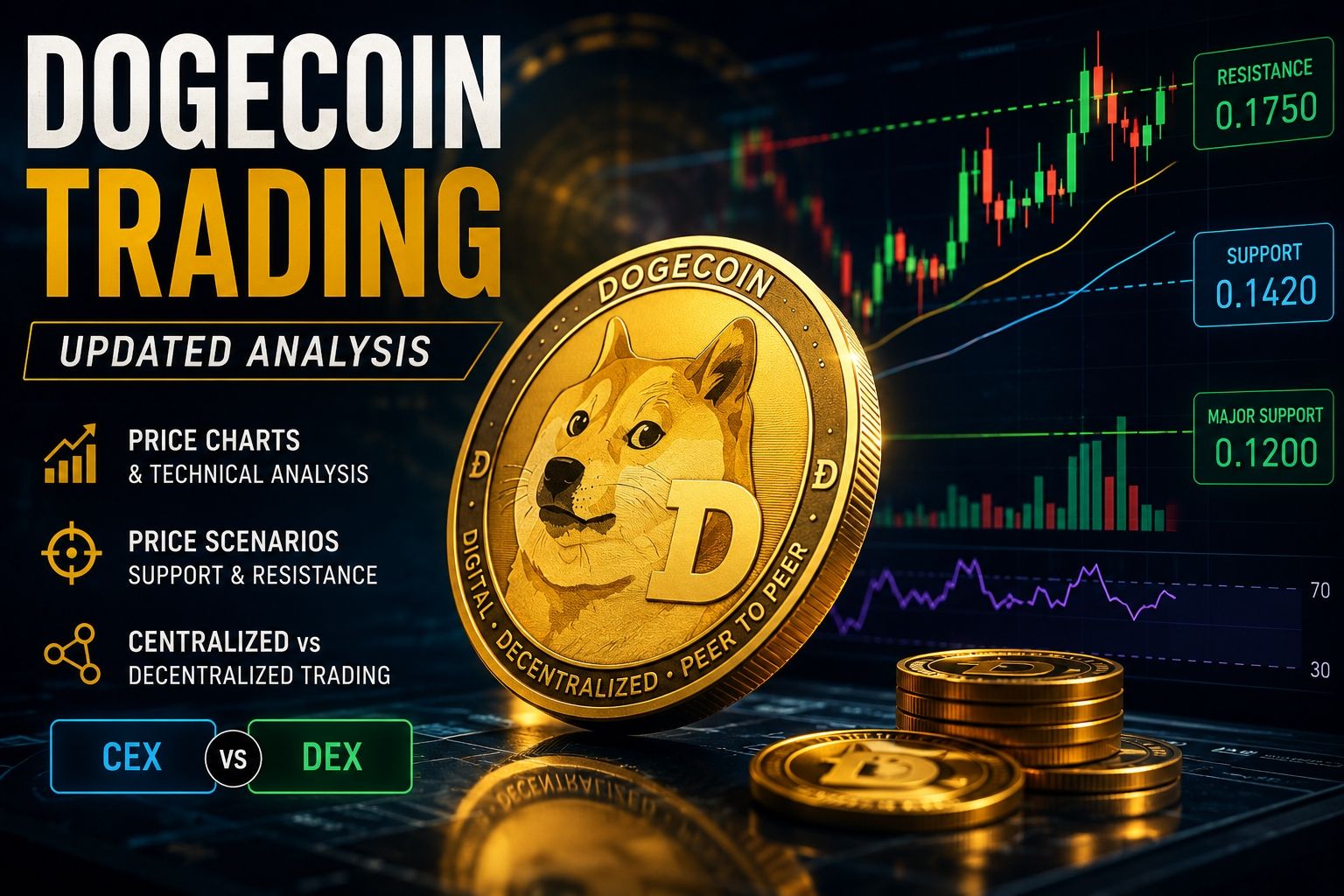
Updated in August 2026. This Dogecoin trading analysis follows the latest DOGE price action, key technical levels, market momentum and fundamental developments that could influence the next move.
Dogecoin remains one of the most actively followed cryptocurrencies. Originally created as a meme coin, DOGE has developed into a highly liquid digital asset traded by retail investors, professional traders and, increasingly, investors using traditional exchange-traded products.
Its price can still move extremely quickly. Bitcoin direction, crypto liquidity, meme coin sentiment and social attention remain important, but the Dogecoin market has also evolved. Regulated investment products now provide another source of exposure, while derivatives and institutional participation have become more relevant.
But Dogecoin trading is not simply about reacting to hype. Traders need to understand market structure, momentum, liquidity, technical indicators and the fundamental forces behind DOGE.
This updated analysis therefore combines Dogecoin technical analysis, Dogecoin fundamental analysis and practical DOGE trading scenarios.
Dogecoin Trading Snapshot
Market update – August 2026: DOGE is trading around $0.087 after a powerful rebound from the $0.068–$0.070 area toward approximately $0.095–$0.10. The recovery has improved short-term momentum, but Dogecoin is now facing an important long-term resistance zone.
- Current DOGE price: Around $0.087.
- Short-term trend: Neutral to cautiously bullish after the August recovery.
- Immediate support: $0.084–$0.085.
- Major support: $0.080–$0.081.
- Deeper support: $0.074–$0.075, followed by $0.068–$0.070.
- Immediate resistance: $0.089–$0.090.
- Major resistance: $0.094–$0.095.
- Psychological resistance: $0.10.
- Momentum: Improved significantly, although DOGE is no longer deeply oversold.
- Main market driver: Bitcoin remains critical and is trading near the $79,000 area.
A sustained breakout above $0.095–$0.10 would materially improve the current Dogecoin trading structure. A loss of $0.080 would instead suggest that the August recovery is beginning to fail.
What Is Dogecoin Trading?
Dogecoin trading consists of buying and selling DOGE to take advantage of changes in its market price. Strategies can range from intraday trades lasting only a few minutes or hours to swing trades lasting several days or weeks.
DOGE has characteristics that make it particularly attractive to traders.
It is highly recognizable, available on most major exchanges and normally benefits from significant liquidity. At the same time, it tends to react strongly to changes in market sentiment.
Unlike cryptocurrencies whose valuation depends heavily on DeFi revenues, smart contract activity or complex token economics, DOGE remains strongly influenced by liquidity, attention and speculation.
This does not mean that Doge Trading is simple. High volatility means risk management is particularly important.
Why DOGE Attracts Crypto Traders
Dogecoin combines several characteristics traders typically look for: liquidity, volatility, recognition and frequent price movements.
Its brand remains one of the strongest in crypto. Even investors who know little about blockchain technology often recognize Dogecoin.
Liquidity is another important advantage. DOGE is traded across major centralized exchanges and has active spot and derivatives markets. This generally allows traders to enter and exit positions more efficiently than with smaller meme coins.
Dogecoin also reacts strongly when the crypto market moves into a risk-on environment. When Bitcoin stabilizes or rises sharply, speculative capital can rotate toward major altcoins and meme coins.
The opposite is equally important. During risk-off periods, DOGE can fall faster than Bitcoin.
That high-beta behavior is one of the reasons Dogecoin trading continues to attract active traders.
Dogecoin Price: What Happened in August 2026?
August produced a significant change in DOGE’s technical structure.
After spending much of the first half of the month around $0.069–$0.071, Dogecoin began to recover strongly. DOGE subsequently moved through $0.075 and $0.080 before reaching the $0.09 area.
The rally eventually pushed DOGE close to $0.10, representing an increase of more than 30% from its August lows.
However, the move encountered a major technical obstacle.
The $0.094–$0.10 area contains both historical resistance and long-term moving-average resistance. Sellers appeared around this zone and DOGE subsequently returned toward approximately $0.087.
This creates an interesting Dogecoin trading situation.
The market is considerably stronger than it was near $0.07, but DOGE has not yet confirmed a long-term bullish reversal.
Dogecoin Technical Analysis

Dogecoin technical analysis is particularly useful because DOGE is highly liquid and frequently reacts around recognizable support and resistance zones.
The principal elements to monitor are trend structure, moving averages, RSI, volume and the behavior of price around major psychological levels.
Current Trend Direction
The short-term Dogecoin trend has improved considerably.
DOGE recovered from approximately $0.07 and moved above several short and medium-term moving averages during August.
The market is therefore no longer in the same clearly bearish structure seen earlier in the summer.
However, calling the trend completely bullish would still be premature.
DOGE is now testing an area where the 200-day moving averages and horizontal resistance converge. A decisive move through this zone would provide much stronger confirmation.
Dogecoin Technical Analysis – Current Setup
Short-term structure: Neutral to cautiously bullish.
Momentum: Positive compared with early August, although the market has cooled after the sharp rally.
Key battle zone: $0.089–$0.095.
Bullish confirmation: A sustained break above $0.095 followed by a successful move above $0.10.
First warning: A break below $0.084.
Stronger bearish signal: A loss of $0.080–$0.081.
Structural invalidation of the recovery: A return below approximately $0.074–$0.075 would significantly weaken the August rebound.
Support and Resistance
Support and resistance remain central to any Dogecoin technical analysis.
The first short-term support is located around $0.084–$0.085. This area is close to recent consolidation levels and short-term moving averages.
Below this zone, $0.080–$0.081 is considerably more important. This level acted as resistance earlier in the recovery and may now become support.
If $0.080 fails, traders should watch $0.074–$0.075.
Finally, the $0.068–$0.070 area remains the major structural support established during the summer.
On the upside, DOGE first needs to recover $0.089–$0.090.
The next challenge is approximately $0.094–$0.095. This is particularly important because it corresponds closely with long-term moving-average resistance.
Above that, $0.10 is the psychological level that could change market perception.
Moving Averages
Moving averages currently provide one of the clearest signals in the Dogecoin chart.
DOGE is trading above several short and medium-term averages after the August rebound. This indicates that momentum has improved.
However, the long-term picture remains more complicated.
The 200-day simple moving average is around the high-$0.08 area, while the 200-day exponential moving average is closer to approximately $0.095.
This means the current price is effectively testing a major long-term trend zone.
A sustained move above these averages would strengthen the bullish case considerably.
A rejection would suggest DOGE remains inside a broader recovery attempt rather than a confirmed long-term uptrend.
RSI and Momentum
The RSI is another useful indicator for Dogecoin technical analysis.
The daily RSI is currently around the mid-60s.
This is a major improvement compared with the weak momentum seen earlier in August, but it also means DOGE is no longer deeply oversold.
The indicator is approaching the area where traders begin to watch for overbought conditions.
This does not automatically mean DOGE must fall. During strong rallies, RSI can remain elevated for an extended period.
The more important question is whether momentum remains strong while DOGE attempts another attack on $0.095–$0.10.
If DOGE reaches resistance while RSI forms lower highs, traders should pay attention to possible bearish divergence.
Volume and Market Participation
Volume is essential when analyzing DOGE breakouts.
The August move from approximately $0.07 toward $0.09 was accompanied by a major increase in trading activity, which made the recovery more credible.
But the next breakout requires confirmation.
If DOGE moves above $0.095 or $0.10 on strong volume, the signal will be considerably more convincing than a brief intraday spike.
Rising derivatives activity can also increase volatility.
This creates opportunities for Doge Trading, but also increases liquidation risk if too many leveraged traders position in the same direction.
Dogecoin Trading Price Scenarios
No technical analysis can predict exactly what DOGE will do.
A more useful approach is to prepare several scenarios and identify the levels that would confirm or invalidate each one.
Bullish Scenario
The bullish scenario requires DOGE to hold above approximately $0.084–$0.085 and regain $0.09.
The crucial test would then be $0.094–$0.095.
A breakout above this level with increasing volume could bring another test of $0.10.
If DOGE manages to move above $0.10 and subsequently transform it into support, the technical structure would become considerably more constructive.
The next areas traders could monitor would be approximately $0.105–$0.115 and then $0.12.
Such a scenario would probably require supportive Bitcoin price action and improving crypto risk appetite.
Neutral Scenario
The neutral scenario would see DOGE remain trapped between approximately $0.080 and $0.095.
In that case, the August rebound would remain intact but without confirmation of a larger trend reversal.
A consolidation phase would not necessarily be negative.
After a rally of more than 30%, sideways movement could allow moving averages and momentum indicators to normalize before another major move.
For traders, patience may be preferable until DOGE leaves the range decisively.
Bearish Scenario
The bearish scenario begins to strengthen if DOGE loses $0.084 and then breaks below the important $0.080–$0.081 zone.
That would suggest buyers are losing control of the recovery.
A move below $0.075 could expose DOGE to another test of $0.068–$0.070.
Failure of that structural support would be much more serious and could reopen significantly lower price scenarios.
DOGE Trading Levels to Watch
Bullish case: DOGE reclaims $0.09 and breaks $0.095 before establishing $0.10 as support. The next zones to monitor would be approximately $0.105–$0.115 and $0.12.
Neutral case: DOGE consolidates between $0.080 and $0.095 while momentum stabilizes.
Bearish case: DOGE loses $0.080. The next major levels would be $0.074–$0.075 and then $0.068–$0.070.
Dogecoin Fundamental Analysis

Dogecoin fundamental analysis is different from analyzing Ethereum, Solana or a DeFi protocol.
Dogecoin does not have a large smart contract ecosystem generating protocol fees. Its fundamental value proposition relies more heavily on liquidity, network longevity, community, brand recognition, payment utility and cultural relevance.
In 2026, however, another factor has become increasingly important: access through traditional financial markets.
Dogecoin ETFs and Institutional Access
One of the most important developments for Dogecoin fundamental analysis is the existence of U.S.-listed exchange-traded products providing direct DOGE exposure.
The Bitwise Dogecoin ETF, ticker BWOW, trades on NYSE Arca and holds Dogecoin as its underlying asset.
The 21Shares Dogecoin ETF, ticker TDOG, began trading on Nasdaq in January 2026 and also provides exposure backed by DOGE.
This changes the Dogecoin market in an important way.
Traditional brokerage clients can now gain DOGE exposure without opening a crypto exchange account or managing a private wallet.
It would nevertheless be wrong to interpret the existence of these products as proof of massive institutional adoption.
For example, TDOG’s assets remain relatively modest compared with major Bitcoin investment products.
The fundamental development is therefore primarily about accessibility and market infrastructure, rather than evidence that institutions are suddenly accumulating DOGE on a very large scale.
A Warning From the Corporate Treasury Narrative
The institutional narrative also has a negative side.
CleanCore Solutions previously adopted a corporate Dogecoin treasury strategy, but abandoned it during 2026.
The company sold substantially all of its remaining 463 million DOGE in July for approximately $33.4 million as it shifted its strategy toward artificial intelligence infrastructure.
This is useful information for Dogecoin fundamental analysis because it demonstrates that corporate treasury demand should not be considered permanent.
Institutional adoption can create buying pressure, but institutional exits can create supply.
DOGE traders therefore need to distinguish between durable structural demand and temporary narratives.
Brand and Community
Dogecoin continues to have one of the strongest brands in crypto.
Its meme identity helped it reach an audience far beyond traditional cryptocurrency investors.
That cultural recognition remains a genuine economic advantage.
Attention creates liquidity. Liquidity attracts traders. Trading activity attracts exchanges and investment products.
Dogecoin has also survived multiple crypto cycles, unlike thousands of meme coins that disappeared after short speculative phases.
Longevity is one of the strongest elements in any Dogecoin fundamental analysis.
Liquidity and Exchange Access
DOGE remains available on most major crypto exchanges.
Strong liquidity generally means tighter spreads and lower slippage than smaller meme coins.
This is particularly important for active Dogecoin trading, because a highly volatile asset requires traders to enter and exit positions quickly.
Dogecoin’s liquidity also helps it maintain relevance even during periods when meme coin speculation declines.
Dogecoin as a Digital Currency
Dogecoin was designed as a simple peer-to-peer digital currency.
Its blockchain is not intended to compete directly with complex smart contract networks.
Instead, DOGE emphasizes simple transfers, relatively low transaction costs and accessibility.
Dogecoin has historically been used for payments, tipping and community transactions.
Its simplicity is both an advantage and a limitation.
It makes Dogecoin easy to understand, but it also means that investors cannot rely on the same ecosystem metrics used to value DeFi or smart contract platforms.
Supply Dynamics
Dogecoin does not have Bitcoin’s fixed 21 million coin supply.
New DOGE continues to enter circulation.
This inflationary model is important for long-term valuation because continued issuance creates ongoing supply.
However, the inflation rate gradually declines in percentage terms as the total Dogecoin supply grows.
For short-term Doge Trading, supply issuance is normally much less important than Bitcoin direction, market liquidity and speculative demand.
For long-term investors, it remains an important difference between DOGE and scarce digital assets such as Bitcoin.
Market Sentiment and External Catalysts
Sentiment remains one of Dogecoin’s most powerful fundamental drivers.
DOGE can react to:
- Bitcoin and the broader crypto cycle;
- meme coin market rotations;
- ETF flows and institutional product demand;
- large holder accumulation or selling;
- payment and adoption announcements;
- social media trends;
- comments from influential public figures;
- changes in macroeconomic liquidity and risk appetite.
This is why Dogecoin fundamental analysis cannot rely only on traditional blockchain metrics.
Attention and liquidity are fundamental components of the Dogecoin market.
Centralized vs Decentralized Dogecoin Trading
Most Dogecoin trading still takes place on centralized exchanges.
These platforms usually offer the deepest DOGE liquidity, traditional order books, derivatives markets and easy conversion between DOGE, stablecoins and fiat currencies.
Decentralized DOGE trading is also possible, but traders need to understand an important distinction.
Native DOGE exists on the Dogecoin blockchain.
DOGE used inside DeFi applications on other networks is often represented by a wrapped or synthetic version of the asset.
These tokens can allow traders to access decentralized exchanges, liquidity pools and other DeFi strategies.
However, they introduce additional risks.
Wrapped DOGE can involve bridge risk, smart contract risk, liquidity risk and the possibility that the wrapped asset loses its expected relationship with native DOGE.
Advantages of Decentralized DOGE Trading
The principal advantage of decentralized Dogecoin trading is self-custody.
Users can trade from a private wallet instead of depositing funds with a centralized exchange.
Transactions and liquidity can also be inspected directly on-chain.
For experienced DeFi users, wrapped DOGE can be integrated into broader portfolio strategies.
However, decentralized trading is not automatically safer.
A trader may eliminate centralized exchange counterparty risk while simultaneously accepting smart contract, bridge and wallet risks.
The quality and depth of the liquidity pool are therefore essential.
Risks of Dogecoin Trading
The largest risk in Dogecoin trading remains volatility.
DOGE can gain 20%, 30% or more over a relatively short period, but the same volatility can work in the opposite direction.
Another major risk is chasing momentum.
Buying DOGE after a large rally simply because the asset is attracting attention can result in poor entry prices.
Leverage increases these risks considerably.
Because DOGE can move several percentage points quickly, highly leveraged positions can be liquidated even if the trader’s broader market thesis eventually proves correct.
Platform risk must also be considered.
Centralized exchanges introduce counterparty and custody risk.
Decentralized exchanges introduce smart contract, bridge and wallet risks.
Finally, DOGE remains closely linked to the broader crypto market.
Even positive Dogecoin-specific developments may have limited impact if Bitcoin enters a sharp correction.
Dogecoin Trading Strategy: What to Watch Every Week
A useful Dogecoin trading strategy should be updated regularly rather than based on a fixed prediction.
The first market to watch is Bitcoin.
DOGE usually performs better when Bitcoin is stable or rising and global crypto liquidity is improving.
The second factor is DOGE’s own market structure.
At present, $0.080–$0.081 is one of the most important support zones, while $0.094–$0.10 is the principal resistance zone.
Volume is the third factor.
A breakout without increasing volume deserves more caution than a breakout supported by significant market participation.
Momentum indicators such as RSI and MACD can help determine whether a move is accelerating or losing strength.
Finally, traders should monitor sentiment and news.
DOGE remains more sensitive to attention cycles than many other large cryptocurrencies.
Weekly Dogecoin Trading Checklist
- Is Bitcoin supporting or weakening the broader crypto market?
- Is DOGE holding above $0.084–$0.085?
- Is the major $0.080–$0.081 support still intact?
- Can DOGE reclaim $0.09?
- Can buyers break the $0.094–$0.095 resistance zone?
- Is the $0.10 psychological level becoming support or resistance?
- Is volume confirming the latest price move?
- Is RSI strengthening or showing divergence?
- Are ETF flows and institutional demand improving?
- Is meme coin sentiment strengthening or weakening?
Is Dogecoin Trading Worth It?
Dogecoin can be an interesting market for traders who accept volatility and use disciplined risk management.
DOGE combines strong liquidity, worldwide recognition and a long history of major price movements.
These characteristics can create attractive trading opportunities.
They also create substantial risk.
A famous cryptocurrency is not necessarily a safe cryptocurrency.
The strongest Dogecoin trading setups generally occur when several signals point in the same direction: technical structure, volume, Bitcoin momentum and market sentiment.
When those signals conflict, reducing exposure or waiting for confirmation may be more appropriate.
At the current price, the market is particularly interesting because DOGE sits between an improving short-term structure and significant long-term resistance.
A breakout above $0.095–$0.10 would strengthen the bullish case.
A return below $0.080 would weaken it substantially.
FAQ About Dogecoin Trading
Is Dogecoin good for trading?
Dogecoin can be attractive for active trading because DOGE is liquid, volatile and widely followed. Those same characteristics also make it risky, particularly when leverage is used.
What does Dogecoin technical analysis currently show?
The current Dogecoin technical analysis shows an improving short-term structure following the August recovery. DOGE is nevertheless confronting important long-term resistance between approximately $0.089 and $0.095, followed by the psychological $0.10 level.
What are the main Dogecoin support levels?
The first support is around $0.084–$0.085. The more important support is approximately $0.080–$0.081. Below that, traders may monitor $0.074–$0.075 and then $0.068–$0.070.
What are the main DOGE resistance levels?
DOGE faces resistance around $0.089–$0.090 and $0.094–$0.095. A sustained move above $0.10 would represent a considerably stronger bullish technical signal.
What does Dogecoin fundamental analysis focus on?
Dogecoin fundamental analysis focuses on brand strength, community, liquidity, network longevity, payment utility, supply inflation, market sentiment and increasingly the development of regulated Dogecoin investment products.
Are there Dogecoin ETFs?
Yes. U.S.-listed Dogecoin exchange-traded products include Bitwise’s BWOW on NYSE Arca and 21Shares’ TDOG on Nasdaq. They provide traditional brokerage investors with exposure to DOGE without requiring direct crypto custody.
Can DOGE be traded in DeFi?
DOGE exposure can be traded through wrapped or synthetic versions on smart contract networks. Traders should understand that wrapped DOGE introduces additional bridge, smart contract and liquidity risks.
Is Dogecoin trading risky?
Yes. DOGE can experience rapid price changes and is strongly influenced by crypto market sentiment. Leverage, emotional trading and weak risk management can significantly increase losses.
Conclusion: Dogecoin Trading Faces a Decisive Technical Zone
Dogecoin remains one of the most important speculative assets in the crypto market.
Its liquidity, brand recognition and extraordinary cultural reach continue to make Dogecoin trading attractive.
The fundamental picture has also evolved.
U.S.-listed Dogecoin investment products now provide another route into the market, showing that DOGE has moved beyond purely retail exchange trading. At the same time, the exit of a major corporate Dogecoin treasury illustrates that institutional demand can reverse and should never be treated as permanent.
From a technical perspective, August 2026 has been much more constructive.
DOGE recovered from approximately $0.07 and briefly approached $0.10.
The next move now depends heavily on the battle around $0.089–$0.095.
A sustained breakout above this zone followed by a move above $0.10 could confirm a stronger recovery.
Conversely, a loss of $0.080 would significantly weaken the structure and put $0.074–$0.075 and eventually $0.068–$0.070 back into focus.
The best approach to Doge Trading remains the same: combine technical structure with volume, momentum, Bitcoin direction and Dogecoin fundamental analysis rather than relying on hype alone.
Risk warning: This Dogecoin trading analysis is for educational purposes only and does not constitute financial advice. Dogecoin is a volatile crypto asset. Always do your own research and never invest more than you can afford to lose.
Recommended Reading
Bitcoin Price Analysis

Bitcoin remains one of the most important indicators for Dogecoin trading. BTC market structure, liquidity and momentum can strongly influence the direction of DOGE and the broader altcoin market.


Thortrading brings together two cryptocurrency traders with around five years of active market experience. Their work focuses on Bitcoin, altcoins, DeFi and crypto market trends, with an approach based on technical analysis, market cycles and risk management. Through their articles, they aim to help readers better understand both the opportunities and risks of crypto trading
One thought on “Dogecoin Trading: Updated DOGE Price Analysis and Charts”
Comments are closed.