

Decentralized Ethereum (ETH) trading enters October 2026 with Ethereum consolidating near $2,700 after a strong recovery during the second half of September.
ETH is trading at approximately $2,680–$2,700 after repeatedly testing the $2,750–$2,800 region. The rally from below $2,400 remains technically significant, but the market has not yet established $2,800 as support.
For ETH trading, this changes the immediate setup. The first important support area is now around $2,650–$2,670, while $2,700–$2,750 is the first resistance zone and $2,780–$2,800 remains the major short-term hurdle.
Ethereum’s decentralized fundamentals also remain substantial. DeFi TVL is around $53–$54 billion, stablecoin market capitalization on Ethereum remains above $146 billion, and approximately 43.7 million ETH — around 35.8% of supply — is currently staked.
At the same time, decentralized exchange activity has cooled from the previous week’s surge, while U.S. spot Ethereum ETF flows turned negative at the end of September after a seven-session inflow streak.
This means decentralized Ethereum (ETH) trading enters October with a more balanced setup: strong staking participation and substantial on-chain liquidity, but a price still capped below $2,800 and institutional ETF flows that have become less consistent.
Weekly Update: Decentralized Ethereum (ETH) Trading
Weekly ETH Trading Snapshot
Updated on: October 1, 2026
ETH Price Snapshot
- Current ETH price: approximately $2,680–$2,700
- Immediate support: $2,650–$2,670
- Secondary support: approximately $2,610–$2,630
- Major breakout support: $2,550–$2,600
- Major medium-term support: $2,480–$2,500
- Immediate resistance: $2,700–$2,750
- Major resistance: $2,780–$2,800
- Higher resistance: $2,950–$3,000
Ethereum DeFi Market Snapshot
- Ethereum DeFi TVL: approximately $53–$54 billion
- Stablecoins on Ethereum: approximately $146.3 billion
- DEX volume over 7 days: approximately $9.7 billion
- DEX volume over 24 hours: approximately $1.2–$1.4 billion
- Weekly DEX volume change: approximately -13% to -15%
- RWA active AUM: approximately $13.9 billion
- Perpetual DEX volume over 7 days: approximately $2.8 billion
- ETH staked: approximately 43.7 million ETH
- Staking ratio: approximately 35.77% of ETH supply
- Ethereum staking APR: approximately 2.64%
Weekly ETH Trading Scenario
For ETH trading, the main question is whether Ethereum can turn the $2,700–$2,750 area into sustainable support.
ETH has already demonstrated that buyers are willing to defend the broader breakout from the $2,500–$2,550 region, but repeated difficulty near $2,800 shows that sellers remain active at higher levels.
A sustained move above $2,750 would bring $2,780–$2,800 back into focus.
A confirmed daily close above $2,800, followed by a successful retest, would materially strengthen the technical structure and reopen the path toward approximately $2,950–$3,000.
On the downside, $2,650–$2,670 is the first zone to monitor.
Below that, approximately $2,610–$2,630 and then $2,550–$2,600 become increasingly important.
For decentralized Ethereum (ETH) trading, ETF flows, DEX liquidity, staking queues and derivatives positioning remain particularly relevant as Ethereum begins the fourth quarter.
Ethereum Market Overview
Ethereum enters October with a substantially stronger structure than it had in early September, but the latest rally has shifted into consolidation.
ETH recovered from below $2,400 and successively reclaimed the $2,500, $2,550, $2,600 and $2,700 regions before encountering repeated selling pressure close to $2,800.
The latest market price is again fluctuating around $2,700.
For ETH trading, the question is therefore no longer whether Ethereum can recover from the September lows.
It is now:
Can ETH establish a sustainable base above $2,700 and finally break $2,800, or will consolidation extend toward $2,650, $2,610 or the former $2,550–$2,600 breakout zone?
Market Snapshot
Ethereum On-Chain Activity Remains Substantial
According to DeFiLlama, Ethereum currently secures approximately $53–$54 billion in DeFi TVL.
Stablecoin market capitalization remains around $146.3 billion, while active RWA assets are close to $13.9 billion.
Ethereum has also been processing around two million mainnet transactions per day.
DEX volume remains significant at roughly $9.7 billion over seven days, although activity has declined from the stronger levels recorded during the previous update.
For decentralized Ethereum (ETH) trading, this is an important distinction: on-chain liquidity remains deep, but decentralized spot activity is no longer accelerating at the pace seen during the September breakout.
Decentralized Ethereum (ETH) Trading: Technical Analysis
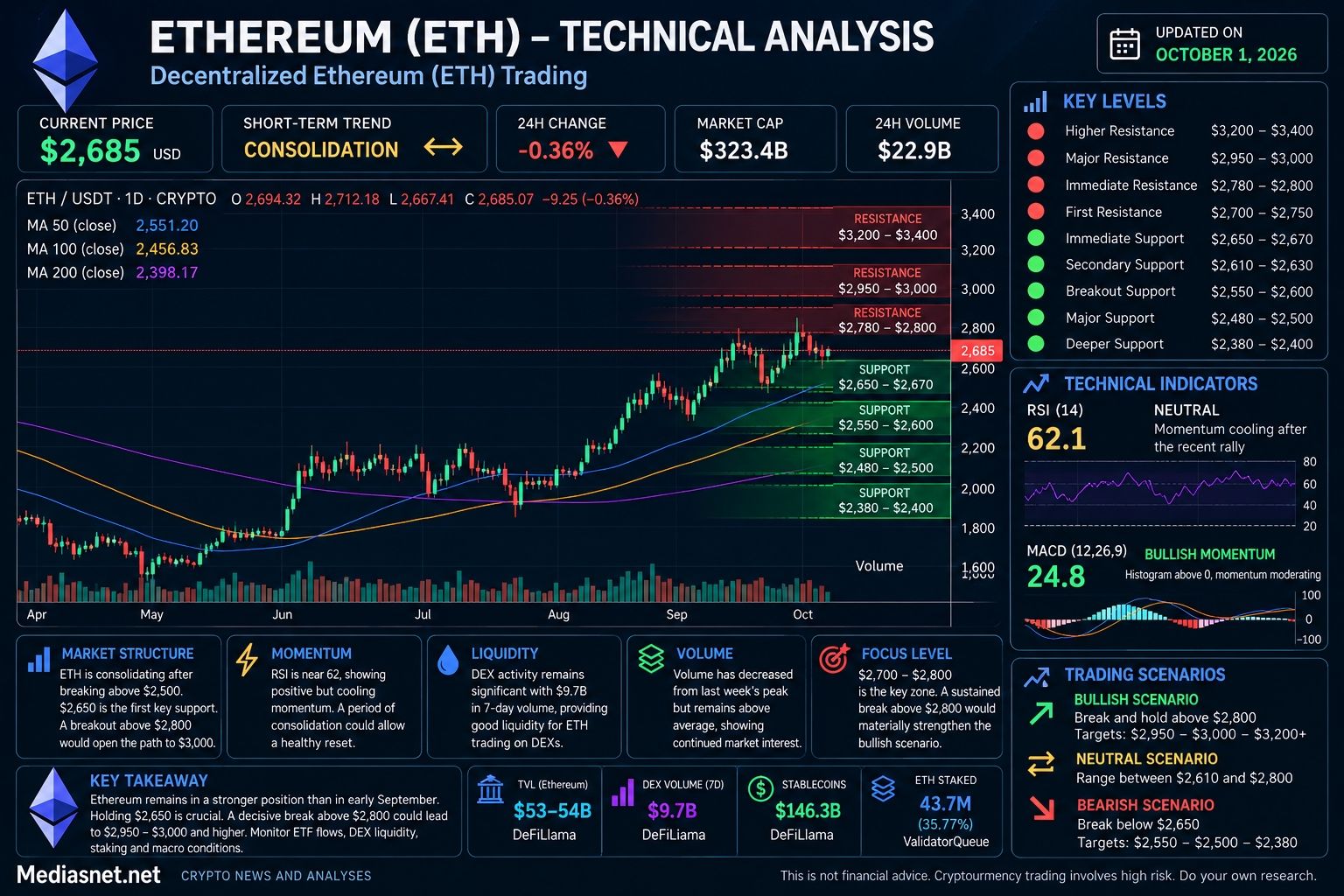
ETH Is Consolidating After the September Breakout
The previous technical structure was dominated by resistance around $2,500–$2,550.
That zone has been broken.
Ethereum subsequently moved through $2,600 and briefly established trading above $2,700 before reaching the $2,750–$2,800 resistance region.
The latest price action is therefore better described as post-breakout consolidation rather than a new confirmed breakout.
For ETH trading, this distinction matters.
The medium-term recovery remains intact while ETH stays above the former breakout zones, but buyers still need to demonstrate that they can absorb supply around $2,750–$2,800.
Key ETH Price Levels to Watch
- Immediate support: $2,650–$2,670
- Dynamic support: approximately $2,610–$2,630
- Breakout support: $2,550–$2,600
- Technical support: $2,480–$2,500
- Major deeper support: $2,380–$2,400
- Immediate resistance: $2,700–$2,750
- Major resistance: $2,780–$2,800
- Psychological resistance: $2,950–$3,000
- Higher resistance zone: $3,200–$3,400
$2,650–$2,670 Is the First Important Support
Ethereum has repeatedly traded around $2,700, making the region immediately below it increasingly important.
The $2,650–$2,670 area is now the first significant support zone for short-term ETH trading.
If buyers continue to defend this region, ETH can remain in a consolidation structure while preparing another test of $2,750–$2,800.
A decisive loss of $2,650 would shift attention toward approximately $2,610 and then $2,550–$2,600.
$2,700–$2,750 Is the Immediate Battleground
With ETH fluctuating around $2,700, the first challenge is establishing sustained trading above this level.
The recent 24-hour trading range has repeatedly extended into the low-to-mid $2,700s before encountering resistance.
A daily close above approximately $2,750 would improve the short-term setup and put $2,780–$2,800 back at the center of the market.
$2,800 Remains the Critical Breakout Level
The $2,800 zone remains the most important resistance for decentralized Ethereum (ETH) trading.
Ethereum approached this area several times during the late-September recovery but has not yet established a sustained breakout above it.
This makes $2,800 more important than a simple psychological price level.
A decisive breakout accompanied by strong spot volume would indicate that buyers have absorbed the supply that has repeatedly appeared in this region.
A short intraday move above $2,800 without follow-through would provide a weaker signal.
$3,000 Remains the Next Major Objective Above $2,800
The $3,000 level remains technically relevant, but ETH first needs to establish $2,800 as support.
If that happens, approximately $2,950–$3,000 would become the next major resistance zone.
A failure to break $2,800 would instead keep Ethereum inside a broader consolidation between approximately $2,600 and $2,800.
Momentum and RSI
Ethereum’s momentum remains positive compared with early September, but the rapid acceleration of the previous rally has cooled.
Daily RSI has moved back toward the low-60 area rather than remaining close to overbought conditions.
For ETH trading, this is potentially constructive because momentum has cooled without ETH surrendering the entire September breakout.
A period of consolidation above $2,600–$2,650 would allow technical momentum to reset.
A renewed price surge accompanied by rising spot volume and RSI would provide stronger confirmation of another breakout attempt.
Short-Term ETH Trading Scenarios
| Scenario | Main Conditions | Price Zones to Watch |
|---|---|---|
| Bearish | ETH loses $2,650 and then $2,600 | $2,550, $2,500, then $2,380–$2,400 |
| Base | ETH consolidates after the September rally | $2,610–$2,800 |
| Bullish | ETH breaks and holds above $2,800 | $2,950–$3,000, then $3,200+ |
Why Technical Levels Matter More on DEXs
On centralized exchanges, liquidity is concentrated mainly in order books.
On decentralized exchanges, liquidity is distributed across pools, concentrated-liquidity ranges, aggregators, Ethereum mainnet and multiple Layer 2 networks.
This creates important differences for decentralized Ethereum (ETH) trading.
- large price moves can shift concentrated liquidity ranges
- thin pools can produce higher slippage
- rapid breakouts can increase MEV exposure
- large swaps can receive materially different execution across protocols
- Layer 2 liquidity can differ significantly from mainnet liquidity
- volatile periods can increase gas costs and transaction competition
Technical price levels should therefore be evaluated together with actual liquidity and execution conditions.
How Decentralized Ethereum Trading Works
Decentralized Ethereum (ETH) trading typically takes place through DEXs, aggregators, decentralized perpetual platforms and lending protocols.
Users trade directly from wallets rather than permanently transferring assets to a centralized exchange.
The main ETH trading routes include:
- DEXs: Uniswap, Curve, Balancer and similar protocols
- DEX aggregators: platforms comparing several liquidity routes
- Perpetual DEXs: decentralized derivatives and leveraged trading platforms
- Ethereum mainnet: deep settlement liquidity but potentially higher transaction costs
- Layer 2 networks: lower-cost execution environments such as Arbitrum, Base and Optimism
The advantage is self-custody and direct access to on-chain liquidity.
The trade-off is additional technical risk, including smart-contract vulnerabilities, token approvals, bridge risk, slippage, MEV and wallet-security errors.
Layer 2 Networks and ETH Trading
Layer 2 networks continue to absorb a large share of Ethereum ecosystem execution.
For active ETH trading, this matters because smaller transactions can often be executed more economically away from Ethereum mainnet.
Layer 2 networks can provide:
- lower transaction fees
- faster execution
- access to specialized perpetual DEXs
- additional liquidity pools
- more frequent trading strategies
- new lending and collateral markets
However, lower transaction costs do not automatically mean better execution.
Liquidity depth, bridge architecture, asset representation and protocol risk must also be considered.
For decentralized Ethereum (ETH) trading, execution quality should remain more important than simply selecting the network with the lowest transaction fee.
Decentralized Ethereum (ETH) Trading: Fundamental Analysis
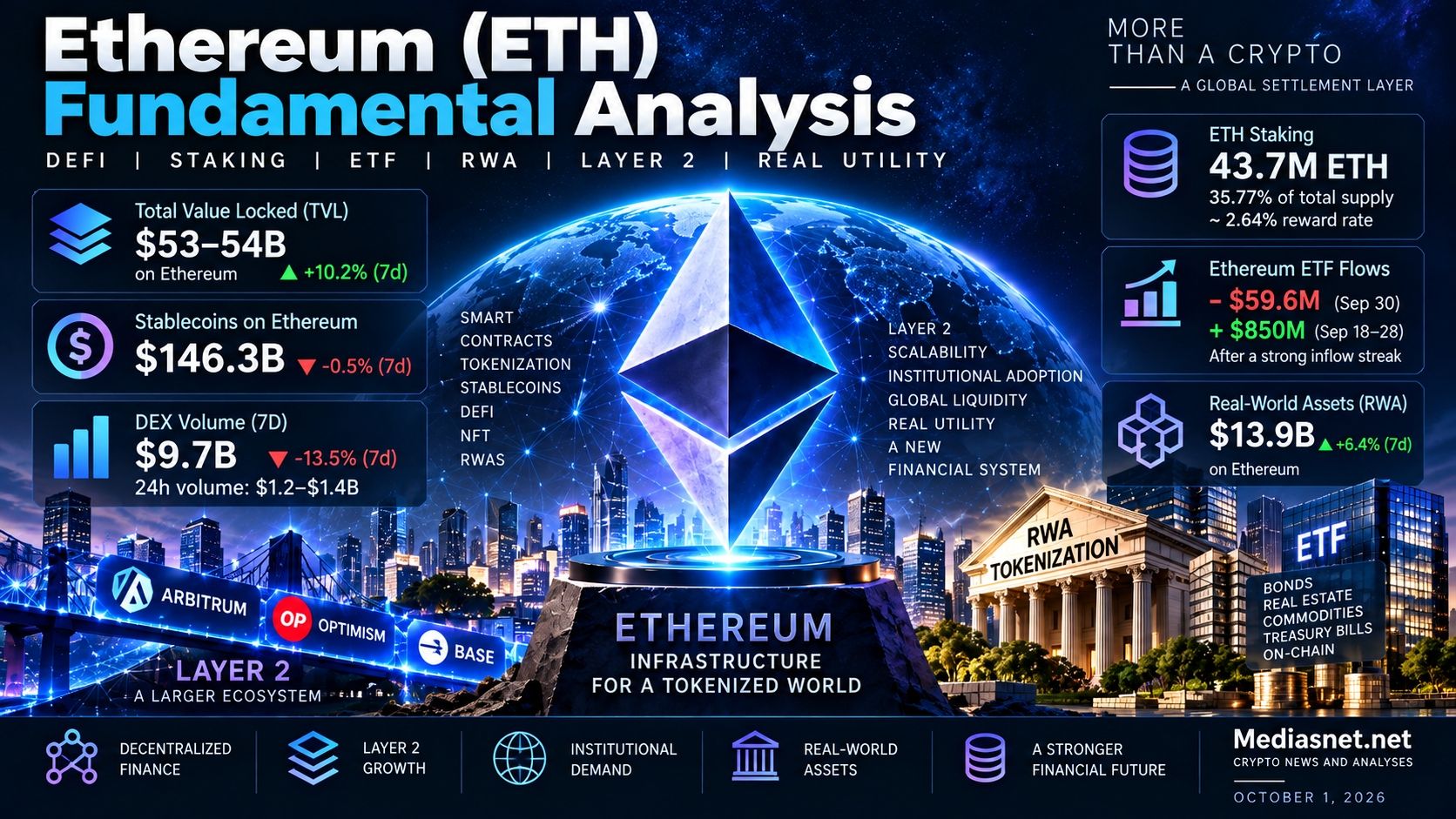
Ethereum DeFi TVL Remains Above $53 Billion
Ethereum currently secures approximately $53–$54 billion in DeFi TVL.
This remains substantially above the levels seen earlier in September and confirms that significant capital continues to be deployed across Ethereum lending, liquid staking, DEXs and other DeFi applications.
TVL should not be interpreted as a direct predictor of ETH price.
For ETH trading, however, it remains a useful indicator of the amount of capital actively deployed within Ethereum’s decentralized financial ecosystem.
DEX Volume Has Cooled to Around $9.7 Billion
Ethereum’s seven-day DEX volume surged above $10 billion during the previous update.
It has since eased toward approximately $9.7 billion over seven days.
The latest data indicates a weekly decline of roughly 13–15%.
Daily DEX volume is fluctuating around approximately $1.2–$1.4 billion.
For decentralized Ethereum (ETH) trading, this is an important change.
The network still has substantial decentralized spot liquidity, but the acceleration in trading activity observed during the September breakout has moderated.
Stablecoin Liquidity Remains Above $146 Billion
Ethereum currently hosts approximately $146.3 billion in stablecoin market capitalization.
This enormous liquidity base remains one of Ethereum’s most important structural advantages.
Stablecoins are central to ETH trading because they provide quote liquidity for DEXs, lending protocols, derivatives, collateral strategies and on-chain settlement.
The seven-day change has recently returned slightly positive.
RWA Assets Remain Close to $14 Billion
DeFiLlama currently tracks approximately $13.9 billion in active real-world-asset AUM associated with Ethereum.
Different providers use different methodologies, so exact totals can vary.
The broader trend remains more important than a single number: Ethereum continues to be a major settlement environment for tokenized Treasuries, funds, private credit and other traditional financial assets.
For decentralized Ethereum (ETH) trading, continued RWA expansion could gradually increase institutional on-chain liquidity and collateral diversity.
Ethereum Staking Reaches Approximately 43.7 Million ETH
Ethereum staking has continued to expand.
According to ValidatorQueue, approximately 43.7 million ETH is currently staked.
That represents roughly 35.77% of ETH supply.
The base staking APR is approximately 2.64%.
The entry queue contains roughly 1.56 million ETH, corresponding to a wait of approximately 27 days at the latest snapshot.
The exit queue has also increased significantly and recently stood above 770,000 ETH.
For ETH trading, these queues deserve attention because they provide information about capital moving into and out of Ethereum’s staking system.
A high staking ratio can reduce immediately liquid ETH supply, but staking should not automatically be interpreted as a bullish price signal.
Validator exits, liquid staking tokens and treasury strategies can all change effective market liquidity.
Ethereum ETF Flows Cool After a Strong Inflow Streak
U.S. spot Ethereum ETF demand was one of the strongest institutional signals during the second half of September.
From September 18 through September 28, Ethereum ETFs recorded seven consecutive sessions of net inflows, bringing in approximately $850 million.
The largest day was September 21, with roughly $270 million of net inflows.
That sequence has now ended.
Ethereum ETFs recorded approximately:
- September 28: +$17.1 million
- September 29: -$2.8 million
- September 30: -$59.6 million
Cumulative U.S. spot Ethereum ETF net inflows remain around $13.9 billion.
For ETH trading, the latest reversal does not erase the strong September inflows, but it shows that institutional demand cannot currently be treated as a one-way source of buying pressure.
A renewed sequence of large inflows would strengthen the spot-demand argument.
Continued outflows would increase the importance of support around $2,650 and $2,600.
BitMine Now Holds More Than 6 Million ETH
Corporate Ethereum treasury accumulation has continued.
BitMine reported that its Ethereum holdings reached 6,001,302 ETH as of September 27, 2026.
That represents approximately 4.9% of Ethereum’s reported 122.1 million ETH supply.
The company also reported approximately 5,067,309 ETH staked.
This concentration is relevant for decentralized Ethereum (ETH) trading because large corporate treasury positions can remove substantial ETH from immediately liquid circulation.
However, concentration also creates dependency.
If large treasury holders materially change their acquisition, staking or disposal strategies, market liquidity could be affected.
Glamsterdam Approaches Its Sepolia Testnet Milestone
Ethereum’s next major protocol upgrade remains Glamsterdam.
According to the official Ethereum roadmap, Glamsterdam remains expected on mainnet during Q4 2026, although the final mainnet date has not yet been confirmed.
The next major milestone is the Sepolia activation scheduled for October 6, 2026.
Glamsterdam combines the Amsterdam execution-layer upgrade with the Gloas consensus-layer upgrade.
Its major areas include:
- Layer 1 scaling
- enshrined proposer-builder separation
- block-level access lists
- parallel execution improvements
- more efficient block processing
- gas-pricing improvements
- state-growth management
For ETH trading, the upgrade should not automatically be treated as a price catalyst.
Its longer-term economic importance depends on whether increased network capacity translates into greater usage, liquidity, blockspace demand and sustainable economic activity.
The Layer 2 Value-Capture Debate
One of Ethereum’s most important valuation questions remains unresolved.
Layer 2 networks can dramatically increase Ethereum ecosystem activity while simultaneously reducing the amount users pay directly on Layer 1.
That distinction matters.
More Layer 2 transactions do not automatically produce higher Ethereum base-layer fees.
For decentralized Ethereum (ETH) trading, traders should therefore monitor both ecosystem expansion and how much economic value ultimately returns to ETH through fees, settlement, staking and collateral demand.
Key Risks for Decentralized Ethereum (ETH) Trading
Rejection at $2,750–$2,800
Ethereum has repeatedly struggled to establish a sustained move above the upper-$2,700 region.
A new rejection could keep ETH inside its current consolidation or send price back toward $2,650 and $2,600.
Loss of $2,600
A decisive break below the $2,600 area would weaken the September breakout structure and shift attention toward $2,550 and $2,500.
ETF Flow Reversal
Ethereum ETFs recorded substantial inflows during the second half of September, but the final two sessions of the month were negative.
Institutional flows therefore remain an important variable rather than a consistently positive catalyst.
Staking Exit Queue
The Ethereum exit queue has increased from the extremely low levels observed earlier in September.
That does not necessarily imply immediate selling, but it is a liquidity indicator worth monitoring.
Liquidity Fragmentation
DEX liquidity remains divided between Ethereum mainnet and multiple Layer 2 networks.
MEV and Execution Risk
Volatile markets can increase slippage, front-running exposure and routing differences.
Liquidation Risk
Leveraged ETH trading can create rapid liquidation cascades when price breaks important support or resistance levels.
Practical ETH Trading Scenarios
Bearish Scenario
- ETH loses $2,650
- $2,610–$2,600 fails to hold
- $2,550 breaks
- ETF outflows accelerate
- DEX activity continues to weaken
- Possible downside zones: $2,500, then $2,380–$2,400
Base Scenario
- ETH continues to defend approximately $2,600–$2,650
- price fluctuates around $2,700
- $2,800 continues to cap rallies
- ETF flows remain mixed
- on-chain liquidity remains stable
- Possible range: approximately $2,610–$2,800
This would represent a normal consolidation following the September recovery.
Bullish Scenario
- ETH establishes $2,700–$2,750 as support
- $2,800 breaks on strong spot volume
- ETF inflows resume
- DEX activity strengthens again
- spot liquidity absorbs profit-taking
- Possible upside zones: $2,950–$3,000, followed by $3,200+
For decentralized Ethereum (ETH) trading, a daily close above $2,800 followed by a successful retest would provide a stronger technical signal than an isolated intraday move.
Best Practices for Decentralized Ethereum (ETH) Trading
Before trading ETH through a decentralized protocol, traders should check:
- the official token contract
- the network being used
- available pool depth
- slippage tolerance
- gas costs
- wallet approvals
- bridge risk
- protocol security history
For larger ETH trading orders, route comparison is particularly important.
A DEX can report high headline volume while another liquidity pool or aggregator provides materially better execution for a specific transaction size.
ETH Price Outlook and Decentralized Trading Growth
Short Term
In the short term, ETH trading is centered on the $2,650–$2,800 range.
Holding approximately $2,650 keeps the late-September recovery structure intact.
Reclaiming $2,750 would improve short-term momentum.
A confirmed breakout above $2,800 would shift attention toward approximately $2,950–$3,000.
A fall below approximately $2,600 would instead increase the probability of a deeper retest toward $2,550 and $2,500.
Medium Term
Ethereum’s medium-term structure remains stronger than it was at the beginning of September.
ETH has broken the $2,500–$2,550 resistance zone that capped several previous advances.
However, a sustained move above $2,800 — and ultimately $3,000 — would be required for another major technical improvement.
ETF flows, DeFi TVL, DEX volume, staking participation and broader crypto liquidity remain the main variables to monitor.
Long Term
For decentralized Ethereum (ETH) trading, the long-term question remains economic value capture.
Ethereum continues to have significant exposure to DeFi, stablecoins, staking, tokenized real-world assets and Layer 2 settlement.
Glamsterdam could increase Layer 1 capacity further.
The key question is whether growth across these sectors ultimately generates sustained economic demand for ETH itself.
FAQ – Decentralized Ethereum (ETH) Trading
What is the most important ETH trading level right now?
The first important support is approximately $2,650–$2,670. On the upside, $2,700–$2,750 is the first resistance region, while $2,780–$2,800 remains the major breakout level.
What happens if Ethereum breaks $2,800?
A confirmed move above $2,800 would shift attention toward approximately $2,950–$3,000. A successful retest of $2,800 as support would strengthen the breakout signal.
What happens if ETH falls below $2,650?
The next area to monitor would be approximately $2,610–$2,630, followed by the former $2,550–$2,600 breakout zone.
How much DeFi TVL does Ethereum currently have?
Ethereum currently has approximately $53–$54 billion in DeFi total value locked, although the figure changes continuously with asset prices, deposits and withdrawals.
How much DEX trading volume does Ethereum generate?
Ethereum currently processes roughly $9.7 billion in DEX volume over seven days, with recent daily volume around $1.2–$1.4 billion.
Are Ethereum ETF flows still positive?
Ethereum ETFs recorded a strong seven-session inflow streak during the second half of September, but the trend weakened at month-end. Net flows were approximately -$2.8 million on September 29 and -$59.6 million on September 30.
How much Ethereum is currently staked?
Approximately 43.7 million ETH is currently staked, representing around 35.77% of the ETH supply.
Are more validators entering or leaving Ethereum staking?
Both queues are currently significant. Around 1.56 million ETH is waiting to enter staking, while the exit queue has recently risen above 770,000 ETH. These figures change continuously.
What is Ethereum’s next major upgrade?
Ethereum’s next major protocol upgrade is Glamsterdam. It remains expected on mainnet in Q4 2026, with the Sepolia testnet activation scheduled for October 6, 2026.
Is decentralized ETH trading better on Ethereum mainnet or Layer 2?
Layer 2 networks generally offer lower transaction costs, while Ethereum mainnet may provide deeper liquidity for certain transactions. Execution quality depends on transaction size, pool depth, slippage, bridge structure and protocol risk.
Can Ethereum reach $3,000?
The $3,000 region becomes technically more relevant if ETH first breaks and holds above $2,800. Until then, $2,750–$2,800 remains the more immediate resistance zone.
What is the biggest risk in decentralized Ethereum trading?
There is no single risk. Smart-contract vulnerabilities, bridge risk, MEV, slippage, leverage, liquidations, wallet errors and rapid ETH price reversals can all cause losses.
Conclusion: Decentralized Ethereum (ETH) Trading in October 2026
Decentralized Ethereum (ETH) trading enters October with a stronger market structure than it had at the beginning of September, but the latest breakout has transitioned into consolidation.
ETH recovered from below $2,400, broke the former $2,500–$2,550 resistance zone and reached the upper-$2,700 region.
The market is now trading around $2,680–$2,700 while $2,780–$2,800 continues to act as the major technical ceiling.
Ethereum’s decentralized fundamentals remain substantial.
DeFi TVL is around $53–$54 billion, stablecoin market capitalization remains above $146 billion, approximately 43.7 million ETH is staked and active RWA AUM remains close to $14 billion.
DEX volume has cooled to around $9.7 billion over seven days, indicating that decentralized trading activity is still significant but no longer accelerating as rapidly as it did during the September breakout.
Institutional signals have also become more mixed.
U.S. spot Ethereum ETFs attracted roughly $850 million during their seven-session inflow streak, but September ended with two consecutive days of outflows.
Meanwhile, BitMine’s ETH treasury has exceeded 6 million ETH, and Ethereum staking participation has reached approximately 35.8% of supply.
For ETH trading, the technical roadmap is therefore relatively clear.
A sustained move above $2,750–$2,800 would improve the probability of another advance toward $2,950–$3,000.
A break below $2,650 would shift attention toward approximately $2,610 and then $2,550–$2,600.
For successful decentralized Ethereum (ETH) trading, price action should continue to be evaluated alongside DEX liquidity, ETF flows, staking queues, Layer 2 activity and Ethereum’s approaching Glamsterdam upgrade.
Read Next
Compare Ethereum and Bitcoin Market Setups

Ethereum remains central to decentralized markets, but Bitcoin continues to influence the broader crypto cycle.
To compare the two market structures, read our latest Bitcoin Price Analysis.
Educational Disclaimer
This article is for educational purposes only and does not constitute financial advice.
Ethereum and DeFi trading involve significant risks, including volatility, smart-contract risk, slippage, liquidation risk and permanent loss of funds.
Always do your own research and never invest more than you can afford to lose.


Thortrading brings together two cryptocurrency traders with around five years of active market experience. Their work focuses on Bitcoin, altcoins, DeFi and crypto market trends, with an approach based on technical analysis, market cycles and risk management. Through their articles, they aim to help readers better understand both the opportunities and risks of crypto trading