
Updated: June 2026
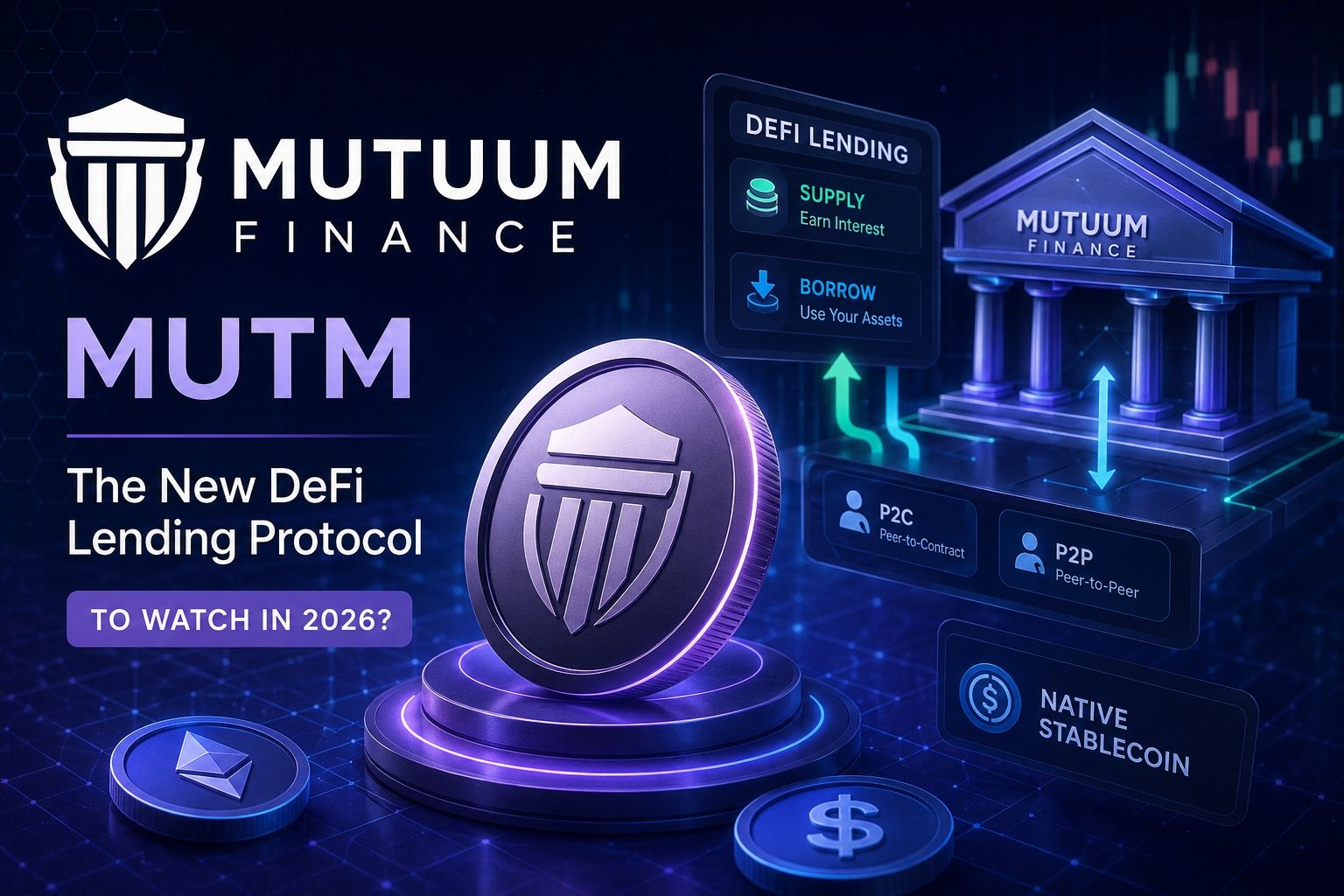
Mutuum Finance is attracting attention with its MUTM token, advanced presale, decentralized lending model and ambition to combine crypto loans, a native stablecoin, protocol revenues and multi-chain infrastructure. In a market where DeFi News increasingly focuses on real utility, lending protocols and sustainable liquidity, one key question remains: can this new protocol really establish itself in a sector already dominated by giants such as Aave, Compound and Morpho?
In this analysis, we look at how the protocol works, the role of the MUTM token, the presale figures, the strengths of the project, but also the risks that investors should understand before gaining exposure to this still young crypto asset.
Mutuum Finance in Brief
- Project: DeFi protocol for crypto lending and borrowing
- Token: MUTM
- Sector: DeFi lending, decentralized liquidity, overcollateralized loans
- Model: Peer-to-Contract (P2C) + Peer-to-Peer (P2P)
- Ambition: to build a lending platform with a native stablecoin and ecosystem revenue mechanisms
- Important point: MUTM remains a presale token, with high speculative potential but also significant risks
Why Is This DeFi Project Getting Attention?
This project is part of a new wave of DeFi initiatives trying to benefit from renewed interest in lending protocols. After several years marked by centralized failures, hacks, liquidity crises and artificial yield excesses, decentralized finance is entering a more selective phase. Investors are no longer looking only at yield promises. They want to understand the economic model, security, liquidity, tokenomics and the real ability of a protocol to attract users.
It is in this context that Mutuum Finance is trying to position itself. The project aims to offer a non-custodial crypto lending and borrowing infrastructure, meaning that user funds are not directly held by a centralized entity. Users could deposit assets, borrow against collateral, provide liquidity or participate in a more flexible market between lenders and borrowers.
On paper, the positioning is clear: this new protocol wants to enter the large crypto lending market, a sector already validated by platforms such as Aave and Compound. But it is also a very difficult market to conquer, because liquidity naturally concentrates on the oldest, most audited and most widely used platforms.
What Is Mutuum Finance?
This new protocol is presented as a decentralized liquidity platform allowing users to lend, borrow and generate interest from crypto assets. The principle is relatively simple: some users deposit cryptocurrencies into liquidity pools, while others borrow by depositing collateral worth more than the value of the loan.
This model is already well known in DeFi. It is based on overcollateralization, meaning that the borrower must deposit more value than they receive as a loan. If the value of the collateral falls too much, the protocol can automatically liquidate the position in order to protect lenders.
This mechanism avoids some of the classic risks of traditional credit. There is no need for a bank, a credit file or a human intermediary to approve the loan. The smart contract applies the rules defined by the protocol. In theory, this makes the system more transparent, faster and more accessible.
But this automation does not eliminate all risks. It shifts them. Instead of depending on a bank, the user depends on the quality of the code, the security of the smart contracts, price oracles, available liquidity and the overall robustness of the protocol.
The Peer-to-Contract Model: The Core of the Protocol
The first pillar of the project is its Peer-to-Contract model, often abbreviated as P2C. In this system, lenders do not negotiate directly with borrowers. They deposit their assets into pools managed by smart contracts. Borrowers then access this liquidity by depositing collateral.
This model offers several advantages. First, it allows more immediate liquidity. A borrower does not need to wait for a lender to manually accept an offer. If the pool has enough funds and the conditions are met, the loan can be executed automatically.
Second, lenders can generate passive interest. They do not need to select each borrower individually. Their yield depends on pool utilization, borrowing demand, applied interest rates and the economic design of the protocol.
Finally, the P2C model improves transparency. Deposits, loans, liquidations and liquidity flows are meant to be visible on-chain. This does not mean that everything is risk-free, but it gives users verifiable elements, unlike some centralized platforms where fund management remained opaque.
The Peer-to-Peer Model: More Flexibility for Advanced Users
The second pillar announced by this DeFi project is the Peer-to-Peer model, or P2P. Unlike P2C, this model allows two users to interact more directly. A lender and a borrower can theoretically define more customized terms: loan amount, duration, interest rate, type of collateral or specific conditions.
This approach may appeal to more experienced users who do not necessarily want to rely on the standard parameters of a pool. It could also open the door to more specialized markets, especially for less liquid assets or more complex DeFi strategies.
However, P2P is not necessarily simpler. It requires a better understanding of risk. A user accepting low-quality, highly volatile or illiquid collateral may be exposed to losses if the market moves quickly. This is why the success of this part of the protocol will depend heavily on the safeguards put in place.
On this point, the project will need to find the right balance: offering enough flexibility to differentiate itself, without opening the door to markets that are too risky and could weaken the platform.
MUTM: What Is the Token Used For?
The MUTM token is presented as the native asset of the ecosystem. Its role is central in the project’s communication, as it is expected to align the interests of users, liquidity providers and participants in governance or economic mechanisms.
In this type of project, the token can have several functions: access to certain benefits, participation in reward mechanisms, distribution of part of protocol revenues, liquidity incentives or a role in governance. But caution is necessary: as long as the protocol is not fully operational and revenues are not verifiable at scale, the value of the token mainly depends on market expectations.
This is an essential point. This asset is not yet comparable to a mature DeFi token such as AAVE, which benefits from history, significant liquidity, observable revenues and a long-standing presence in the ecosystem. MUTM remains a presale token. That can offer higher speculative potential, but also a much higher level of risk.
The MUTM Presale: Opportunity or Warning Signal?
The presale is one of the main drivers of visibility for this new ecosystem. The project communicates a multi-phase structure, with prices increasing at each stage. The first phase was associated with a very low price, while the more recent phases display a higher price before the planned token launch.
This type of structure is common in crypto presales. It creates a strong psychological incentive: early participants benefit from a lower price, while later investors may feel they need to act quickly before the next increase. This can support short-term demand, but it does not guarantee real adoption of the protocol.
To properly analyze a presale, two things must be separated: the commercial momentum of fundraising and the fundamental strength of the protocol. A presale that raises a lot of money can show strong market interest, but it does not yet prove that the platform will be used sustainably.
The positive element is that the project team communicates about product development, security audits and the intention to launch functional infrastructure. The riskier element is that investors are still buying a promise of future execution. In crypto, the gap between a convincing roadmap and a truly adopted product can be huge.
Summary Table: Mutuum Finance and MUTM
| Element | Detail |
|---|---|
| Project name | Mutuum Finance |
| Token | MUTM |
| Sector | DeFi lending, crypto borrowing, decentralized liquidity |
| Model | Peer-to-Contract and Peer-to-Peer |
| Objective | Allow users to lend, borrow and generate interest from crypto assets |
| Main risk | Young project, presale token, adoption not guaranteed |
A Native Stablecoin: A Strategic Building Block
This new protocol also highlights the idea of a fully collateralized native stablecoin. In a lending protocol, a stablecoin can play a central role. It can be used as a borrowing asset, a temporary store of value, collateral or a risk management tool for users.
After the collapse of TerraUSD, the market became much more cautious about poorly designed or insufficiently backed stablecoins. A credible DeFi stablecoin must be transparent, overcollateralized, properly audited and able to withstand periods of high volatility.
If the team manages to integrate a robust stablecoin into its ecosystem, it could strengthen the utility of the platform. Users could lend or borrow in a more stable unit than volatile cryptocurrencies. It could also facilitate certain yield strategies.
But once again, everything will depend on execution. A native stablecoin is a double-edged sword. If well designed, it can become a powerful adoption driver. If poorly designed, it can create systemic risk for the entire protocol.
Mutuum Finance vs Aave, Compound and Morpho
To understand the potential of this project, it is useful to compare it with the already established players in DeFi lending.
Aave remains one of the leaders in the sector. The protocol benefits from deep liquidity, a recognized brand, a long history and a presence across several blockchains. For a new entrant, competing with Aave is extremely difficult, because DeFi users often prefer platforms where liquidity is deepest.
Compound is another historical reference. Even though its relative influence has evolved over time, Compound helped establish the model of decentralized money markets. It remains an important comparison point for any lending protocol.
Morpho, for its part, represents a newer and more optimized generation of DeFi lending. Its modular approach and more sophisticated positioning show that the market is no longer limited to simple liquidity pools. Users are now looking for better capital efficiency, more competitive rates and more flexible architectures.
This ecosystem therefore enters a real market, but one that is already highly competitive. Its P2C + P2P model may allow it to differentiate itself, but that will not be enough. To establish itself, it will need to attract liquidity, reassure users, prove the security of its code and generate sustainable organic activity.
The Real Challenge
The challenge is not just to launch a token or complete a presale. The real challenge is to become a used protocol. In DeFi lending, value comes from liquidity, trust, borrowing volume, risk management and the ability to survive bear markets.
The Strengths of This New Ecosystem
Despite the risks, this project presents several interesting elements. The first is its positioning. DeFi lending is not an empty narrative. It is one of the most important use cases in decentralized finance. Users genuinely need to lend, borrow, optimize their capital and access liquidity without selling their assets.
The second positive point is the willingness to combine two models: P2C and P2P. This architecture can serve two types of users. Simpler profiles can use automated pools, while more advanced users can look for more customized conditions.
The third point is the communication around security. In DeFi, audits never guarantee absolute safety, but they remain essential. A project that wants to manage deposits, loans and liquidations must show that it takes security seriously.
Finally, the advanced presale shows that the project has managed to capture the attention of an investor community. This does not prove the quality of the protocol, but it may give the team the financial resources to continue development.
- A promising sector: lending remains one of the pillars of DeFi.
- A hybrid model: P2C for efficiency, P2P for flexibility.
- A clear ambition: to create a crypto lending and borrowing infrastructure.
- A visible presale: the project has attracted significant market attention.
- A native stablecoin announced: potentially useful if its design proves robust.
The Risks to Consider Before Buying MUTM
A serious article about such a project cannot focus only on promises, because this new ecosystem also carries several major risks.
The first is the presale risk. Crypto presales are often highly speculative. The price increases by stages, but that does not mean the secondary market will follow the same trajectory. After a listing, early investors may sell, liquidity may be insufficient, and the price may become very volatile.
The second risk is the execution risk. Many crypto projects have ambitious roadmaps, but not all of them manage to deliver a solid product. Here, the challenge will be to transform communication into reality: a functional platform, real liquidity, effective risk management and a convincing user experience.
The third risk is the security risk. Even audited protocols can be hacked. Vulnerabilities can come from smart contracts, oracles, bridges, liquidation parameters or poor management of certain assets. In DeFi lending, a single mistake can be very costly.
The fourth risk is the competitive risk. Aave, Compound, Morpho and other protocols already have users, liquidity and reputation. This project will need to offer a real reason for users to migrate or add liquidity to a new protocol.
Finally, there is a marketing risk. Many articles around certain crypto presales are highly promotional. Investors should therefore verify information, read the official documentation, examine audits, understand tokenomics and never rely solely on price projections.
The Main Risks of MUTM
- Presale risk: the price before listing does not guarantee the price after listing.
- Liquidity risk: a young token may be difficult to sell under good conditions.
- Execution risk: the roadmap still needs to be delivered.
- Security risk: an audit reduces some risks, but never eliminates them.
- Competitive risk: DeFi lending is already dominated by powerful players.
- Speculative risk: current interest may be linked more to the presale than to actual protocol usage.
Can MUTM Really Increase in Value?
This is obviously the question investors care about: can MUTM rise significantly after launch? The honest answer is nuanced.
Yes, a presale token can experience a strong increase if several conditions are met: high demand at listing, sufficient liquidity, a favorable crypto market, a functional product, an active community, listings on visible platforms and an attractive DeFi narrative.
But no, such a rise is never guaranteed. Many presale tokens experience strong volatility after launch. Some rise quickly before correcting. Others fail to maintain market interest. The price will depend less on initial promises than on the real adoption of the protocol.
For MUTM, the potential will therefore depend on several factors: the team’s ability to launch the platform, attract deposits, generate borrowing activity, maintain protocol security, create real demand for the token and survive competition.
A cautious investor should not analyze MUTM only as a “x10 opportunity” or a “x20 opportunity”. The more fundamental question is this: can this protocol become useful, liquid and sustainable in the DeFi ecosystem?
How to Analyze the Project Before Investing
Before buying a token like MUTM, it is useful to follow a simple analysis framework.
The first step is to read the official documentation. Investors need to understand how the protocol works, which assets will be supported, how interest rates will be calculated, how liquidations will be executed and what the exact utility of the token will be.
The second step is to check the audits. An audit is not a guarantee, but it shows whether external firms have reviewed the code. It is also important to see whether the reports are public, detailed and recent.
The third step is tokenomics analysis. How many tokens exist? What share is sold in presale? What is the vesting schedule? When will early investors be able to sell? What share goes to the team, marketing, liquidity or rewards? These questions are essential to avoid unpleasant surprises after listing.
The fourth step is product observation. A credible DeFi protocol must eventually offer an interface, smart contracts, active markets and verifiable on-chain data. As long as everything relies mainly on communication, the risk remains high.
Finally, investors should compare the project with its competitors. If Aave, Compound or Morpho already offer a more liquid, safer and more recognized solution, the new entrant will need to bring a real difference to attract users.
Quick Checklist Before Looking at MUTM
- Read the official documentation.
- Check the audits and their real scope.
- Understand tokenomics and vesting.
- Assess the quality of the team and communication.
- Compare the project with Aave, Compound and Morpho.
- Never invest only on the basis of a price projection.
- Limit exposure if the token remains in presale.
Should Investors Watch Mutuum Finance in 2026?
Yes, this new ecosystem deserves to be watched in 2026, especially if the project manages to reach several concrete milestones: functional launch, real liquidity, user adoption, security confirmed in real conditions and transparency around protocol revenues.
The narrative is interesting. DeFi lending remains a major sector. The P2C + P2P model can offer a relevant combination of automation and flexibility. The native stablecoin can strengthen the ecosystem if it is well designed. And the MUTM token may benefit from speculative interest if the broader crypto market remains favorable.
But investors must remain realistic. At this stage, the potential still depends heavily on future execution. Until the protocol has demonstrated real and sustainable usage, MUTM should be considered a high-risk asset.
Verdict: DeFi Opportunity or Speculative Bet?
Mutuum Finance has several attractive elements: positioning in DeFi lending, a hybrid model, a native token, a visible presale and the ambition to build a real crypto lending and borrowing infrastructure.
But MUTM remains above all a young token, linked to a presale and to a roadmap that still needs to be executed. The project could become interesting if the platform attracts real liquidity and users. On the other hand, if adoption does not follow, the token may remain dependent on speculation.
Conclusion: this is a DeFi project to follow, but not one to buy blindly. The potential exists, but it must be weighed against the high risks associated with crypto presales.
FAQ
What is Mutuum Finance?
Mutuum Finance is a DeFi lending protocol that aims to allow users to lend and borrow crypto assets through smart contracts. The project highlights a Peer-to-Contract and Peer-to-Peer model.
What is the MUTM token used for?
MUTM is the native token of the ecosystem. It is associated with the project’s presale and could play a role in protocol economics, liquidity incentives or certain benefits for users.
Is the token already mature?
No. MUTM should be considered a young and speculative token. It remains linked to a launch phase and to the future execution of the protocol. The risk is therefore higher than for already established DeFi tokens.
Can this new project compete with Aave?
Mutuum Finance can try to position itself in the same sector, but competing with Aave is very difficult. Aave already has deep liquidity, a strong track record and a recognized brand. The project will need to prove its difference through real usage.
What are the main risks of MUTM?
The main risks are presale risk, liquidity risk after listing, roadmap execution risk, smart contract security risk and competitive risk against established DeFi protocols.
Should investors buy into this ecosystem?
This article does not constitute investment advice. The project may be interesting to watch, but MUTM remains a high-risk speculative asset. Every investor should do their own research and only invest what they can afford to lose.
Should investors buy into this ecosystem?
This article does not constitute investment advice. The project may be interesting to watch, but MUTM remains a high-risk speculative asset. Every investor should do their own research and only invest what they can afford to lose.
Explore More Crypto Presales

Mutuum Finance is only one example of the growing number of crypto presales attracting attention in the DeFi market. Some projects offer real innovation, while others remain highly speculative.
To compare other early-stage opportunities, token launches and high-risk crypto projects, visit our dedicated Crypto Presales section.

