
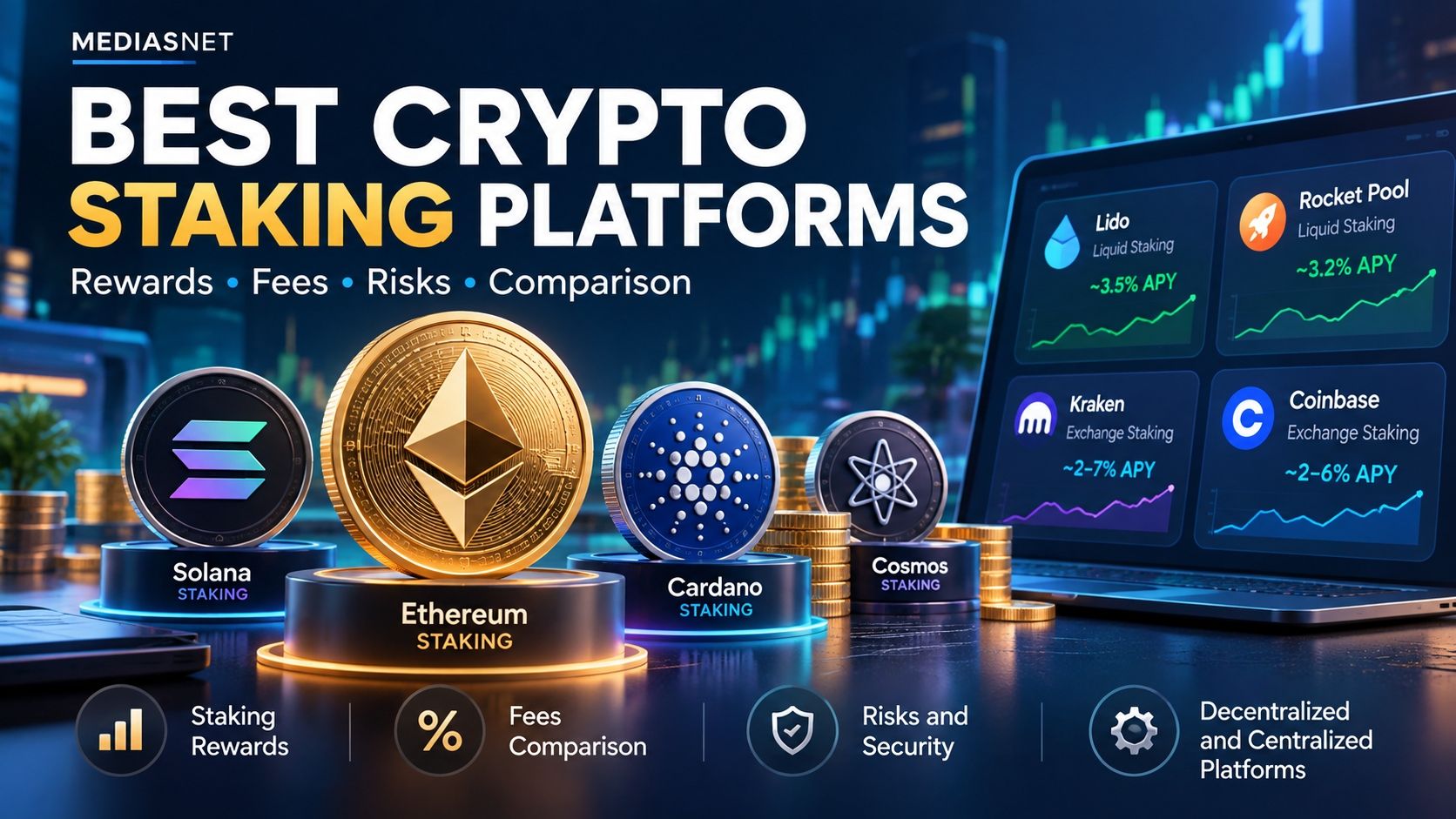
What are the best crypto staking platforms? The answer depends on the cryptocurrency you hold, the rewards you expect, the fees charged by the provider and the level of control you want over your assets. Lido and Rocket Pool are important options for Ethereum liquid staking, while Kraken and Coinbase offer more accessible custodial services. Native delegation on networks such as Solana and Cardano provides another alternative.
But the platform offering the highest advertised annual percentage yield (APY) is not necessarily the one delivering the best investment outcome.
Some providers charge substantial commissions on staking rewards. Others introduce smart contract exposure, withdrawal delays or additional risks through liquid staking and restaking.
For investors seeking to generate income from cryptocurrency holdings, understanding these differences can be more valuable than chasing an extra percentage point of yield.
This guide compares the best crypto staking platforms, examines their reward mechanisms, explains how fees affect actual returns and explores which solutions may be appropriate for different types of investors.
New to the subject? Start with our detailed guide to staking definition, crypto examples and restaking before comparing individual platforms.
Quick answer: which staking platform should you consider?
For Ethereum liquid staking: Lido or Rocket Pool.
For exchange-based staking: Kraken or Coinbase, depending on eligibility, fees and available products.
For native staking: Direct delegation through supported Solana or Cardano wallets.
For advanced strategies: Restaking protocols may offer additional reward opportunities, but require a more detailed risk assessment.
Most important: Compare net rewards, custody arrangements and withdrawal rights before depositing cryptocurrency.
Best crypto staking platforms: comparison overview
Several platforms stand out because of their different approaches to staking. However, a fair comparison requires distinguishing between custodial exchanges, decentralized liquid staking protocols and direct blockchain delegation.
These services do not offer identical products, even when they support the same cryptocurrency.
| Platform or method | Main assets | Staking model | Main advantage | Main limitation |
|---|---|---|---|---|
| Lido | ETH | Liquid staking | Transferable stETH | Protocol and LST risks |
| Rocket Pool | ETH | Liquid staking | Distributed node operators | Contract and liquidity risks |
| Kraken | ETH, SOL, ATOM, DOT, ADA and others | Custodial staking | Multiple assets and simplified access | Custody and reward commissions |
| Coinbase | ETH, SOL, ADA, ATOM and others | Custodial staking | Simple account-based staking | Standard commissions can be high |
| Solana native staking | SOL | Validator delegation | Direct network participation | Validator selection and deactivation timing |
| Cardano native staking | ADA | Stake-pool delegation | ADA remains spendable | Variable pool rewards |
The comparison is based on the general characteristics of each staking arrangement, not a ranking determined solely by advertised yields.
Rewards, available assets, eligibility and fees should always be checked directly before investing.
Lido: Ethereum liquid staking with stETH
Lido is an established Ethereum liquid staking protocol that allows holders to participate in ETH staking without personally operating validators.
Its defining feature is the issuance of stETH, a liquid staking token representing a position in the underlying staking system.
How does Lido staking work?
Users deposit ETH into the protocol and receive stETH through the supported mechanism.
The protocol allocates ETH to validators operated through its staking infrastructure. Rewards accrue to the underlying staked position, and the stETH accounting mechanism reflects the corresponding staking balance.
Because stETH is transferable, investors may also use it within compatible decentralized finance applications.
However, trading stETH on a secondary market is different from redeeming the underlying ETH through the protocol.
Lido staking rewards and fees
Lido calculates its advertised staking APR using recent protocol performance, including relevant Ethereum consensus and execution rewards.
The protocol currently specifies a 10% fee on staking rewards, allocated according to its operating and governance arrangements.
This means the protocol fee is charged on rewards, not as a 10% deduction from the entire deposited ETH amount.
For example, if a position generated a hypothetical 3% gross annual staking reward, a 10% commission on those rewards would reduce the annual staking return to approximately 2.7%, before other expenses.
This example is illustrative rather than a live Lido APR.
Advantages and risks of Lido
The primary advantages include access to Ethereum staking without running validator infrastructure, integration with compatible DeFi applications and a transferable staking representation.
The main considerations include smart contract security, protocol governance, validator concentration, stETH market liquidity and possible redemption delays.
Who may find Lido useful? Investors seeking Ethereum staking exposure who understand the additional risks associated with liquid staking tokens.
Rocket Pool: decentralized Ethereum staking with rETH
Rocket Pool is another important Ethereum liquid staking protocol, with an emphasis on distributed validator participation.
Rather than requiring every token holder to operate a validator, Rocket Pool allows users to obtain rETH, a token representing exposure to its pooled Ethereum staking system.
How does rETH generate staking rewards?
The economic value of rETH relative to its underlying ETH position is designed to reflect accrued staking rewards after applicable protocol deductions.
Unlike a token balance that increases through rebasing, rETH generally represents rewards through changes in the amount of ETH attributable to each rETH token.
Its secondary-market price can nevertheless diverge from the underlying redemption value.
Rocket Pool fees
Rocket Pool’s documented commission framework has included a 14% share of staking rewards associated with its pooled staking arrangements.
Governance discussions have explored adjustments to this structure. Therefore, the exact fee applicable to a new position should be confirmed from current protocol parameters rather than assumed to remain permanently unchanged.
A difference between a 10% and a 14% commission may appear small, but the cumulative effect can matter over extended holding periods.
Why choose Rocket Pool?
Rocket Pool may interest investors who value its validator operator architecture, exposure through rETH and its role within Ethereum’s broader decentralized staking ecosystem.
Its risks include smart contract vulnerabilities, operator performance, governance changes, token liquidity and protocol-specific withdrawal arrangements.
Rocket Pool is not inherently risk-free simply because its infrastructure is decentralized.
Kraken: a centralized staking platform with multiple cryptocurrencies
Kraken offers custodial staking services across numerous eligible cryptocurrencies.
Its main attraction is convenience: users may participate through an exchange interface instead of managing staking transactions directly through separate wallets or protocols.
Supported staking assets
Kraken’s published staking selection includes Ethereum, Solana, Cardano, Cosmos, Polkadot, NEAR, Avalanche, Tezos and other eligible assets.
Available products depend on jurisdiction and account eligibility.
Kraken distinguishes between staking arrangements such as bonded staking and flexible or automatic earning products.
These products can have different liquidity conditions, reward structures and commissions.
How much does Kraken charge for staking?
According to Kraken’s published bonded staking fee schedule, commissions on staking rewards depend on the amount of assets under management within the relevant staking products.
| Relevant staked assets | Bonded staking reward commission |
|---|---|
| Under $1 million | 25% |
| $1 million to $5 million | 20% |
| $5 million to $50 million | 10% |
| $50 million to $100 million | 5% |
| $100 million or more | 0% |
Published fee schedule reviewed in October 2026. Eligibility, calculation rules and product terms may change. Other staking products can use different commissions.
Kraken also publishes a 30% commission on rewards for its flexible staking and Auto Earn arrangements, subject to product-specific exceptions.
The distinction between gross APY and net APY is particularly important. Investors should review how each advertised rate is calculated and whether the platform’s commission is already deducted.
Is Kraken suitable for staking?
Kraken can be convenient for users who already hold supported assets on the exchange and want a consolidated interface.
However, custodial staking introduces counterparty and operational risks that are different from self-custodied native delegation.
Users should also verify geographical restrictions, withdrawal terms and whether the particular product involves direct staking or another yield arrangement.
Coinbase: simple staking with significant reward commissions
Coinbase provides another accessible route into cryptocurrency staking through its exchange infrastructure.
Users can participate in eligible staking programs directly from their accounts, subject to applicable conditions.
Which assets can be staked on Coinbase?
Coinbase lists staking support for selected Proof-of-Stake assets, including Ethereum, Solana, Cardano, Cosmos, Polkadot and Tezos, depending on product and jurisdiction.
Rewards are affected by underlying blockchain conditions and the company’s commission arrangements.
Coinbase staking fees explained
Coinbase’s published standard staking commission is 35% on rewards for several supported assets, including ETH, SOL, ADA, ATOM, DOT and XTZ.
Certain eligible subscription tiers or promotional arrangements may provide lower commissions.
Coinbase indicates that the staking rewards presented within the account reflect the amount after its applicable commission.
For example, if a network generated a hypothetical 4% gross staking return and the provider retained 35% of the rewards, the resulting net return would be approximately 2.6% before other costs.
That difference becomes meaningful when staking larger positions over multiple years.
Convenience versus profitability
Coinbase may appeal to users who prefer a simplified account experience over independently managed staking infrastructure.
However, the commission structure can materially reduce net rewards compared with certain direct delegation or decentralized staking options.
This does not automatically make Coinbase unsuitable. Convenience, service availability and operational simplicity can have value.
The important point is to recognize the price of those services.
Native staking: is staking directly on a blockchain better?
One of the most overlooked alternatives to commercial staking platforms is native delegation.
On supported blockchains, token holders can participate in network staking through compatible wallets without relying on a centralized exchange to custody the assets.
This can provide more direct control over the position, although it shifts additional responsibility to the user.
Solana native staking
Solana holders can delegate SOL to validators through supported wallet interfaces.
Validators participate in network consensus and receive rewards according to blockchain rules.
Staking returns depend on factors including validator performance, total network stake, token issuance and validator commissions.
Rewards are typically coordinated around Solana epochs, and stake activation or deactivation can involve waiting periods.
Native delegation may appeal to holders who want to avoid exchange custody and choose their own validator.
However, independent validator selection requires research into performance, commissions and operational reliability.
Cardano native staking
Cardano allows ADA holders to delegate to stake pools while retaining control of their cryptocurrency.
A particularly useful feature is that delegated ADA generally remains spendable instead of being locked for a fixed staking period.
Rewards are calculated according to Cardano’s protocol rules and depend in part on stake pool performance, fees and network parameters.
For long-term ADA holders, native delegation can be a comparatively straightforward way to participate in the network.
Is native staking cheaper?
It can be, but not always.
Direct delegation may avoid an exchange’s additional commission, while still involving validator fees, transaction costs and blockchain-specific deductions.
Investors must also consider the value of their time, wallet security and the risks of making operational mistakes.
Crypto staking yields: current examples and how to interpret them
Staking reward rates can fluctuate significantly across assets and products.
The following figures illustrate publicly advertised rates from Kraken’s staking page reviewed in October 2026.
They should be treated as a dated reference snapshot rather than guaranteed annual returns or directly comparable net investor yields.
| Cryptocurrency | Published bonded rate | Important consideration |
|---|---|---|
| Ethereum (ETH) | 2.72% | Network conditions and provider commissions |
| Solana (SOL) | 6.88% | SOL volatility and validator rewards |
| Cosmos (ATOM) | 19.15% | Token inflation, volatility and unbonding |
| Avalanche (AVAX) | 5.11% | Staking duration and price exposure |
| NEAR | 5.28% | Validator commissions and variable yield |
| Polkadot (DOT) | 2.95% | Network economics and payout conditions |
Source: Kraken’s published staking rate examples, consulted October 9, 2026. Rates are platform-specific snapshots, not universal blockchain yields. Kraken indicates that its displayed APY estimates do not necessarily include its staking commissions. The actual return received may therefore be lower. Verify current figures before making a decision.
These figures illustrate why the highest published APY is not automatically the most attractive investment.
A cryptocurrency offering a much higher token reward rate may also have greater inflation, lower liquidity or higher market volatility.
How staking platform fees affect your actual returns
Comparing the best crypto staking platforms requires examining net rewards rather than simply looking at annualized percentages.
Example: $100,000 staked at a 4% gross annual return
Imagine staking an asset position worth $100,000 at the beginning of a year.
Assume the underlying network produces rewards equal to 4% annually, with no compounding, transaction costs or price changes.
| Reward commission | Gross annual rewards | Net annual rewards | Net yield |
|---|---|---|---|
| 0% | $4,000 | $4,000 | 4.00% |
| 10% | $4,000 | $3,600 | 3.60% |
| 14% | $4,000 | $3,440 | 3.44% |
| 25% | $4,000 | $3,000 | 3.00% |
| 35% | $4,000 | $2,600 | 2.60% |
The difference between a 10% and 35% commission is $1,000 annually in this hypothetical example.
For larger positions or longer holding periods, these differences can become even more significant.
Of course, this comparison isolates commission effects only. It does not account for the different risks, underlying rewards or services associated with each platform.
Staking APR vs APY: why investors should understand both
APR generally represents an annualized rate without considering compounding. APY incorporates compounding according to specified assumptions.
For example, a hypothetical 5% APR compounded monthly produces an effective annual percentage yield of approximately 5.12%.
However, advertised APY calculations can differ between platforms, especially when rewards are variable or paid in multiple cryptocurrencies.
Token-denominated returns versus dollar returns
Suppose an investor holds 10,000 tokens and earns another 500 through staking during the year.
The token balance rises by 5%.
But if the token’s market price drops by 30%, the dollar value of the total position falls to approximately 73.5% of its initial value.
Staking can therefore increase the number of units held while the overall investment loses money.
The effect of inflation
Some Proof-of-Stake networks finance rewards partly through newly issued cryptocurrency.
Additional token issuance can dilute holders who do not participate in staking.
Even participants receiving rewards should consider whether their token balance is growing meaningfully faster than total token supply.
Comparing nominal yields without evaluating issuance and market demand provides an incomplete picture of real investment performance.
Liquid staking vs centralized staking platforms
Liquid staking protocols and centralized exchanges solve different problems.
Liquid staking creates transferable positions that may be integrated into decentralized finance applications.
Centralized staking platforms provide convenient account interfaces and generally assume responsibility for managing technical operations on users’ behalf.
Advantages of liquid staking
Liquid staking can provide transferability, DeFi compatibility and exposure to native staking rewards without requiring individual validator operation.
However, it introduces smart contract dependencies and possible deviations between token market prices and underlying redemption values.
Advantages of custodial staking
Custodial staking may simplify access, reward tracking and portfolio administration.
Some investors also value having staking integrated into an existing exchange account.
The principal trade-off is counterparty dependence, including account restrictions, provider solvency, service eligibility and withdrawal processing.
Which model is safer?
Neither model can be universally described as safer.
Direct staking removes certain custody dependencies but increases responsibility for self-custody and validator selection.
Liquid staking introduces protocol and liquidity exposure.
Centralized exchange staking adds counterparty and operational dependencies.
The relevant question is which risks the investor can understand, evaluate and manage effectively.
Restaking platforms: should you pursue additional yield?
Restaking allows eligible staking-related assets to provide economic security to additional blockchain services.
Protocols such as EigenLayer have developed infrastructure for assigning stake to additional services and operator sets.
These arrangements can create reward opportunities beyond the original blockchain staking process.
However, the existence of a restaking product does not guarantee additional rewards or a positive risk-adjusted return.
Restaking increases the number of dependencies
An investor may initially have exposure to Ethereum staking.
Adding liquid staking introduces another protocol and a token representing the underlying position.
Adding restaking creates exposure to additional services, operator obligations and potentially new slashing conditions.
A liquid restaking token may introduce yet another contract and liquidity layer.
The risk profile can therefore become considerably more complex than the original ETH staking position.
Why the highest restaking yield can be misleading
Restaking rewards may be financed partly through token incentives rather than established revenue streams.
These incentives can change or expire.
In addition, yields distributed through volatile tokens may be worth considerably less when eventually sold.
For many investors, understanding the security obligations and possible penalties is more important than attempting to maximize short-term rewards.
Our introductory staking and restaking guide explains these mechanisms and their differences in greater detail.
How to choose the best crypto staking platform
The most suitable provider is not necessarily the one advertising the highest return. A useful evaluation involves several complementary criteria.
Security and transparency
Examine the provider’s security model, smart contract architecture, custody arrangements and incident history.
For decentralized protocols, independently accessible documentation, audits and on-chain activity can provide additional transparency.
Audits should be considered useful evidence rather than guarantees against future exploits.
Net staking rewards
Compare the reward rate after validator commissions, platform fees and other deductions.
Check whether the advertised figure is gross or net, whether rewards are compounded and whether the rate is historical, projected or promotional.
Withdrawal conditions
Understand whether funds are immediately transferable, subject to an unbonding period or dependent on secondary-market liquidity.
Liquidity requirements can be particularly important during volatile market conditions.
Custody and control
Determine who controls the private keys and whether the user retains direct withdrawal authority.
A platform may offer an attractive interface while requiring investors to accept significant custody risks.
Validator concentration
For native and pooled staking, review the distribution of stake across validators and operators.
A very high degree of concentration can create governance or operational vulnerabilities.
Tax and reporting implications
Staking rewards may create taxable events depending on jurisdiction and personal circumstances.
Liquid staking exchanges, restaking operations and subsequent token sales may also have separate tax consequences.
Investors should review applicable local rules rather than assume all staking arrangements receive identical treatment.
Which staking platform is best for different types of investors?
A practical comparison should consider investor objectives instead of producing a single ranking based on yield.
For beginners seeking convenience
Kraken or Coinbase may be appropriate candidates for users who prioritize a simplified interface and support for multiple cryptocurrencies.
However, investors must understand custody risks, eligibility restrictions and reward commissions.
For long-term Ethereum holders
Lido and Rocket Pool offer distinct liquid staking approaches, while direct Ethereum validation is another possibility for eligible users with suitable technical resources.
The decision depends on preferred custody arrangements, protocol exposure, available liquidity and willingness to manage infrastructure.
For Solana holders
Native validator delegation can be a useful alternative to leaving SOL on a centralized exchange.
Investors should compare validator uptime, commission policies, stake concentration and exit procedures.
For Cardano holders
Native ADA delegation offers the important advantage of maintaining spendable assets while participating in stake-pool rewards.
Pool reliability and reward parameters remain relevant.
For investors prioritizing capital preservation
No cryptocurrency staking product should be treated as a guaranteed capital-preservation instrument.
Even a technically reliable staking mechanism cannot protect the dollar value of an underlying asset against severe market declines.
Investors with low tolerance for volatility should take this limitation seriously.
For advanced DeFi investors
Liquid staking and restaking strategies provide more flexibility but require substantially more research.
Such strategies can create overlapping exposure to validators, smart contracts, token liquidity and additional security services.
Complexity should be justified by a clear understanding of the additional expected benefit.
Staking strategies for larger cryptocurrency portfolios
For investors managing substantial amounts of cryptocurrency, the decision extends beyond choosing the provider with the highest reward rate.
Operational resilience, custody arrangements and exit liquidity can become especially important.
Avoid excessive platform concentration
Concentrating an entire staking portfolio within a single exchange or smart contract can create a significant single point of failure.
Where suitable, diversification across independent arrangements may reduce some forms of provider-specific risk.
However, diversification does not eliminate exposure to correlated blockchain or market failures.
Evaluate withdrawal capacity
A large staking position may not be easy to exit quickly without delays, fees or unfavorable market prices.
Investors should assess redemption procedures, validator exit conditions and secondary-market depth before entering a position.
Prioritize documentation
Maintain records of deposits, staking rewards, withdrawals, validator assignments and fees.
Accurate documentation can help with financial reporting, tax compliance and demonstrating the origin of funds when required by financial institutions.
Separate investment returns from operational yield
A high annual staking reward does not necessarily compensate for exposure to a volatile underlying token.
For larger portfolios, the asset allocation decision may have a much greater financial impact than the difference between two staking providers’ commissions.
Common mistakes when comparing staking platforms
Several mistakes regularly distort investors’ understanding of staking profitability.
Choosing only the highest APY
High rewards may reflect token inflation, temporary incentives or compensation for substantial risk.
The most attractive headline rate is not necessarily the best long-term investment.
Ignoring platform commissions
Reward commissions can make a substantial difference to net results.
Investors should verify whether quoted APYs already reflect the applicable deductions.
Confusing staking with lending
Not every crypto yield product represents direct Proof-of-Stake participation.
Products involving borrowing, liquidity pools or other financial arrangements can have entirely different risk profiles.
Ignoring unstaking restrictions
Withdrawal delays can become especially problematic when investors need liquidity during a market downturn.
A position that earns attractive rewards may still be unsuitable if it cannot be exited when needed.
Assuming a reputable platform eliminates risk
Established providers can experience technical incidents, operational interruptions, security problems or regulatory restrictions.
Past reliability is useful information but not a guarantee.
FAQ: best crypto staking platforms and rewards
What are the best crypto staking platforms?
Well-known options include Lido and Rocket Pool for Ethereum liquid staking, Kraken and Coinbase for exchange-based staking, and native delegation through supported Solana and Cardano wallets. The most appropriate option depends on asset compatibility, fees, liquidity, custody and risk tolerance.
Which staking platform pays the highest APY?
There is no permanent leader because staking rates change and products involve different levels of risk. Higher advertised yields may also reflect token inflation or promotional incentives. Investors should compare net rewards and the underlying source of yield.
Is Kraken better than Coinbase for staking?
Kraken and Coinbase offer different staking products, commissions and eligibility conditions. Published standard commissions can make Kraken more competitive for certain products, but the best option depends on the asset, account conditions and individual priorities.
Is Lido better than Rocket Pool?
Neither protocol is universally superior. Lido offers stETH through its liquid staking architecture, while Rocket Pool offers rETH through its distributed operator system. Their commission structures, token mechanics, liquidity and protocol risks differ.
Can I earn 10% annually from crypto staking?
Some cryptocurrency staking products advertise annualized rates above 10%. However, these returns are variable and may be offset by token depreciation, inflation, platform fees or other losses. A 10% token-denominated reward does not guarantee a 10% dollar return.
What is the safest crypto staking platform?
No staking platform is completely safe. Native delegation, custodial staking and liquid staking each introduce different risks. Investors should compare security arrangements, custody, validator concentration, smart contract dependencies and withdrawal conditions.
Can I lose money when staking Ethereum?
Yes. Ethereum’s price can decline, validators can incur penalties and third-party staking arrangements can introduce additional risks. Earning ETH rewards does not guarantee a positive investment return in dollars.
What is the difference between liquid staking and restaking?
Liquid staking provides a transferable representation of an eligible staking position. Restaking allows qualifying economic stake to secure additional services. Some strategies combine both mechanisms, introducing multiple layers of protocol exposure.
Do staking platforms guarantee rewards?
No. Rewards generally depend on blockchain performance, participation conditions and provider arrangements. Advertised rates can change and should not be treated as guaranteed income.
Is native staking better than using an exchange?
Native staking can provide greater control and reduce reliance on exchange custody, but it also requires users to manage wallet security and select validators. Exchange staking may be more convenient at the cost of additional commissions and counterparty exposure.
Are staking rewards taxable?
Tax treatment depends on local laws and the precise transaction. Receiving rewards, exchanging staking tokens and selling accumulated cryptocurrency may be treated differently across jurisdictions. Personalized professional advice may be necessary.
Conclusion: choosing the right crypto staking platform
Comparing the best crypto staking platforms requires more than identifying the highest annual percentage yield.
Lido and Rocket Pool illustrate the possibilities of decentralized Ethereum liquid staking. Kraken and Coinbase demonstrate how centralized platforms simplify access while charging commissions for their services. Native delegation on networks such as Solana and Cardano provides additional choices.
For investors, understanding the relationship between rewards, custody, liquidity and protocol risk is essential.
The most attractive platform is not necessarily the cheapest, the largest or the one promising the highest yield. It is the one whose economic model, technical structure and withdrawal conditions are appropriate for the investor’s objectives.
A sustainable staking strategy starts with understanding where rewards come from, how much is actually retained after fees and what can happen when market conditions deteriorate.
Understand staking before choosing a platform
Still comparing Proof-of-Stake, liquid staking and restaking? Understanding the underlying mechanisms will help you evaluate providers more effectively.
Read our complete staking definition and restaking guide →
You can also explore the latest developments through our crypto and DeFi news coverage.
Official sources and further reading
The following primary resources provide information about the products, rates and mechanisms discussed in this comparison.
- Lido — Protocol fee structure
- Rocket Pool — Protocol documentation
- Kraken — Staking products and commissions
- Coinbase — Staking rewards and conditions
- Solana — Official staking documentation
- Cardano — Staking and delegation
Last editorial review: October 9, 2026. Published yields and fee schedules are time-sensitive and may vary by jurisdiction, service tier and product. This article is educational and does not constitute personalized financial or tax advice.


Trader, investor and author specializing in cryptocurrencies, DeFi and Web3.
On Mediasnet, I share my market analysis, practical guides and research on crypto markets, decentralized protocols and emerging trends across the ecosystem.
Follow me on: Facebook – X (Twitter)