
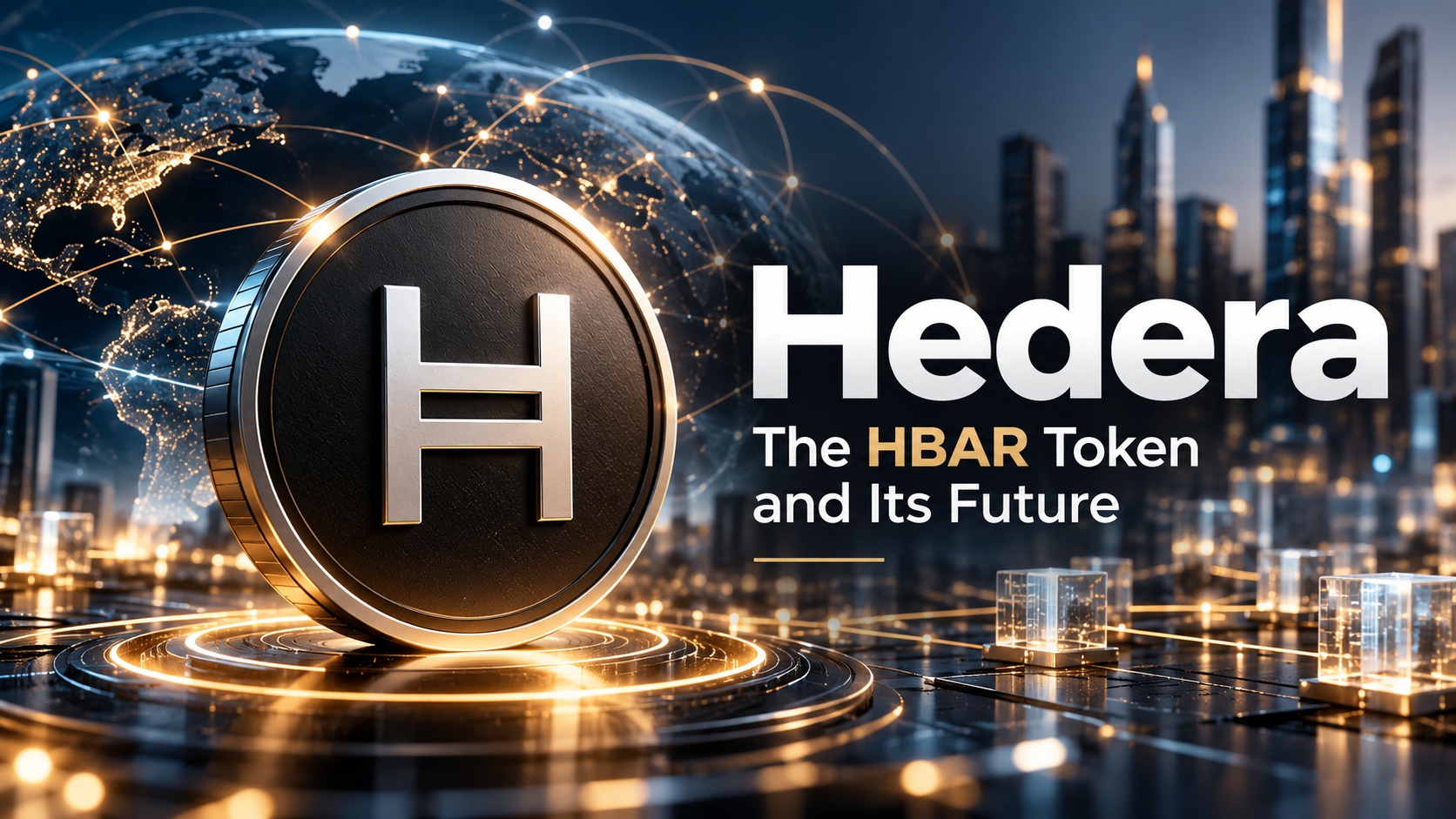
Hedera is a public distributed ledger built on Hashgraph, a consensus technology that differs from the traditional blockchain architecture used by networks such as Bitcoin and Ethereum.
Its native cryptocurrency is HBAR. The token is used to pay network fees, secure the system through proof-of-stake and support applications built on the infrastructure.
What makes the project unusual is its combination of Hashgraph technology, low and predictable transaction fees, EVM-compatible smart contracts and a governance model involving major international organizations.
But technology alone does not determine the value of a cryptocurrency. For HBAR investors, the central question is whether growing network adoption can generate enough economic demand for the token itself.
In brief
Hedera is an open-source public distributed ledger powered by the Hashgraph consensus algorithm. HBAR is its native cryptocurrency and is used for transaction fees and proof-of-stake security. Its maximum supply is fixed at 50 billion HBAR.
What is Hedera?
Hedera is a public proof-of-stake distributed ledger that uses Hashgraph rather than a conventional blockchain to reach consensus.
It allows developers and organizations to build decentralized applications, issue tokens, execute Solidity smart contracts and record or verify information through native network services.
The infrastructure can therefore support many of the same types of applications as smart-contract blockchains such as Ethereum, although its underlying consensus architecture is different.
It is particularly designed for applications where high transaction volumes, fast finality, predictable costs and security are important.
Is Hedera a blockchain?
Technically, it does not use a traditional linear blockchain. Its consensus mechanism is based on Hashgraph, which uses a directed acyclic graph, or DAG, to record how information spreads between network nodes.
In a conventional blockchain, transactions are grouped into blocks that are added sequentially to a chain. Hashgraph takes a different approach.
How does Hashgraph work?
The consensus algorithm relies on two important concepts: gossip-about-gossip and virtual voting.
Nodes rapidly share information about transactions and about the history of how that information was received. This progressively creates a graph representing communication between network participants.
Because each node can reconstruct this history, it can mathematically calculate how other nodes would vote on the ordering of transactions without requiring those votes to be repeatedly transmitted across the network.
This process is known as virtual voting.
The result is a consensus system designed to provide rapid finality while maintaining asynchronous Byzantine Fault Tolerance, or aBFT.
| Feature | Hashgraph network | Traditional blockchain |
|---|---|---|
| Structure | Hashgraph / DAG | Linear chain of blocks |
| Consensus | Gossip-about-gossip + virtual voting | Depends on the network |
| Native asset | HBAR | Depends on the blockchain |
| Security model | Proof-of-stake / aBFT | PoS, PoW or another model |
| Smart contracts | EVM compatible | Depends on the blockchain |
What is HBAR?
HBAR is the native cryptocurrency of the network. It has two fundamental functions: paying for services and helping secure the distributed ledger through proof-of-stake.
This distinction is important:
- Hedera refers to the network and technological infrastructure.
- HBAR is the native cryptocurrency used within that infrastructure.
When an application performs transactions or accesses network services, fees are paid in HBAR.
The cryptocurrency is also staked to consensus nodes and contributes to their voting weight.
For investors, however, an important distinction remains: growth in network adoption does not automatically guarantee a proportional increase in the HBAR price. The economic relationship between usage and demand for the token must also be considered.
What is the HBAR token used for?
The HBAR token is primarily used to pay transaction fees and secure the network through proof-of-stake.
This gives the cryptocurrency native utility beyond trading on exchanges.
Paying network fees
Applications pay transaction fees in HBAR.
These costs can apply to transfers, token operations, smart-contract execution and other interactions with network services.
One notable characteristic is that fees are generally denominated in US dollars and converted into HBAR when transactions are processed.
This mechanism is intended to make costs more predictable for businesses and developers even when the market price of the cryptocurrency fluctuates.
Securing the network through staking
The system uses proof-of-stake.
Each consensus node has a voting weight related to the amount of HBAR staked to it. The token therefore plays a direct role in economic security.
HBAR holders can stake their account to a consensus node while keeping their tokens liquid.
Unlike some proof-of-stake systems, native staking does not require a lock-up period and does not expose holders to slashing because of node misconduct.
Staking rewards can reach up to 2.5% APY, although actual rewards depend on network parameters and may be lower.
How many HBAR tokens exist?
The maximum HBAR supply is fixed at 50 billion tokens.
The entire maximum supply was created when the network launched rather than being progressively mined through proof-of-work.
Maximum supply and circulating supply should not be confused, however. The distribution of tokens has taken place progressively according to treasury and release policies.
For long-term analysis of the HBAR token, investors should therefore monitor both adoption and changes in circulating supply.
Who governs the network?
The project has one of the most unusual governance structures in the crypto industry.
Governance is organized through the Hedera Council, which brings together organizations from different industries and geographical regions.
The objective is to avoid concentrating strategic governance in a single company while providing a structured model that enterprises and institutions can understand.
Council participation has included major names from technology, finance, telecommunications, industry and academia.
The organization continued expanding in 2026. FedEx joined the Council in February, while Accenture was approved as a governing member in May.
Is the network decentralized?
The answer requires some nuance.
It is public and open source: developers can build applications and users can interact with the distributed ledger.
However, consensus nodes have historically been operated by Council members rather than through a completely permissionless validator model.
This governance structure can be interpreted in different ways.
For institutions, identifiable and geographically distributed organizations participating in governance may increase confidence.
For crypto users who prioritize maximum permissionless decentralization, it can instead represent a limitation compared with networks where virtually anyone can operate a validator.
Why could enterprises use Hedera?
The infrastructure is positioned around applications requiring high transaction volumes, fast finality, predictable costs and technology suitable for enterprise deployment.
Several areas could become particularly important for its long-term development.
Tokenization and real-world assets
Tokenization allows ownership rights or financial instruments to be represented digitally on distributed ledgers.
Potential examples include bonds, funds, commodities, real estate interests, stablecoins and other financial assets.
The Hedera Token Service allows developers and organizations to create and manage native fungible and non-fungible tokens without necessarily deploying a dedicated smart contract for every asset.
EVM-compatible smart contracts remain available when more complex programmable logic is required.
This combination could make the ecosystem relevant to the growing market for tokenized real-world assets, or RWA.
Stablecoins and digital payments
Stablecoins and tokenized money represent another potentially important market.
A notable development occurred in March 2026 when Wyoming’s Frontier Stable Token (FRNT) went live on the network.
FRNT is a US state-issued stable token and was minted using the EVM environment.
This does not guarantee that the infrastructure will become a dominant payment network, but it provides a concrete example of a public-sector digital asset being deployed on it.
Smart contracts and DeFi
The network supports Solidity-based smart contracts and is compatible with the Ethereum Virtual Machine.
Developers familiar with Ethereum tooling can therefore build applications without having to learn an entirely new smart-contract programming environment.
DeFi represents both an opportunity and a challenge.
The infrastructure can support decentralized exchanges, lending applications and other financial protocols, but it competes against ecosystems such as Ethereum and Solana that already possess substantial liquidity and developer activity.
Can Hedera benefit from artificial intelligence?
The network could provide infrastructure for AI applications requiring verifiable data, identity, payments or trusted event ordering.
One potential use involves autonomous AI agents that need to exchange value or verify information without relying entirely on a centralized database.
The Consensus Service can also create verifiable timestamps and ordering for events without requiring every piece of application data to be stored directly on the ledger.
These characteristics could become useful for AI provenance, identity, audit trails and machine-to-machine payments.
However, investors should distinguish genuine adoption from the broader “AI crypto” narrative.
The important metric will not be how frequently the project is associated with artificial intelligence in announcements, but how much measurable activity AI applications eventually generate.
What could drive the HBAR price?
The HBAR price ultimately depends on supply and demand, but several fundamental developments could influence demand over time.
More real network usage
This is arguably the most important factor.
Applications pay fees in HBAR. Sustained growth in transactions and services therefore increases the economic relevance of the token.
Transaction numbers alone should not be analyzed in isolation. Investors should also consider the economic value of that activity and how much demand for HBAR it actually generates.
Institutional adoption
The governance structure and enterprise-oriented strategy give the ecosystem a distinctive position within the crypto market.
Continued adoption by financial institutions, companies and public-sector organizations could strengthen its credibility.
However, an institutional partnership should not automatically be interpreted as direct buying pressure on HBAR.
Growth of tokenized assets
If bonds, funds, stablecoins and other real-world assets increasingly move onto distributed ledgers, infrastructure capable of supporting regulated tokenization could benefit.
The native token service places the ecosystem directly within this competition.
Expansion of DeFi and interoperability
Greater liquidity and more decentralized applications could increase demand for network services.
Interoperability is also important because digital assets are unlikely to exist on a single blockchain or distributed ledger.
What are the main risks of HBAR?
The project’s technology and institutional relationships do not eliminate the risks associated with the HBAR token.
Strong competition
The network competes with Ethereum, Solana, Avalanche, Stellar, XRP Ledger and numerous other infrastructures across payments, tokenization, smart contracts and institutional finance.
Strong technology alone does not guarantee adoption.
Network adoption may not translate directly into HBAR value
This is one of the most important risks for HBAR investors.
An enterprise can use distributed-ledger infrastructure without necessarily creating substantial buying pressure for its native cryptocurrency.
The relevant question is therefore not simply how many organizations announce new projects.
Investors should examine whether those deployments create sustained transactions, fees, liquidity and economic demand for HBAR.
Governance differs from fully permissionless networks
The Council model may appeal to institutions but can be less attractive to users who believe decentralized networks should allow anyone to operate consensus infrastructure without permission.
Crypto market volatility
HBAR remains an altcoin and can experience substantial price fluctuations regardless of developments in the underlying technology.
Macroeconomic conditions, Bitcoin market cycles, regulation and changes in investor risk appetite can affect its price independently of network progress.
What is the future of Hedera?
Its future will largely depend on whether technological advantages and institutional positioning translate into sustained economic activity.
The project has several distinctive characteristics: Hashgraph consensus, rapid finality, predictable fees, EVM compatibility, native tokenization and structured governance involving established organizations.
The next challenge is adoption at scale.
Enterprises, financial institutions, developers and users must choose the network for applications that remain active after pilots and announcements are completed.
| Factor | Potential impact |
|---|---|
| Institutional adoption | Positive if it creates sustained network activity |
| RWA tokenization | Potentially major growth market |
| Stablecoins and payments | Could increase transaction demand |
| DeFi growth | Could increase liquidity and HBAR utility |
| AI applications | Promising but must translate into measurable usage |
| Competition | Major long-term risk |
| Weak HBAR value capture | Key economic risk for token holders |
Hedera vs HBAR: what is the difference?
The distinction is simple: one is the network, while HBAR is its native cryptocurrency.
| Network | HBAR |
|---|---|
| Public distributed ledger | Native cryptocurrency |
| Uses Hashgraph consensus | Used for network fees |
| Supports smart contracts and tokenization | Used in proof-of-stake security |
| Adoption measured through applications and usage | Value determined by utility, supply and market demand |
This distinction matters when analyzing the investment thesis.
The infrastructure could become more widely used without the HBAR price necessarily increasing at the same rate. The long-term case therefore depends partly on how effectively adoption translates into demand for the token.
Is HBAR a good long-term investment?
There is no certain answer.
HBAR nevertheless has a relatively unusual profile among major crypto assets.
The underlying network combines a differentiated consensus technology with enterprise governance, native tokenization, smart contracts and exposure to several potentially important trends, including real-world assets, stablecoins, payments and institutional digital finance.
That provides a credible technological and strategic proposition.
But investors should separate two questions:
Can the network become an important distributed-ledger infrastructure?
and:
How much of the economic value created by that infrastructure will ultimately be captured by HBAR?
The second question is particularly important for anyone evaluating the long-term HBAR future.
Hedera FAQ
What is Hedera?
Hedera is an open-source public proof-of-stake distributed ledger using the Hashgraph consensus algorithm. It supports smart contracts, tokenization and consensus services for decentralized applications.
What is HBAR?
HBAR is its native cryptocurrency. It is used to pay network transaction fees and secure the distributed ledger through proof-of-stake.
Is Hedera a blockchain?
Not in the traditional technical sense. It uses Hashgraph, a DAG-based consensus architecture, rather than organizing transactions into a linear chain of blocks.
What is Hashgraph?
Hashgraph is the consensus technology underlying the network. It combines gossip-about-gossip and virtual voting to allow nodes to agree on transaction ordering and timestamps without proof-of-work mining.
How many HBAR tokens are there?
The maximum supply is fixed at 50 billion HBAR. The tokens were created at network launch, although the full supply did not enter circulation at once.
Can you stake HBAR?
Yes. HBAR holders can stake their account balance to a consensus node. Native staking keeps the tokens liquid, requires no lock-up period and does not expose holders to slashing.
What is HBAR used for?
HBAR is primarily used to pay transaction and service fees and to contribute to proof-of-stake network security.
Who controls Hedera?
Governance is organized through the Hedera Council, which consists of organizations from multiple industries and geographical regions. Consensus nodes have historically been operated by Council members.
Can it be used for real-world assets?
Yes. The native token service allows digital assets such as stablecoins and financial instruments to be created and managed on the network, while EVM-compatible smart contracts provide additional programmability.
Does it support Ethereum smart contracts?
Yes. The network supports Solidity-based smart contracts through an EVM-compatible environment, allowing developers to use many familiar Ethereum tools.
What could determine HBAR’s future?
Its long-term prospects will depend on real network adoption, institutional usage, tokenization, stablecoins, DeFi and whether these activities create sustainable economic demand for HBAR.
Conclusion: technology is only part of the HBAR story
Hedera stands apart from many public distributed ledgers because of Hashgraph consensus, enterprise-oriented governance and the combination of native tokenization with EVM-compatible smart contracts.
The HBAR token also has genuine native utility. It pays for network services and contributes directly to proof-of-stake security.
Developments such as Wyoming’s FRNT stable token and the continued expansion of the Council illustrate the type of institutional adoption being pursued.
But partnerships and technological performance alone cannot determine the long-term value of HBAR.
The most important question is whether real-world adoption can produce sustained transactions, fees and economic demand for the token.
The distinction between network adoption and token value is likely to remain one of the most useful metrics for evaluating HBAR over the coming years.
HBAR is not the only crypto asset whose long-term value depends on whether institutional adoption can translate into real demand for its native token.
Discover our analysis of Quant Network and QNT, another project focused on connecting digital assets, financial institutions and blockchain infrastructure.
Disclaimer
The information in this article is provided for educational and informational purposes only. It does not constitute financial advice or a recommendation to buy or sell HBAR or any other digital asset. Cryptocurrencies are volatile assets and may result in partial or total loss of invested capital.