
Solana vs Ethereum: Which Crypto Has Better Long-Term Growth?
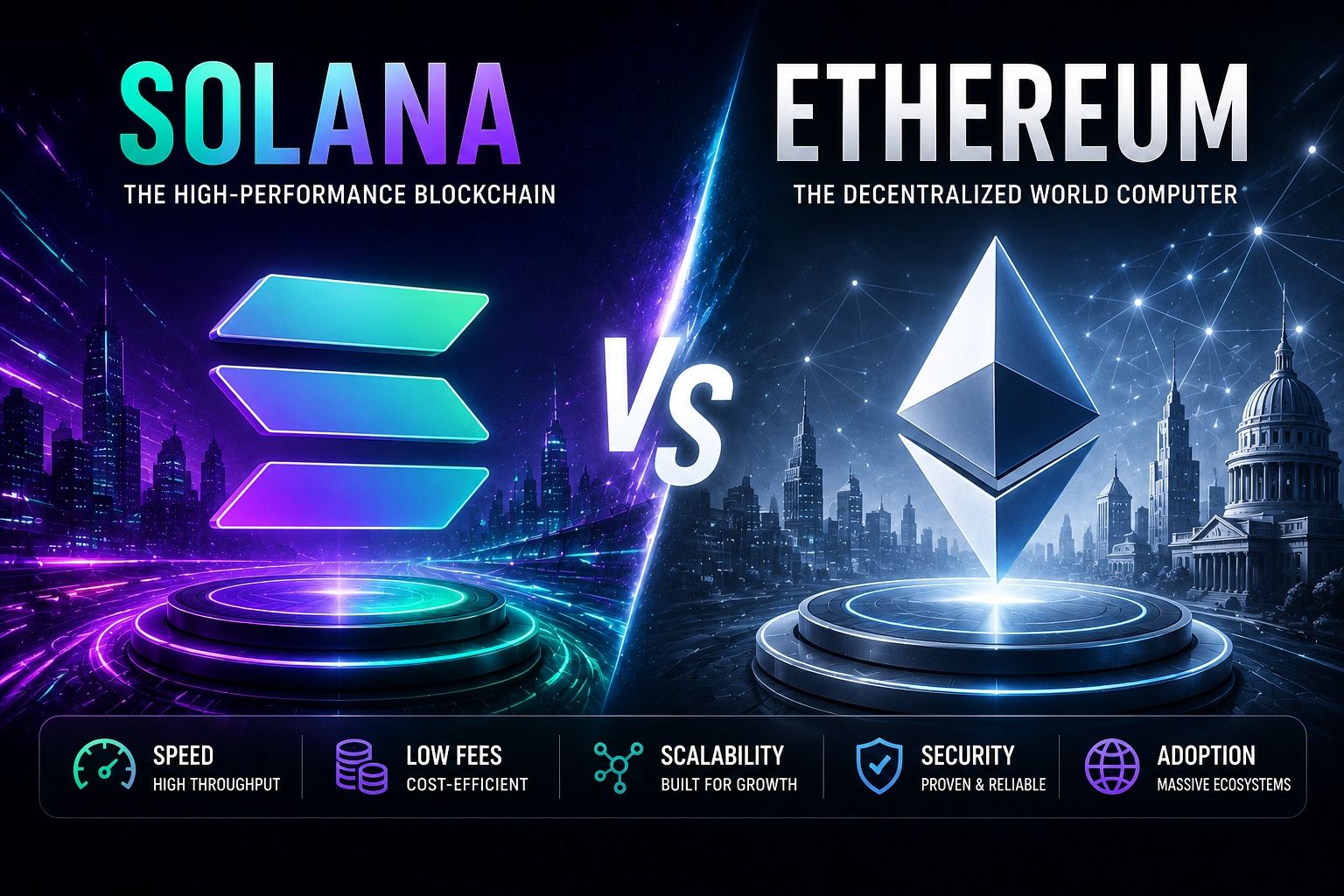
The debate between Solana and Ethereum has become impossible to ignore in today’s crypto market.
On one side, Ethereum remains the dominant blockchain ecosystem, backed by massive institutional adoption, a huge DeFi infrastructure, and a long-standing reputation for security and reliability. On the other, Solana has rapidly emerged as one of the strongest challengers thanks to its high-speed network, extremely low transaction costs, and user-friendly experience.
But beyond the simple comparison between two major blockchains, investors are asking a much bigger question:
👉 Which crypto offers the strongest long-term growth potential today?
The Solana vs Ethereum debate is no longer just about technology. It also involves adoption trends, capital flows, market narratives, developer activity, and each ecosystem’s ability to attract long-term users and investors.
In this article, we’ll explore the Solana or Ethereum debate across multiple areas including adoption, performance, growth potential, risks, market positioning, and long-term outlook.
Understanding the Difference Between Solana and Ethereum
Before comparing the long-term potential in the Solana vs Ethereum debate, it’s important to understand what truly separates these two major blockchain ecosystems.
Ethereum is widely considered the leading blockchain for decentralized applications. In the Ethereum vs Solana comparison, ETH still dominates major sectors of crypto including decentralized finance (DeFi), stablecoins, institutional infrastructure, and Web3 development.
Ethereum’s philosophy has historically focused on:
- security
- decentralization
- long-term stability
- network resilience
Solana follows a very different approach.
The Solana blockchain is primarily optimized for:
- speed
- scalability
- low transaction costs
- smooth user experience
This fundamental difference explains why Ethereum and Solana often attract very different types of investors and users.
Speed and Fees: Solana’s Biggest Advantage
One of Solana’s strongest advantages is its technical performance.
Ethereum still struggles with network congestion during periods of high activity, which can lead to expensive transaction fees and slower execution times.
Solana was designed from the beginning to process a massive number of transactions at very low cost.
| Metric | Solana | Ethereum |
|---|---|---|
| Transaction Speed | Very High | Moderate |
| Fees | Extremely Low | Often Expensive |
| User Experience | Smooth | Sometimes Complex |
| Scalability | Native | Relies on Layer 2s |
Because of this efficiency, Solana has become especially popular among:
- retail traders
- memecoin communities
- NFT users
- high-frequency trading applications
- consumer-focused crypto apps
Ethereum remains incredibly powerful, but for many users, Solana simply feels faster and easier to use.
Why Ethereum Still Dominates the Crypto Market
Despite Solana’s rapid rise, Ethereum still holds a dominant position across the crypto industry.
That dominance is built on several major advantages.
Strong Institutional Trust
Ethereum benefits from enormous credibility among institutional investors.
Many funds and financial firms view ETH as the most legitimate crypto asset after Bitcoin.
- Ethereum’s long history
- proven network security
- high decentralization
- mature ecosystem
The approval and expansion of Ethereum ETFs have also strengthened Ethereum’s institutional image.
Ethereum Remains the DeFi Leader
Ethereum still dominates decentralized finance.
Most of the largest DeFi protocols were either built on Ethereum or remain heavily connected to its ecosystem.
This creates an extremely powerful network effect.
- liquidity
- developers
- users
- institutional capital
…the harder it becomes to replace.
The Importance of Layer 2 Networks
Ethereum is also scaling through its rapidly growing Layer 2 ecosystem.
These networks allow users to access lower fees while still benefiting from Ethereum’s security.
This strategy could help Ethereum maintain long-term dominance despite limitations on the main chain itself.
Why Solana Is Attracting More Investors
Even though Ethereum remains dominant, Solana continues gaining momentum.
And this growth is not purely speculative.
A Better User Experience
One of Solana’s biggest strengths is simplicity.
- fast transactions
- near-instant execution
- extremely cheap fees
For everyday users, the experience often feels much smoother compared to Ethereum.
In the long run, blockchains that offer frictionless user experiences could achieve much broader mainstream adoption.
Solana’s Strong Retail Momentum
Solana has become one of the favorite ecosystems among retail investors.
- low fees
- highly active communities
- strong internet culture
- viral market narratives
This momentum has helped Solana dominate several fast-growing crypto sectors.
Rapid Ecosystem Growth
The Solana ecosystem continues expanding quickly.
- increasing on-chain activity
- rising trading volumes
- more active users
- stronger developer interest
While Solana still trails Ethereum in several areas, its growth rate remains extremely impressive.
Price History and ATH Recovery Potential
One of the most interesting parts of the Solana vs Ethereum comparison involves their theoretical upside potential toward previous all-time highs.
Ethereum previously reached an all-time high near $4,800 during the last major bull market. Because ETH already has a massive market capitalization, many investors believe its upside potential may now be more limited mechanically.
Solana, meanwhile, previously climbed close to $260 during the prior cycle.
Based on current market conditions:
- ETH could potentially revisit previous highs with a more moderate upside profile
- SOL may still offer a much more aggressive return potential if market momentum returns strongly
This is exactly why many growth-focused investors continue paying close attention to Solana.
In the Solana vs Ethereum debate, ETH is often viewed as the more mature and institutionally secure asset, while SOL is increasingly seen as a higher-risk, higher-growth opportunity capable of outperforming during strong altcoin cycles.
Solana vs Ethereum: Which Has More Upside?
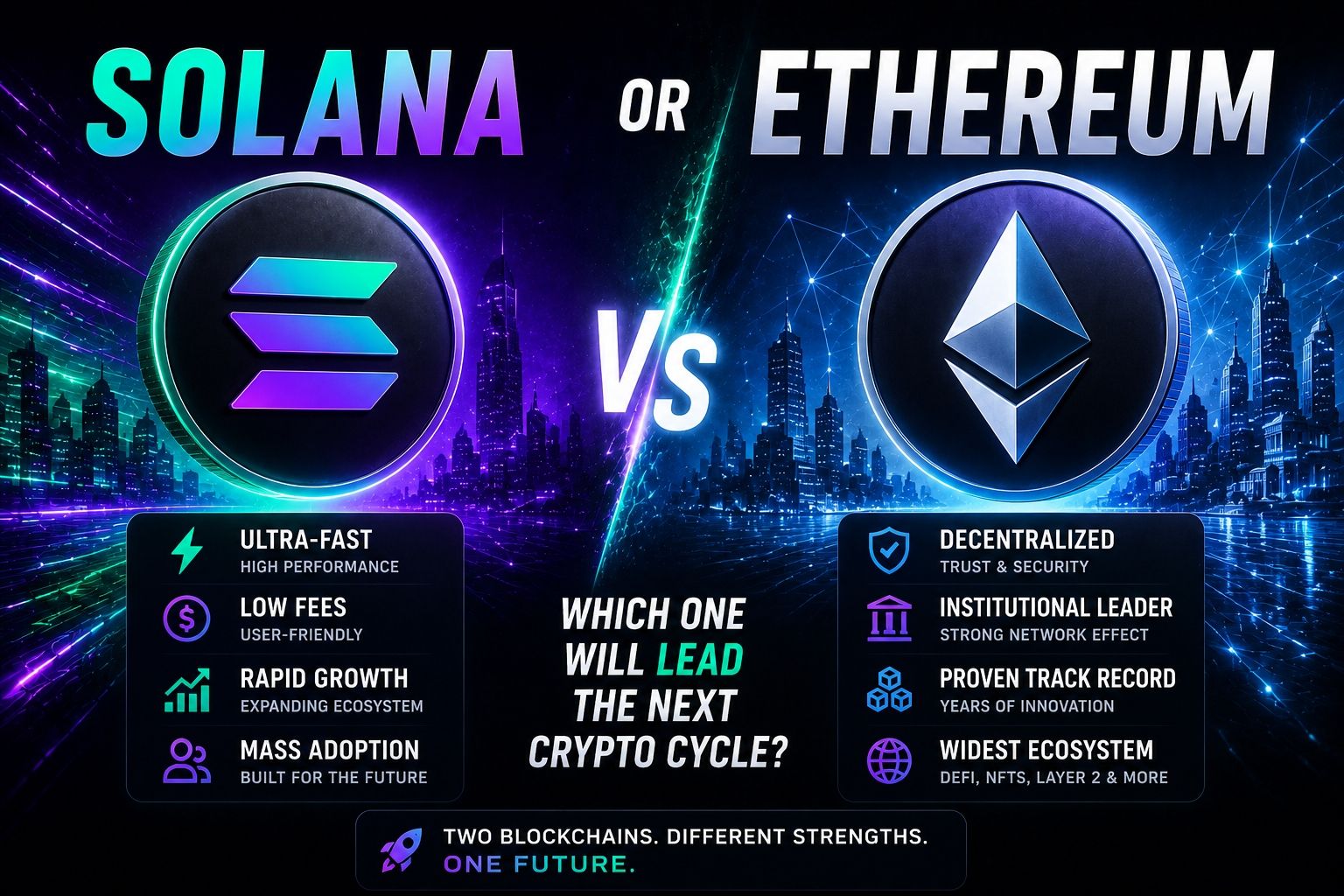
For investors, the core question remains simple:
👉 Which crypto has the stronger long-term growth potential?
ETH: A More Mature Asset
Ethereum is already valued at an enormous scale.
- lower perceived risk
- greater market stability
- potentially lower upside multiples
Even so, ETH remains one of the strongest crypto assets in the market today.
SOL: Higher Growth Potential
The Solana vs Ethereum comparison highlights two very different investment profiles.
While Ethereum already operates as a highly mature multi-billion-dollar ecosystem, Solana is still viewed by many investors as a blockchain in a much earlier expansion phase.
This difference is important because emerging ecosystems often have significantly more room for exponential growth if adoption continues accelerating.
During the previous crypto bull market, SOL surged from just a few dollars to nearly $260 at its all-time high, massively outperforming most major cryptocurrencies over the same period.
Even after becoming one of the largest blockchain ecosystems in crypto, Solana still maintains a market capitalization significantly smaller than Ethereum’s, which leaves many investors believing the network could continue gaining market share over the coming years.
Several long-term growth drivers continue supporting Solana’s expansion:
- extremely low transaction fees
- high-speed infrastructure
- rapidly growing on-chain activity
- strong retail adoption
- expanding DeFi and stablecoin ecosystems
- increasing institutional interest
For many investors, Solana represents one of the few large-cap cryptocurrencies that still combines strong ecosystem adoption with potentially explosive upside potential.
If the crypto market enters another major expansion cycle, some analysts believe SOL could eventually attempt to revisit — or even surpass — its previous all-time high levels.
This is precisely why Solana continues attracting aggressive growth-focused investors looking for higher upside opportunities than more mature crypto assets like Ethereum.
- higher volatility
- greater speculative exposure
- higher overall risk
Governance and Decentralization: Two Different Philosophies
Another important aspect of the Solana vs Ethereum debate involves governance and decentralization.
Ethereum is widely viewed as the more decentralized ecosystem, supported by a large global validator network and a development process that tends to prioritize long-term security and stability over rapid execution.
This stronger decentralization is often seen as one of Ethereum’s biggest advantages, especially for institutional investors seeking resilience and censorship resistance.
Solana, meanwhile, follows a more performance-oriented approach. The network prioritizes speed, scalability, and user experience, allowing it to deliver significantly faster and cheaper transactions.
Critics argue that Solana remains less decentralized than Ethereum, while supporters believe this trade-off allows the ecosystem to scale more efficiently and compete more aggressively for mainstream adoption.
Ultimately, the difference reflects two distinct visions of blockchain development: Ethereum focuses on maximum decentralization and long-term robustness, while Solana emphasizes scalability, efficiency, and rapid ecosystem growth.
Solana or Ethereum – Conclusion
The Solana vs Ethereum debate perfectly reflects the current evolution of the crypto market.
Ethereum remains the dominant blockchain ecosystem thanks to strong institutional credibility, proven security, and a highly mature infrastructure.
But Solana continues establishing itself as one of the most serious challengers through faster transactions, lower costs, and a far more accessible user experience.
Over the long term, both ecosystems could continue growing side by side with different market roles.
Ethereum may remain the institutional foundation of Web3, while Solana could emerge as one of the leading consumer-focused blockchain networks.
The difference between the two ecosystems increasingly reflects a broader evolution within the crypto industry itself.
Ethereum continues positioning itself as a highly secure and decentralized infrastructure layer designed for institutional finance, tokenization, stablecoins, and long-term blockchain adoption.
Solana, meanwhile, appears to be capturing a different segment of the market by focusing on scalability, speed, mobile accessibility, and user experience.
This positioning has helped Solana attract growing interest from retail traders, developers, startups, and high-activity applications looking for a more efficient blockchain environment.
At the same time, Ethereum’s dominance in DeFi, liquidity, and institutional trust remains extremely difficult to challenge.
In the long-term Solana vs Ethereum debate, the two ecosystems may ultimately evolve as complementary blockchain networks serving different roles across the future digital economy rather than directly replacing one another.
For investors, the Solana vs Ethereum decision will ultimately depend on:
- risk tolerance
- investment horizon
- belief in future blockchain adoption trends
Some investors may prefer Ethereum’s stability and institutional positioning, while others may be more attracted to Solana’s aggressive growth profile and potential upside during future market cycles.
Ultimately, the Solana vs Ethereum rivalry will likely remain one of the most important narratives shaping the next generation of blockchain adoption and crypto investing.
Related Articles
If you want to better understand Solana’s long-term potential, market positioning, and future growth opportunities, you may also enjoy these articles:


Trader, investor and author specializing in cryptocurrencies, DeFi and Web3.
On Mediasnet, I share my market analysis, practical guides and research on crypto markets, decentralized protocols and emerging trends across the ecosystem.
Follow me on: Facebook – X (Twitter)