
How Chainlink Works: The Backbone of DeFi
Introduction
In the rapidly evolving world of blockchain and decentralized finance (DeFi), one fundamental limitation has always stood in the way of broader adoption: blockchains cannot access real-world data on their own.
This is where Chainlink comes in.
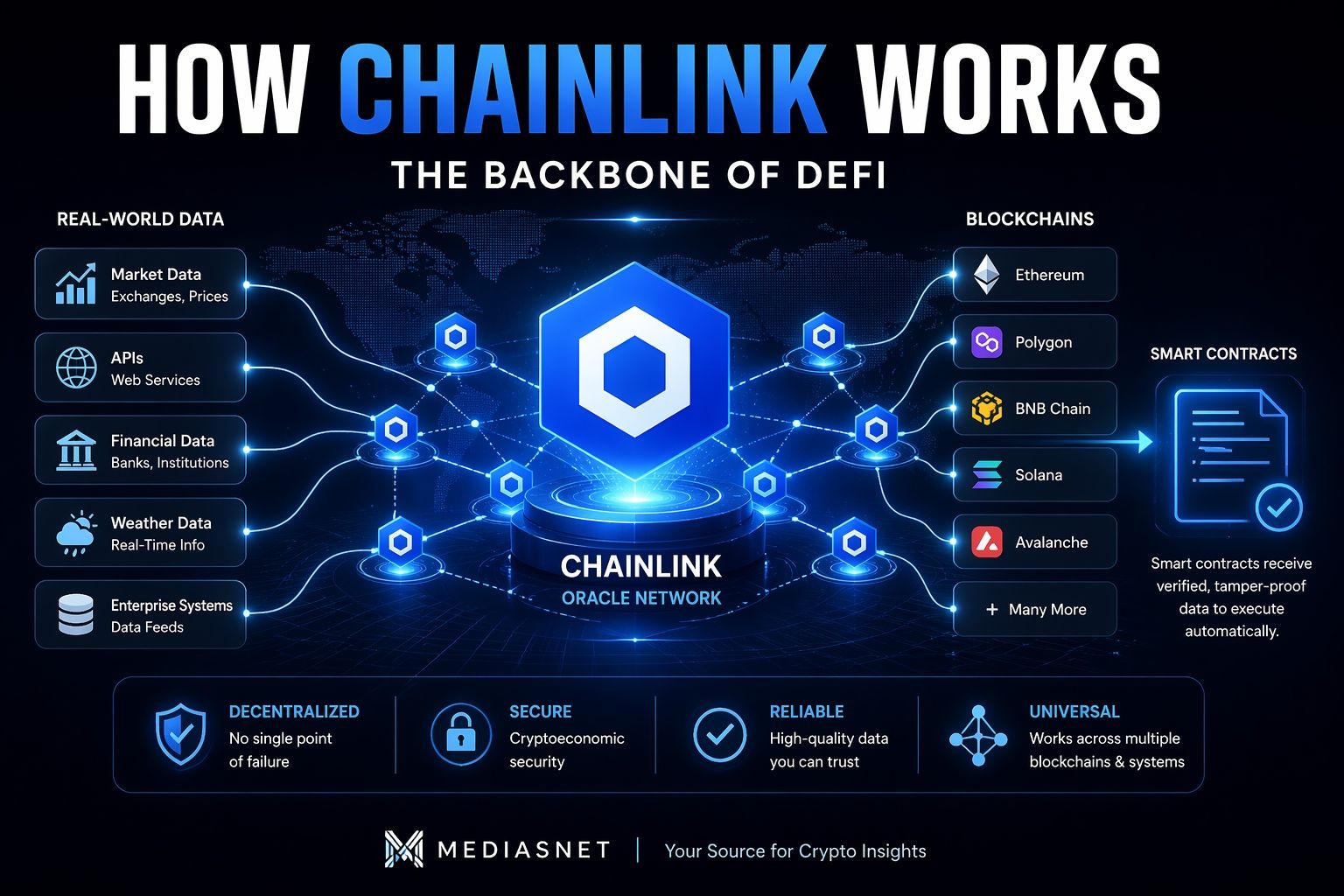
If you’ve ever wondered how Chainlink works, the answer goes far beyond a simple crypto project. Chainlink is a critical infrastructure layer that connects smart contracts to real-world data, enabling entire ecosystems like DeFi, tokenized assets, and even AI-powered blockchain applications.
In this article, we’ll break down how Chainlink works, why it matters, and why it is often referred to as the backbone of DeFi.
What Is Chainlink?
Chainlink is a decentralized oracle network designed to bridge the gap between blockchain-based smart contracts and external data sources.
Smart contracts are powerful, but they are inherently limited. They can only operate using the data available on their native blockchain. This means they cannot directly access information like:
- Asset prices
- Weather data
- Sports results
- Real-world events
Chainlink solves this limitation by providing reliable external data to smart contracts in a secure and decentralized way.
Understanding how Chainlink works starts with understanding this core problem: blockchains are isolated by design, and Chainlink connects them to the real world.
The Oracle Problem Explained
To fully understand how Chainlink works, you need to understand the “oracle problem.”
Blockchains are deterministic systems. Every node must reach consensus using the same data. If external data is introduced incorrectly or manipulated, it can compromise the entire system.
A simple solution would be to use a single data provider (an oracle). However, this creates a major issue:
👉 a single point of failure
If that oracle is compromised, corrupted, or simply wrong, the smart contract will execute based on faulty data.
Chainlink solves this by decentralizing the oracle layer.
Instead of relying on one source, Chainlink aggregates data from multiple independent nodes. This significantly reduces the risk of manipulation and ensures higher reliability.
How Chainlink Works (Step-by-Step)
Understanding how Chainlink works requires looking at the full lifecycle of a data request — from a smart contract to real-world data and back.
Here’s a simplified but detailed breakdown of the process.
1. Smart Contract Request
Everything starts with a smart contract that needs external data to execute properly.
For example, a DeFi lending protocol may require the real-time price of ETH/USD to determine whether a position should be liquidated.
Since blockchains cannot access off-chain data directly, the smart contract sends a request to the Chainlink network.
2. Chainlink Request Creation and Node Selection
Once the request is initiated, Chainlink translates it into a set of instructions that oracle nodes can process.
The network then selects multiple independent node operators based on criteria such as:
- reputation
- past performance
- reliability
This selection mechanism ensures that no single entity controls the data flow.
3. Data Retrieval from External Sources
Each selected node retrieves the requested data from external sources.
These sources can include:
- APIs (financial data providers, exchanges)
- enterprise systems
- web data feeds
By using multiple sources, Chainlink reduces the risk of relying on a single inaccurate or manipulated data point.
4. Data Aggregation and Validation
Once the data is collected, Chainlink aggregates the responses from all nodes.
This step is critical.
Outliers and inconsistent values are filtered out, and a consensus value is calculated. This process ensures that the final result reflects a reliable and tamper-resistant dataset.
5. Delivery to the Smart Contract
The verified data is then delivered back on-chain to the original smart contract.
At this point, the smart contract can execute automatically based on accurate and trusted information.
For example, it may trigger a liquidation, settle a derivative, or update collateral ratios.
6. Incentives and Security Layer
An often overlooked aspect of how Chainlink works is its incentive system.
Node operators are rewarded in LINK tokens for providing accurate data. If they behave maliciously or provide incorrect data, they risk losing their stake or future rewards.
This economic model aligns incentives and strengthens the reliability of the network.
👉 This entire process is what defines how Chainlink works: a decentralized, multi-layered system designed to securely connect smart contracts with real-world data.
Why Chainlink Is Critical for DeFi
Decentralized finance relies heavily on accurate, real-time data — especially price feeds.
Without reliable price data, DeFi protocols cannot function safely.
Chainlink provides:
- Secure price feeds
- Tamper-resistant data
- High availability
Many major DeFi platforms depend on Chainlink to operate. Lending platforms, derivatives, and stablecoins all require precise data inputs.
This is why understanding how Chainlink works is essential if you want to understand how DeFi works.
Without Chainlink (or similar oracle solutions), DeFi as we know it would not exist.
Key Use Cases of Chainlink
Chainlink is not limited to DeFi. Its technology is expanding into multiple sectors.
DeFi Price Feeds
The most common use case. Protocols rely on Chainlink for accurate asset pricing.
Real-World Asset Tokenization (RWA)
Chainlink enables the integration of real-world data into blockchain systems, making tokenization possible for:
- Real estate
- Bonds
- Commodities
Cross-Chain Interoperability (CCIP)
Chainlink’s Cross-Chain Interoperability Protocol allows different blockchains to communicate securely.
This is a major step toward a multi-chain future.
Gaming and NFTs
Randomness and off-chain data are essential for fair gameplay and dynamic NFTs.
What Is the LINK Token?
The LINK token is the native utility token of the Chainlink network and plays a central role in how Chainlink works from an economic perspective.
At its core, LINK is used to facilitate interactions between smart contracts and oracle nodes, ensuring that data requests are processed efficiently and securely.
Key functions:
- Payment for oracle services
- Incentivizing node operators
- Staking and network security
When a smart contract requests data, node operators are paid in LINK for retrieving and delivering accurate information. This creates a decentralized marketplace for data services.
To maintain reliability, Chainlink introduces economic incentives. Node operators that provide accurate data are rewarded, while those acting maliciously or delivering incorrect information risk losing future rewards — and, with staking, potentially part of their locked tokens.
This incentive structure is essential to understanding how Chainlink works, as it aligns all participants toward honest behavior and high-quality data delivery.
👉 While this overview covers the basics, the LINK token has deeper mechanics — including staking models, token demand dynamics, and its role in the broader ecosystem — which we will explore in a dedicated article: LINK Price Prediction: What Is Chainlink (LINK) and Its Future Potential
Chainlink and the Future of Blockchain
Looking ahead, Chainlink’s role is expanding beyond simple data feeds.
Institutional Adoption
Chainlink is increasingly involved in partnerships with traditional financial institutions exploring blockchain integration.
AI + Blockchain
As AI systems require external data and verification layers, Chainlink could become a bridge between AI and decentralized systems.
Tokenized Economy
With the rise of tokenized assets, reliable data becomes even more critical — reinforcing Chainlink’s importance.
Understanding how Chainlink works today gives you insight into how the next generation of financial infrastructure may function.
Advantages and Limitations
Advantages
- Decentralized oracle network
- Strong adoption in DeFi
- High reliability through data aggregation
- Expanding use cases
Limitations
- Dependence on node operator quality
- Competition from other oracle solutions
- Complexity for newcomers
Chainlink Price Potential (Optional Insight)
While this article focuses on how Chainlink works, it’s worth mentioning that its value is closely tied to:
- Network usage
- Adoption in DeFi and RWAs
- Demand for oracle services
If Chainlink continues to dominate the oracle space, its long-term potential remains significant.
Conclusion
Chainlink is much more than a cryptocurrency.
It is a foundational layer that enables smart contracts to interact with the real world in a secure and decentralized way. By solving the oracle problem, Chainlink has become a critical component of the blockchain ecosystem — especially in DeFi.
But its importance goes far beyond today’s use cases.
As blockchain technology continues to evolve, the need for reliable, tamper-proof data will only increase. From decentralized finance to real-world asset tokenization, insurance, gaming, and even AI-driven applications, smart contracts are becoming more sophisticated — and more dependent on accurate external inputs.
This is where Chainlink’s long-term value lies.
Rather than competing as just another crypto asset, Chainlink positions itself as essential infrastructure — a neutral and decentralized data layer that multiple ecosystems can rely on. In a future where blockchains interact with traditional finance, global markets, and real-world systems, this role becomes increasingly strategic.
Understanding how Chainlink works is not just about understanding one project — it’s about understanding how the next generation of digital systems will operate.
As adoption grows and new use cases emerge, Chainlink is likely to remain at the core of this transformation, quietly powering some of the most important innovations in Web3.
FAQ – How Chainlink Works
What problem does Chainlink solve?
Chainlink solves the oracle problem by providing reliable external data to smart contracts without relying on a single centralized source.
How Chainlink works in simple terms?
Chainlink collects data from multiple sources, verifies it, and delivers it to smart contracts so they can execute based on real-world information.
Why is Chainlink important for DeFi?
DeFi protocols need accurate price data. Chainlink provides secure and decentralized price feeds that make DeFi possible.
What is the role of LINK token?
The LINK token is used to pay node operators and secure the network through incentives and staking.
Is Chainlink only used for crypto?
No. Chainlink is also used for real-world applications like asset tokenization, insurance, and cross-chain communication.
Understanding how Chainlink works is key to understanding the future of decentralized systems. As blockchain adoption grows, solutions like Chainlink will likely remain at the core of this transformation.


Trader, investor and author specializing in cryptocurrencies, DeFi and Web3.
On Mediasnet, I share my market analysis, practical guides and research on crypto markets, decentralized protocols and emerging trends across the ecosystem.
Follow me on: Facebook – X (Twitter)