
Injective is a Layer 1 blockchain designed for decentralized finance, onchain trading and the tokenization of traditional financial assets. Unlike general-purpose networks, the Injective blockchain provides specialized financial infrastructure that developers can use to build exchanges, derivatives markets, lending applications and institutional financial products.
Its native cryptocurrency, INJ, plays an important role in network security, governance, staking and the economic mechanisms that support the ecosystem. Injective has also expanded considerably beyond its original decentralized exchange ambitions, introducing native Ethereum Virtual Machine compatibility, new tokenization services and institutional partnerships.
But what actually makes Injective different from Ethereum, Solana or other financial blockchains? And can the development of its ecosystem create sustainable economic value for the INJ token?
This guide explores how Injective works, its blockchain architecture, tokenomics, staking, real-world asset initiatives, major developments in 2026 and long-term opportunities and risks.
Updated October 16, 2026. Network parameters, market conditions and regulatory developments may change. This article provides independent educational analysis, not investment advice.
In this article
How does the Injective blockchain work?
EVM, Cosmos and cross-chain interoperability
What is the INJ token used for?
INJ tokenomics, inflation and token burns
What Is Injective (INJ)?
Injective is an independent Layer 1 blockchain optimized for financial applications. It combines a Proof-of-Stake consensus network with specialized modules for decentralized exchanges, derivatives, asset transfers and financial infrastructure.
Its objective is to make sophisticated financial applications easier to develop and operate without relying entirely on centralized exchanges, brokers or traditional settlement systems.
In practical terms, Injective enables developers to create applications where users can interact with financial markets through blockchain-based systems.
These markets can involve cryptocurrencies, decentralized derivatives, stablecoins, tokenized real-world assets and other programmable financial instruments.
Injective at a glance
| Feature | Description |
|---|---|
| Project | Injective |
| Native token | INJ |
| Blockchain type | Layer 1 |
| Consensus | Proof of Stake |
| Technology | Cosmos SDK, EVM, CosmWasm and MultiVM |
| Main specialization | Onchain finance and financial applications |
| Token applications | Staking, governance, network fees and token economics |
| Interoperability | IBC and additional cross-chain infrastructure |
| Main ambition | Financial markets and tokenized assets on blockchain infrastructure |
Why was Injective created?
Traditional financial markets rely on multiple intermediaries. Brokers execute orders, clearing organizations manage obligations, custodians hold assets and settlement systems reconcile ownership records.
Blockchain technology offers an alternative architecture in which certain activities can be represented, executed and recorded using programmable infrastructure.
However, general-purpose blockchains were not originally designed to provide every feature required by sophisticated financial markets.
Developers often need to create or integrate separate components for trading, risk management, price data, order matching and settlement.
Injective addresses this problem by incorporating financial functionality directly into its blockchain architecture.
This specialization is central to the project’s strategy: rather than competing exclusively on transaction speed, it aims to reduce the complexity of building decentralized financial services.
Who can use Injective?
The network serves several categories of participants:
- Developers creating decentralized exchanges, lending platforms and other financial applications.
- Traders accessing supported spot and derivatives markets.
- INJ holders participating in staking and governance.
- Financial institutions exploring tokenized asset issuance, settlement and recordkeeping.
- Infrastructure providers operating validators and developing services for the network.
These categories have different objectives. A trader may be interested in liquidity and execution quality, while an institutional issuer may prioritize compliance controls, asset ownership records and reliable settlement.
Injective’s challenge is to support these needs without compromising security or decentralization.
How Does the Injective Blockchain Work?
The Injective blockchain operates through an independent Proof-of-Stake network combined with native modules designed for financial transactions. Validators secure the network, while applications interact with specialized infrastructure to create and manage financial markets.
A Layer 1 blockchain rather than an Ethereum Layer 2
Injective is not simply a scaling solution built on Ethereum.
It has its own validators, governance processes, transaction environment and native cryptocurrency.
This distinction matters because a Layer 1 network is responsible for its own economic security and operational performance.
Injective’s architecture originated in the Cosmos ecosystem, using the Cosmos SDK and a Tendermint-derived consensus framework.
These technologies support modular blockchain development and transaction finality through a validator-based consensus process.
As with other Proof-of-Stake networks, the practical level of decentralization depends on validator distribution, governance participation and the concentration of staked assets.
The native order book and trading infrastructure
One of Injective’s defining features is its native central limit order book infrastructure, often abbreviated as CLOB.
Many decentralized exchanges use automated market makers, where traders interact with liquidity pools governed by mathematical pricing formulas.
An order book works differently.
Buyers and sellers submit orders with specified prices and quantities. These orders can be matched when their conditions are compatible.
Injective incorporates order management and matching capabilities into its native exchange infrastructure.
This provides developers with financial functionality that would otherwise require additional smart contracts and custom systems.
Why shared financial modules are useful
Imagine two developers launching separate trading applications on the same network.
Without common infrastructure, each application might need to establish its own markets, order books and liquidity sources.
That can fragment trading activity, making execution more expensive or less efficient for users.
Injective’s architecture allows applications to interact with common financial modules, potentially improving composability and reducing duplicated infrastructure.
This does not eliminate liquidity fragmentation automatically. Different products, assets, market parameters and interfaces can still attract distinct groups of traders.
Nevertheless, reusable financial components can be a meaningful advantage for developers.
Oracles, derivatives and insurance mechanisms
Financial applications require reliable information about asset prices and market conditions.
Injective supports oracle infrastructure that can provide pricing information to decentralized applications.
The network also includes modules associated with derivatives markets and insurance funds.
These components help applications manage financial operations that would be difficult to reproduce using basic token transfers alone.
They do not remove the risks of leveraged trading, incorrect price data or extreme market movements.
Users should therefore distinguish technical sophistication from financial safety.
Injective Technology: EVM, Cosmos and Cross-Chain Interoperability
Injective combines technologies from different blockchain environments to make its infrastructure accessible to a broader developer community.
The most significant architectural evolution was the introduction of its native Ethereum Virtual Machine environment on mainnet in November 2025.
What does native EVM support mean?
The Ethereum Virtual Machine, or EVM, provides a standardized environment for executing Ethereum-compatible smart contracts.
Developers familiar with Solidity and Ethereum development tools can use this environment to build applications on Injective.
The advantage is not simply compatibility with Ethereum software.
Injective aims to combine EVM applications with the financial modules already available on its native blockchain.
This reduces the need for developers to create separate financial infrastructures for every application.
It may also simplify the process of bringing existing Ethereum-oriented development expertise into the Injective ecosystem.
MultiVM: combining different execution environments
Injective supports a MultiVM architecture that brings together EVM functionality and WebAssembly-based smart contract execution.
WebAssembly, often referred to as WASM, supports efficient execution of applications developed using compatible programming languages and frameworks.
The integration of multiple execution environments can help applications share assets and interact across different technological standards.
For developers, this offers greater flexibility when choosing how to build a financial product.
For users, the ultimate value depends on whether these technical capabilities produce applications that are easier to access, more reliable and economically competitive.
Injective and the Cosmos ecosystem
Injective maintains important technological connections with the wider Cosmos ecosystem.
One of the principal mechanisms is the Inter-Blockchain Communication protocol, or IBC.
IBC enables compatible blockchain networks to exchange messages and transfer assets through supported communication channels.
It is an important component of the broader vision of interoperable blockchain networks.
Nevertheless, interoperability should not be interpreted as the complete elimination of cross-chain risks.
Bridges, messaging systems and asset representations may introduce operational dependencies or security vulnerabilities.
Does Injective need Ethereum to operate?
No. Injective operates as an independent blockchain with its own security infrastructure and native token.
Its EVM compatibility allows Ethereum-oriented developers to deploy applications and use familiar tools, but Injective does not depend on Ethereum’s validator set to finalize its native transactions.
This independence is both an opportunity and a responsibility: the network can optimize its own architecture, but it must maintain its own security and economic incentives.
What Is the INJ Token Used For?
INJ is the native cryptocurrency of Injective. Its main functions include network staking, participation in governance, payment of applicable network fees and involvement in economic mechanisms such as the Community BuyBack.
The token connects participants in the blockchain’s security and governance to the broader development of the ecosystem.
Network security
Injective uses Proof of Stake, which relies on validators to process transactions and help maintain network integrity.
Validators place capital at risk through staking mechanisms, while other users can delegate tokens to selected validators.
INJ therefore has a concrete function in securing the network.
Governance and protocol decisions
INJ also supports the governance of Injective.
Governance proposals can address technical upgrades, monetary parameters and other aspects of network operations.
Token holders participating in governance can influence how the blockchain develops.
However, governance power may be unevenly distributed if large holders or validators control substantial voting weight.
Transactions and network operations
INJ is associated with transaction processing and network operations.
Not every application user necessarily needs to purchase INJ directly, however.
Applications can implement mechanisms that simplify the user experience, including fee sponsorship or different transaction interfaces.
This distinction is important when evaluating whether increasing network activity will necessarily result in greater demand for the native token.
Economic participation and buyback programs
The token is also central to Injective’s mechanisms for distributing certain ecosystem revenues and permanently removing tokens from supply.
These arrangements are governed by program rules and should not be confused with guaranteed dividends or contractual returns.
Understanding the relationship between ecosystem activity and INJ’s supply is essential to any serious fundamental analysis.
Injective Tokenomics: INJ Supply, Inflation and Token Burns
Injective’s tokenomics combine new token issuance with mechanisms that permanently destroy INJ. The net supply therefore depends on the balance between tokens created and tokens burned.
This is more nuanced than describing INJ as simply a cryptocurrency with a fixed supply.
The original INJ supply
INJ launched with an initial token allocation of 100 million units, distributed across categories including investors, the project team, community initiatives and ecosystem development.
According to Injective’s current token documentation, the historical unlocking schedules for the original allocations have been completed.
That means the original vesting arrangements no longer represent an ongoing schedule of future insider token releases.
But the completion of these unlocks does not mean that the blockchain is mathematically incapable of issuing additional INJ.
Why circulating supply and total supply differ
Investors should distinguish the original allocation, circulating supply and total existing supply.
Proof-of-Stake networks may issue additional tokens to fund validator rewards and network security.
INJ also has mechanisms for reducing the number of outstanding tokens through permanent burns.
Consequently, historical supply figures should not be interpreted as an immutable maximum without examining the protocol’s current monetary rules.
A key distinction for INJ investors
Fully unlocked does not mean permanently capped.
The absence of future vesting unlocks is different from the absence of new staking-related issuance.
The relevant economic indicator is net supply change: new INJ issued minus INJ permanently burned.
How the INJ burn mechanism developed
Injective introduced token burning early in the network’s development.
Its original burn auction model was associated with a portion of exchange fees generated by decentralized trading applications.
Over time, the mechanism expanded to encompass a wider range of ecosystem activities.
The project subsequently introduced the Community BuyBack model, designed to involve participating community members while permanently removing INJ through its buyback and burn process.
The exact economic benefits to participants depend on the applicable program rules, revenue available for distribution and market conditions.
INJ 3.0 and monetary policy changes
Injective’s monetary policy has changed through successive governance upgrades.
INJ 3.0, approved in April 2024, introduced adjustments to issuance parameters and mechanisms designed to strengthen the network’s deflationary characteristics.
Later developments continued this approach rather than simply repeating the original weekly auction structure.
The INJ Supply Squeeze in January 2026
On January 20, 2026, Injective announced community approval of governance proposal IIP-617, known as the INJ Supply Squeeze.
The proposal aimed to tighten INJ issuance parameters further and strengthen the token’s deflationary design.
Injective described the change as doubling the rate of supply reduction under its revised monetary framework.
This is an important development, but investors must distinguish the protocol’s intended monetary trajectory from the actual net change in supply observed over time.
A strong burn mechanism can reduce supply pressure, but it cannot guarantee positive investment returns.
Does burning INJ automatically increase its price?
No. Token burning reduces the number of units that would otherwise remain in existence, but market prices still depend on demand, liquidity, expectations and investor behavior.
Consider a simplified example:
- A blockchain issues 100,000 new tokens during a period.
- Its economic mechanisms burn 70,000 tokens.
- The net supply increases by 30,000 tokens.
In this example, the project conducts meaningful burns but still experiences net inflation.
If 130,000 tokens were burned instead, net supply would decrease by 30,000 tokens.
These are hypothetical figures, not current Injective statistics.
The distinction illustrates why tokenomic analysis should focus on net issuance rather than promotional burn totals alone.
INJ Staking: How It Works, Rewards and Risks
Injective allows eligible INJ holders to participate in network security through staking and delegation.
Staking provides an economic incentive for validators and delegators to contribute to the operation of the blockchain.
How can users stake INJ?
The usual process involves obtaining native INJ, connecting a compatible wallet, selecting an available validator and delegating tokens through the supported staking interface.
Injective Hub provides access to important network functions, including validator information and governance participation.
Users should always verify the official interface and the wallet network before approving transactions.
How are staking rewards determined?
Staking rewards depend on network monetary parameters, the amount of tokens delegated, total participation and validator commissions.
Different validators can apply different commission rates and may have different performance records.
The displayed staking APR or APY should therefore be treated as variable rather than guaranteed.
It is also necessary to distinguish token-denominated rewards from returns measured in dollars or another fiat currency.
A user may receive more INJ while the market value of the total position declines.
What are the main staking risks?
Staking exposes users to several considerations beyond ordinary token volatility.
- Validator risk: poor performance or protocol violations can affect rewards or trigger penalties.
- Slashing risk: certain validator failures may cause losses to staked funds.
- Liquidity constraints: unstaking can involve a waiting period.
- Token inflation: rewards may be partially financed through new issuance.
- Custody risk: staking through centralized providers introduces additional counterparty exposure.
Staking can be appropriate for participants with a longer-term perspective, but it should not be confused with a bank deposit or risk-free interest-bearing investment.
For readers unfamiliar with the process, our staking definition and practical examples guide explains the underlying concepts.
The Injective Ecosystem: Trading, DeFi and Financial Applications
The value of a financial blockchain depends not only on its technology but also on the applications people actually use.
Injective’s ecosystem combines trading infrastructure, decentralized financial services and emerging institutional products.
Helix: decentralized trading infrastructure
Helix is one of the best-known trading applications associated with Injective.
It provides access to supported decentralized markets, including spot and derivatives products.
For traders, an order-book-based environment can offer a different experience from automated market maker exchanges.
Order types, market depth, trading fees and available instruments are important considerations.
However, the existence of an advanced trading interface does not ensure deep liquidity in every market.
Execution quality depends on active market participation, available counterparties and prevailing conditions.
Decentralized lending and liquidity services
Injective also supports the development of broader DeFi applications, including lending and borrowing services.
These platforms may allow users to supply assets, borrow against collateral or participate in structured liquidity strategies.
Such products require careful examination of collateral rules, oracle reliability, liquidation mechanisms and smart contract security.
The fact that an application runs on a specialized financial blockchain does not remove these risks.
Stablecoins and settlement infrastructure
Stablecoins play a crucial role in decentralized finance because they provide units of account and settlement instruments that are generally intended to maintain relatively stable values.
For Injective, stablecoin adoption can support trading, collateral management and financial settlement.
The availability of liquid and reliable stablecoins can be especially important for institutions and applications handling tokenized assets.
Yet stablecoins have distinct risks, including reserve quality, issuer solvency, depegging and possible restrictions on transfers.
What makes a strong DeFi ecosystem?
A large number of announced applications does not necessarily indicate a healthy ecosystem.
More informative measures include active users, sustainable fees, financial activity, stablecoin liquidity and continued developer participation.
Trading volume should also be evaluated alongside actual revenue, as promotional incentives or unusually low fees can produce large headline volumes without equivalent economic value.
This distinction is particularly important for Injective because its long-term ambitions extend into sophisticated financial markets.
Injective and Real-World Asset Tokenization
Real-world asset tokenization is one of Injective’s most important development areas. It involves representing financial rights, ownership records or economic exposure to traditional assets through blockchain-based systems.
Potential applications include securities, bonds, commodities, credit instruments and financial receivables.
What does tokenization actually mean?
A tokenized asset represents a relationship between an onchain record and an underlying economic or legal arrangement.
However, not every tokenized product represents direct ownership of the underlying asset.
Some tokens may represent contractual claims, while others provide synthetic exposure or operate as derivatives.
Investors must understand who issues the product, who holds the underlying assets, which legal rights exist and what happens if the issuer fails.
The presence of a token on a blockchain is not sufficient evidence of legally enforceable ownership.
Injective Mint and institutional asset issuance
In 2026, Injective expanded its tokenization infrastructure through Injective Mint, a platform designed to facilitate the issuance and management of tokenized assets.
Its approach includes configurable controls for permissioned financial products.
These capabilities are especially relevant for institutional users who must address ownership records, eligibility requirements and regulatory considerations.
This direction marks a shift from the earliest generation of DeFi applications, which focused heavily on unrestricted cryptocurrency trading.
SEC transfer agent registration in August 2026
On August 19, 2026, Injective announced that Injective Institutional Services had become registered with the U.S. Securities and Exchange Commission as a transfer agent.
A transfer agent can perform functions associated with maintaining securities ownership records and processing changes to those records.
This development may support certain institutional tokenization activities by connecting blockchain infrastructure with established securities-market functions.
However, this registration applies to the relevant entity and its regulated function.
It does not mean that the SEC has approved the INJ token as an investment or guaranteed the safety of all financial products developed on Injective.
Pineapple Financial and mortgage record tokenization
In September 2026, Injective announced that Pineapple Financial had moved more than $1 billion in residential mortgage records onto its infrastructure.
This announcement illustrates the growing interest in blockchain-based financial recordkeeping.
But it is essential to interpret the reported amount accurately.
The value of mortgage records represented onchain is not automatically equivalent to liquid capital deposited in DeFi applications.
Nor does it demonstrate that the same amount was actively traded or generated transaction revenue for the blockchain.
Recordkeeping, token issuance, trading liquidity and actual protocol revenue are different economic measurements.
Why institutional tokenization matters
If tokenized financial instruments achieve meaningful adoption, blockchain infrastructure could become involved in a broader range of financial operations.
Such activity may include issuance, transfer restrictions, servicing, reconciliation and settlement.
Injective aims to position itself as an infrastructure provider for these processes.
Its long-term success will depend on reliability, regulatory compatibility, developer adoption and the ability to attract actual financial activity rather than only announcements.
Artificial Intelligence and Automated Finance on Injective
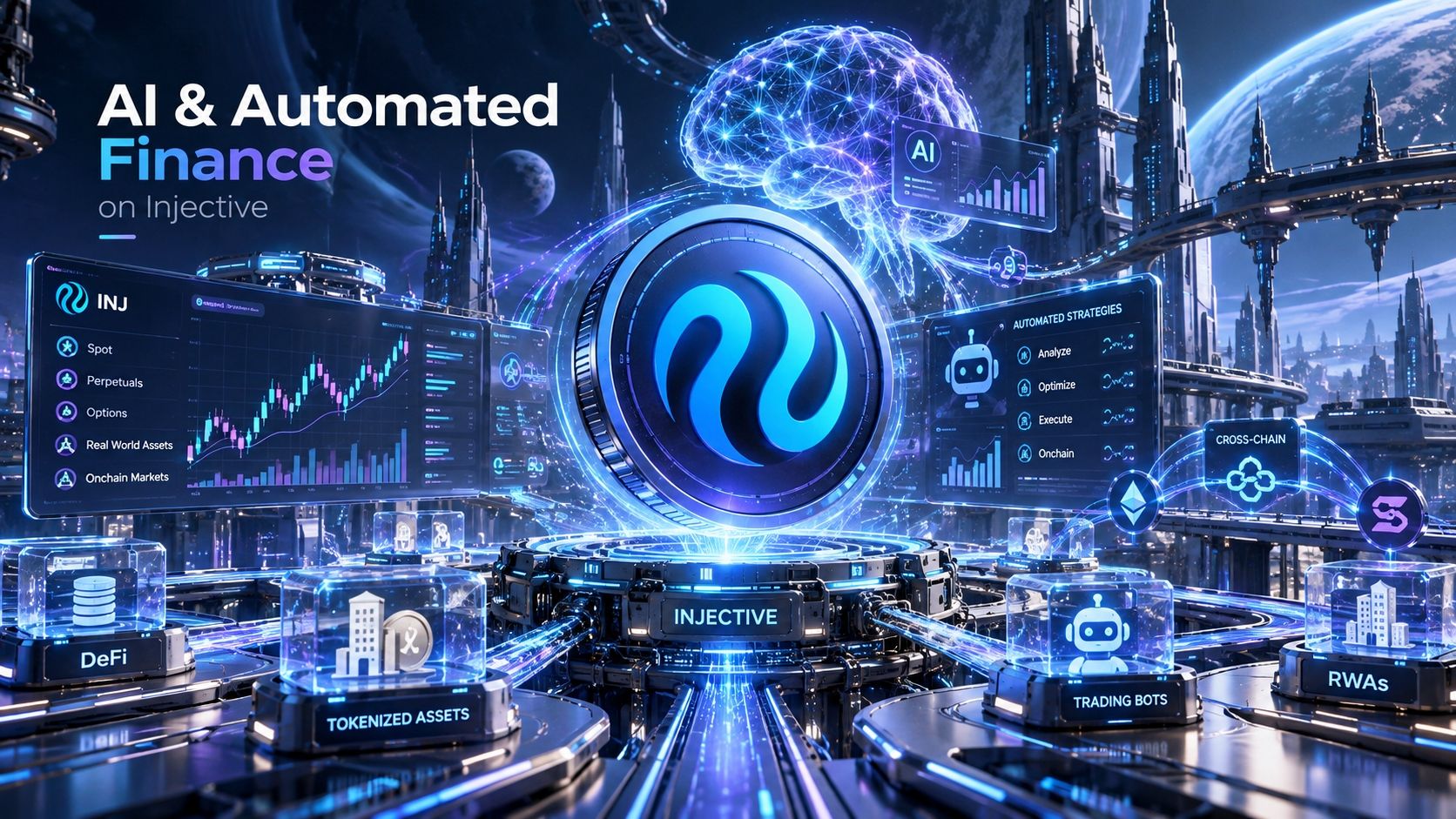
Artificial intelligence is another area of development within the Injective ecosystem.
The project has introduced tools intended to simplify blockchain development and support automated interactions with financial applications.
AI-assisted blockchain development
Building financial applications traditionally requires programming expertise, infrastructure knowledge and extensive testing.
AI-assisted development tools can make certain parts of this process more accessible.
Injective has explored this approach through initiatives such as iBuild and additional developer tooling.
These technologies can help automate parts of application development, but generated smart contracts still require careful review, testing and security assessments.
AI agents and financial transactions
AI agents can potentially interpret instructions, retrieve market information and interact with supported applications.
In February 2026, Injective introduced an MCP-based server intended to connect conversational tools with decentralized derivatives trading workflows.
This development illustrates the project’s interest in making onchain financial operations accessible through more natural interfaces.
Nevertheless, automated financial execution presents significant risks.
An agent can misunderstand an instruction, act on inaccurate data or initiate a transaction under unfavorable conditions.
Natural-language interfaces should therefore incorporate robust permissions, transaction limits and user oversight.
Will AI adoption increase demand for INJ?
Not necessarily.
AI-enabled applications could increase activity on the Injective blockchain, but the economic impact on INJ depends on transaction fees, revenue distribution and actual token demand.
Technology adoption and native-token appreciation are related possibilities, not equivalent outcomes.
Major Injective Developments in 2026
Several developments during 2026 illustrate Injective’s transition toward a wider financial infrastructure strategy.
These milestones concern its monetary policy, institutional relationships, tokenization services and cross-chain accessibility.
January 2026: INJ Supply Squeeze
The community approved IIP-617, which strengthened the project’s deflationary monetary strategy.
The initiative focuses on lowering new issuance relative to previous parameters and complementing existing token burns.
July and August 2026: institutional tokenization infrastructure
Injective expanded its tokenization ambitions through Injective Mint and the development of an affiliated registered transfer agent function.
These initiatives address a different audience from conventional retail DeFi trading applications.
The central opportunity lies in connecting digital asset technology with the operational requirements of financial institutions.
September 2026: mortgage records and expanded INJ access
The Pineapple Financial announcement highlighted the use of Injective for recording substantial volumes of mortgage-related financial information.
Separately, INJ became accessible through additional Solana ecosystem infrastructure in September.
This expansion can increase the token’s accessibility, although investors must distinguish the original native asset from representations used across other networks.
September 2026: Stockdrop and Community BuyBack
On September 22, Injective introduced Stockdrop, combining participation in community token burns with rewards linked to tokenized equities.
The initiative builds on the existing Community BuyBack structure.
Its attractiveness depends on specific participation rules, asset characteristics and the economic value of distributed rewards.
Participants must also consider legal eligibility and the financial risks associated with tokenized stock products.
October 2026: Gulf Labs becomes an institutional validator
On October 8, Injective announced that Gulf Labs, associated with Thailand’s GULF group, had become an institutional validator.
The relationship also opened discussions concerning tokenization, stablecoins, education and related digital infrastructure initiatives.
This is a concrete development because the validator activity is operational.
However, possible future institutional projects should still be regarded as opportunities rather than completed deployments or proven sources of substantial revenue.
What should investors monitor next?
Announcements can indicate strategic direction, but the strongest evidence of adoption comes from recurring economic activity.
For Injective, the critical questions concern institutional deployment, trading liquidity, application fees, tokenized-asset usage and whether growing activity materially improves the network’s economic sustainability.
Injective vs Ethereum, Solana and Other Financial Blockchains
Injective competes in a crowded market where several blockchains offer infrastructure for decentralized finance and tokenized assets.
Its principal differentiation is the integration of specialized financial functionality into the base layer.
| Network | Main strength | Main consideration |
|---|---|---|
| Injective | Financial modules and onchain markets | Must attract sufficient users, liquidity and institutional activity |
| Ethereum | Established DeFi ecosystem and infrastructure | Execution costs and the complexity of its scaling ecosystem |
| Solana | High-performance general-purpose applications | Strong competition for developers and trading liquidity |
| Cosmos ecosystem | Interoperability and modular blockchain design | Liquidity and economic activity distributed across different networks |
| Specialized trading networks | Optimized decentralized trading experiences | Potential advantages in liquidity concentration and trader adoption |
Why is specialization important?
A purpose-built financial blockchain may simplify application development by providing tools that general-purpose chains do not include natively.
That specialization can become an advantage when developers need advanced market infrastructure.
But established networks benefit from their own strengths, including existing liquidity, user bases, recognized development frameworks and network effects.
Injective must therefore demonstrate that its financial modules produce sufficient practical benefits to attract activity away from competing environments.
Could Injective coexist with larger networks?
Yes. Blockchain infrastructure does not necessarily follow a winner-takes-all model.
Different networks may specialize in specific applications or types of financial activity.
Interoperability can also allow assets and applications to interact across multiple networks.
However, coexistence is not the same as profitability. Injective still needs sustainable usage and an economic model that supports its continued development.
For another perspective on specialized financial blockchains, see our analysis of Hyperliquid and the HYPE token.
What Influences the INJ Price?
The INJ price is determined by market demand, available supply, trading liquidity, overall cryptocurrency conditions and expectations about Injective’s future adoption. No technical upgrade or token burn mechanism guarantees an increase in market value.
Network usage and ecosystem revenue
Growth in financial applications can increase activity on the blockchain.
That activity may create transaction fees or other forms of ecosystem revenue.
However, investors need to understand how that revenue is distributed and whether it creates meaningful economic demand for the token.
Changes in INJ net supply
Reduced issuance and higher token burns can improve the supply side of the economic equation.
But even a decreasing supply may coincide with a falling price if investors lose confidence or demand declines.
Staking participation
A significant proportion of tokens being staked can influence the availability of immediately liquid INJ.
However, staked tokens are not necessarily permanently removed from the market.
Validator rewards and future unstaking activity can also affect liquidity conditions.
Bitcoin and broader market sentiment
INJ remains part of the broader cryptocurrency market.
Altcoin valuations can be influenced by Bitcoin’s performance, financing conditions, investor risk appetite and exchange liquidity.
Even strong technological progress may fail to support the token during a broad market correction.
Why precise long-term price predictions are unreliable
Some cryptocurrency forecasting websites publish numerical INJ price targets extending many years into the future.
These models can depend heavily on assumptions about adoption, market capitalization and future trading behavior.
Targets extending to 2030 or 2050 should not be interpreted as evidence of a likely outcome.
A more useful approach is to monitor observable fundamentals and construct scenarios based on economic conditions.
Injective’s Future: Can the Blockchain Become a Major Financial Infrastructure?
Injective’s future will depend on its ability to convert specialized blockchain technology into sustained financial activity. Its architecture, institutional initiatives and tokenomics create opportunities, but the outcome remains uncertain.
Three broad scenarios can help frame the long-term outlook.
Bullish scenario: strong adoption of onchain finance
In a favorable scenario, tokenized financial products become more widely used and developers increasingly choose specialized infrastructure for trading, settlement and asset issuance.
Injective succeeds in attracting applications with meaningful liquidity and recurring revenue.
Institutional partners move beyond exploratory announcements and launch operational financial services.
The network’s monetary mechanisms also reduce net token issuance or create sustained net supply contraction.
These factors could strengthen the economic case for INJ, provided token demand develops alongside network usage.
Neutral scenario: progress without a major competitive breakthrough
In a more moderate scenario, Injective continues improving its technology and attracts new applications, but growth remains uneven.
Some financial services gain users while others struggle to compete with established ecosystems.
Institutional adoption develops gradually and does not immediately translate into substantial fees.
The INJ token retains its utility, but its market performance remains strongly influenced by broader cryptocurrency cycles.
Bearish scenario: limited adoption and stronger competitors
In an unfavorable scenario, competing networks attract most of the available financial liquidity and developer activity.
Injective continues to operate but fails to generate enough economic activity to justify ambitious market expectations.
Token burns remain relatively limited, new issuance continues and investor demand weakens.
Under these conditions, the market valuation of INJ could decline even if the underlying blockchain continues to function.
Which metrics should investors monitor?
Fundamental analysis should focus on measurable developments rather than isolated announcements.
| Metric | Why it matters |
|---|---|
| Ecosystem revenue | Indicates whether applications generate real economic activity |
| Trading liquidity | Shows the depth and usefulness of financial markets |
| Net INJ issuance | Measures the balance between newly created and burned tokens |
| Staking participation | Provides information about network security and token participation |
| Active applications | Helps distinguish operational products from announced projects |
| Tokenized asset activity | Measures adoption of financial issuance, transfers and settlement |
| Developer activity | Indicates the continued development of the blockchain ecosystem |
No single metric can predict the future price of INJ.
However, combining these indicators provides a more useful picture of whether Injective is evolving into a sustainable financial infrastructure.
What Are the Main Risks of Injective?
Like every blockchain project, Injective faces technological, competitive, economic and regulatory risks.
Competition from established networks
Ethereum, Solana and other ecosystems already host major financial applications and substantial market liquidity.
Attracting users away from established platforms can require significant incentives and sustained improvements in the user experience.
Smart contract and infrastructure security
Financial blockchains rely on complex software systems.
Potential vulnerabilities can affect smart contracts, bridges, oracle infrastructure, market mechanisms or transaction processing.
Audits and public development practices can reduce certain risks but cannot eliminate them completely.
Validator and governance concentration
The security of a Proof-of-Stake network depends in part on validator behavior and the distribution of staked capital.
A concentration of tokens among large participants could influence governance decisions or security assumptions.
Tokenomic uncertainty
Changes in issuance rates, staking participation and burn activity can alter the supply outlook for INJ.
Even favorable monetary changes cannot guarantee increased demand or higher prices.
Regulatory challenges
Derivatives markets, securities tokenization and permissioned financial products are subject to different regulatory requirements around the world.
A product available in one jurisdiction may not be legally accessible in another.
Institutional partnerships and registrations do not imply universal regulatory approval of every application or token.
Liquidity and market risk
Crypto markets can move sharply, and liquidity can deteriorate during periods of stress.
For users trading derivatives, leverage can amplify losses and result in liquidation.
For long-term holders, significant price declines can occur independently of network development.
How to Buy, Store and Use INJ Safely
INJ is available through supported cryptocurrency exchanges and blockchain applications.
However, the method of acquisition and the chosen network are important.
Buying the INJ token
Users can obtain INJ through exchanges that support the asset in their jurisdiction.
Before purchasing, it is sensible to compare trading fees, liquidity, withdrawal networks and custody arrangements.
The availability of a trading pair does not necessarily mean that native withdrawals to Injective are supported.
Native INJ versus cross-chain representations
INJ has been made accessible through different blockchain environments.
A token representation on another network may not be interchangeable with native INJ in every application without an appropriate transfer or bridging process.
Users should verify network compatibility before depositing assets or attempting native staking.
Sending funds through the wrong network may create recovery difficulties or permanent losses.
Using a self-custody wallet
A compatible self-custody wallet gives users direct control over the private keys associated with their assets.
Such wallets can provide access to supported DeFi applications, transfers, governance and staking.
They also require responsible management of recovery phrases, transaction approvals and application permissions.
Hardware wallet compatibility should be checked for the specific network and operation being performed.
Where to access official Injective services
Users can consult Injective’s official website for ecosystem resources and Injective Hub for supported native network functions.
Always verify URLs carefully, particularly when connecting a wallet or approving blockchain transactions.
Injective FAQ: Frequently Asked Questions
What is Injective in simple terms?
Injective is a Layer 1 blockchain designed specifically for financial applications. It provides infrastructure for decentralized exchanges, derivatives, tokenized assets and other onchain financial services.
What is the difference between Injective and INJ?
Injective is the blockchain and its financial ecosystem. INJ is the native cryptocurrency used for staking, governance and other economic functions associated with the network.
Is Injective a Layer 1 or Layer 2?
Injective is an independent Layer 1 blockchain. It has its own validators, consensus mechanisms and native cryptocurrency rather than relying on Ethereum for transaction finality.
Is Injective built on Cosmos?
Injective uses technology developed within the Cosmos ecosystem, including the Cosmos SDK and IBC interoperability. However, it operates as an independent blockchain.
Does Injective support Ethereum smart contracts?
Yes. Injective launched native EVM functionality on mainnet in November 2025, enabling Ethereum-compatible smart contract development alongside its existing blockchain modules.
What is the INJ token used for?
INJ supports network staking, governance, transaction-related functions and tokenomic mechanisms such as the Community BuyBack and burn process.
Is INJ a deflationary cryptocurrency?
INJ incorporates deflationary mechanisms, including token burns and monetary policy adjustments. However, actual net supply changes depend on the balance between new issuance and token destruction.
Can users earn rewards by staking INJ?
Yes. Eligible users can delegate native INJ to network validators and earn variable staking rewards. Returns are not guaranteed, and staking involves validator, liquidity and market risks.
Does Injective tokenize real-world assets?
Injective provides infrastructure intended to support the issuance and management of tokenized financial assets. Different products may represent ownership records, contractual claims or synthetic financial exposure.
Is Injective regulated by the SEC?
An affiliated entity, Injective Institutional Services, announced effective SEC transfer agent registration in August 2026. This does not amount to blanket regulatory approval of the Injective blockchain, the INJ token or all ecosystem applications.
Can Injective compete with Ethereum or Solana?
Injective competes through its specialization in financial infrastructure. Its success depends on whether developers and users find these specialized services sufficiently valuable compared with larger networks.
What could influence Injective’s future?
Important factors include application adoption, institutional tokenization, financial market liquidity, protocol revenue, validator participation, regulatory developments and the net supply dynamics of INJ.
Conclusion: Is Injective an Important Blockchain for the Future of Finance?
Injective occupies an interesting position in the blockchain industry because it focuses on financial infrastructure rather than attempting to serve every possible decentralized application equally.
Its native financial modules, order-book architecture, Proof-of-Stake network and MultiVM environment provide developers with tools for creating complex financial applications.
The project’s development has also accelerated beyond conventional cryptocurrency trading.
Institutional tokenization, compliant asset issuance, financial recordkeeping and automated financial applications have become increasingly important parts of its strategy.
The developments announced during 2026 reinforce this direction, although their long-term commercial significance will depend on adoption and measurable financial activity.
For investors, the INJ token offers exposure to the economic development of the ecosystem, but the relationship between network success and token value is not automatic.
Staking rewards, issuance adjustments and burn mechanisms all need to be analyzed alongside demand and genuine revenue generation.
Our assessment: Injective has a differentiated technological proposition in onchain finance. Its long-term relevance will be determined by the ability to attract developers, financial institutions and users who generate sustained activity on the network.
That is ultimately more important than speculative price targets or promotional claims about token scarcity.
Stay Informed About the Future of DeFi
Injective is part of a broader transformation involving decentralized markets, blockchain infrastructure and tokenized financial assets.
To understand how these developments fit into the wider crypto ecosystem, explore our regularly updated research covering the most important decentralized finance trends, protocols and market risks.
Official Sources and Further Reading
The following primary sources provide additional technical information and details about the developments discussed in this article:
- Injective — INJ token and tokenomics
- Injective — technical architecture and developer overview
- Injective — INJ Supply Squeeze, January 2026
- Injective — transfer agent registration, August 2026
- Injective — Stockdrop and Community BuyBack
- Injective — Gulf Labs institutional validator, October 2026


Trader, investor and author specializing in cryptocurrencies, DeFi and Web3.
On Mediasnet, I share my market analysis, practical guides and research on crypto markets, decentralized protocols and emerging trends across the ecosystem.
Follow me on: Facebook – X (Twitter)
One thought on “Injective (INJ): what is it?”
Comments are closed.