
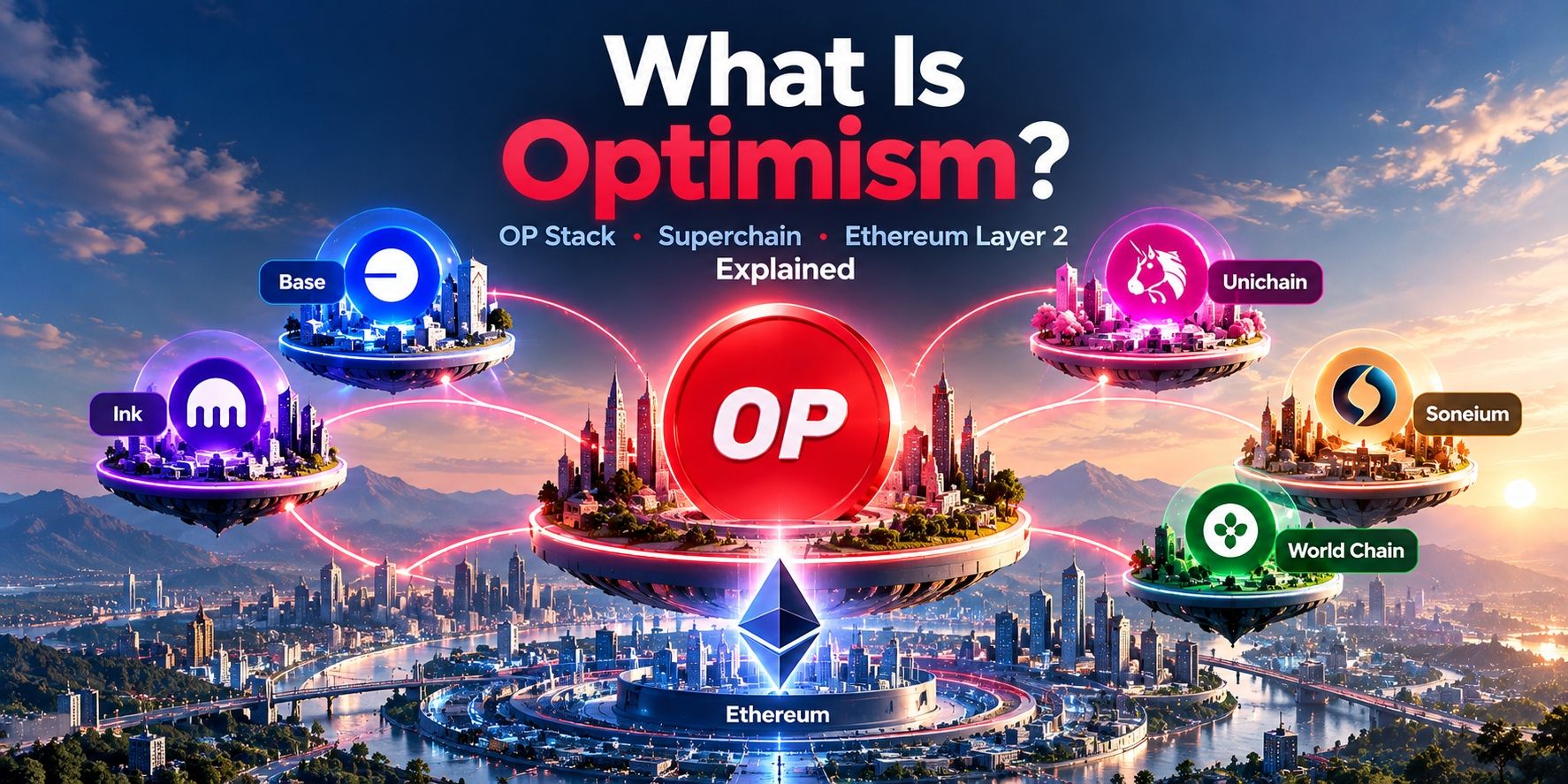
What is Optimism, and why has it become an important part of Ethereum’s scaling infrastructure? Originally known for offering faster and cheaper transactions through its Layer 2 network, Optimism has evolved into a broader blockchain ecosystem built around the OP Stack, the Superchain and an expanding network of technology and financial partners.
Its ambitions now extend beyond decentralized finance. Cryptocurrency exchanges, payment companies, financial institutions and developers are exploring blockchain infrastructure that can support large numbers of users without relying exclusively on Ethereum’s main execution layer.
Optimism offers one approach to this challenge. Rather than competing directly with Ethereum, it provides software and scaling infrastructure designed to support applications operating within the wider Ethereum ecosystem.
However, there is an important distinction between the technological success of Optimism and the investment potential of its native governance token, OP.
As more networks adopt the OP Stack, investors increasingly need to understand how economic value moves through the Superchain, what revenue reaches the Optimism Collective, and whether the OP token can benefit from that activity.
This guide examines the Optimism blockchain, its underlying technology, the OP Stack architecture, Superchain interoperability, institutional adoption, governance, token economics and the main risks facing the ecosystem.
Optimism explained in 30 seconds
Optimism is an Ethereum scaling ecosystem built around OP Mainnet, the open-source OP Stack and the Superchain. OP Mainnet processes transactions as an Ethereum Layer 2 network, while the OP Stack allows developers and businesses to launch additional compatible blockchains. The Superchain aims to connect participating networks through shared standards and interoperability infrastructure.
The OP token primarily supports governance and has an evolving economic relationship with Superchain revenues. It is not the universal gas token for every OP Stack chain.
What Is Optimism and How Does It Work?
Optimism is a blockchain scaling ecosystem developed to improve Ethereum’s transaction capacity and usability.
Ethereum remains a foundational platform for decentralized applications, smart contracts, stablecoins and tokenized assets. However, executing every transaction directly on its main network can become expensive when demand increases.
Optimism addresses this problem through Layer 2 technology, which processes transactions in a separate execution environment while relying on Ethereum for important aspects of data availability, settlement and security.
Its original network, OP Mainnet, uses an optimistic rollup architecture. The broader ecosystem also includes the OP Stack, an open-source technology framework used to build other blockchains.
What problem does Optimism solve?
The central problem is blockchain scalability.
A blockchain must balance transaction capacity, security, decentralization and economic costs. Increasing throughput without compromising other properties can be difficult.
Ethereum prioritizes a highly decentralized base layer, while Layer 2 networks provide additional execution capacity.
This arrangement allows applications to serve more users without requiring every individual computation to be executed directly on Ethereum.
For example, a decentralized exchange may need to process frequent token swaps, liquidity adjustments and automated transactions. Executing these activities on a Layer 2 can make certain operations more affordable.
Lower costs can also support payments, blockchain games, digital identity applications and financial services involving relatively small transactions.
What is the difference between Optimism, OP Mainnet and OP?
These terms describe related but different components of the ecosystem.
| Component | Definition | Main role |
|---|---|---|
| Optimism | Blockchain ecosystem | Technology, development and governance |
| OP Mainnet | Ethereum Layer 2 | Transactions and decentralized applications |
| OP Stack | Modular blockchain software | Building and operating additional chains |
| Superchain | Shared network ecosystem | Common standards and interoperability |
| OP token | Governance asset | Collective governance and evolving economic mechanisms |
This distinction is particularly important when evaluating Optimism as an investment.
Growing usage of the OP Stack does not automatically create an equivalent increase in demand for the OP token.
How Does the Optimism Blockchain Scale Ethereum?
The Optimism blockchain is historically based on an optimistic rollup design.
An optimistic rollup processes transactions away from Ethereum’s main execution layer and publishes the necessary information to Ethereum.
Its name reflects the assumption that proposed state transitions are valid unless successfully challenged through the protocol’s fault-proof system.
How does an optimistic rollup process transactions?
Consider an application processing several thousand user transactions.
Instead of executing each transaction independently on Ethereum, the Layer 2 performs the operations within its own execution environment.
The system then submits transaction data and related commitments according to its settlement architecture.
The main components include:
- Transaction execution: smart contracts and user transactions run within the Layer 2 environment.
- Sequencing: a sequencer determines transaction ordering and provides confirmations.
- Batch submission: transaction information is published to Ethereum.
- Fault proofs: mechanisms allow invalid state proposals to be challenged under applicable protocol rules.
- Settlement: Ethereum provides the underlying settlement and verification environment.
These components work together to reduce the amount of execution that must occur directly on Ethereum.
However, optimistic rollups are not automatically decentralized simply because they use Ethereum. Their security also depends on sequencer arrangements, withdrawal mechanisms, upgrade permissions and the fault-proof implementation.
Why are Optimism transactions generally cheaper?
Layer 2 networks can distribute the cost of publishing data and settling transactions across many operations.
Ethereum improvements have also contributed to this process.
EIP-4844 introduced blob transactions, providing a more efficient data availability mechanism for rollups. Subsequent upgrades have continued to improve Ethereum’s data capacity.
These developments can reduce operating costs for Layer 2 networks and potentially improve the economics of applications built on them.
Nevertheless, fees are not fixed. They depend on network activity, Ethereum data costs, transaction complexity and the policies of individual networks.
How long does an Optimism withdrawal take?
Ordinary Layer 2 transactions may receive confirmations quickly, but native withdrawals to Ethereum can require a challenge period.
For traditional optimistic rollup withdrawals, this period is commonly around seven days.
Liquidity providers and third-party bridges may offer faster transfers, although users must assess their additional risks, liquidity conditions and fees.
Transaction confirmation, withdrawal finalization and bridge settlement should therefore be treated as separate concepts.
What happens if the sequencer stops working?
A sequencer outage can disrupt new transaction processing or delay the usual transaction experience.
However, a sequencer interruption does not necessarily mean user assets are permanently frozen.
Optimism’s September 2026 technical clarification explains that the protocol provides a withdrawal path through Ethereum even when the sequencer pauses, subject to the relevant procedures and settlement conditions.
This distinction is important when evaluating operational resilience and the limits of centralization within Layer 2 networks.
What Is the OP Stack?
The OP Stack is an open-source collection of software components used to build and operate Ethereum-compatible blockchain networks.
While OP Mainnet represents one blockchain, the OP Stack is the technological framework that can support many different chains.
This is one of the defining characteristics of the wider Optimism ecosystem.
Instead of developing an entirely new blockchain infrastructure, teams can use established components covering execution, transaction sequencing, data publication and other protocol functions.
The technology is modular, allowing different implementations and configurations for different operational requirements.
Why is the OP Stack important for developers?
Launching a blockchain requires substantial engineering resources.
A development team must consider security, execution software, compatibility, infrastructure reliability, maintenance and protocol upgrades.
Using an established technology stack can reduce some of this complexity.
The OP Stack offers several advantages:
- Compatibility with established Ethereum development tools.
- Reusable blockchain infrastructure components.
- Open-source software and shared technical standards.
- Support for customizable network architectures.
- Integration opportunities with wallets, applications and existing Ethereum services.
- A shared development ecosystem capable of distributing some maintenance and upgrade efforts.
These characteristics make it attractive to projects seeking a dedicated blockchain without creating an entirely independent technology stack.
Official Optimism materials published in 2026 describe more than 50 chains using OP Stack technology. This illustrates the framework’s reach, although the number of deployed chains should not be confused with economically active Superchain participants.
Can companies build their own blockchain with the OP Stack?
Yes. Businesses can deploy dedicated networks using OP Stack software and select operational models that meet their requirements.
For example, a financial technology company may want a dedicated execution environment for payment services or digital assets.
A cryptocurrency exchange may prefer its own network to integrate decentralized applications with its existing products.
A gaming company may prioritize low transaction costs and a simplified user experience.
These projects can share a technological foundation without necessarily using identical governance structures or security configurations.
Is the OP Stack the same as a blockchain?
No. The OP Stack is software infrastructure, while individual chains are operational blockchain networks created using that infrastructure.
The distinction resembles the difference between a software platform and the individual services deployed on it.
Using the same framework does not make every chain technically or economically identical.
Some networks may use different data availability arrangements, administrative controls or operational models.
Developers and users must evaluate each network on its own merits.
Explore the official OP Stack overview.
What Is the Optimism Superchain?
The Optimism Superchain is a vision for a network of blockchains built around common infrastructure, shared standards and progressively improved interoperability.
The objective is not simply to launch more blockchains. It is to reduce the fragmentation that occurs when each network develops independently.
Historically, the blockchain industry has created many separate environments with their own applications, liquidity pools and bridges.
This fragmentation can make decentralized finance difficult to navigate, particularly for users who must regularly move assets between networks.
The Superchain aims to create a more coordinated ecosystem while preserving room for individual networks to develop specialized products.
Why does interoperability matter?
Imagine holding a stablecoin on one Layer 2 and wanting to use it within a lending application on another.
Without effective interoperability, the process may involve a bridge, a network switch, additional transaction fees and waiting periods.
Users may also encounter multiple versions of the same asset, with different liquidity and security characteristics.
Improved interoperability could simplify these operations and reduce the need for users to understand every technical detail of the underlying infrastructure.
For developers, interoperable networks may provide access to a larger pool of users and liquidity.
For businesses, they may simplify integrations across multiple blockchain-based products.
Which blockchains use the OP Stack?
Several prominent networks have adopted OP Stack technology, although their technical configurations and economic relationships with Optimism differ.
| Network | Associated ecosystem | Main focus |
|---|---|---|
| Base | Coinbase | Consumer applications and onchain finance |
| Unichain | Uniswap | Decentralized finance and liquidity |
| Ink | Kraken | Onchain financial applications |
| Soneium | Sony Block Solutions Labs | Entertainment and Web3 applications |
| World Chain | World ecosystem | Human-centered blockchain applications |
These networks demonstrate the flexibility of the technology and the diversity of its potential applications.
However, a chain’s use of OP Stack software does not automatically mean that all its transaction fees are paid to the Optimism Collective or that its activity directly increases demand for OP.
Does the Superchain already operate as one unified network?
Not entirely.
Shared technology and common standards create the foundation for interoperability, but they do not automatically eliminate the boundaries between separate blockchains.
Cross-chain communication, liquidity management and security assumptions require dedicated infrastructure.
Some interoperability mechanisms are available, while other capabilities continue to evolve.
It is therefore more accurate to describe the Superchain as an expanding ecosystem pursuing greater integration rather than a single blockchain where every application already shares the same state and liquidity.
Could the Superchain become an Ethereum infrastructure standard?
That is one of the project’s most interesting long-term possibilities.
Software standards can become valuable when many participants adopt them because developers gain familiarity, tools become more mature and infrastructure providers can benefit from shared improvements.
However, Ethereum scaling remains a competitive industry.
Alternative rollup frameworks, zero-knowledge technologies and specialized blockchains may offer different performance or security advantages.
Optimism’s opportunity depends on its ability to remain technically relevant while attracting projects that generate meaningful economic activity.
OP Stack Architecture: The Main Technical Components
Understanding the architecture helps explain why the OP Stack can support different types of blockchain networks.
The stack separates several functions that are closely connected in traditional blockchain implementations.
Execution layer
The execution layer processes transactions and smart contracts.
Ethereum compatibility is particularly valuable because developers can reuse familiar programming languages, wallet integrations and application frameworks.
This reduces the effort required to migrate or deploy many existing Ethereum applications.
Execution compatibility, however, does not guarantee identical behavior across every network configuration.
Sequencing layer
Sequencers are responsible for ordering transactions and providing the initial transaction experience.
They play an important role in performance, reliability and censorship-resistance considerations.
Many Layer 2 networks have historically relied on concentrated sequencing arrangements, making decentralization and alternative ordering models significant areas of research.
For users and institutions, sequencer design affects availability, operational continuity and the practical ability to submit transactions during disruptions.
Data availability layer
Data availability ensures that information needed to reconstruct or verify blockchain state is accessible according to the network’s security model.
Ethereum provides a major data availability option for rollups.
However, different OP Stack deployments may choose different configurations, which can change costs and trust assumptions.
Lower data expenses should not be evaluated separately from the security trade-offs of the chosen design.
Settlement and verification
The settlement architecture determines how state commitments, withdrawals and disputes are handled.
Fault-proof systems allow certain invalid state transitions to be challenged.
The implementation matters enormously: the existence of an optimistic rollup design does not by itself establish that every network offers the same permissionless verification guarantees.
Security assessments must consider deployed contracts, permission settings, upgrade controls and the available exit mechanisms.
Governance and protocol upgrades
Blockchains evolve through software changes and protocol upgrades.
For systems managing substantial assets, upgrade authority represents an important security consideration.
Optimism’s September 2026 governance clarification states that OP Stack upgrades are approved through Token House governance and implemented by a Security Council with 13 voting members and a non-voting lead.
This separates the approval process from technical execution, although governance concentration and upgrade procedures remain appropriate subjects for independent scrutiny.
What Is OP Enterprise?
OP Enterprise is an infrastructure and support offering designed for organizations that want to deploy blockchain-based products without necessarily managing every technical component themselves.
Introduced in January 2026, the service reflects Optimism’s expansion from protocol development into infrastructure offerings intended for commercial and institutional users.
The underlying idea is straightforward: an organization may want the benefits of dedicated blockchain infrastructure without becoming a specialist in operating sequencers, nodes, monitoring systems and protocol upgrades.
What operating models are available?
OP Enterprise offers different approaches according to an organization’s requirements.
| Model | Description | Typical use case |
|---|---|---|
| OP Mainnet | Existing public Layer 2 | Launching without operating a separate chain |
| Self Managed | Customer operates infrastructure with technical support | Organizations with internal blockchain engineering teams |
| Fully Managed | Infrastructure operated by the service provider | Businesses seeking a dedicated chain without daily infrastructure management |
The offering also includes different support and service arrangements, with additional options for organizations requiring stronger operational commitments.
According to Optimism’s September 2026 clarification, its Fully Managed tier includes a contractual 99.9% uptime service-level agreement, while the Mission-Critical option can provide a 99.95% commitment.
These commitments concern specified enterprise services and should not be confused with a guarantee that every OP Stack blockchain will operate without interruption.
Why does managed blockchain infrastructure matter?
Enterprise adoption often depends on requirements that receive less attention in speculative cryptocurrency markets.
Financial institutions need operational accountability, technical support, incident management and predictable processes for upgrading critical systems.
They may also need to integrate blockchain activity with existing accounting, compliance and custody arrangements.
Managed infrastructure can reduce some technical obstacles, although it does not remove regulatory or operational responsibilities.
For Optimism, enterprise services also represent a potential source of commercial activity beyond transactions on OP Mainnet.
Read the official OP Enterprise announcement.
Optimism and Institutional Blockchain Adoption
Institutional adoption has become an increasingly important aspect of the Optimism ecosystem.
Organizations exploring tokenized securities, digital payments and blockchain-based financial infrastructure require reliable execution environments and long-term technical support.
Optimism has positioned the OP Stack and OP Enterprise as possible solutions for these requirements.
Bitpanda and Vision Chain
In March 2026, Optimism announced that Bitpanda planned to launch Vision Chain using its managed enterprise infrastructure.
The initiative illustrates how an established digital asset business can consider dedicated blockchain infrastructure for its products.
It also demonstrates a potential commercial use case for the OP Stack beyond traditional decentralized applications.
However, announcing a network and achieving significant operational adoption are different milestones.
Any assessment should distinguish deployment plans from live usage, transaction activity and sustainable revenue.
Institutional tokenization in South Korea
On September 23, 2026, Optimism announced a memorandum of understanding involving KB Securities and Securitize.
The collaboration aims to explore tokenized investment funds for Korean institutional investors using OP Mainnet.
Initial plans include a tokenized money market fund and a product associated with an existing KB Asset Management investment strategy.
The initiative remains subject to the relevant regulatory environment and the development of the participating products.
Its significance is that a traditional financial institution is evaluating blockchain infrastructure for regulated investment products, rather than merely experimenting with a speculative cryptocurrency.
What are real-world assets?
Real-world asset tokenization involves representing rights or interests in financial or physical assets using blockchain-based records.
Potential examples include investment funds, debt instruments and certain forms of financial collateral.
The technology may improve settlement processes, recordkeeping and interoperability between financial services.
However, tokenization does not automatically make an asset liquid, eliminate custody risk or override securities regulation.
Legal ownership, redemption arrangements and the responsibilities of asset issuers remain essential.
Could institutional adoption drive OP token demand?
It could contribute indirectly, but the relationship is not automatic.
Institutional users may pay infrastructure fees, generate onchain activity or contribute to the wider Superchain economy.
Whether those activities translate into sustained OP demand depends on the economic agreements and mechanisms connecting revenues to the token.
That is why enterprise adoption and token valuation should be analyzed separately.
What Is the OP Token Used For?
The OP token is the principal governance asset associated with the Optimism Collective.
It allows tokenholders to participate in applicable governance processes, including delegating voting power to representatives.
Its role should not be confused with ETH, which is commonly used to pay transaction fees on OP Mainnet.
OP is also not an equity security automatically granting ownership of the Optimism Foundation or a contractual right to corporate profits.
How does Optimism governance work?
The Optimism Collective has developed a governance structure involving different bodies and responsibilities.
Its historical design includes the Token House and Citizens’ House.
Token House participation is based on OP token voting and delegation, while other governance processes address different aspects of ecosystem development and public goods funding.
The exact distribution of responsibilities can evolve through governance decisions.
Importantly, treasury allocation does not consist of individual tokenholders voting directly on every expenditure.
Optimism’s published governance clarification explains that treasury resources are directed through approved budgets and governance processes.
Voting participation is open to tokenholders, but voting power can be concentrated among a relatively small number of delegates.
Does the OP token capture Superchain revenue?
Optimism has worked to establish a more direct relationship between Superchain economic activity and OP.
In January 2026, a governance proposal sought to authorize a twelve-month program dedicating 50% of incoming Superchain revenue to OP token purchases.
The proposal passed the applicable governance vote, which concluded on January 28, 2026.
The approved framework planned monthly conversions of eligible revenue into OP, beginning in February, with purchased tokens held in the Collective treasury.
Approval of the program does not establish the exact value of completed purchases. Those figures require separate verification from subsequent execution and treasury disclosures.
The program is important because it provides a possible economic connection between infrastructure revenue and OP demand.
It does not mean every Superchain transaction automatically creates a purchase of OP.
Is an OP buyback equivalent to a token burn?
No.
A buyback involves acquiring tokens, while a burn permanently removes tokens from circulation according to the applicable mechanism.
The approved program provides for purchased OP to be held in the Collective treasury rather than automatically destroyed.
Future use of those assets may depend on governance decisions.
Consequently, buybacks should not automatically be described as permanently reducing total token supply.
Could buybacks increase the price of OP?
Buybacks can create market demand, but their effect depends on size, execution, liquidity and other market forces.
If new token supply and selling pressure exceed purchasing demand, the market price may still decline.
Similarly, revenue growth may not translate into proportionate price appreciation if the volume of revenue available for buybacks is relatively small.
Investors should compare actual purchases, revenue generation, token unlocks and market capitalization.
Review the official OP token buyback governance proposal.
OP Tokenomics: Supply, Distribution and Market Value
OP’s initial reference supply was established at 4,294,967,296 tokens.
Its distribution framework was designed to support different parts of the Optimism ecosystem, including community initiatives, development and other designated allocations.
However, initial supply, circulating supply and future supply are not necessarily identical.
As with other governance tokens, distribution schedules can affect the liquid supply available to market participants.
Why do OP token unlocks matter?
Tokens allocated to investors, contributors or ecosystem initiatives may become available according to predetermined schedules.
As additional tokens enter circulation, the amount of supply that can potentially be sold increases.
This does not mean every unlocked token will immediately be sold.
Nevertheless, unlock schedules are an important part of valuation analysis.
A network may grow rapidly while its token performs poorly if available supply increases faster than demand.
How should investors evaluate OP’s valuation?
Several indicators can help create a more complete assessment.
| Indicator | Why it matters |
|---|---|
| Circulating market cap | Values the circulating token supply |
| Fully diluted valuation | Provides a valuation based on a specified supply assumption |
| Unlock schedule | Highlights possible changes in liquid supply |
| Superchain revenue | Measures economic contributions to the ecosystem |
| Buyback execution | Measures actual purchases rather than announced targets |
| Treasury deployment | Indicates how collective resources are managed |
No single metric provides a complete picture.
The relationship between protocol adoption, revenue generation, token supply and governance policy is more informative than the token’s unit price alone.
Optimism vs Arbitrum, Base and ZK Rollups
Ethereum scaling has developed into a competitive market involving different technologies and business models.
Some networks focus on decentralized finance liquidity, while others prioritize consumer applications, specialized infrastructure or enterprise deployment.
Optimism vs Arbitrum
Optimism and Arbitrum are historically associated with optimistic rollup technology.
Both seek to improve Ethereum scalability, but their architectures, proving systems, software frameworks and governance arrangements differ.
Arbitrum also supports an extensive decentralized finance ecosystem and customizable blockchain infrastructure.
Comparing the two requires more than looking at transaction counts or token prices.
Relevant criteria include active applications, liquidity, operating costs, decentralization, protocol revenue and developer adoption.
Optimism vs Base
Base has a different relationship with Optimism because it was developed using OP Stack technology.
The network’s success can reinforce the broader adoption of this software framework.
However, Base has its own users, application ecosystem and commercial priorities.
Activity on Base does not necessarily translate into equivalent demand for OP.
The relationship therefore includes elements of technological cooperation and economic differentiation.
Optimistic rollups vs zero-knowledge rollups
Zero-knowledge rollups use cryptographic validity proofs to establish that certain computations or state transitions satisfy specified rules.
Optimistic rollups traditionally rely on challenge mechanisms for detecting invalid state transitions.
Both approaches have advantages and trade-offs.
Validity proofs can offer different finality properties, while proof generation requires computational resources and specialized engineering.
Optimism has also explored additional proving technologies, including a 2026 collaboration with Succinct.
This demonstrates that rollup infrastructure may evolve beyond a rigid division between optimistic and zero-knowledge designs.
| Technology | Main approach | Key consideration |
|---|---|---|
| Optimism | OP Stack and Superchain | Shared infrastructure and network adoption |
| Arbitrum | Optimistic rollups and customizable chains | DeFi ecosystem and execution infrastructure |
| Base | OP Stack-based Layer 2 | Consumer distribution and application adoption |
| ZK rollups | Cryptographic validity proofs | Proof costs, security and finality |
What Are the Main Risks of Optimism?
Optimism combines technological potential with several important risks.
These risks should be considered independently of short-term cryptocurrency market movements.
Sequencer centralization
Transaction sequencing arrangements can affect network availability and censorship resistance.
A network may rely on Ethereum for settlement while still depending on a relatively concentrated sequencing system for its normal operation.
Decentralization is therefore multidimensional and cannot be assessed through a single label.
Protocol upgrade and governance risk
Smart contract upgrade permissions are especially important when a network secures valuable assets.
Governance processes, security councils and emergency mechanisms can improve operational control but also introduce additional trust assumptions.
Users should evaluate who can authorize upgrades, what delays apply and whether participants have appropriate exit mechanisms.
Smart contract and bridge vulnerabilities
Layer 2 applications remain exposed to smart contract vulnerabilities, malicious integrations and operational mistakes.
Bridges can introduce additional security risks depending on their architecture and custody model.
Audits and bug bounty programs can reduce uncertainty, but they do not eliminate the possibility of failures.
Competitive pressure
The Layer 2 market includes established networks and continuously evolving technologies.
Lower fees alone may become insufficient as competing networks improve their capabilities.
Optimism must maintain a compelling developer experience, useful infrastructure and sustainable business relationships.
Weak token value capture
This is particularly important for OP investors.
The OP Stack could become widely adopted without generating revenue sufficient to support meaningful token purchases or other forms of economic demand.
The relationship between technology adoption and token value remains one of the project’s central investment questions.
Enterprise adoption risk
Institutional partnerships can be promising, but announcements and memoranda of understanding do not guarantee commercial deployment.
Financial institutions may delay projects, change providers or encounter regulatory obstacles.
Real adoption should be measured through launched products, active users, transaction volumes and verifiable financial activity.
What Is the Future of Optimism?
The future of Optimism depends on whether it can convert widespread infrastructure adoption into a durable and competitive economic ecosystem.
Several developments could influence its position over the coming years.
Scenario one: the OP Stack becomes a leading Ethereum infrastructure framework
In a favorable scenario, more companies deploy networks using the OP Stack, existing chains expand their activity and interoperability improves.
Developers benefit from shared infrastructure and standardized tools, while enterprises gain confidence in operating blockchain-based services.
If this growth generates meaningful contributions to the Optimism Collective, the economic resources supporting the ecosystem could increase.
OP might benefit if the applicable mechanisms translate those resources into sustained token demand.
Scenario two: adoption grows without proportional OP appreciation
A second possibility is that OP Stack adoption expands substantially while the token captures only a limited portion of the resulting value.
Open-source technology can become successful without creating exclusive economic benefits for a specific token.
Networks may retain significant autonomy, operational costs may decline and token supply may grow.
Under these conditions, technical success and investment performance could diverge.
Scenario three: competing infrastructures gain market share
A less favorable outcome could involve developers and businesses shifting toward alternative frameworks or more specialized networks.
Interoperability challenges, governance disputes or security incidents could also weaken confidence.
In such circumstances, the ecosystem might struggle to maintain its strategic position despite its early technological achievements.
What should investors and developers monitor?
The most useful indicators include:
- Growth in economically active OP Stack networks.
- Actual Superchain revenue and contributions to the Collective.
- Execution and disclosure of OP token buybacks.
- Token supply changes and unlock schedules.
- Adoption of interoperable applications.
- Enterprise deployments moving beyond announcements.
- Security upgrades and changes in decentralization.
- Developer activity and sustained user demand.
These metrics provide a more grounded framework than relying entirely on speculative price predictions.
Is Optimism a Good Long-Term Blockchain Project?
Optimism offers a credible technological proposition because its software is used across a broad range of blockchain networks and its infrastructure strategy extends into enterprise services.
The project benefits from Ethereum compatibility, open-source development and a growing ecosystem of specialized chains.
However, assessing Optimism as blockchain infrastructure is not the same as determining whether the OP token is attractively valued.
The first question concerns technological adoption, security, developer experience and competitive positioning.
The second concerns revenue attribution, token supply, governance and the price an investor pays.
Mediasnet analysis: the key takeaway
Optimism is increasingly an infrastructure story rather than simply an Ethereum scaling token. The OP Stack, Superchain and enterprise services give the ecosystem several potential sources of long-term adoption.
Yet successful infrastructure does not automatically create a successful token investment. OP’s economic outlook depends on how much activity produces revenue for the Collective, how those resources are deployed and whether market demand can absorb changes in token supply.
Bottom line: the technology has demonstrated meaningful adoption, but the investment case must be evaluated separately.
Frequently Asked Questions About Optimism
What is Optimism in cryptocurrency?
Optimism is an Ethereum scaling ecosystem that includes OP Mainnet, the OP Stack and the Superchain initiative. It provides infrastructure for lower-cost blockchain transactions and for building additional Ethereum-compatible networks.
Is Optimism a Layer 1 or Layer 2 blockchain?
OP Mainnet is an Ethereum Layer 2 blockchain. The wider Optimism ecosystem also develops software used to launch additional networks. Their specific security arrangements depend on their architecture and configuration.
What is the OP Stack used for?
The OP Stack is open-source blockchain software used to build and operate Ethereum-compatible networks. It provides modular infrastructure components that reduce the need to develop a completely new blockchain system.
What is the Optimism Superchain?
The Superchain is an ecosystem of networks based on shared standards and infrastructure. Its objective is to improve interoperability and coordination among participating chains, although full integration across every network is not automatic.
Is Base part of Optimism?
Base was developed using the OP Stack and has participated in the broader Superchain ecosystem. However, Base operates as a separate blockchain with its own development priorities and economic arrangements.
Does Optimism use ETH or OP for gas fees?
Ordinary gas fees on OP Mainnet are paid in ETH. OP is primarily a governance token. Other OP Stack chains may have different configurations, so users should check the requirements of the specific network.
What is the difference between Optimism and Arbitrum?
Both are Ethereum scaling ecosystems historically associated with optimistic rollup technology. They differ in technical architecture, proving systems, software frameworks, governance and ecosystem development strategies.
Can the OP token benefit from Superchain growth?
Potentially. The governance-approved buyback framework creates a mechanism intended to connect eligible Superchain revenues with OP purchases. However, revenue growth does not guarantee token appreciation, particularly when supply and market conditions are changing.
Does Optimism burn tokens through its buyback program?
The January 2026 governance-approved framework provides for purchased tokens to be held in the Collective treasury. It does not automatically burn every token acquired through the program.
Is Optimism decentralized?
Optimism includes decentralized governance and Ethereum-based settlement mechanisms, but decentralization varies across components such as sequencing, governance, upgrades and verification. Individual OP Stack chains may have different security and administrative arrangements.
Can businesses build private or dedicated chains using the OP Stack?
Organizations can deploy dedicated OP Stack-based networks and choose different infrastructure management arrangements. Privacy requirements, regulatory obligations and the selected architecture must be evaluated separately.
What are the main risks of the OP token?
Key risks include token supply changes, weak economic value capture, governance concentration, competitive pressure, smart contract vulnerabilities and overall cryptocurrency market volatility.
What is the long-term outlook for Optimism?
Its outlook depends on OP Stack adoption, Superchain interoperability, enterprise demand, sustainable revenues and the evolving economic role of OP. These factors provide a more meaningful basis for analysis than fixed long-term token price targets.
Conclusion: Can Optimism Become a Core Part of Ethereum’s Future?
What is Optimism ultimately trying to become? More than a cheaper transaction network, it aims to provide a widely adopted technological foundation for Ethereum-compatible blockchains.
The OP Stack offers reusable infrastructure, while the Superchain seeks to connect a growing number of networks through common standards and improved interoperability.
Enterprise services and financial-sector initiatives add another dimension to this strategy, potentially expanding adoption beyond traditional decentralized finance.
Nevertheless, the distinction between protocol success and token value remains essential.
OP investors should pay particular attention to actual revenues, governance decisions, treasury management, token unlocks and the implementation of approved economic mechanisms.
Optimism may become an increasingly important part of Ethereum’s infrastructure landscape. Whether that success creates lasting value for OP depends on economic outcomes rather than technological adoption alone.
Follow Ethereum, DeFi and blockchain infrastructure
Optimism is one of several ecosystems shaping the next generation of decentralized finance. Follow Mediasnet for analysis of blockchain developments, Layer 2 technology, crypto projects and the trends influencing digital asset markets.
Beyond Optimism: What’s Next for DeFi?
Optimism is just one piece of a rapidly evolving decentralized financial ecosystem. From Ethereum Layer 2 networks and emerging DeFi protocols to institutional adoption and new blockchain technologies, the landscape is constantly changing.
Which projects are gaining momentum, and which developments could reshape the future of decentralized finance? Stay ahead of the trends with our latest news, insights and independent analysis.
Explore:
Sources and Further Reading
The following primary sources provide additional information about the technology, governance and institutional developments discussed in this guide.
- Optimism — OP Stack technical overview
- Optimism — Introducing OP Enterprise
- Optimism governance — OP token buyback proposal
- Optimism — KB Securities and Securitize tokenization collaboration
Disclaimer: This article is provided for educational and informational purposes only and does not constitute investment advice. Digital assets are volatile and can result in substantial or total capital loss. Blockchain security arrangements, governance policies and economic mechanisms may change after the editorial review date.


Trader, investor and author specializing in cryptocurrencies, DeFi and Web3.
On Mediasnet, I share my market analysis, practical guides and research on crypto markets, decentralized protocols and emerging trends across the ecosystem.
Follow me on: Facebook – X (Twitter)