
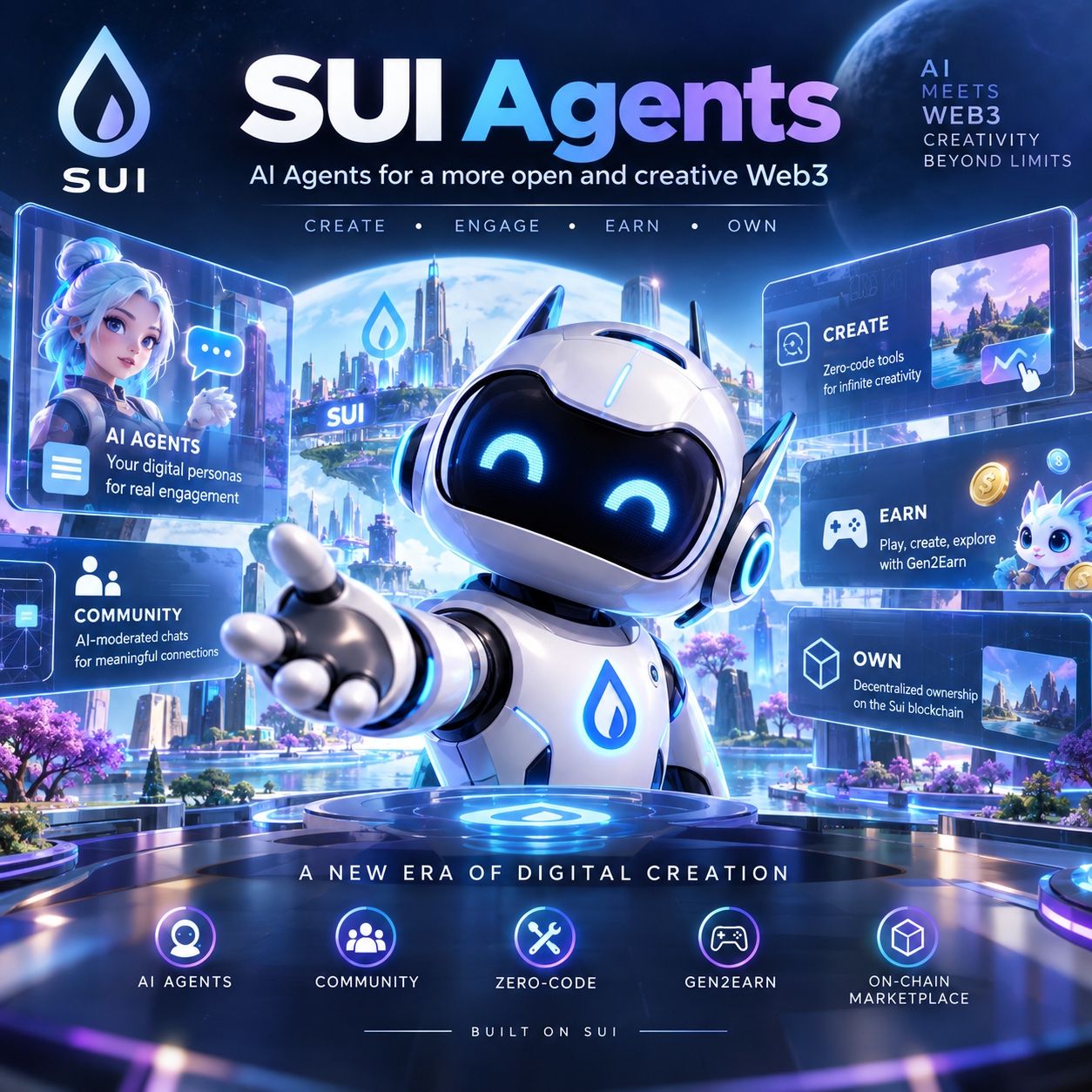
SUI Agents is an AI-agent platform built around the Sui ecosystem. This updated guide examines what the project actually offers, the role of the SUIAI token, its tokenomics, the 2024 Hacken audit, its 2026 market status and the main risks to monitor.
Updated on September 19, 2026.
SUI Agents sits at the intersection of artificial intelligence, autonomous software and blockchain. The project was launched with a simple idea: let users create, deploy, tokenize and interact with AI agents without requiring them to build the underlying blockchain infrastructure themselves.
That positioning is still visible on the official website and documentation. However, the project must now be evaluated very differently from when this article was first published in December 2024. The original roadmap was centered on 2025, the SUIAI token has experienced a dramatic collapse in market activity, and several promised features remain difficult to verify independently.
At the same time, the wider Sui ecosystem has moved much more seriously into autonomous AI infrastructure. Sui itself now presents agentic execution, programmable transactions, verifiable compute and machine-to-machine payments as important use cases. That makes the core idea behind AI agents on Sui more relevant than it was in 2024, but it does not automatically validate SUI Agents as a project or the SUIAI token as an investment.
What is SUI Agents?
SUI Agents is a Web3 platform designed to make the creation and use of AI agents easier. Its official documentation describes a system where creators, brands and communities can build generative AI agents, create AI-powered social personas, tokenize projects and connect those digital agents to blockchain-based ownership and funding mechanisms.
The project is associated with the Sui blockchain, a Layer 1 network based on the Move programming language. Sui’s object-centric architecture and programmable transaction model are particularly relevant to autonomous software because an AI agent may need to own assets, interact with applications, execute several actions and settle transactions under predefined rules.
SUI Agents attempts to turn those capabilities into a simpler user-facing product. Instead of asking users to code smart contracts or manually connect an AI model to blockchain tools, the platform’s proposition is a zero-code or low-friction AI-agent deployment layer.
The original SUI Agents proposition
The project’s website and litepaper describe several core functions:
- AI-agent creation: users can create digital agents designed for automated interaction and content generation.
- Social personas: an agent can be connected to social-media use cases, including X/Twitter-style personas.
- Tokenization: AI agents or projects can be linked to blockchain assets and liquidity mechanisms.
- Marketplace functionality: the project has presented an on-chain marketplace for creating, buying and selling AI-related digital assets.
- Community rating and funding: projects can theoretically be ranked by the community and selected projects can access tokenization or decentralized funding mechanisms.
- AI-powered communities: the roadmap included AI-moderated conversations and public discussion spaces.
These features are more specific than the generic claim that blockchain can be combined with AI. The economic model of SUI Agents is designed around the idea that AI agents themselves can become on-chain assets, while the SUIAI token acts as a utility and liquidity asset inside the ecosystem.
How SUI Agents is supposed to work
Creating AI agents without coding
The most important part of the project is the creation layer. SUI Agents has promoted the ability to launch an AI agent without building the entire technical stack from scratch. The platform has described agents that can be configured, deployed and connected to on-chain functions from a simplified interface.
This is an important distinction. A normal chatbot generates responses, but an autonomous agent is intended to execute actions according to goals, data and permissions. In a crypto environment, that can potentially include interacting with wallets, applications, tokenized assets or marketplaces.
The project’s social channels promoted its decentralized AI-agent platform as live during 2026 and directed users to its dApp. Nevertheless, the dApp returned a service error during our September 19, 2026 verification. A temporary outage does not prove that a product has been discontinued, but it is a reason to verify access and functionality before depositing funds or relying on the service.
Tokenizing an AI agent
SUI Agents also connects AI creation with tokenization. According to the project’s documentation, an AI agent can be associated with a token and liquidity pool. The native SUIAI token is designed to play a central role in that process rather than functioning only as a speculative asset detached from the product.
The proposed model makes SUIAI the default pairing asset for tokenized agents. In practical terms, the project’s token utility depends heavily on users actually creating, tokenizing and trading agents through the platform. If platform activity remains low, the economic demand generated by this mechanism would also remain low.
AI social personas and automated interaction
Another use case is the creation of AI-controlled social personas. The original SUI Agents concept allowed generative agents to interact with audiences, publish content and participate in online communities. This part of the project anticipated a broader crypto trend that became much more visible in 2025 and 2026: autonomous AI agents acting as persistent digital identities rather than simple chat interfaces.
The important question is not whether this use case is technically possible. It is whether SUI Agents can attract enough active creators, users and liquidity for its own network effect to matter.
SUI Agents and the Sui blockchain
The broader Sui ecosystem has evolved significantly since SUI Agents appeared in 2024. Sui now explicitly promotes infrastructure for agentic execution: autonomous software can operate within defined permissions, execute multi-step workflows and settle outcomes on-chain.
In July 2026, Sui reported that a public AI-agent experiment using programmable tunnels reached a peak of more than six million transactions per second. The experiment included agents and users interacting through games, payments and chat before settlement to Sui mainnet. Sui has also highlighted tools such as Walrus for decentralized data, Seal for access control and Nautilus for verifiable compute.
This matters for SUI Agents because the underlying blockchain is moving in a direction that is compatible with autonomous software. However, Sui’s progress and SUI Agents are not the same thing. Network-level adoption of AI agents cannot be used as evidence that the SUI Agents platform itself is gaining users, revenue or liquidity.
What is the SUIAI token used for?
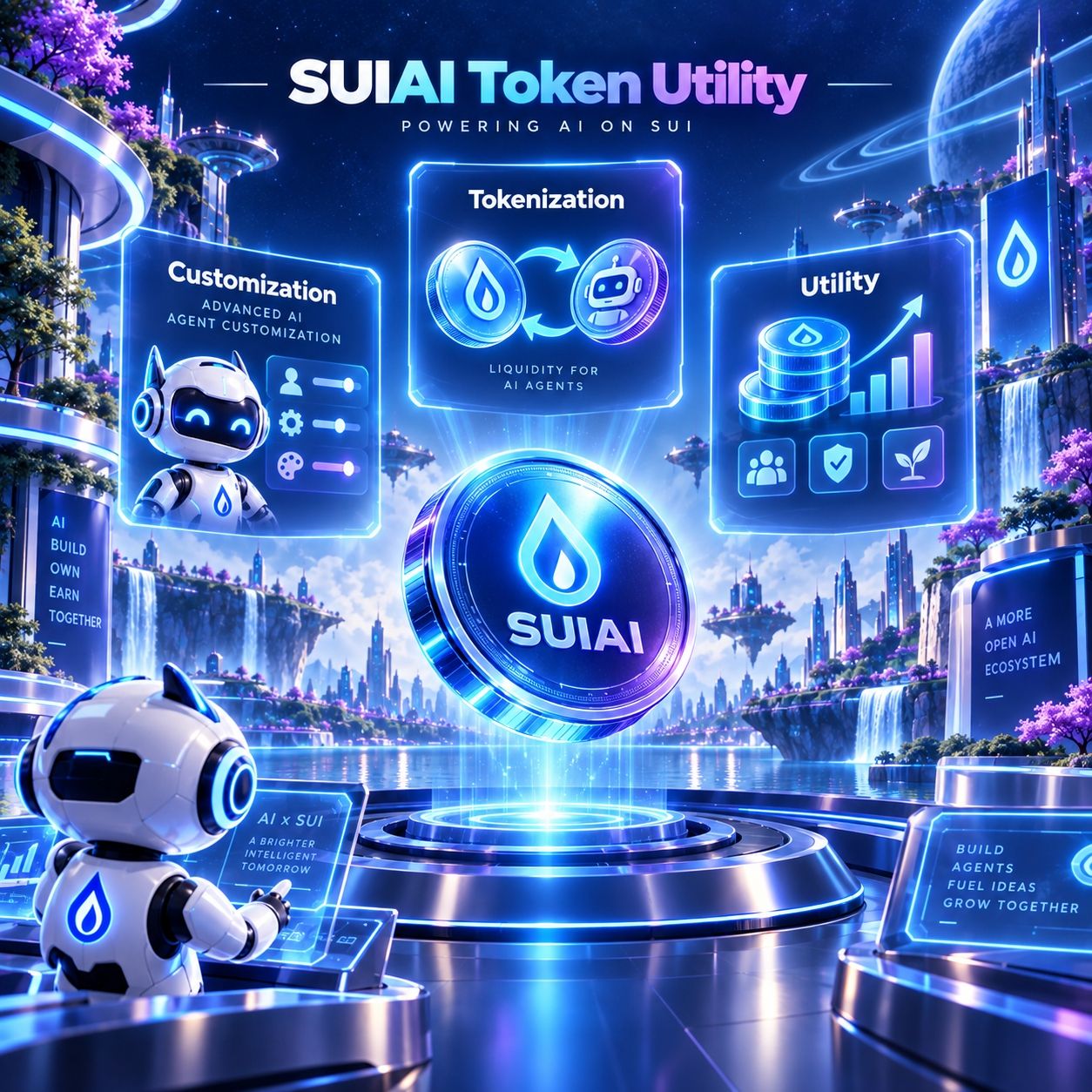
The SUIAI token is the native economic asset described by SUI Agents. The official documentation assigns it three principal functions.
Advanced agent customization
Basic creation is presented as accessible to users, while advanced customization can require SUIAI. If the platform develops a meaningful user base, this creates a direct connection between product use and token demand.
Default pairing asset for tokenized agents
When an agent is tokenized, the project’s model uses SUIAI as a default pairing token. A specified amount can be allocated to a liquidity pool when a new agent is created. This is intended to connect every new tokenized agent to the native ecosystem asset.
Tokenization and project funding
The documentation also describes funding mechanisms for selected projects. SUI Agents states that a 3% transaction fee can apply when a new project IDO is launched, with funds converted into SUIAI and staked for a period before being used to support ecosystem development and community initiatives.
These mechanisms give the SUIAI token a theoretical utility model. Their economic importance, however, depends on measurable platform usage. A token can have documented utility without generating significant real demand if the underlying application has little activity.
SUIAI tokenomics: an important contradiction to understand
The official SUI Agents tokenomics documentation states a total supply of 66,785,500 SUIAI. Its published allocation includes seed investors, a public sale, liquidity, team tokens, community rewards, marketing and development, advisers and KOL allocations.
| Allocation | Share |
|---|---|
| Seed round | 22.94% |
| Public sale | 17.21% |
| Marketing & development | 16.40% |
| Liquidity | 15.29% |
| KOL | 7.65% |
| Team | 4.97% |
| Community rewards | 3.06% |
| Advisers | 2.36% |
There is nevertheless a material point that should not be ignored. Hacken’s December 2024 audit of the token contracts reported that the Ethereum version of SUIAI allowed the owner to mint tokens without a hard supply cap. Hacken therefore described the audited ERC-20 contract as having an unlimited total supply from a technical perspective and identified unrestricted minting as a centralization and inflation risk.
That does not mean 66.8 million tokens have necessarily been exceeded. It means investors should distinguish between the published tokenomics supply and the permissions embedded in the audited contract. A stated allocation schedule is not the same as an immutable maximum supply when a privileged address retains minting authority.
SUI Agents security audit: what Hacken actually found
SUI Agents underwent a smart-contract security assessment by Hacken in December 2024. The scope covered the SUIAI token contracts on Ethereum and Sui rather than every component of the full SUI Agents application.
| Audit point | Result |
|---|---|
| Total findings | 6 |
| Critical findings | 0 |
| High findings | 0 |
| Medium findings | 0 |
| Low findings | 5 |
| Observations | 1 |
| Status in audit | 6 accepted, 0 resolved |
The absence of critical, high or medium findings in that audit is relevant, but it should not be interpreted as a guarantee of platform security. Hacken specifically identified the unrestricted mint function, ownership-related risks and other low-severity issues. The audit also noted limited functional and technical documentation for the contracts under review.
Most importantly, an audit of token contracts does not test every possible risk associated with an AI-agent application, front end, wallet integration, external model, API, marketplace or future smart contract. Users should therefore treat the Hacken report as one piece of due diligence rather than a blanket security certification.
SUIAI price and market status in September 2026
The market situation is currently the weakest part of the SUI Agents investment case.
On September 19, 2026, CoinGecko displayed SUIAI near $0.000235, with a market capitalization of approximately $15,700 and only about $2 in 24-hour trading volume. It also stated that the token had stopped trading on all exchanges tracked by CoinGecko around 17 days earlier and showed no active trading pairs.
The same page recorded an all-time high of approximately $0.3752 on December 12, 2024 and an all-time low near $0.0002145 on July 29, 2026. On that basis, the token was trading roughly 99.9% below its historical peak.
Other market-data services have displayed very different or stale SUIAI quotations. That discrepancy is itself important: when liquidity is extremely thin, a displayed price can be very different from the price at which a meaningful position can actually be bought or sold.
What changed since the 2024 launch?
SUIAI was listed on exchanges including MEXC and Gate in December 2024. The token initially benefited from the AI-agent narrative and the novelty of projects connecting generative AI with the Sui ecosystem. The subsequent market data shows that this early attention did not translate into durable token liquidity.
This does not by itself prove that the SUI Agents platform has failed. A product can continue to operate while its token loses liquidity. But it creates a major practical problem for an ecosystem whose token is supposed to serve as a pairing asset and economic layer for tokenized agents.
Is SUI Agents still active in 2026?
There are mixed signals.
The official SUI Agents website remains online and continues to describe the AI-agent platform, tokenization model, marketplace and Cryptochi concept. The official Telegram community also remains accessible. Public social posts promoted the SUI Agents dApp and zero-code agent deployment during 2026.
On the other hand, the public website still presents a roadmap centered on 2024 and 2025, including milestones for the AI-GENS mainnet, AI conversations, advanced customization and IDO functionality. We did not find a clearly maintained public roadmap that marks each of those milestones as completed with current usage statistics.
In addition, the dApp endpoint was unavailable during our latest check. Because of this, the safest description is that the project still maintains a public presence, but the current operational depth of the platform is not fully verifiable from public information alone.
For readers evaluating SUI Agents today, the most useful evidence would be current active-user numbers, agent creation statistics, marketplace volume, protocol revenue, active liquidity and recent development releases. Those figures would provide a much stronger basis for analysis than roadmap language alone.
SUI Agents: opportunity versus risk
What still makes the concept interesting
The underlying thesis has actually become stronger at the blockchain-infrastructure level. Autonomous agents increasingly need identity, permissions, payments, data access and verifiable execution. Sui is explicitly developing infrastructure around those requirements. A user-friendly platform that makes AI agents on Sui easy to create could therefore address a real emerging use case.
SUI Agents also has a more coherent token model than projects where an “AI token” has no direct relationship with the product. SUIAI is designed for customization, agent liquidity and tokenization. If the platform were to generate substantial activity, those mechanisms could theoretically create native token demand.
The risks are currently more measurable than the adoption
The problem is execution and evidence. The market currently provides several warning signals: extremely low reported volume, a collapse from the 2024 peak, inconsistent pricing across data providers and uncertainty around active trading venues.
There is also a technical tokenomics issue. The official allocation refers to a finite supply figure, while the audited token contract included owner minting authority without a hard cap. Finally, the project’s older roadmap needs clearer public confirmation of which functions are fully deployed and generating real usage.
For that reason, SUI Agents should currently be analyzed primarily as an early and highly speculative AI crypto project, not as an established AI infrastructure protocol. A recovery in the token would be much more credible if accompanied by measurable product activity and restored liquidity.
What to monitor before considering the SUIAI token
- Working product access: confirm that the SUI Agents dApp is available and that agent creation works end to end.
- Real users: look for verifiable active-agent, wallet or marketplace statistics rather than follower counts.
- Liquidity: verify current pools, depth, trading volume and realistic slippage before relying on quoted prices.
- Development activity: check for recent releases and technical updates that go beyond marketing posts.
- Token supply: monitor minting authority and actual supply in circulation, especially given the Hacken audit findings.
- Utility: determine whether SUIAI is genuinely required by active platform functions.
- Sui integration: watch for concrete use of Sui’s newer agentic infrastructure rather than assuming ecosystem alignment.
These indicators would make it possible to distinguish a genuine product revival from a temporary rebound in an illiquid token.
FAQ – SUI Agents and the SUIAI token
What is SUI Agents?
SUI Agents is a platform designed to combine generative AI agents with Web3 infrastructure. Its stated functions include creating AI agents, building social personas, tokenizing agents or projects and using blockchain-based marketplace and funding mechanisms.
Is SUI Agents built on Sui?
Yes. SUI Agents is positioned around the Sui ecosystem and its SUIAI token has had a Sui-based version. However, SUI Agents is an independent project and should not be confused with Mysten Labs or the Sui network itself.
What is the SUIAI token?
The SUIAI token is the native token described by SUI Agents. Its intended utilities include advanced AI-agent customization, pairing with tokenized agents and participation in funding and tokenization mechanisms.
What is the total supply of SUIAI?
The official tokenomics page states a total supply of 66,785,500 SUIAI. However, Hacken’s 2024 audit found that the audited ERC-20 contract allowed the owner to mint tokens without a hard supply cap. The published tokenomics figure should therefore be distinguished from the technical minting permissions of the contract.
Was SUI Agents audited?
The SUIAI token contracts were audited by Hacken in December 2024. The report listed five low-severity findings and one observation, with no critical, high or medium findings. The findings were marked as accepted rather than resolved. The audit covered token contracts, not every component of the SUI Agents platform.
Is the SUIAI token still actively traded?
Liquidity appears extremely weak. On September 19, 2026, CoinGecko showed only a few dollars of 24-hour volume and stated that no active trading pairs were available on the exchanges it tracked. Because other providers displayed inconsistent quotations, any current price should be checked against executable liquidity before being treated as reliable.
Does the growth of AI agents on Sui help SUI Agents?
It creates a potentially favorable technological environment. Sui is actively developing infrastructure for autonomous agents and machine-driven transactions. But that broader trend does not prove adoption of SUI Agents specifically. The project’s own users, liquidity, development and revenue remain the more relevant indicators.
Conclusion: SUI Agents has a relevant idea, but needs measurable adoption
SUI Agents was early in identifying the convergence between generative AI, autonomous agents and blockchain ownership. In 2026, that thesis looks less experimental because Sui itself is increasingly focused on infrastructure for autonomous execution, payments and AI-agent workflows.
Yet the investment picture surrounding the SUIAI token is much weaker than the technological narrative. Token liquidity has deteriorated sharply, market prices are inconsistent across data providers, the token is far below its 2024 peak and the project’s current product activity is not transparent enough to confirm broad adoption.
The most important development to watch is therefore not a price rebound. It is whether SUI Agents can demonstrate a working, actively used platform with real agents, measurable marketplace activity and sustainable demand for SUIAI. Until those signals become visible, the project remains an interesting but very high-risk part of the AI crypto sector.
Suggested reading: Interested in another AI crypto project with a very different economic model?
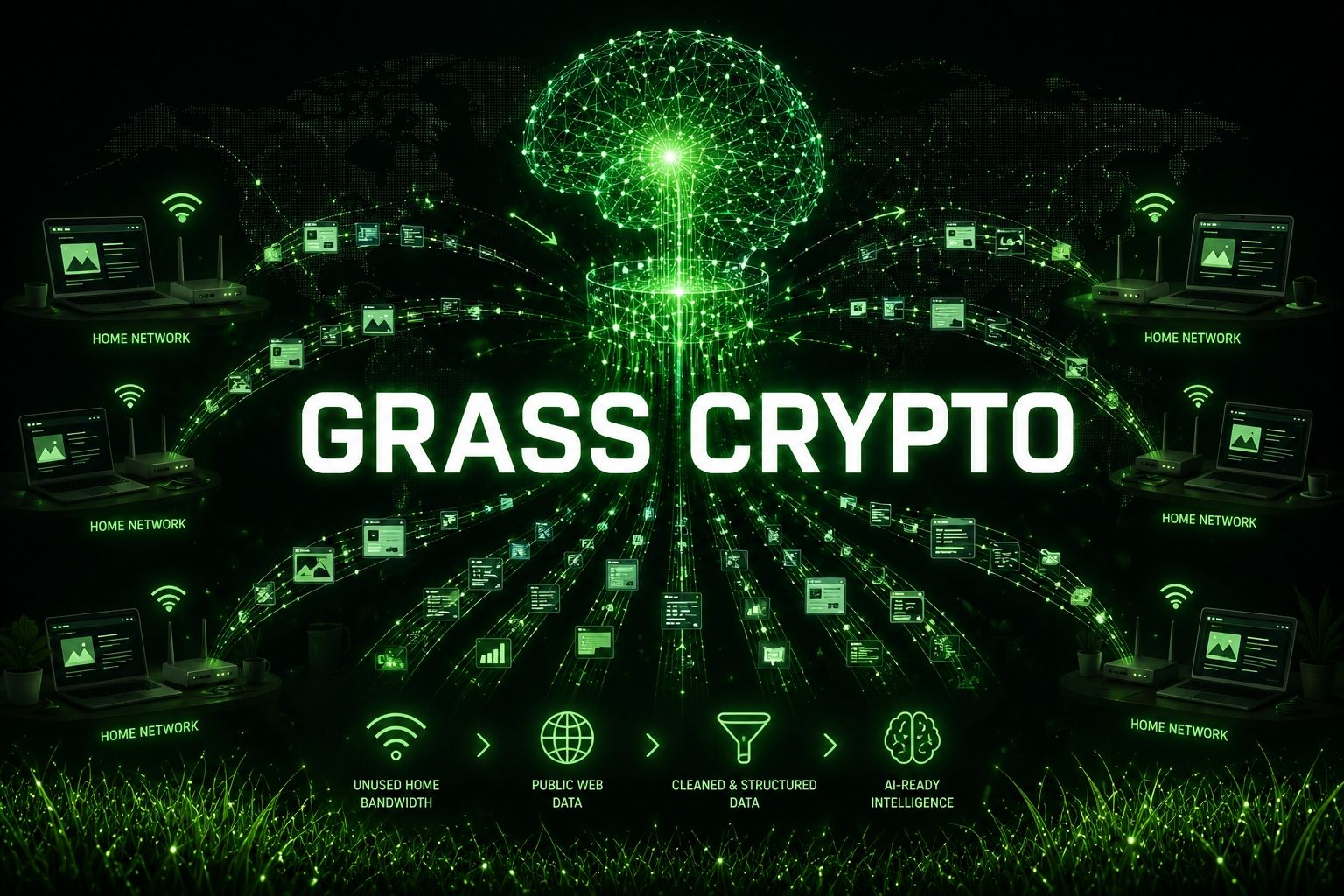
Read our analysis of Grass crypto, which focuses on decentralized web data infrastructure for artificial intelligence.
Disclaimer: This article is for informational purposes only and does not constitute financial or investment advice. Crypto assets, particularly low-liquidity tokens, can be extremely volatile and may result in a total loss of capital. Always verify smart-contract addresses, liquidity and official project information before making any transaction.

