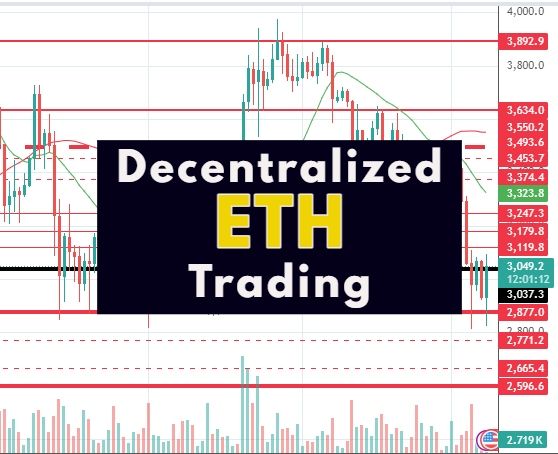
Decentralized Ethereum (ETH) Trading. Discover the price zones to watch and the advantages of decentralized trading.
Decentralized Ethereum (ETH) trading, an excellent way to profit from and trade the rise and fall of the ETH price. Discover the advantages of decentralized ETH trading.
While the technical structure of Ethereum currently leans bearish in the short to mid term, fundamentals tell a more nuanced story. Price action reflects sentiment and liquidity — but fundamentals reveal whether the underlying network is strengthening or weakening.
Here’s a structured fundamental breakdown to complement the technical outlook.
Decentralized Ethereum (ETH) Trading: Fundamental Analysis
1️⃣ Network Activity: Slower Growth, But Not Structural Decline
Ethereum remains the dominant smart contract platform by:
-
Total value locked (TVL)
-
Stablecoin settlement volume
-
DeFi infrastructure depth
-
Institutional integration
However, on-chain activity has moderated compared to peak cycles. Transaction growth is steady but not explosive. Gas fees remain relatively contained, signaling that demand is stable but not overheated.
Importantly, layer-2 scaling solutions (Arbitrum, Optimism, Base, etc.) are now absorbing a significant portion of transaction activity. That reduces mainnet fee pressure but strengthens Ethereum’s broader ecosystem.
This is not contraction — it’s structural evolution.
2️⃣ Supply Dynamics: Structural Scarcity Still Intact
Since the implementation of EIP-1559 and the transition to Proof of Stake, Ethereum’s monetary structure has fundamentally changed.
Key points:
-
ETH issuance is significantly lower than under Proof of Work.
-
During periods of high activity, ETH becomes net deflationary.
-
A substantial portion of supply is locked in staking.
With over 20%+ of total ETH supply staked, circulating liquidity is structurally constrained. That reduces sell pressure during normal conditions.
However, in low-activity environments, ETH can return to mild inflation — reducing the deflation narrative in quieter markets.
Bottom line: the long-term supply structure remains supportive, but short-term demand determines whether deflation kicks in.
3️⃣ Institutional Positioning: Early but Growing
Ethereum is increasingly viewed as:
-
The infrastructure layer of Web3
-
A yield-generating digital asset (via staking)
-
A programmable settlement network
Spot ETF products and institutional custody solutions have made ETH more accessible to traditional investors. While inflows are not yet explosive, the structural bridge between TradFi and Ethereum is stronger than in prior cycles.
The institutional thesis is shifting from « speculative altcoin » to « digital infrastructure asset. »
That shift takes time — but it is happening.
4️⃣ DeFi, Stablecoins, and Real-World Assets
Ethereum continues to dominate:
-
DeFi liquidity
-
Stablecoin issuance
-
Tokenized real-world assets (RWAs)
Stablecoin settlement on Ethereum and its layer-2 ecosystem remains substantial. Even when speculative trading slows, stablecoin usage often persists — a key signal of utility beyond speculation.
Real-world asset tokenization (Treasuries, funds, credit products) is also expanding. This positions Ethereum as a settlement layer for hybrid finance models.
If capital markets increasingly tokenize assets, Ethereum remains a primary beneficiary.
5️⃣ Macro Environment: The Real Driver
Ethereum does not trade in isolation.
Its performance is heavily influenced by:
-
Federal Reserve policy
-
Liquidity cycles
-
U.S. dollar strength
-
Equity market volatility
In tight liquidity conditions, risk assets suffer — including ETH.
In expanding liquidity cycles, Ethereum historically outperforms due to its higher beta compared to Bitcoin.
Right now, macro uncertainty is limiting aggressive capital deployment into high-beta digital assets.
6️⃣ Competitive Landscape: Still Dominant, But Challenged
Ethereum faces growing competition from faster, lower-cost blockchains.
However:
-
Most institutional pilots still launch on Ethereum.
-
The developer ecosystem remains the largest.
-
Security and decentralization standards remain higher than most competitors.
The market share battle is real — but Ethereum’s network effects remain powerful.
Fundamental Scenarios
📉 Bearish Fundamental Scenario
-
Continued macro tightening
-
Weak on-chain growth
-
ETF inflows stagnate
-
Reduced fee burn → mild inflation
In this case, fundamentals would fail to counterbalance technical weakness.
📈 Bullish Fundamental Scenario
-
Liquidity expansion cycle begins
-
Stablecoin and RWA growth accelerates
-
Fee burn increases → deflation returns
-
Institutional allocation increases
This would create alignment between technical breakout and structural demand growth.
Decentralized Ethereum (ETH) Trading: Technical Analysis
Introduction
Ethereum is going through a pivotal phase. After several attempts to stabilize, the price is currently trading in the $1,900–$2,000 range, amid elevated volatility and broader market uncertainty.
The key question for investors is simple: Are we nearing the end of this correction — or just at the beginning of another downside leg?
Here’s a structured technical breakdown in USD to understand what’s really happening.
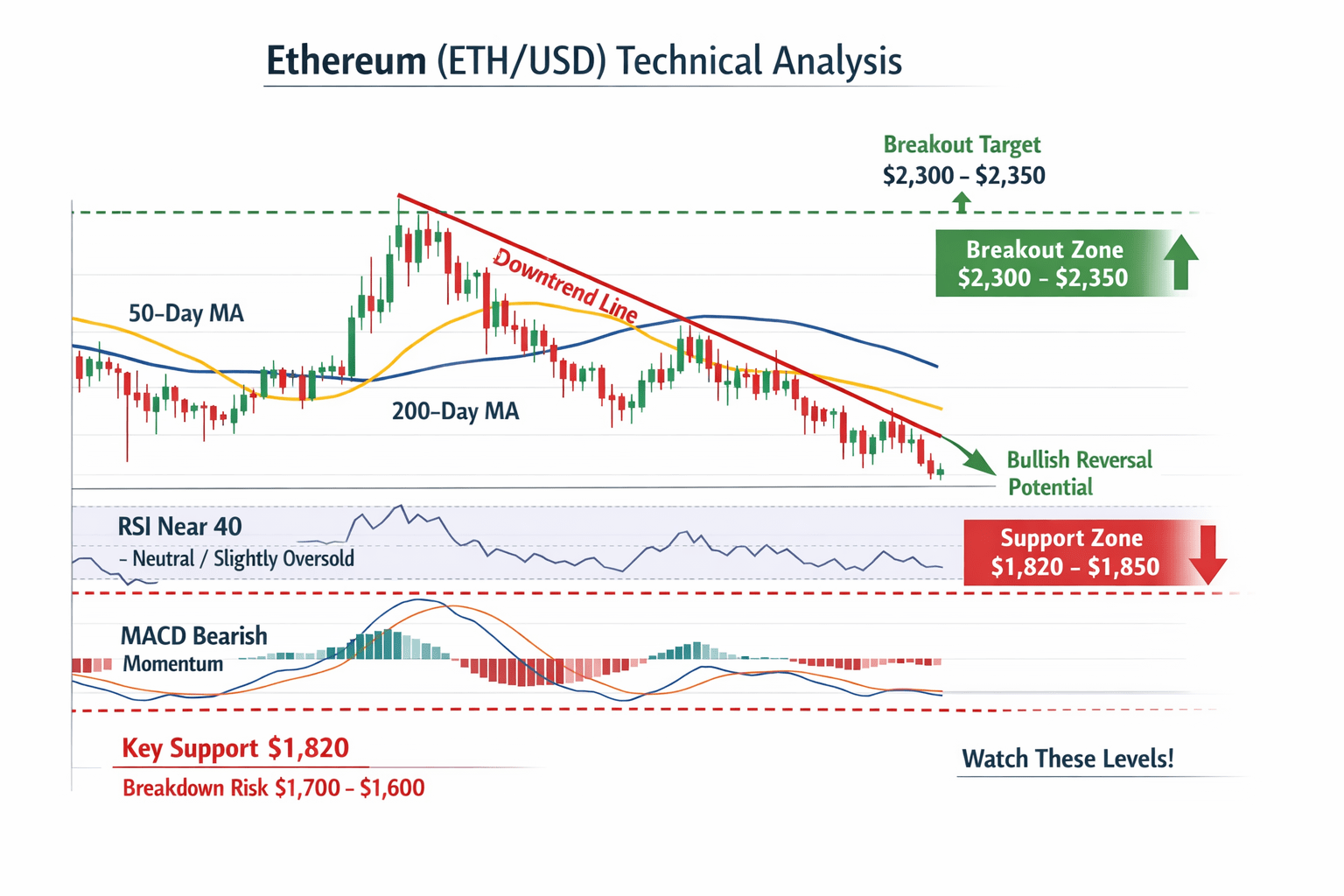
Market Structure: Clearly Weakened
From a chart perspective, Ethereum is showing a bearish short- and mid-term trend.
-
Lower highs are forming.
-
Rebounds lack strong volume.
-
Price remains below key moving averages.
The 50-day moving average (MA50) is still above the current price, reinforcing downside pressure. Until ETH reclaims and holds above this level, sellers remain in control.
From a long-term standpoint, however, the broader structure is more neutral. Ethereum is still significantly below its all-time high near $4,800, meaning the market is not overheated — it’s adjusting.
Technical Indicators: Weak Momentum, Possible Bounce
RSI: Neutral to Slightly Oversold
The Relative Strength Index (RSI) is fluctuating around the 40–50 zone.
This reflects a lack of strong bullish momentum — but not full capitulation either.
On lower time frames, RSI occasionally dips into oversold territory (<30), which can trigger short-term relief rallies. However, in bearish environments, those bounces tend to be temporary.
MACD: Negative Momentum
The MACD remains in negative territory, confirming continued seller dominance.
There is no clear bullish divergence at this stage to suggest a structural reversal.
Key Levels to Watch
Two zones are critical right now:
🔴 Major Support: $1,820–$1,850
This area has historically attracted buyers.
A decisive breakdown below this level could open the door toward $1,700 or even $1,600.
🟢 First Major Resistance: $2,300–$2,350
A sustained move above this range would be the first credible signal of a trend shift.
If ETH reclaims $2,350 with strong volume, momentum could flip more decisively bullish.
Correlation with the Broader Market
Ethereum remains highly correlated with Bitcoin.
When Bitcoin consolidates or drops, ETH typically amplifies the move.
Additional influencing factors include:
-
Crypto ETF inflows and outflows
-
Interest rate expectations
-
U.S. dollar strength
-
Overall risk appetite in equity markets
In uncertain macro conditions, digital assets remain particularly sensitive to shifts in liquidity and sentiment.
Volume and Market Sentiment: Cautious Positioning
Current volume does not suggest aggressive institutional accumulation.
There’s no clear surge in buying pressure yet.
Market sentiment leans cautious to defensive. Many traders appear to be waiting for confirmation rather than stepping in aggressively.
Potential Scenarios
📉 Bearish Scenario
-
Breakdown below $1,820
-
Acceleration toward $1,700 or lower
-
Confirmation of extended correction
This remains the dominant scenario as long as ETH trades below $2,300.
📈 Bullish Scenario
-
Price stabilizes above $1,850
-
Gradual recovery supported by rising volume
-
Breakout above $2,300–$2,350
That would mark a meaningful short- to mid-term trend reversal.
Bottom Line: Fragile, Not Collapsing
Ethereum is not in free fall — but it is clearly under technical pressure.
✔ Short/mid-term trend: Bearish
✔ Momentum: Negative
✔ Critical support: $1,820
✔ Reversal trigger: $2,350
The market appears to be balancing between prolonged correction and quiet accumulation.
For strategic investors, this is a time for risk management, patience, and disciplined positioning rather than emotional decision-making.
Decentralized Ethereum (ETH) Trading – the advantages:
Decentralized trading of Ethereum (ETH) is gaining traction in the digital finance world. Unlike traditional centralized trading platforms, decentralized exchanges (DEXs) offer a new way to trade digital assets, emphasizing transparency, security, and user autonomy. This article explores the key advantages of decentralized ETH trading.
1. Enhanced Security
Resistance to Hacks
DEXs operate without a centralized intermediary, significantly reducing the risk of hacking. User funds are not stored on a single platform but remain under the control of the owners in their private wallets. This structure minimizes vulnerabilities that hackers often exploit to attack centralized platforms.
Use of Smart Contracts
DEXs rely on smart contracts, autonomous programs executed on the blockchain. These contracts ensure the automatic and secure execution of transactions, eliminating the need for trust in a third party. Ethereum’s smart contracts are known for their robustness, further enhancing the security of exchanges.
2. Transparency and Verifiability
Open Source
Decentralized platforms are often open source, allowing anyone to audit the code. This transparency builds user trust, as the code can be reviewed to identify and fix potential vulnerabilities.
Blockchain Record
All transactions conducted on a DEX are recorded on the blockchain, providing complete traceability. Users can verify the history of all transactions, increasing transparency and reducing the chances of manipulation or fraud.
3. Autonomy and Control
Private Key Management
In a DEX, users retain control of their private keys. This autonomy prevents fund losses due to bankruptcies or malicious behavior by a centralized platform. Users are solely responsible for managing and securing their assets.
Global and Uninterrupted Access
DEXs operate without interruption, regardless of local regulations or technical issues with a central server. They are accessible at any time and from anywhere, offering greater freedom for traders worldwide.
4. Reduced Fees
Transaction Fees
Centralized exchanges often charge significant fees for transactions and withdrawals. By using a DEX, users can benefit from lower transaction fees, as there is no intermediary to charge additional fees.
No Deposit and Withdrawal Fees
DEXs allow users to deposit and withdraw funds directly from and to their private wallets without additional fees, which can represent significant savings, especially for frequent traders.
5. Diversity of Assets
Wide Range of Tokens
DEXs often offer a greater variety of tokens compared to centralized exchanges, including lesser-known or newly launched tokens. This diversity allows traders to find unique investment opportunities.
Quick Addition of New Assets
New tokens can be listed on DEXs much faster than on centralized platforms because there is no centralized approval process. This allows traders to access new market opportunities quickly.
Conclusion
Decentralized ETH trading offers numerous advantages over centralized platforms. Enhanced security, increased transparency, user autonomy, reduced fees, and asset diversity are among the key benefits attracting more and more traders to this new form of exchange. As the decentralized finance (DeFi) ecosystem continues to grow, DEXs play a crucial role in democratizing and securing cryptocurrency trading.
This always impacts the price of ETH:
Network Upgrades & Structural Evolution:
The Ethereum network continues to evolve beyond the Shanghai upgrade, which successfully enabled validator withdrawals and reduced staking uncertainty. The ecosystem is now focused on scalability improvements, rollup efficiency, and data availability enhancements following the Dencun upgrade. These developments strengthen Ethereum’s long-term infrastructure by lowering Layer-2 costs and improving network efficiency.
Future roadmap milestones centered on scaling and modular architecture remain critical for investor confidence. As Ethereum matures into a settlement and infrastructure layer for decentralized finance and tokenized assets, protocol upgrades are increasingly viewed through a long-term adoption lens rather than short-term speculation.
Additionally, the expansion of spot ETH ETF products and broader institutional access continues to influence sentiment. ETF flows, staking yields, and institutional custody developments now play a growing role in price dynamics.
Macro & Regulatory Environment:
Ethereum’s performance remains closely tied to global liquidity conditions. U.S. Federal Reserve policy, interest rate expectations, and dollar strength significantly affect capital flows into risk assets, including digital assets.
Regulatory clarity in the United States and other major jurisdictions also plays a key role. Clearer frameworks for digital assets, staking, and stablecoins reduce uncertainty and support institutional participation. Conversely, regulatory ambiguity or restrictive policy shifts can dampen investor confidence.
Investors should monitor macroeconomic indicators, central bank communication, ETF flow data, and major regulatory developments alongside crypto-specific news.
Direct access to decentralized ETH trading


Community of experienced traders in the Forex, commodities and crypto markets, offering articles to help you learn about trading through: relevant information – technical and fundamental analysis. Specificity: specialized in decentralized trading.
Communauté de traders expérimentés sur les marchés du Forex, matières premières, cryptos, offrant des articles permettant de s’éduquer au trading à travers : information pertinente – analyse technique et fondamentale. Spécificité : spécialisé dans le trading décentralisé.