
Cosmos Network is one of the most influential projects in the development of blockchain interoperability. Rather than attempting to bring every application onto a single blockchain, Cosmos supports an ecosystem of independent networks that can communicate and exchange digital assets.
Its technologies have helped developers create specialized blockchains for decentralized finance, payments, digital asset trading and other applications. The Cosmos SDK and Inter-Blockchain Communication protocol (IBC) have become important building blocks within the broader blockchain industry.
However, Cosmos also presents an interesting investment paradox. Its technology can become more widely adopted without automatically increasing the economic value of the ATOM token.
This distinction matters for anyone researching the Cosmos ecosystem or considering a long-term investment in ATOM.
The Cosmos Hub, the blockchain associated with ATOM, is now exploring a more ambitious economic strategy. Its developers and community are studying changes to token issuance, staking incentives, network revenue and the relationship between blockchain activity and token value.
At the same time, interoperability, stablecoins and tokenized financial assets are creating new opportunities for infrastructure capable of connecting different blockchain environments.
But how does Cosmos actually work? What makes its architecture different from Ethereum or Polkadot? What is the relationship between Cosmos Network and ATOM? And can the Cosmos Hub develop a sustainable economic model?
This guide examines the technology, real-world applications, competitive position, investment risks and future potential of Cosmos.
Cosmos Network at a Glance
Cosmos Network is an ecosystem of blockchain technologies designed to support independent, interoperable networks.
Core technologies: Cosmos SDK, CometBFT and the Inter-Blockchain Communication protocol.
Native token of Cosmos Hub: ATOM.
Main use cases: specialized blockchains, decentralized finance, payments, tokenization and cross-chain communication.
Key investment challenge: ecosystem adoption does not automatically generate demand for ATOM.
Long-term opportunity: creating economically sustainable services that connect blockchain infrastructure with real financial activity.
What Is Cosmos Network?
Cosmos Network is an ecosystem of software frameworks, protocols and independent blockchains developed around the concept of interoperability.
Its central idea is straightforward: different blockchain applications should be able to use networks designed for their specific requirements while retaining the ability to communicate with other compatible systems.
Instead of imposing one shared execution environment on every application, Cosmos provides tools for building customized blockchain infrastructure.
Why Does Blockchain Interoperability Matter?
Blockchains have historically operated as relatively isolated environments.
Bitcoin, Ethereum and other networks maintain their own transaction histories, consensus rules and security systems. Moving information or assets between these environments can require additional infrastructure.
This fragmentation creates practical difficulties for users and developers.
For example, a decentralized trading platform may want to access liquidity from several blockchains. A payment provider might need to transfer stablecoins across different networks. An institution could require connections between private financial infrastructure and public blockchain applications.
Interoperability aims to make these interactions more efficient.
Cosmos addresses this challenge through technologies that facilitate communication between compatible blockchains without requiring every application to operate on the same chain.
Is Cosmos a Single Blockchain?
No. Cosmos is not simply one blockchain.
The term describes a broader technological ecosystem that includes development frameworks, consensus software, interoperability protocols and independent networks.
The Cosmos Hub is one blockchain within this environment.
It has its own validators, governance process and native cryptocurrency, ATOM.
Other networks can use Cosmos technologies while maintaining their own tokens, validators and economic models.
Understanding this structure is essential because the success of the broader ecosystem is not necessarily equivalent to the financial success of Cosmos Hub.
How Does Cosmos Network Work?
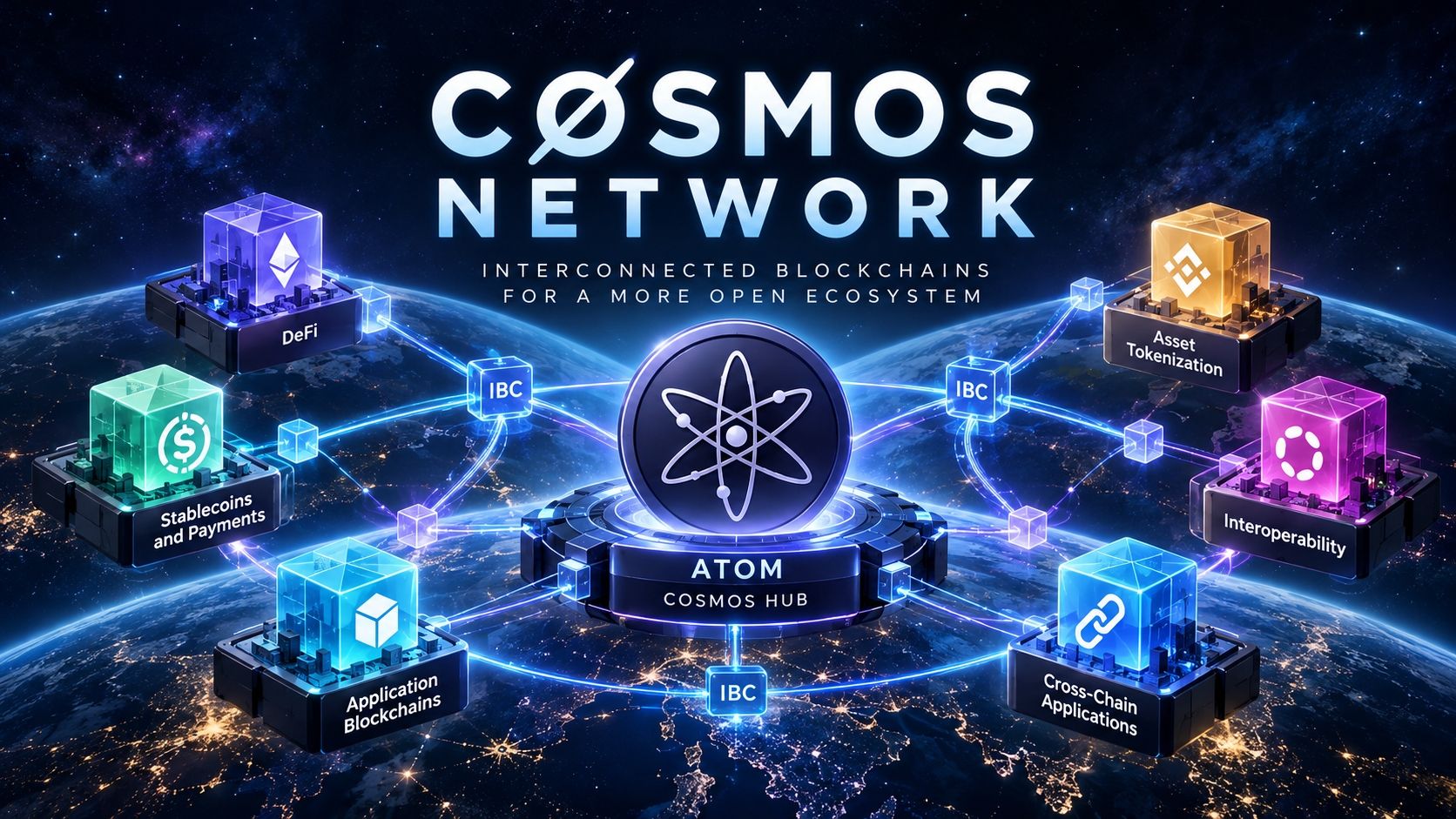
Cosmos Network combines modular blockchain development, consensus infrastructure and standardized communication protocols.
These components help developers build networks that can be customized for different activities.
Three technologies are particularly important: Cosmos SDK, CometBFT and IBC.
Cosmos SDK: Building Independent Blockchains
The Cosmos SDK is an open-source software development framework designed to simplify the creation of blockchain applications and networks.
Developers can use existing modules for essential functionality instead of creating every component from scratch.
These modules can handle operations such as:
- User accounts and transaction processing.
- Token transfers and asset management.
- Proof-of-Stake delegation and validator operations.
- Governance proposals and voting.
- Transaction fees and network parameters.
- Communication with compatible blockchains.
The modular structure allows developers to select, extend or replace functionality according to their requirements.
A blockchain designed for financial trading might prioritize transaction processing and liquidity-related features.
A payments-focused network might instead concentrate on predictable fees, settlement reliability and operational controls.
However, customization creates responsibilities. Every independent blockchain must consider its security arrangements, software maintenance, validator incentives and economic sustainability.
CometBFT: Consensus and Transaction Finality
CometBFT is a consensus engine associated with the Cosmos technology stack and historically derived from Tendermint Core.
It helps distributed validators agree on the state of a blockchain.
Its Byzantine fault-tolerant approach is designed to maintain consensus under defined assumptions, even when some participants are unavailable or behave incorrectly.
One important characteristic is transaction finality.
Once a transaction is finalized under the consensus protocol, it does not depend on the same probabilistic confirmation process used by certain Proof-of-Work networks.
This can be particularly valuable for applications where rapid settlement certainty is important.
Nevertheless, consensus technology is only one component of blockchain security. Software vulnerabilities, validator concentration, governance weaknesses and operational failures can still create risks.
IBC: Connecting Different Blockchains
The Inter-Blockchain Communication protocol, or IBC, is one of the defining technologies associated with Cosmos.
IBC establishes standards for communicating between compatible blockchain systems.
It can support asset transfers and the exchange of information across networks, depending on the applications and implementations involved.
This communication is particularly useful when blockchains need to remain independent while interacting with other systems.
It is also central to understanding why Cosmos is often described as an ecosystem of interconnected blockchains rather than a single execution platform.
IBC Explained: How Blockchain Interoperability Works
IBC allows compatible blockchains to exchange authenticated messages through standardized communication mechanisms.
Its architecture can involve light clients, cryptographic proofs, communication channels and relayers that transmit messages between networks.
The objective is to reduce dependence on trusted intermediaries where the participating blockchain systems support the necessary verification mechanisms.
How Does an IBC Token Transfer Work?
Consider an investor who holds a supported digital asset on one blockchain but wants to use it within a decentralized application on another.
An IBC-compatible transfer mechanism can coordinate the relevant asset movement and representation across the networks.
The exact transaction process depends on the transfer implementation.
Users must still consider the original asset, its representation on the destination chain and the security assumptions of both networks.
A token transferred between chains may not automatically have identical liquidity, redemption arrangements or operational risks everywhere.
Is IBC Safer Than a Traditional Crypto Bridge?
IBC and cryptocurrency bridges address related problems, but their security architectures can differ substantially.
Some bridges rely on multisignature arrangements, external validators, custodians or smart contracts.
IBC provides standardized mechanisms through which compatible chains can verify information and communicate.
This architecture may reduce certain intermediary risks, but it does not eliminate the possibility of software vulnerabilities, implementation errors or compromised components.
Security must therefore be evaluated at the level of each actual deployment.
What Is IBC Eureka?
IBC Eureka represents an effort to broaden interoperability beyond the original Cosmos-focused environment.
The underlying ambition is to make communication between different blockchain architectures more accessible, including integrations involving ecosystems with different technical structures.
Broader interoperability could become increasingly valuable as the number of blockchain networks grows.
Yet one distinction is essential: greater use of IBC does not automatically mean greater demand for the ATOM token.
Whether additional activity benefits ATOM depends on the economic services and mechanisms connected to Cosmos Hub.
Cosmos Hub and the ATOM Token: Understanding the Difference
Cosmos Hub is a sovereign Proof-of-Stake blockchain operating within the broader Cosmos ecosystem.
ATOM is its native cryptocurrency.
The Hub maintains its own validator network, governance system and economic parameters.
It does not control every blockchain built with Cosmos SDK, nor does it automatically collect fees from every network using Cosmos technologies.
What Is the ATOM Token Used For?
The ATOM token serves several functions within Cosmos Hub.
- Network security: ATOM is used in the Hub’s Proof-of-Stake consensus system.
- Staking: token holders can delegate ATOM to validators.
- Governance: staked ATOM can provide voting power in governance, including through delegation arrangements.
- Transaction fees: ATOM can be used for network operations.
- Economic incentives: token emissions and transaction-related mechanisms help compensate network participants.
These functions establish ATOM as an important asset within Cosmos Hub.
However, they do not necessarily create a direct link between ATOM’s market value and the adoption of every Cosmos-based application.
Why Doesn’t Every Cosmos Blockchain Need ATOM?
Cosmos supports sovereign blockchains.
Developers can establish their own networks with independent token economies and validator arrangements.
Such networks may adopt Cosmos SDK or IBC without using ATOM as their primary cryptocurrency.
This freedom is one of the ecosystem’s defining advantages.
At the same time, it raises a major question for investors: how can ATOM capture value from technologies that other blockchains can use independently?
The ongoing economic redesign of Cosmos Hub is partly intended to address this challenge.
The Cosmos Investment Paradox
Cosmos technologies can support successful blockchains, decentralized exchanges and institutional services without requiring those networks to generate direct revenue for ATOM holders.
For ATOM to benefit sustainably from ecosystem growth, Cosmos Hub must establish meaningful economic connections between adoption, network services and token demand.
Exploring the Cosmos Ecosystem and Its Applications
The Cosmos ecosystem includes projects focused on financial services, decentralized exchanges, payments, infrastructure and specialized blockchain applications.
These networks demonstrate how customizable blockchain architecture can support different business models.
Some projects have changed their technical infrastructure or economic arrangements over time, so ecosystem membership should not be treated as a permanent or uniform classification.
Osmosis: Decentralized Trading and Liquidity
Osmosis is historically one of the most recognizable decentralized finance projects associated with Cosmos technologies.
Its development has focused on digital asset exchanges, liquidity infrastructure and mechanisms designed for cross-chain financial activity.
Osmosis illustrates how a specialized blockchain can build applications around particular requirements rather than relying entirely on a general-purpose environment.
The relationship between Osmosis and Cosmos Hub has also been the subject of community discussions and strategic proposals.
Any potential integration should be evaluated through actual governance decisions, deployment plans and economic outcomes rather than assumptions about future mergers.
Injective: Blockchain Infrastructure for Financial Applications
Injective is another important example of infrastructure developed using elements of the Cosmos technology stack.
It focuses on financial applications, including trading-related infrastructure and tokenized asset use cases.
Its presence in the broader Cosmos environment illustrates the appeal of customizable blockchain networks for specialized financial operations.
However, Injective has its own token economics and governance arrangements.
Its adoption should not automatically be counted as a source of direct financial demand for ATOM.
dYdX and Application-Specific Infrastructure
The development of dedicated blockchain infrastructure for decentralized trading has also demonstrated the potential advantages of application-specific architecture.
Trading applications may require predictable performance, specialized matching systems, low latency or tailored fee mechanisms.
Such requirements help explain why some developers prefer a sovereign blockchain over deploying every component on a general-purpose smart contract platform.
Nevertheless, maintaining independent infrastructure involves costs and operational responsibilities that must be justified by actual user demand.
Stablecoins and Payment Networks
Stablecoins are another important part of the interoperability discussion.
Businesses and users increasingly require mechanisms for transferring dollar-denominated digital assets between different networks.
Cosmos technologies can help facilitate these interactions where compatible infrastructure exists.
The migration of USDC liquidity between Cosmos-related networks during 2026 also illustrates that blockchain interoperability is a practical operational challenge, not merely a theoretical benefit.
Asset availability, issuer support, network security and liquidity arrangements all influence the user experience.
Why Cosmos Network Matters for Decentralized Finance
Decentralized finance requires infrastructure capable of supporting transactions, liquidity, collateral management and communication between applications.
Cosmos provides technologies that can help developers design systems for these purposes.
Its particular advantage is flexibility.
Custom Blockchains for Financial Applications
Different financial services have different technical requirements.
A decentralized exchange may require specialized transaction processing.
A payments network may prioritize reliability, low transaction costs and compliance-related functionality.
An institutional asset platform may need access controls, auditability and integration with existing financial systems.
Cosmos-based infrastructure can be adapted to these requirements.
But customization should not be confused with guaranteed commercial success. A network still needs users, security, liquidity and a sustainable operating model.
Cross-Chain Liquidity and Capital Efficiency
Liquidity fragmentation is a recurring problem in decentralized finance.
When the same economic asset exists across several networks, available liquidity may be divided among multiple pools, applications and trading venues.
Interoperability can help applications coordinate access to assets across different environments.
However, cross-chain activity may also introduce additional execution costs, security assumptions and operational complexity.
The economic benefits depend on whether improved connectivity reduces these costs sufficiently.
For further analysis of decentralized financial infrastructure and market developments, readers can explore the latest DeFi news and market analysis on Mediasnet.
ATOM Staking: Rewards, Validators and Risks
ATOM staking allows token holders to participate in the economic security of Cosmos Hub by delegating their tokens to network validators.
Validators help process transactions and maintain the network’s consensus system.
Delegators can receive a share of staking rewards, subject to network parameters and validator commissions.
How Does ATOM Staking Work?
A typical staking process involves selecting a compatible wallet, transferring native ATOM to the appropriate network and choosing a validator.
After delegation, the tokens contribute to the validator’s effective staking weight.
Rewards are determined by the economic rules of the network and the performance and commission structure of the selected validator.
Investors should examine several factors before delegating:
- Validator reliability and operational history.
- Commission levels and potential changes.
- Governance participation.
- Concentration of voting power.
- Slashing exposure.
- Token liquidity requirements.
Delegating to a validator does not eliminate the risks associated with cryptocurrency ownership.
How Much Can ATOM Staking Earn?
Staking rewards vary according to the protocol’s monetary parameters, the percentage of tokens staked and validator commissions.
A high advertised annual percentage rate should not be interpreted as a guaranteed investment return.
Consider a purely hypothetical example.
If an investor holds 1,000 ATOM and receives a nominal annual reward equivalent to 10%, that would represent approximately 100 additional ATOM before applicable deductions and changes in compounding.
But the investment’s value in dollars could still decline if the ATOM market price falls.
Inflation also matters. When new tokens are issued, staking rewards may partly compensate for supply dilution rather than create an equivalent increase in economic purchasing power.
What Is the ATOM Unbonding Period?
The Cosmos Hub has historically used a 21-day unbonding period for native staking.
During this period, tokens being undelegated are generally unavailable for immediate transfer or sale.
Investors should verify the current rules before staking or withdrawing, since governance decisions can modify network parameters.
This liquidity restriction matters during periods of high market volatility.
Can Staked ATOM Be Lost?
Staking carries several types of risk.
Validator misbehavior can lead to slashing penalties under the rules of the protocol.
Operational problems may interrupt rewards, while wallet security failures can threaten the investor’s assets.
There is also market risk: staking rewards do not prevent token prices from declining.
For these reasons, selecting a reliable validator and understanding withdrawal restrictions are essential parts of an informed staking strategy.
ATOM Tokenomics: Inflation, Supply and Economic Sustainability
Tokenomics describes the economic design of a cryptocurrency, including its issuance, distribution, incentives and sources of demand.
ATOM’s monetary structure has become a central part of the debate surrounding Cosmos Hub.
Unlike Bitcoin, ATOM does not have an equivalent fixed maximum supply of 21 million tokens.
Its supply can increase through issuance determined by network parameters.
Why Does ATOM Have Inflation?
Inflationary issuance has historically been used to support Proof-of-Stake security by rewarding validators and delegators.
These incentives encourage token holders to participate in securing the blockchain.
But issuing new tokens also increases supply.
If demand fails to grow sufficiently, additional supply can create economic pressure.
The balance between network security, rewards and dilution is therefore particularly important.
Does Higher Inflation Always Mean a Lower ATOM Price?
No. Cryptocurrency prices depend on supply and demand, market expectations, liquidity and broader economic conditions.
A token with positive inflation can appreciate if demand grows faster than supply.
Likewise, reducing inflation does not guarantee price appreciation.
The economic question is whether issuance produces benefits that justify its cost.
For Cosmos Hub, these benefits primarily involve security and participant incentives.
What Did the Gauntlet Tokenomics Research Find?
In 2026, Cosmos Labs worked with quantitative research firm Gauntlet to examine ATOM’s economic structure.
The first phase analyzed holder behavior, staking economics and token selling patterns.
The research identified a more complicated picture than the simple argument that inflation alone explains ATOM’s market performance.
Staking demand appeared relatively persistent, while selling behavior was concentrated among particular groups of holders and market participants.
These findings suggested that token issuance, reward distribution and investor behavior needed to be evaluated together.
The subsequent research phase examined potential changes to issuance mechanisms and staking incentives.
Why Is Cosmos Hub Considering an Economic Redesign?
The Hub’s October 2026 updates identified three broad issues.
First, the network may be paying more for economic security through token issuance than is strictly necessary.
Second, liquid staking rewards can create recurring selling incentives.
Third, Cosmos Hub needs mechanisms capable of receiving and distributing revenue generated by future products and services.
The proposed direction is to explore more efficient security spending and stronger connections between actual network revenue and staking economics.
However, as of October 13, 2026, these ideas remain under review.
Specific mechanisms, parameters and implementation schedules should not be treated as finalized governance decisions.
Why the ATOM Economic Redesign Matters
Reducing inflation could improve certain supply dynamics, but it would not necessarily solve the broader value-capture problem.
The more important objective is to create a sustainable relationship between Cosmos Hub’s economic activity, security costs and token-holder incentives.
A stronger token economy requires more than fewer new tokens: it needs meaningful demand and productive network activity.
The End of the Historical Interchain Security Model
Cosmos Hub previously pursued Interchain Security, a mechanism designed to allow other blockchains to benefit from its validator security infrastructure.
The idea was economically attractive in principle.
New blockchains could potentially reduce the difficulty of establishing their own validator network, while Cosmos Hub might earn compensation for providing shared security services.
Why Did the Model Face Difficulties?
The historical implementation encountered economic and operational challenges.
Supporting additional networks imposed costs and responsibilities on validators, while the revenue generated did not develop as originally expected.
In 2026, the Hub moved toward retiring this historical model.
This strategic change is important because it demonstrates a broader lesson in blockchain economics.
Technical feasibility is not the same as commercial viability.
Even sophisticated infrastructure must generate enough demand and economic value to justify its operating costs.
What Does This Mean for ATOM?
Ending an unsuccessful economic model can create room for alternative strategies.
But it does not automatically produce better token economics.
The Hub must demonstrate that new services can attract paying users or institutions and provide measurable economic benefits.
For investors, this makes revenue generation and execution quality increasingly important indicators.
Cosmos Network vs Ethereum, Polkadot and Avalanche
Several blockchain ecosystems are competing to support decentralized applications, institutional infrastructure and communication between networks.
Cosmos occupies a distinctive position because of its focus on sovereignty and modular construction.
| Network | Primary approach | Key trade-off |
|---|---|---|
| Cosmos | Sovereign blockchains and interoperability | Independent security and fragmented token economics |
| Ethereum | Smart contracts and Layer 2 scaling | Complex coordination between layers and liquidity environments |
| Polkadot | Coordinated multichain infrastructure | Resource allocation and shared infrastructure economics |
| Avalanche | Customizable blockchain environments | Adoption, interoperability and network security arrangements |
Cosmos vs Ethereum: Which Architecture Is More Flexible?
Ethereum provides a mature smart contract ecosystem supported by an extensive developer community and numerous scaling technologies.
Cosmos offers a different model in which projects can develop independent blockchains with customized operating rules.
Neither architecture is universally superior.
Ethereum may benefit applications that prioritize compatibility with established liquidity and tooling.
Cosmos can appeal to projects requiring greater control over blockchain execution, governance or economic parameters.
Interoperability technologies may increasingly connect both approaches rather than making them mutually exclusive.
Cosmos vs Polkadot: Sovereignty and Shared Infrastructure
Cosmos and Polkadot have historically approached multichain infrastructure from different directions.
Cosmos emphasizes the ability to build sovereign networks and communicate through standardized protocols.
Polkadot has developed coordinated infrastructure and shared security concepts.
Both ecosystems continue to evolve, making older comparisons based entirely on original architectural models potentially misleading.
The practical considerations include developer adoption, security economics, liquidity, technical compatibility and operating costs.
Can Cosmos Compete With Ethereum Layer 2 Networks?
Ethereum Layer 2 ecosystems have expanded the range of options available to blockchain application developers.
These networks can benefit from Ethereum-related infrastructure and ecosystems while reducing certain execution costs.
Cosmos-based blockchains offer an alternative in which sovereignty and specialization play a central role.
Competition will likely depend increasingly on user experience, connectivity, regulatory requirements and economic sustainability rather than transaction throughput alone.
The Future of Cosmos Network: Major Growth Opportunities
The future of Cosmos Network is closely linked to the broader evolution of blockchain infrastructure.
If financial activity increasingly takes place across multiple networks, interoperability may become more important.
However, the scale of that opportunity depends on actual adoption and the competitive position of Cosmos technologies.
Real-World Asset Tokenization
Tokenization allows financial or other assets to be represented through digital tokens and associated legal arrangements.
Potential applications include investment funds, bonds, deposits, private credit and other financial instruments.
Different institutions may require distinct operating environments, compliance controls and settlement systems.
Customized blockchains and interoperability protocols could support these needs.
In October 2026, Cosmos Hub outlined a long-term vision involving connections between traditional finance and on-chain financial services.
Potential product concepts include arrangements that combine exposure to assets or yields originating from multiple blockchains.
These concepts remain subject to commercial validation, technical development and, where relevant, regulatory requirements.
Institutional Blockchain Infrastructure
Financial institutions may be interested in blockchain infrastructure for settlement, asset issuance and transaction coordination.
Cosmos technologies could be relevant because of their modular architecture and interoperability capabilities.
Nevertheless, institutional adoption requires much more than technical functionality.
Compliance, custody, governance, privacy, reliability and integration with existing systems are all significant considerations.
Commercial adoption also depends on whether blockchain solutions provide measurable improvements over established infrastructure.
Stablecoin Payments and Cross-Chain Transfers
Stablecoins are increasingly used to represent value and transfer funds across blockchain networks.
As multiple ecosystems support stablecoins, services that simplify communication and asset transfers may become valuable.
Cosmos infrastructure could participate in this development, particularly through interoperability standards.
Yet users still need to evaluate the issuer, asset backing, supported networks and transfer mechanisms.
Interoperability Beyond Crypto-Native Applications
Cross-chain communication may also be relevant to systems that are not primarily designed for cryptocurrency trading.
Potential applications include business-to-business settlement, data exchange, digital identity and coordination between specialized ledgers.
Whether these activities develop into sustainable markets for Cosmos technology will depend on actual demand and practical advantages over alternative solutions.
Can the Cosmos Hub Capture More Value From Ecosystem Growth?
This is arguably the most important strategic question surrounding Cosmos.
The ecosystem’s open architecture makes its technologies available to a broad range of developers.
But openness also means that technology adoption alone does not ensure a corresponding increase in economic activity on Cosmos Hub.
Potential Sources of Network Revenue
Several categories of services could, in principle, support the Hub’s economic development.
- Asset issuance and related financial infrastructure.
- Cross-chain coordination and settlement services.
- Specialized services for institutions.
- Infrastructure supporting liquidity and asset management.
- Commercial products developed around interoperability technology.
These opportunities should be distinguished from revenues that have already been demonstrated.
Commercial agreements, transaction activity and actual fee generation are more reliable indicators than roadmap announcements alone.
How Could Revenue Benefit ATOM?
Potential mechanisms might involve the use of network revenue to support security incentives, staking rewards or other approved economic purposes.
However, each mechanism involves trade-offs.
Revenue-sharing arrangements must be designed to avoid creating unsustainable incentives or weakening network security.
Any significant change also requires appropriate technical implementation and governance approval.
The economic effects cannot be assumed before specific proposals are adopted and operating data becomes available.
ATOM Price Potential: Three Long-Term Scenarios
Predicting the future price of ATOM with precision is not possible.
Its market value depends on cryptocurrency market conditions, token supply, liquidity, investor expectations and the economic performance of Cosmos Hub.
Rather than presenting unsupported price targets, three scenarios provide a more useful analytical framework.
Bullish Scenario: Economic Adoption and Improved Tokenomics
In a favorable scenario, Cosmos technologies gain wider adoption across financial infrastructure and interoperable blockchain services.
Cosmos Hub successfully develops revenue-generating products and introduces economically sustainable token incentives.
Network activity creates greater demand for services connected to ATOM, while issuance policies become better aligned with actual security requirements.
Under these conditions, the token’s economic fundamentals could improve.
However, even stronger fundamentals would not guarantee a particular market price.
Neutral Scenario: Strong Technology, Limited Value Capture
In a middle scenario, the Cosmos technology stack remains important and continues attracting developers.
Independent blockchains grow, but Cosmos Hub captures only a limited share of their economic activity.
ATOM retains its security and governance functions, while its market valuation remains heavily influenced by cryptocurrency market cycles.
This scenario demonstrates why technological adoption and token investment performance must be evaluated separately.
Bearish Scenario: Competition and Weak Economic Results
In an unfavorable scenario, competing platforms attract more developer activity and liquidity.
Cosmos Hub fails to establish commercially successful services, while token issuance and limited demand create unfavorable economic conditions.
Governance conflicts or operational difficulties could increase uncertainty.
The token might then experience prolonged weakness even if parts of the Cosmos technology ecosystem remain in use.
What Metrics Should Investors Monitor?
Evaluating Cosmos Network and the ATOM token requires more than examining short-term price movements.
A combination of economic and technical indicators can offer a clearer perspective.
Network Revenue and Fee Generation
Revenue generated by actual users and services is particularly important when assessing the Hub’s economic transition.
Investors should distinguish transaction fees and commercial revenues from inflation-funded rewards.
A network that issues tokens to compensate participants is not necessarily producing an equivalent amount of external economic revenue.
ATOM Supply and Issuance
Changes in the rate of token creation affect the evolution of supply.
Any economic assessment should include both issuance policies and the demand incentives associated with staking.
Staking Participation and Validator Concentration
Staking participation provides information about the security structure and economic behavior of token holders.
Validator concentration also matters.
A broadly distributed validator network may offer different resilience characteristics from one dominated by a small number of operators.
IBC Activity and Ecosystem Usage
Interoperability activity can help measure how widely compatible networks are communicating.
However, these metrics should be interpreted carefully.
Higher message counts or transfer volumes do not necessarily translate into profitable network services or increased ATOM demand.
Governance Decisions and Roadmap Execution
Governance proposals reveal the economic and technical priorities of Cosmos Hub.
For long-term investors, actual implementation is often more informative than preliminary announcements.
Progress should be measured through deployed software, operating services, user activity and transparent financial results.
What Are the Main Risks of Cosmos Network and ATOM?
Cosmos has important technical strengths, but its open ecosystem and independent network model create several risks.
Economic Value-Capture Risk
The expansion of Cosmos-based blockchains may not produce equivalent demand for ATOM.
This is a structural challenge, not merely a temporary market issue.
Inflation and Token Supply Risk
ATOM’s issuance model can increase circulating supply over time.
Although staking helps compensate participants, it does not eliminate dilution concerns or market risk.
Governance Risk
Protocol decisions can significantly alter monetary policy, validator incentives and the allocation of community resources.
Governance systems can also face coordination problems and security vulnerabilities.
Technical and Security Risk
Smart contract vulnerabilities, protocol bugs, compromised infrastructure and configuration failures can affect blockchain networks.
In September 2026, the wider Cosmos Hub ecosystem dealt with the consequences of a Neutron governance exploit and associated recovery discussions.
These events highlight the importance of security monitoring and incident-response procedures.
They should not be interpreted as evidence that every Cosmos-based blockchain shares the same security weaknesses.
Liquidity and Market Risk
ATOM is exposed to the volatility typical of digital assets.
Market declines, reduced liquidity and changes in investor sentiment can substantially affect its price.
Staking restrictions may also complicate an investor’s ability to respond immediately to market conditions.
Is Cosmos Network a Good Long-Term Investment?
Cosmos Network offers a compelling technological proposition for developers and organizations interested in blockchain sovereignty and interoperability.
But evaluating ATOM as an investment requires a separate analysis.
Investors should determine whether the Cosmos Hub can turn technological relevance into sustained economic activity.
Several questions are especially important:
- Are new products generating verifiable revenue?
- Does the network’s economic activity support demand for ATOM?
- Are staking incentives sustainable?
- Can token issuance be aligned with security needs?
- Does governance support disciplined execution?
- Can the Hub differentiate itself from competing infrastructure?
Clear answers to these questions would provide a stronger foundation for assessing ATOM than speculative price forecasts.
Investors should also consider portfolio diversification, investment horizon, personal risk tolerance and the possibility of significant losses.
Frequently Asked Questions About Cosmos Network
What is Cosmos Network?
Cosmos Network is an ecosystem of technologies for building independent blockchains and enabling interoperability. Its core components include Cosmos SDK, CometBFT and the IBC protocol.
What is the ATOM token?
ATOM is the native cryptocurrency of Cosmos Hub. It is used for Proof-of-Stake security, delegation, governance and certain network fees.
Is Cosmos Network the same as Cosmos Hub?
No. Cosmos Network describes the broader technology ecosystem, while Cosmos Hub is a specific blockchain within it. ATOM is native to Cosmos Hub.
Do all Cosmos blockchains use ATOM?
No. Blockchains built using Cosmos SDK can operate with their own tokens, validators and economic rules without requiring ATOM.
What is IBC in Cosmos?
IBC is a communication protocol that enables compatible blockchain systems to exchange authenticated messages and support cross-chain applications, including asset transfers.
What is Cosmos SDK used for?
Cosmos SDK helps developers create customizable blockchain applications and networks using modular software components.
Can investors stake ATOM?
Yes. ATOM holders can delegate their tokens to Cosmos Hub validators and receive variable staking rewards, subject to network rules and risks.
Does ATOM have a maximum supply?
ATOM does not have a fixed maximum supply equivalent to Bitcoin’s 21-million-coin limit. Its issuance is governed by Cosmos Hub’s monetary parameters.
Does Cosmos Network compete with Ethereum?
Cosmos and Ethereum offer different infrastructure approaches. Cosmos emphasizes independent customizable blockchains, while Ethereum supports a large smart contract and Layer 2 ecosystem.
What is the biggest economic challenge for ATOM?
The central challenge is value capture: adoption of Cosmos technologies does not automatically create revenue or demand for the ATOM token.
What is the future of Cosmos Network?
Its prospects depend on developer adoption, interoperability demand, institutional applications and the economic performance of Cosmos Hub. The proposed ATOM tokenomics redesign is another important factor.
Can Cosmos benefit from real-world asset tokenization?
Potentially. Cosmos technologies can support customized financial networks and interoperability, but actual benefits for ATOM depend on commercially successful services and their economic connection to Cosmos Hub.
Final Analysis: Can Cosmos Network Build a Sustainable Future?
Cosmos Network occupies an important position in blockchain infrastructure because of its contributions to modular development and interoperability.
Its architecture provides developers with flexibility, while technologies such as IBC can help reduce fragmentation between compatible blockchain environments.
These strengths are meaningful, particularly as decentralized finance, stablecoins and tokenized financial assets continue to evolve.
Yet the central economic question remains unresolved.
Cosmos can succeed as a technology ecosystem without guaranteeing the financial success of the ATOM token.
The strategic work taking place in 2026 suggests that Cosmos Hub is increasingly focused on this distinction.
Its proposed economic changes seek to improve the relationship between network security, token issuance, staking behavior and revenue generation.
At the same time, the Hub’s longer-term ambitions involve connecting traditional financial activities with on-chain infrastructure.
Whether these initiatives succeed will depend on technical execution, real users, commercial viability and governance decisions.
For investors, the most constructive approach is to monitor measurable economic progress rather than relying exclusively on ecosystem announcements or optimistic price predictions.
Our conclusion: Cosmos Network has established a significant technological foundation. Its long-term relevance will depend on continued adoption, while ATOM’s investment potential will depend much more directly on whether Cosmos Hub can develop a sustainable economic model that connects real activity with token utility.
Explore More Blockchain and DeFi Analysis
Understanding interoperability is only one part of evaluating the blockchain market. Follow protocol developments, emerging applications and the wider financial implications of decentralized infrastructure.

Sources and Further Reading
For readers who want to examine the underlying technology and economic decisions, the following primary sources provide useful documentation:
- Cosmos — Official Website: ecosystem and infrastructure overview.
- Cosmos Documentation: technical architecture and software documentation.
Disclaimer: This article is intended for educational and informational purposes only. It does not constitute personalized financial advice or a recommendation to purchase or sell any cryptocurrency. Digital assets are volatile and involve a substantial risk of capital loss. Staking returns and network rules may change.


Trader, investor and author specializing in cryptocurrencies, DeFi and Web3.
On Mediasnet, I share my market analysis, practical guides and research on crypto markets, decentralized protocols and emerging trends across the ecosystem.
Follow me on: Facebook – X (Twitter)