
SatoshiDEX overview: SatoshiDEX is a decentralized exchange project developed within the Bitcoin ecosystem through the Stacks blockchain. Its ambition is to combine decentralized token trading, automated liquidity pools and Bitcoin-connected security infrastructure.
Unlike conventional cryptocurrency exchanges, which rely on centralized intermediaries, SatoshiDEX aims to make digital asset trading accessible through smart contracts and decentralized liquidity mechanisms.
However, the emergence of Bitcoin decentralized finance does not automatically guarantee the commercial success of every protocol operating in this sector. Liquidity, security, adoption and token sustainability remain essential considerations.
This updated SatoshiDEX overview examines how the project works, its relationship with Bitcoin and Stacks, the SATX token, its tokenomics, the project’s development ambitions and the principal risks facing investors and decentralized traders.
Quick answer: SatoshiDEX is a Bitcoin-oriented decentralized exchange built around the Stacks ecosystem. Its native token, SATX, has a stated maximum supply of 10 billion tokens. The project targets decentralized swaps, liquidity provision and DeFi services, but its limited market liquidity means that adoption and execution risks remain significant.
What Is SatoshiDEX?
SatoshiDEX is a decentralized exchange (DEX) designed to support cryptocurrency trading within the Bitcoin-connected Stacks ecosystem.
The project emerged from the broader movement to expand Bitcoin beyond its traditional roles as a store of value and peer-to-peer payment network.
Bitcoin has considerable strengths, including its established consensus mechanism, extensive mining infrastructure and transparent monetary policy. However, its base layer was not designed to execute the same variety of complex financial applications commonly associated with Ethereum.
Stacks addresses part of this limitation by providing an environment for smart contracts, decentralized applications and tokenized assets that settles its history to Bitcoin.
SatoshiDEX aims to use this infrastructure to introduce Bitcoin decentralized exchange services inspired by automated market maker platforms such as Uniswap.
The Main Objective of SatoshiDEX
The central concept of this Bitcoin decentralized exchange is straightforward: enable users to exchange supported digital assets through a decentralized protocol without requiring traditional exchange custody.
Its proposed ecosystem includes several complementary activities:
- Decentralized cryptocurrency swaps.
- Automated liquidity pools.
- Liquidity incentives for eligible participants.
- Token-related governance mechanisms.
- Potential access to additional Bitcoin DeFi applications.
These features represent the project’s stated design and ambitions. Their actual availability, usage and technical implementation must be verified separately.
Why Bitcoin Needs Decentralized Exchanges
Bitcoin remains one of the most important assets in the cryptocurrency market, yet much decentralized trading activity has historically taken place on other blockchains.
When Bitcoin holders wanted to access DeFi, they often needed to use centralized platforms or wrapped representations of BTC on external networks.
Bitcoin-oriented decentralized exchanges aim to reduce this fragmentation by introducing trading opportunities within ecosystems more closely connected to Bitcoin.
For additional background, read our guide explaining what decentralized finance is and how DeFi works.
How SatoshiDEX Connects to Bitcoin and the Stacks Blockchain
The technical foundation of the SatoshiDEX overview is the relationship between Bitcoin, Stacks and decentralized exchange applications.
The Stacks blockchain provides an execution layer for smart contracts and decentralized applications, while Bitcoin serves as the settlement and finality anchor for the Stacks network.
What Is the Stacks Blockchain?
Stacks is a Bitcoin layer-2 network designed to enable smart contracts and decentralized applications while connecting their settlement security to Bitcoin.
Its architecture relies on several components:
- STX: the native cryptocurrency used within the Stacks network.
- Proof of Transfer (PoX): a consensus mechanism connecting Stacks block production to Bitcoin.
- Clarity: a smart contract programming language designed for predictable execution.
- Bitcoin finality: an anchoring mechanism connecting confirmed Stacks history to Bitcoin.
- sBTC: a Bitcoin-backed asset designed to make BTC usable in Stacks-based applications.
The distinction between Stacks and Bitcoin is important. Application transactions execute on Stacks rather than being individually executed as ordinary Bitcoin transactions.
Proof of Transfer: Connecting Two Blockchain Networks
Proof of Transfer allows Stacks miners to commit BTC as part of the process used to compete for block production rights.
Under this model, Bitcoin becomes an economic component of the Stacks consensus process.
STX holders can also participate through a mechanism known as stacking, which involves locking eligible STX balances to help support network consensus and potentially receive BTC rewards.
However, PoX does not automatically eliminate vulnerabilities in decentralized applications deployed on Stacks.
Smart contracts, liquidity pools, user interfaces and cross-chain systems introduce additional security considerations beyond the underlying blockchain.
The Nakamoto Upgrade and Bitcoin Finality
The Nakamoto upgrade, activated in October 2024, represented a major development for the Stacks ecosystem.
It introduced faster block production and significantly strengthened the relationship between Stacks transaction finality and Bitcoin.
Before this upgrade, the production of Stacks blocks was more directly constrained by Bitcoin’s block intervals.
Under the upgraded architecture, Stacks can produce blocks more rapidly while periodically anchoring its confirmed chain history to Bitcoin.
This improves the technical environment available to decentralized applications, including Bitcoin decentralized exchange protocols.
Nevertheless, Bitcoin finality does not mean that every operation performed by a DEX is individually stored on the Bitcoin blockchain.
It also does not guarantee that the DEX itself is free from programming errors or economic exploits.
The Role of sBTC in Bitcoin DeFi
Another important development is sBTC, a tokenized representation of Bitcoin within the Stacks ecosystem.
sBTC is designed to maintain a one-to-one backing relationship with BTC, allowing Bitcoin exposure to interact with Stacks smart contracts.
This infrastructure is relevant to decentralized exchanges because it creates opportunities to use Bitcoin-linked liquidity in applications such as trading, lending and collateralized financial services.
However, sBTC is not identical to native BTC held directly on Bitcoin.
Its operation depends on the integrity of its peg, signer infrastructure, smart contracts and withdrawal mechanisms.
Important distinction: Stacks and sBTC provide infrastructure that may support Bitcoin DeFi applications. Their existence does not establish that every feature described in SatoshiDEX’s roadmap has been implemented or that native BTC can be traded directly without additional mechanisms.
SatoshiDEX Features and Trading Mechanisms
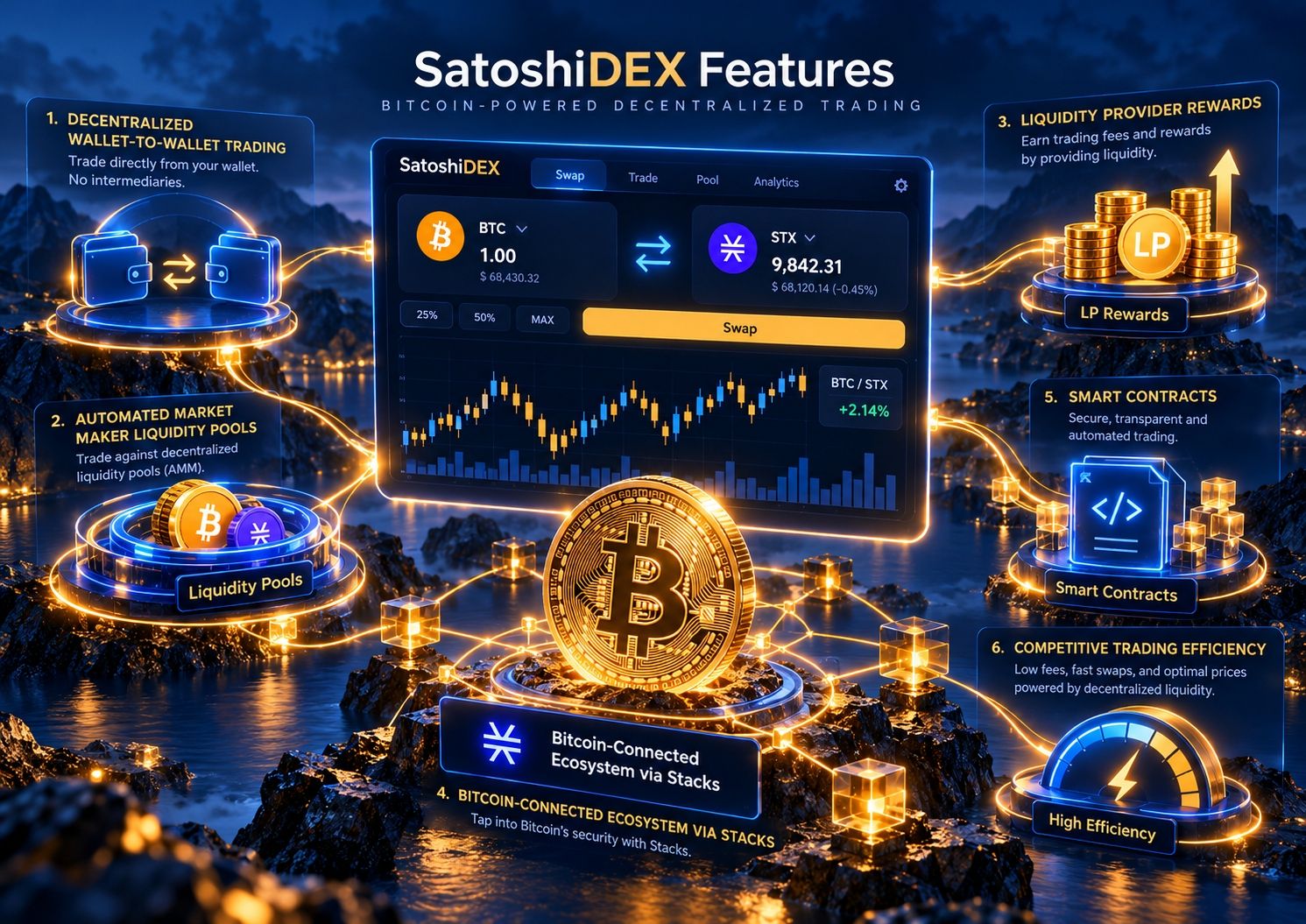
The SatoshiDEX project draws inspiration from established decentralized trading protocols while attempting to adapt their functionality to the Bitcoin-connected environment.
1. Decentralized Cryptocurrency Swaps
One of the intended functions of SatoshiDEX is to allow users to exchange supported tokens without depositing their assets into a conventional centralized exchange account.
On an operational DEX, users typically connect a compatible wallet, choose a trading pair and approve a transaction through a smart contract.
Assets are then exchanged according to the liquidity available in the relevant pool and the protocol’s pricing rules.
For SatoshiDEX, users must verify the currently supported assets, contracts and functioning exchange interface before attempting a trade.
2. Automated Market Maker Technology
Automated market makers, commonly called AMMs, allow decentralized exchanges to operate without relying exclusively on traditional order books.
Instead of matching every buyer with a seller, AMMs use liquidity pools and mathematical pricing mechanisms.
The project documentation describes SatoshiDEX as being inspired by this model.
In a typical AMM, prices adjust according to the relative quantities of assets held in the liquidity pool.
For example, buying an asset reduces the quantity available in its pool. Depending on the pricing formula, this can push the asset’s quoted price higher.
The exact impact depends on the size of the trade and available liquidity.
3. Liquidity Provision
Liquidity providers contribute assets to decentralized trading pools to facilitate exchanges.
In return, they may receive a share of trading fees or additional token incentives, depending on the protocol.
SatoshiDEX documentation identifies liquidity incentives as one of the intended utilities of its SATX token.
However, depositing assets into a liquidity pool introduces risks that are absent from simply holding cryptocurrencies in a private wallet.
These include smart contract exploits, impermanent loss, price volatility and the possibility of insufficient liquidity when withdrawing positions.
4. Token Governance
The project proposes that SATX holders participate in governance decisions concerning the platform.
Governance mechanisms can potentially allow token holders to influence parameters such as liquidity incentives, development priorities or protocol upgrades.
However, the existence of governance rights in token documentation should not be confused with evidence that a fully operational decentralized autonomous organization is already functioning.
The actual voting contracts, governance procedures and implementation history should be independently examined.
5. Transaction Costs and Accessibility
Operating on Stacks may provide opportunities for more efficient smart contract transactions than attempting similar application logic directly on Bitcoin’s base layer.
Nevertheless, transaction costs are not determined by the network architecture alone.
The total cost of a decentralized swap can include:
- Blockchain transaction fees.
- Protocol trading fees.
- Liquidity provider fees.
- Slippage resulting from the trade’s market impact.
- Additional bridging costs when applicable.
For smaller DEX platforms, slippage can represent a substantially greater cost than network fees.
Technical Architecture and Security of SatoshiDEX
The proposed architecture of SatoshiDEX combines smart contracts, decentralized exchange mechanisms and the Stacks blockchain.
Understanding the different components helps distinguish the security benefits of Bitcoin-connected settlement from the security of the exchange application itself.
Smart Contracts and the Clarity Programming Language
Stacks uses Clarity, a programming language designed specifically for smart contract execution.
Clarity differs from Solidity, the language widely used for Ethereum smart contracts.
Its design emphasizes transparency and predictability, allowing developers and auditors to reason about contract behavior.
Nevertheless, smart contracts written in Clarity can still contain vulnerabilities or economic design flaws.
Users should therefore look for publicly available contract addresses, reproducible source code and independent security audits.
Exchange Infrastructure
A decentralized exchange generally includes several interdependent components.
| Component | Main Function | Potential Risk |
|---|---|---|
| Trading interface | Allows users to interact with exchange contracts | Website compromise or malicious transaction requests |
| Smart contracts | Execute swaps and manage protocol rules | Programming vulnerabilities |
| Liquidity pools | Provide assets for decentralized trading | Insufficient liquidity and impermanent loss |
| Stacks blockchain | Executes and confirms application transactions | Network congestion or operational disruptions |
| Bitcoin settlement | Anchors Stacks transaction history | Does not eliminate application-level vulnerabilities |
| Cross-chain mechanisms | Enable movement between blockchain environments where supported | Bridge, peg and signer risks |
Does Bitcoin Security Make SatoshiDEX Risk-Free?
No. Bitcoin’s consensus security and decentralized application security are two separate issues.
Bitcoin settlement strengthens the finality properties of Stacks, but cannot prevent every possible smart contract failure.
Similarly, it does not guarantee that a decentralized exchange will have sufficient market liquidity, a sustainable business model or reliable governance.
Users should avoid treating references to Bitcoin security as a substitute for a complete protocol risk assessment.
SATX Token: Utility and Ecosystem Role
The SATX token is associated with the SatoshiDEX ecosystem and its proposed economic model.
According to official project documentation, SATX is intended to support governance, liquidity incentives, staking rewards and potential trading fee advantages.
SATX has also been distributed and traded as a BEP-20 token on BNB Smart Chain.
This distinction matters because the platform’s intended Stacks-based trading infrastructure and the token’s BNB Smart Chain deployment are not the same thing.
SATX Token Utilities
Governance Participation
SATX holders may be entitled to participate in governance decisions if the relevant mechanisms are implemented and operational.
Liquidity Incentives
The project allocates part of its SATX token supply to incentives intended to encourage liquidity provision and activity within its ecosystem.
Potential Trading Fee Advantages
Official documentation describes possible transaction fee benefits for SATX holders.
Any effective discount schedule should be verified against the live platform’s current conditions.
Staking Incentives
Part of the token supply is earmarked for staking-related rewards.
These incentives should not be confused with native STX stacking rewards secured through the Stacks consensus mechanism.
Access to Ecosystem Services
Additional benefits may include preferential access to future trading features or liquidity pools.
Such benefits remain dependent on actual product development and implementation.
Is SATX the Same as STX?
No. SATX and STX represent different assets with different functions.
| Characteristic | SATX | STX |
|---|---|---|
| Project | SatoshiDEX | Stacks blockchain |
| Primary Role | Project utility and incentives | Native network asset |
| Network Association | Includes BNB Smart Chain token deployment | Stacks |
| Consensus Role | Not the native Stacks consensus asset | Used in Stacks stacking and network operations |
| Investment Exposure | Specific project risk | Broader Stacks ecosystem risk |
The future performance of SATX should therefore not be assumed to follow the adoption of STX or Bitcoin.
SATX Tokenomics: Supply, Distribution and Incentives
Tokenomics is one of the most important elements of this updated SatoshiDEX overview.
The official documentation establishes a total supply of 10 billion SATX tokens.
It also describes a distribution model involving presale participants, liquidity incentives, the development team, the ecosystem fund and staking rewards.
Official SATX Token Distribution
| Allocation | Percentage | SATX Tokens | Purpose |
|---|---|---|---|
| Presale | 30% | 3,000,000,000 | Initial token distribution |
| Liquidity Provision | 5% | 500,000,000 | Trading liquidity |
| Team and Advisors | 15% | 1,500,000,000 | Development and contributors |
| Ecosystem Fund | 25% | 2,500,000,000 | Partnerships and ecosystem initiatives |
| Staking | 25% | 2,500,000,000 | Staking-related incentives |
| Total | 100% | 10,000,000,000 | Maximum stated supply |
Source: SatoshiDEX official tokenomics documentation. These figures describe the project’s published allocation model, not independently verified current wallet balances.
SATX Vesting Schedule
The official SATX tokenomics documentation also specifies release conditions for several allocations.
- Presale: 35% unlocked at the token generation event, with the remaining 65% scheduled for linear release over three months.
- Liquidity provision: 40% unlocked at the token generation event, followed by a three-month cliff and release of the remaining 60% over nine months.
- Team and advisors: allocation scheduled for release over 24 months through quarterly vesting.
- Ecosystem fund: no formal vesting period specified in the published model.
- Staking: allocation intended for gradual distribution over 12 months.
These schedules reflect the published model. Actual token movements, unlock execution and current circulating balances require independent on-chain verification.
Why Token Distribution Matters
Token supply alone does not determine the market value of a cryptocurrency.
Investors should also examine circulating supply, trading depth, holder concentration and potential selling pressure.
For SATX, the relatively large ecosystem and staking allocations make it particularly important to understand how tokens are controlled and whether distribution mechanisms remain active.
A project may publish an attractive maximum supply model while still experiencing significant volatility because of insufficient liquidity or concentrated token ownership.
SatoshiDEX Market Status and Liquidity in 2026
The commercial position of SatoshiDEX deserves particular attention.
While the project’s official documentation describes an ambitious decentralized trading ecosystem, available market indicators suggest a platform operating on a much smaller scale than established decentralized exchanges.
What Does DeFiLlama Show?
DeFiLlama identifies SatoshiDEX as an automated market maker protocol operating within the Stacks ecosystem.
Its available protocol data in October 2026 indicates total value locked of only several thousand US dollars.
This is extremely limited compared with major decentralized exchanges, which may hold hundreds of millions or billions of dollars in liquidity.
TVL measures the value of assets deposited in protocol smart contracts. It is not the same as trading volume, revenue or token market capitalization.
Nevertheless, a very low TVL provides an important indication of the project’s current scale.
SATX Trading Liquidity
Market information for SATX also requires caution.
Data published by CoinPaprika in October 2026 showed very low trading activity for SATX on available decentralized exchange markets.
On October 23, reported daily trading volume was approximately $90, with limited observable market depth.
Such figures are snapshots and can change rapidly. However, they underline the importance of verifying liquidity before entering or exiting a position.
Liquidity warning: Low-volume tokens can experience significant price changes even when relatively small orders are executed. Displayed market prices may not represent the price at which a substantial holding can actually be sold.
Why Slippage Can Be More Important Than Trading Fees
Consider a hypothetical token pool with limited liquidity.
A trader wishing to buy or sell several thousand dollars of tokens may cause a large change in the pool’s exchange rate.
Even when the protocol charges low transaction fees, the final execution price can differ significantly from the initial quotation.
Before trading SATX, investors should examine the available liquidity for the exact trading pair rather than relying exclusively on displayed token prices or market capitalization estimates.
SatoshiDEX Roadmap and Development Progress
SatoshiDEX’s published roadmap covers project formation, token distribution, infrastructure development, decentralized trading services and ecosystem expansion.
However, project roadmaps should always be distinguished from independently verified product delivery.
Early Development and Token Launch
The project traces its initial formation to late 2023.
Its early development period focused on establishing the team, defining tokenomics and building an initial community.
During 2024, SATX distribution and token-related development became important elements of the project’s activity.
Development of Exchange Infrastructure
Subsequent roadmap phases described the development of exchange contracts, liquidity mechanisms, test environments and a public trading interface.
The official website has also presented plans for mainnet deployment, liquidity mining and broader ecosystem integration.
2025–2026: Expansion Objectives
The project’s published objectives for 2025 and 2026 included:
- Improving the DEX user experience.
- Expanding supported trading functionality.
- Introducing additional DeFi integrations.
- Developing advanced trading tools.
- Encouraging community governance.
- Increasing ecosystem adoption and liquidity.
However, the available documentation contains differences between some roadmap timelines.
As a result, roadmap milestones should not be treated as proof of completion without corresponding evidence from working applications, contract deployments or verifiable on-chain activity.
What Should Investors Monitor?
For SatoshiDEX to demonstrate sustainable development, several indicators would be particularly valuable:
- Consistent transaction activity on Stacks.
- Increasing liquidity and trading depth.
- Transparent and independently audited smart contracts.
- Regular product development announcements supported by technical evidence.
- Growing numbers of active users.
- Clear implementation of SATX token utilities.
These indicators offer a more reliable basis for evaluating progress than roadmap announcements alone.
SatoshiDEX vs Other Bitcoin Decentralized Exchanges
SatoshiDEX operates in a competitive environment that includes other protocols seeking to provide decentralized trading services connected to Bitcoin.
Within the Stacks ecosystem, projects such as ALEX, Bitflow and Velar have also explored decentralized liquidity, swaps and Bitcoin-related financial applications.
Comparison of Bitcoin DeFi Trading Protocols
| Protocol | Main Focus | Ecosystem | Key Evaluation Criterion |
|---|---|---|---|
| SatoshiDEX | AMM-based decentralized exchange | Stacks / Bitcoin ecosystem | Limited liquidity and execution of roadmap |
| ALEX | Decentralized trading and Bitcoin DeFi infrastructure | Stacks | Security, liquidity and protocol activity |
| Bitflow | Decentralized asset swaps and liquidity routing | Stacks | Available markets and swap efficiency |
| Velar | Decentralized trading and Bitcoin DeFi applications | Stacks | Product availability and liquidity depth |
These platforms may offer different trading mechanisms, asset selections and risk profiles.
In practice, the most important distinction for traders is not necessarily which project promotes the most ambitious vision.
It is whether a protocol provides sufficient liquidity, transparent security practices and reliable transaction execution.
Can SatoshiDEX Compete With Larger DEX Platforms?
Competing with established decentralized exchanges requires more than deploying smart contracts.
Successful DEX ecosystems typically benefit from strong network effects.
Liquidity attracts traders, while trading activity can generate fees that encourage additional liquidity providers to participate.
For smaller platforms, establishing this cycle is particularly challenging.
SatoshiDEX would need to demonstrate sustained adoption and competitive execution quality to secure a meaningful position in the wider Bitcoin DeFi market.
Potential Advantages of SatoshiDEX
Despite its current limitations, the SatoshiDEX concept addresses several areas of potential interest within decentralized finance.
Exposure to Bitcoin DeFi Development
The continued development of Stacks, sBTC and Bitcoin-focused smart contract infrastructure could create new opportunities for decentralized financial applications.
A functioning Bitcoin decentralized exchange operating within this environment could benefit from increased interest in Bitcoin-based trading services.
Non-Custodial Trading Model
When implemented correctly, decentralized exchange mechanisms allow users to retain control of their private keys and authorize transactions through their own wallets.
This reduces reliance on conventional centralized exchange custody, although it does not eliminate the risks of interacting with smart contracts.
Community Incentives
Token incentives may help attract early liquidity providers and encourage participation during the development of a decentralized exchange.
The long-term effectiveness of these incentives depends on whether trading activity can eventually support the platform without excessive dependence on token emissions.
Potential Ecosystem Integration
Interoperability with Stacks applications and Bitcoin-backed assets could expand the usefulness of decentralized trading services.
However, future integration opportunities should be assessed according to verified deployments rather than assumed partnerships.
SatoshiDEX Risks and Challenges
Every decentralized finance project involves risks, but smaller protocols can face additional financial and operational challenges.
For SatoshiDEX, several considerations are particularly important.
1. Very Limited Liquidity
The relatively small amount of value locked in SatoshiDEX indicates limited protocol scale.
Low liquidity can produce wide execution spreads, price manipulation opportunities and difficulties exiting positions.
2. SATX Token Volatility
Small-cap and thinly traded digital assets can experience substantial price movements.
A token may record large percentage increases or decreases even when the absolute value of transactions remains modest.
3. Smart Contract Security
Smart contract vulnerabilities remain a central risk for decentralized exchanges.
Users should seek independently verifiable audit reports and examine whether audit findings have been addressed.
An audit is a useful risk-control measure but does not provide a guarantee against future exploits.
4. Development and Execution Risk
Roadmap commitments may be delayed, modified or discontinued.
Investors should consider whether the platform has a sustainable development process, adequate technical resources and a sufficiently active user community.
5. Token Unlocks and Concentration
The official tokenomics allocate significant amounts of SATX to the ecosystem fund, staking incentives and team-related allocations.
Future selling pressure may depend on actual balances, vesting execution and the behavior of large holders.
6. Cross-Chain and Bridge Risk
If assets move between Bitcoin, Stacks and BNB Smart Chain, users may encounter additional risks associated with token representations, transfers and bridge infrastructure.
Not every token carrying the same name or symbol necessarily represents the same verified asset.
7. Competitive Pressure
Other Bitcoin DeFi protocols may attract more liquidity, partnerships and users.
Even a technically functional decentralized exchange can struggle if traders prefer platforms with better liquidity and execution.
Investor risk assessment: SatoshiDEX should be regarded as a high-risk, speculative DeFi project. Its technical ambitions do not offset the practical risks associated with limited liquidity, uncertain adoption and potential smart contract vulnerabilities.
Future Outlook: Can SatoshiDEX Become a Relevant Bitcoin DEX?
The future of SatoshiDEX depends on two distinct developments: the expansion of Bitcoin decentralized finance and the project’s own ability to attract sustained usage.
The first factor is external.
Bitcoin-oriented smart contract infrastructure has improved considerably following the Nakamoto upgrade and the introduction of sBTC.
These developments provide a stronger technical foundation for applications that seek to integrate Bitcoin exposure into decentralized financial services.
The second factor is project-specific.
SatoshiDEX must demonstrate that it can translate its technology and roadmap into actual trading activity, reliable infrastructure and a sustainable liquidity model.
Bullish Scenario: Growing Adoption
In a favorable scenario, the wider Stacks ecosystem attracts more developers, capital and active users.
SatoshiDEX successfully deploys competitive trading services, obtains meaningful liquidity and develops practical SATX token utilities.
Under these conditions, the protocol could become more relevant within the Bitcoin DeFi sector.
However, this outcome would require measurable adoption rather than simply benefiting from broader interest in Bitcoin.
Neutral Scenario: Limited Niche Activity
The platform may remain operational without achieving significant market share.
Trading activity could remain concentrated among a small community, while SATX liquidity remains relatively limited.
In this case, the project might continue to exist without becoming a major decentralized exchange.
Bearish Scenario: Declining Liquidity and Participation
In an unfavorable scenario, development activity slows, token incentives become less effective and users migrate toward more established platforms.
Thin liquidity could amplify SATX volatility and make market exits increasingly difficult.
The project could ultimately become inactive even if the broader Bitcoin DeFi ecosystem continues expanding.
The Most Important Indicator to Watch
For SatoshiDEX, an increase in sustained trading liquidity and real protocol usage would be more significant than short-lived SATX price movements.
Higher token prices without deeper markets or genuine application adoption would not necessarily indicate an improvement in the project’s long-term prospects.
How to Evaluate SatoshiDEX Before Trading or Investing
Before interacting with SatoshiDEX or purchasing SATX, users should perform several basic checks.
Verify the Official Platform
Begin with the project’s official website and documentation.
Confirm that any trading application or wallet connection originates from a legitimate source.
Fake cryptocurrency interfaces frequently imitate legitimate protocols to obtain malicious wallet approvals.
Check the Correct Token Contract
SATX has been traded on BNB Smart Chain as a BEP-20 token.
Verify the complete contract address using trusted blockchain explorers and official project references.
Do not rely solely on a token’s name, ticker or logo.
Examine Pool Liquidity
Check the liquidity available for the exact token pair before submitting an order.
Review the estimated price impact, trading fees and minimum amount receivable.
For illiquid tokens, these figures may be considerably more important than the displayed market price.
Review Smart Contract Documentation
Look for publicly accessible contract code, independent audits and clear explanations of any privileged administrative functions.
Pay particular attention to upgrade permissions, treasury control and the ability to change contract parameters.
Distinguish Price Performance From Project Adoption
A temporary increase in SATX trading activity does not automatically demonstrate growing use of the SatoshiDEX platform.
Protocol TVL, unique active users, sustainable trading volume and development activity provide complementary indicators.
Use Conservative Wallet Permissions
Avoid granting unlimited token spending approvals unnecessarily.
When experimenting with unfamiliar applications, consider using a separate wallet containing only a small amount of funds.
Never disclose seed phrases or private keys to websites, support accounts or supposed administrators.
FAQ: Frequently Asked Questions About SatoshiDEX
What is SatoshiDEX?
SatoshiDEX is a decentralized exchange project associated with the Stacks blockchain and the wider Bitcoin DeFi ecosystem. It aims to support cryptocurrency swaps, automated liquidity pools and token-based incentives.
Is SatoshiDEX built directly on Bitcoin?
No. SatoshiDEX is designed around Stacks, a blockchain layer connected to Bitcoin through Proof of Transfer and Bitcoin-anchored settlement. Its application transactions are not individually executed on Bitcoin’s base layer.
What is the SATX token?
SATX is the ecosystem token associated with SatoshiDEX. Its published utilities include governance, liquidity incentives, potential trading fee advantages and staking-related rewards.
How many SATX tokens exist?
The official SatoshiDEX tokenomics specify a total supply of 10 billion SATX tokens. The circulating supply may differ from the total supply and should be checked through current market and on-chain data.
Is SATX the native token of Stacks?
No. The native cryptocurrency of Stacks is STX. SATX is a separate project token and has also been traded as a BEP-20 asset on BNB Smart Chain.
Can users trade native Bitcoin on SatoshiDEX?
Bitcoin-connected DeFi applications may use infrastructure such as sBTC to represent BTC within Stacks smart contracts. However, users should verify the exact assets and trading pairs supported by the current SatoshiDEX application. Direct native BTC trading should not be assumed.
Does SatoshiDEX offer staking rewards?
The SATX token’s published tokenomics include an allocation for staking incentives. The current availability, reward rates and withdrawal conditions of any staking product must be independently verified.
Is SatoshiDEX secure because it uses Bitcoin?
Bitcoin-anchored finality can strengthen the security properties of Stacks transactions, but it does not eliminate vulnerabilities in decentralized exchange smart contracts, liquidity pools, websites or cross-chain mechanisms.
Why is SATX considered a high-risk token?
SATX has exhibited very limited trading liquidity. Low market depth can produce extreme volatility, substantial slippage and difficulties buying or selling larger positions.
Can SatoshiDEX become a major decentralized exchange?
It is possible in principle, but not established by current market data. Significant improvements in liquidity, active users, transaction volume and verified product development would be required to support that outcome.
Conclusion: SatoshiDEX Overview and Long-Term Potential
This updated SatoshiDEX overview highlights a project positioned at the intersection of Bitcoin, the Stacks blockchain and decentralized trading.
The underlying concept is relevant. As Bitcoin-oriented smart contract infrastructure develops, decentralized exchanges may play an increasingly important role in enabling BTC-related liquidity, token trading and financial applications.
The Nakamoto upgrade and sBTC have strengthened the broader technical foundations of the Stacks ecosystem, potentially expanding the opportunities available to projects such as SatoshiDEX.
However, the future of the Bitcoin DeFi sector and the future of SatoshiDEX are not necessarily the same.
SatoshiDEX must still demonstrate sustained adoption, substantial liquidity, reliable smart contract infrastructure and clear economic benefits for its users.
The SATX token represents a particularly speculative exposure because market liquidity remains limited and the project’s long-term competitive position is uncertain.
For traders and investors, the most prudent approach is to distinguish technological potential from verified commercial performance.
Our assessment: SatoshiDEX is worth monitoring as a smaller participant in Bitcoin decentralized finance, but current information does not justify presenting it as an established market leader. Future evaluation should prioritize transparent development, trading liquidity and measurable protocol adoption.
Explore the Official SatoshiDEX Website
Visit the project’s official website to consult its documentation, development announcements and available ecosystem services.
Always verify the official application address and token contracts before connecting a cryptocurrency wallet.
Follow the Evolution of Decentralized Finance
Explore the latest developments in decentralized exchanges, Bitcoin DeFi, blockchain infrastructure and emerging protocols through our regularly updated DeFi News and decentralized finance coverage.
Our market analyses focus on protocol fundamentals, liquidity, technological developments and the risks associated with decentralized financial applications.
Sources and Further Reading
- SatoshiDEX – Official SATX Tokenomics
- Stacks Documentation – Bitcoin Finality
- DeFiLlama – SatoshiDEX Protocol Data
Research update: October 25, 2026. Protocol descriptions and token allocations are based on published documentation. Market indicators are time-sensitive and should be independently verified before making financial decisions.
Disclaimer
This article is provided for educational and informational purposes only and does not constitute financial or investment advice. Cryptocurrencies, decentralized exchanges and emerging DeFi tokens involve significant risks, including capital loss, smart contract vulnerabilities, illiquidity and market manipulation. Readers should conduct independent research and consider their financial situation and risk tolerance before interacting with any cryptocurrency protocol.


Trader, investor and author specializing in cryptocurrencies, DeFi and Web3.
On Mediasnet, I share my market analysis, practical guides and research on crypto markets, decentralized protocols and emerging trends across the ecosystem.
Follow me on: Facebook – X (Twitter)