
 The VeChain ecosystem is one of the most distinctive projects in the blockchain industry. While many cryptocurrency networks primarily focus on decentralized finance, speculative trading or digital payments, VeChain has spent years developing infrastructure intended to connect blockchain technology with real-world economic activity.Originally recognized for supply chain tracking, product authentication and enterprise blockchain solutions, VeChain has gradually expanded into a broader ecosystem involving sustainability applications, digital wallets, staking, decentralized governance, tokenized assets and artificial intelligence.
At the center of this infrastructure is the VeChainThor blockchain, a Layer 1 network designed to support smart contracts and verifiable transactions. Its native cryptocurrency, VET, works alongside VTHO, the token used to pay transaction fees. Additional tokens, including B3TR and VOT3, support the VeBetter application and governance ecosystem.
However, the project has entered a particularly important phase. The Galactica and Hayabusa upgrades reshaped VeChainThor’s architecture and economic incentives, while the Interstellar roadmap aims to improve compatibility with Ethereum and support more sophisticated applications.
The development of AgentSuite also introduces another ambition: positioning VeChain as infrastructure for autonomous AI agents that need verifiable identities, trusted information and blockchain-based transactions.
These developments raise several important questions. What is VeChain, and how does its ecosystem actually work? Which VeChain use cases are generating meaningful activity? Can VeChainThor compete with larger blockchain networks? And does growing adoption necessarily translate into greater demand for the VET token?
This comprehensive analysis examines the technology, applications, tokenomics, competitive positioning and long-term prospects of VeChain, while distinguishing measurable progress from expectations that still need to be demonstrated.
VeChain ecosystem: key facts
Blockchain: VeChainThor, an independent Layer 1 network.
Native token: VET, used for network security, staking and economic participation.
Transaction token: VTHO, used to pay blockchain transaction fees.
Main applications: VeBetter, VeWorld, StarGate and enterprise blockchain solutions.
Technology: Smart contracts, delegated fee payments, multi-clause transactions and Delegated Proof of Stake.
Major development areas: Supply chain traceability, sustainability, tokenization, digital product passports, DeFi and AI agents.
Central challenge: Turning ecosystem adoption into sustainable network activity and meaningful economic demand.
What Is VeChain and How Does It Work?
VeChain is a blockchain platform designed to make information, transactions and real-world activities easier to verify through distributed ledger technology. It allows businesses and applications to record data on a shared infrastructure where the history of transactions can be independently examined.
The VeChain project originated in 2015, and its independent VeChainThor blockchain launched in 2018. Its early development focused on enterprise requirements, particularly supply chain management, product authentication and the tracking of physical goods.
Imagine a manufacturer producing luxury goods for distribution across several continents. A product may pass through suppliers, warehouses, transportation providers, customs facilities and retailers before reaching its final customer.
Each participant maintains its own records. Connecting these records reliably can become complicated, particularly when businesses use different software systems.
Blockchain technology offers a potential solution by recording selected information in a shared, tamper-evident environment. Authorized participants can verify when information was registered and whether the corresponding records have subsequently changed.
However, the blockchain does not automatically establish whether the original information was accurate. A false declaration can remain false even when permanently recorded on-chain.
This distinction is essential when evaluating real-world VeChain use cases. The value comes from combining reliable data collection, appropriate verification procedures and a transparent record of the resulting information.
From enterprise blockchain to a broader ecosystem
VeChain’s original positioning was relatively specialized. It focused on providing blockchain infrastructure for established businesses rather than creating a general-purpose ecosystem centered on cryptocurrency speculation.
Over time, its ambitions expanded.
The VeChain ecosystem now includes consumer applications that reward verified activities, tools for developers, staking infrastructure, decentralized governance mechanisms and applications exploring the tokenization of physical assets.
Its latest strategy also considers artificial intelligence as a possible source of blockchain demand.
This evolution matters because enterprise adoption alone can be difficult to scale quickly. Commercial implementations require negotiations, integration with existing systems and long-term contractual commitments.
Consumer applications potentially offer another route to network activity, although their economic sustainability must be evaluated separately from their ability to attract users.
What makes VeChain different from other cryptocurrencies?
The defining characteristic of VeChain is not simply its native VET token. It is the combination of blockchain infrastructure, a two-token economic model and applications intended to interact with real-world processes.
VeChainThor also supports features that can reduce friction for ordinary users. For example, applications may cover transaction fees on their behalf, allowing people to use blockchain-based services without understanding cryptocurrency gas payments.
For an enterprise deploying a product-tracking system, this approach may be considerably more practical than requiring every employee or customer to maintain a funded cryptocurrency wallet.
The main question is whether these advantages are significant enough to attract businesses and developers when competing networks and conventional databases remain available alternatives.
VeChainThor Blockchain: Technology and Architecture
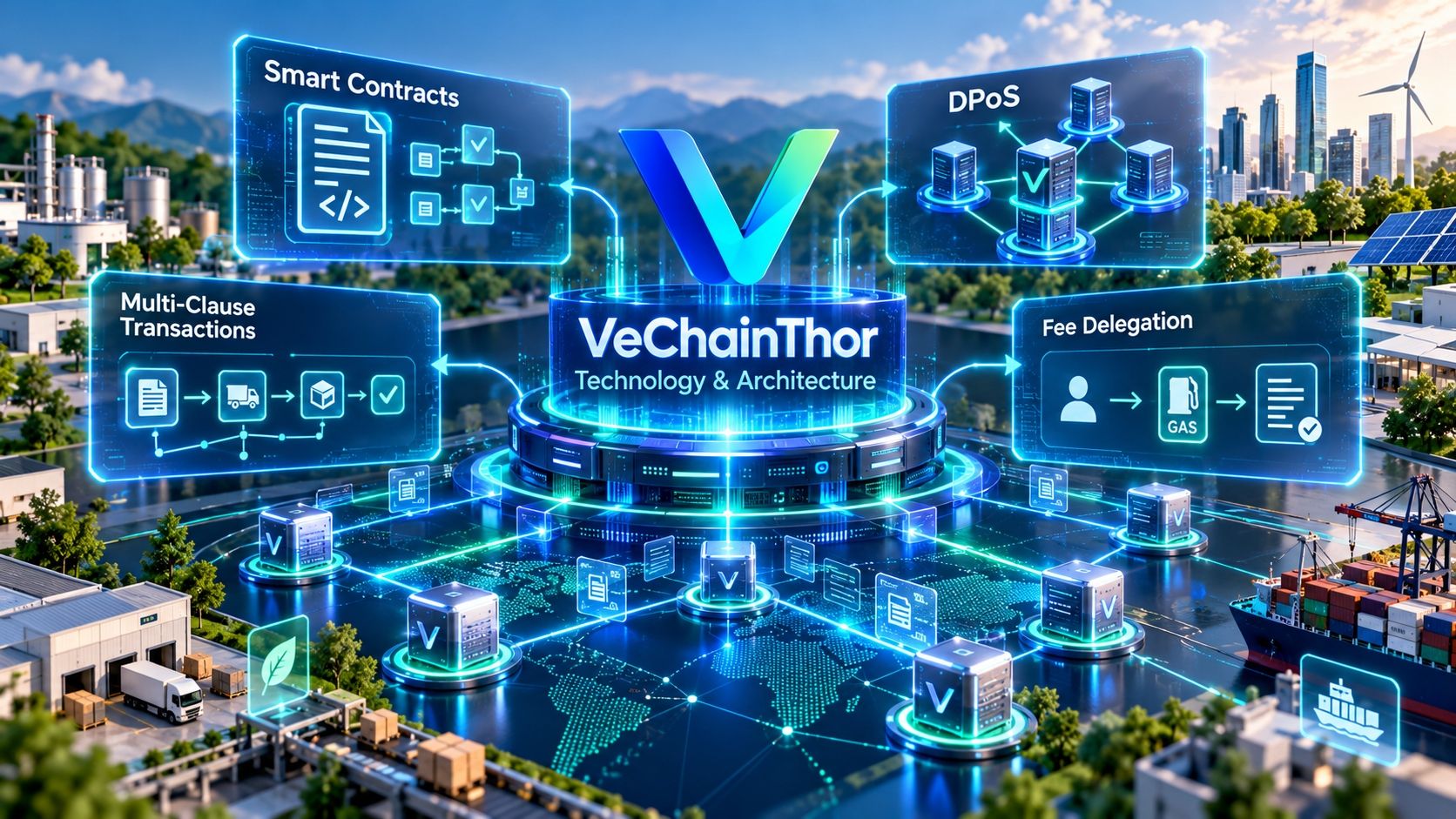
The VeChainThor blockchain is the technical foundation of the entire VeChain ecosystem. It provides transaction processing, smart contract execution, network validation and the infrastructure needed for decentralized applications.
As a Layer 1 blockchain, VeChainThor operates independently rather than relying on Ethereum or another network for its basic consensus and transaction processing.
Its architecture was originally developed with enterprise adoption in mind, placing particular emphasis on predictable transaction handling, flexible fee payment and applications that connect with existing business systems.
Smart contracts on VeChainThor
Smart contracts are programs deployed on a blockchain that automatically execute predetermined instructions.
They can be used to transfer tokens, distribute rewards, verify conditions or coordinate interactions between different participants.
On VeChainThor, a smart contract could support a manufacturer that needs to register delivery events, a consumer application distributing rewards or a digital service that verifies a transaction before granting access.
Developers can build applications using tools associated with the Ethereum Virtual Machine, although the degree of direct compatibility depends on the implementation and the protocol upgrades already deployed.
Improving this compatibility is one of the objectives of the Interstellar development phase.
Multi-clause transactions
One distinctive technical feature of VeChainThor is its support for transactions containing multiple clauses.
A clause represents an operation within a blockchain transaction. By combining several clauses, developers can coordinate different actions without necessarily submitting multiple independent transactions.
For example, a business application might need to update several records associated with a shipment or interact with multiple smart contracts as part of a single workflow.
This structure can simplify application logic and improve the handling of operations that need to be performed together.
It is particularly relevant for enterprise systems, where one commercial process may involve several related actions.
Fee delegation: users do not always need cryptocurrency
Another important feature is transaction fee delegation.
Normally, a user interacting directly with a blockchain must possess enough of the appropriate token to pay transaction fees.
VeChainThor provides mechanisms allowing a third party, such as an application operator, to cover these costs.
A consumer can therefore interact with a blockchain application without directly purchasing VTHO, provided that the application supports the necessary fee-delegation arrangement.
For businesses, this reduces the complexity of onboarding employees and customers. It can also make blockchain applications feel more like conventional software.
However, the transaction costs do not disappear. They are simply paid by another participant in the system.
From Proof of Authority to Delegated Proof of Stake
For much of its history, VeChainThor operated using a Proof of Authority consensus mechanism.
This approach relied on a limited network of identified validators. It offered certain operational benefits for enterprise applications but also raised legitimate questions regarding decentralization and validator accessibility.
The Hayabusa upgrade, activated in December 2025, introduced Delegated Proof of Stake (DPoS).
Under this model, VET holders can participate in the network’s economic security by staking their tokens and delegating their positions to validators.
The transition also changed how protocol rewards are generated and distributed.
Nevertheless, introducing DPoS does not automatically eliminate concentration risks. The actual level of decentralization depends on validator distribution, delegated stakes, governance arrangements and the influence of large token holders.
VeChain Renaissance: Galactica, Hayabusa and Interstellar
VeChain Renaissance is the broader modernization program intended to update VeChainThor’s technical architecture, consensus model and economic incentives.
| Upgrade | Main Changes | Ecosystem Significance |
|---|---|---|
| Galactica
July 2025 |
EVM modernization and dynamic transaction fees. | Improved developer compatibility and network fee management. |
| Hayabusa
December 2025 |
DPoS consensus and revised VTHO generation. | Expanded staking participation and a reworked token economy. |
| Interstellar
2026 roadmap |
Further EVM compatibility, interoperability, infrastructure and developer improvements. | Potential integration with a wider range of applications and Web3 tools. |
Interstellar is particularly relevant to the long-term development of the VeChain ecosystem.
In August 2026, VeChain presented VIP-255, an upgrade proposal intended to extend the network’s EVM capabilities through compatibility improvements associated with more recent Ethereum execution-layer developments.
The broader roadmap also includes improvements to developer tools, blockchain data indexing and interoperability.
These developments could reduce technical barriers for application developers. However, planned upgrades should not be treated as completed functionality until their deployment has been confirmed.
Transaction costs, performance and reliability
VeChainThor attempts to offer an infrastructure in which applications can predict and manage operational costs more efficiently.
The separation between VET and VTHO contributes to this design, although actual transaction costs still depend on network parameters and economic conditions.
For an enterprise, a low transaction fee is useful, but reliability may matter even more.
A factory recording thousands of production events needs predictable processing, available infrastructure and procedures for handling operational failures.
Similarly, applications involving financial settlement or automated transactions require appropriate security and transaction finality.
VeChain’s technical competitiveness should therefore be evaluated through more than theoretical transaction speed. Real throughput, processing reliability, smart contract functionality, developer accessibility and the cost of maintaining applications all matter.
VET, VTHO, B3TR and VOT3: VeChain Tokenomics Explained
The VeChain ecosystem uses several tokens with different economic functions. Understanding how they interact is essential for evaluating both the technology and the potential value of the VET cryptocurrency.
The most important distinction is between VET, the blockchain’s native token, and VTHO, which pays for transaction execution.
VeBetter also introduces B3TR and VOT3 for consumer rewards and governance.
| Token | Primary Function | Typical Use |
|---|---|---|
| VET | Native blockchain token. | Staking, network security, transfers and economic participation. |
| VTHO | Transaction and execution fees. | Paying for blockchain transactions and smart contracts. |
| B3TR | VeBetter rewards. | Incentives for eligible, verified real-world activities. |
| VOT3 | VeBetter governance. | Voting and participation in reward allocation mechanisms. |
VET: the native asset of VeChainThor
The VeChain VET token is the blockchain’s native digital asset. Its total supply is fixed at 86,712,634,466 VET.
VET serves several purposes within the network, including value transfers, staking participation and economic security.
Following Hayabusa, holders who want to receive protocol-generated VTHO rewards must participate through the relevant staking arrangements rather than relying on passive VET ownership.
This gives staking a more explicit role in the economic relationship between the network and its token holders.
Nevertheless, the price of VET depends on supply and demand in cryptocurrency markets. Its value is not mechanically determined by the number of transactions on VeChainThor.
VTHO: the fuel of the VeChainThor blockchain
VTHO is consumed when transactions and smart contract operations are executed.
Under the revised economic system introduced by VeChain Renaissance, VTHO generation is linked to VET committed through staking mechanisms.
Galactica introduced an EIP-1559-inspired fee structure in which the base transaction fee is burned and a priority tip can be paid to the validator.
This creates an economic relationship between transaction activity, VTHO issuance, token destruction and staking rewards.
However, increasing transaction volume does not necessarily mean that the overall supply of VTHO will decline.
That depends on the balance between newly issued VTHO and the amount burned through network usage.
How VET and VTHO interact
The distinction between the two tokens is central to VeChain’s economic design.
VET represents participation in the underlying network, while VTHO handles transaction execution costs.
If the VeChain ecosystem attracts more applications, transaction demand could increase VTHO consumption.
If this activity supports the economic value of staking rewards, holding and staking VET could become more attractive.
But several factors complicate the relationship: the price of VTHO, issuance rates, the share of VET staked, network fees and market expectations.
Therefore, greater adoption of VeChainThor does not automatically guarantee a higher VET price.
B3TR and VOT3: the VeBetter economy
B3TR and VOT3 operate within the VeBetter ecosystem.
B3TR provides incentives for activities recognized by participating applications, while VOT3 supports governance functions, including decisions involving ecosystem rewards.
The purpose is to create an economic environment in which verified actions can generate incentives and users can participate in the development of the platform.
This model is innovative, but the long-term sustainability of reward distribution depends on more than simply creating tokens.
Applications must offer enough independent value to keep users engaged even when financial incentives are reduced.
Understanding VeChain tokenomicsThe crucial question is not merely whether the VeChain ecosystem creates more transactions. It is whether those transactions generate sustainable economic demand that supports the network’s security and incentive mechanisms.
The interaction between VET staking, VTHO issuance, transaction-fee burning and the VeBetter rewards economy deserves close monitoring.
Inside the VeChain Ecosystem: Major Applications and Platforms
The VeChain ecosystem consists of several complementary products rather than one blockchain application.
VeChainThor provides the technical infrastructure, while VeBetter, VeWorld, StarGate and other tools help users, developers and businesses interact with that infrastructure.
Understanding each component reveals how VeChain intends to move beyond its original supply chain specialization.
VeBetter: rewarding real-world behavior
VeBetter is among VeChain’s most distinctive initiatives.
It is designed to encourage selected real-world behaviors through decentralized applications, verifiable activity records and token rewards.
Participating applications may focus on reducing waste, improving consumption habits, encouraging physical activity or supporting other sustainability-related objectives.
Examples include:
- Mugshot: an application associated with more sustainable beverage consumption and reducing disposable-cup waste.
- GreenCart: an application focused on food-related behavior and responsible consumption.
- BYB: an initiative linked to health, fitness and activity-based engagement.
- Evearn: an application rewarding eligible electric and hybrid vehicle activity.
Applications can record verified user actions and distribute B3TR rewards according to their specific rules and the broader VeBetter framework.
In its April 2026 roadmap, VeChain reported more than five million participants, over 50 live applications and tens of millions of verified sustainable actions.
These are meaningful reported ecosystem metrics, but they should not automatically be interpreted as equivalent to unique active users, paying customers or recurring commercial revenue.
Why user retention matters more than registrations
Reward-based applications can attract attention quickly.
However, incentives may also encourage users to perform actions primarily because they expect token rewards.
That creates a significant analytical challenge. If rewards decline, will users continue using the applications?
For VeBetter to develop a sustainable economy, its services need to deliver meaningful benefits beyond cryptocurrency distributions.
Monitoring user retention, recurring activity and the economic cost of rewards is therefore more informative than looking at cumulative registration figures alone.
VeWorld: the wallet connecting the ecosystem
VeWorld is VeChain’s principal wallet and application access point.
It allows users to manage compatible assets, connect to decentralized applications and interact with ecosystem services.
VeWorld is particularly important because mainstream users generally do not want to understand the technical complexity of blockchain networks before accessing a service.
Features such as more familiar onboarding methods and integrated application access can reduce barriers to participation.
VeChain’s roadmap also outlines ambitions involving token swaps, multiple blockchains, payments and tokenized assets.
The extent to which these capabilities become available and widely used will influence VeWorld’s role in the broader VeChain ecosystem.
StarGate: staking infrastructure
StarGate allows eligible VET holders to participate in the blockchain’s staking mechanisms.
It connects token holders with the network’s validator infrastructure and provides a system for managing staking positions.
Positions are represented through NFTs, which identify their characteristics and associated participation rights.
These NFTs have an operational purpose. They are not simply collectible digital images.
By connecting staking participation with VTHO rewards, StarGate creates another relationship between VET holders and network security.
Developer tools and blockchain infrastructure
The VeChain ecosystem also includes development tools, software libraries, APIs and services for integrating blockchain applications.
These technologies allow developers to create smart contracts, monitor transaction activity and connect applications to VeChainThor.
Improved EVM compatibility is strategically important because Ethereum already possesses a large developer ecosystem.
Reducing the differences between the platforms could make VeChainThor more accessible to developers familiar with established Ethereum tools.
However, compatibility alone is unlikely to generate major adoption. Developers also need users, infrastructure providers, liquidity and economically attractive opportunities.
Why the different components matter together
VeBetter generates application activity. VeWorld simplifies access to services. StarGate encourages staking participation. VeChainThor records transactions and provides the underlying execution environment.
In theory, these components reinforce one another.
More useful applications could attract more users. More users could generate additional transactions. Transaction activity could support VTHO demand, while staking provides incentives to help secure the network.
The essential challenge is to establish whether this relationship becomes self-sustaining rather than dependent on continuous incentives and promotional activity.
VeChain Use Cases: Real-World Adoption Beyond Cryptocurrency
One of the most important arguments supporting the VeChain ecosystem is its history of practical blockchain applications.
VeChain has long emphasized projects involving physical products, commercial data and processes that require information to be verified across organizations.
These use cases are worth examining because blockchain adoption should ultimately be measured by the services it provides rather than the popularity of the underlying cryptocurrency.
Supply chain tracking and product authentication
Supply chain traceability remains a fundamental VeChain use case.
A manufacturer may need to track goods through production, storage, shipment and distribution.
Selected events can be linked to a shared digital record, helping participants verify information about the product’s history.
For luxury goods, the application may involve authentication and provenance. For food supply chains, it may involve origin information, handling conditions and relevant certifications.
For industrial equipment, it could support maintenance records or documentation concerning the product’s lifecycle.
None of these processes necessarily requires every piece of information to be stored directly on-chain.
Instead, a blockchain may record identifiers, hashes or attestations linked to information maintained in other systems.
This approach can provide verifiability while limiting unnecessary data exposure and storage costs.
Enterprise partnerships and the limits of announcements
VeChain’s history includes initiatives involving well-known organizations such as Walmart China, DNV and PwC.
These relationships helped establish the project’s enterprise-oriented identity.
However, analysts must distinguish between historical partnerships, experimental programs and commercial systems that remain active.
A major company participating in a pilot project does not automatically imply continuing large-scale network usage or recurring revenue.
For an objective assessment of VeChain use cases, commercial activity should be supported by measurable evidence wherever possible.
Digital Product Passports and European manufacturing
Digital Product Passports, commonly called DPPs, represent an increasingly relevant field for blockchain infrastructure.
A digital product passport can make information concerning a product’s origin, composition, environmental characteristics, repairability and lifecycle more accessible.
The European Union’s Ecodesign for Sustainable Products Regulation establishes a framework under which digital product information requirements will be introduced progressively for applicable product categories.
Businesses therefore have growing reasons to develop systems for organizing, verifying and sharing product data.
VeChain has been working with Rekord and the University of Sheffield’s Advanced Manufacturing Research Centre on infrastructure intended to support industrial product records.
In February 2026, VeChain reported that this initiative had already processed more than 300,000 digital-product-passport-related events on VeChainThor.
This is an interesting example because it addresses a recognizable operational challenge rather than a purely speculative cryptocurrency application.
Nevertheless, European product regulations do not universally require the use of blockchain technology. Businesses can implement compliant information systems using different technical architectures.
VeChain must therefore demonstrate why its solution offers practical advantages over available alternatives.
How blockchain can support product verification
Consider a manufacturer producing components for several international customers.
Production information may include raw-material records, quality checks, shipment events and certification documents.
A digital product record could combine this information through identifiers attached to physical products, such as QR codes, NFC tags or other tracking mechanisms.
Selected proofs can be anchored to VeChainThor, allowing participants to verify that records have not been modified without authorization.
However, the overall system also depends on secure identification, trustworthy data collection, appropriate access controls and protection of confidential commercial information.
The blockchain is one component of the infrastructure rather than a complete solution by itself.
The economic significance of real-world adoption
If industrial applications generate regular transaction activity, they can contribute to demand for blockchain processing and VTHO consumption.
That possibility makes enterprise adoption relevant to VeChain tokenomics.
However, the relationship may be indirect, particularly when applications sponsor transaction fees and customers do not need to hold VET themselves.
The most useful indicators are therefore recurring transaction volumes, actual service demand, implementation durability and the economic value associated with these activities.
Why real-world VeChain use cases matter
Supply chain tracking and digital product passports give VeChain a tangible field of application.
But a successful technology demonstration is not the same as a commercially scalable business. The long-term opportunity depends on recurring usage, integration costs, customer demand and the ability to compete with other infrastructure providers.
StarGate and VET Staking: How Does It Work?
The introduction of Hayabusa made staking a central part of the VeChain ecosystem.
VET holders can commit tokens to staking positions and delegate their participation to eligible validators through StarGate.
By doing so, participants contribute to the economic security of the VeChainThor blockchain and may receive rewards denominated in VTHO.
How to participate in VeChain staking
- Hold VET in a compatible wallet, such as VeWorld.
- Access the official StarGate interface.
- Review the available staking arrangements and requirements.
- Create an eligible staking position.
- Receive the NFT associated with that position.
- Complete any relevant maturation or delegation requirements.
- Select an eligible validator.
- Monitor VTHO rewards and the conditions governing the position.
The exact procedures and restrictions may evolve with protocol updates. Users should verify current requirements directly through the official interface before committing funds.
What determines VET staking rewards?
Staking rewards depend on multiple factors, including network parameters, the amount of VET committed, validator participation and the total amount of VET staked.
It is important to distinguish rewards received in VTHO from returns measured in dollars.
A participant may receive a relatively large number of VTHO tokens without obtaining a high dollar-denominated return if the market price of VTHO is low.
Conversely, fluctuations in the value of VTHO may change the effective return independently of the number of rewards received.
Validator selection and the timing of withdrawals can also affect the practical experience.
Is VET staking risk-free?
No. Staking VET involves exposure to cryptocurrency price volatility, technical risks, protocol rules and potential restrictions governing staking positions.
Participants should understand the relevant contracts and security assumptions, including any applicable maturation periods or conditions on unstaking.
VET staking is not equivalent to a bank deposit, and neither capital value nor investment returns are guaranteed.
VeChain DeFi: Can the Ecosystem Develop Financial Applications?
Decentralized finance is another potential area of development for the VeChain ecosystem.
The VeChainThor blockchain supports smart contracts that can be used to develop decentralized exchanges, liquidity mechanisms and other financial applications.
However, technical capability should not be confused with the scale of the existing financial ecosystem.
Ethereum and several other blockchain networks currently benefit from more established liquidity, lending infrastructure and developer communities.
Why liquidity matters
A decentralized exchange requires sufficient liquidity to enable efficient token trading.
When trading pools are too small, users can face substantial slippage, making transactions more expensive than expected.
Financial applications also need reliable pricing information, secure smart contracts and mechanisms for handling abnormal market conditions.
For VeChain DeFi to become more competitive, the ecosystem needs not only additional applications but also meaningful liquidity and recurring financial activity.
Ethereum compatibility and cross-chain opportunities
Interstellar aims to improve integration with Ethereum-compatible tools and applications.
This could make it easier for developers to adapt existing projects or connect VeChainThor to broader Web3 infrastructure.
Cross-chain connectivity could also improve access to tokens and liquidity from other networks.
Nevertheless, blockchain bridges can introduce additional security risks. Financial applications involving multiple chains require careful evaluation of their underlying technology and custody arrangements.
For broader coverage of these developments, see Mediasnet’s DeFi market analysis and protocol research.
VeChain, Artificial Intelligence and AgentSuite
Artificial intelligence has become one of the most significant new strategic directions for the VeChain ecosystem.
In its 2026 roadmap, VeChain outlined plans to develop blockchain infrastructure that could support autonomous AI agents.
The underlying idea is that software agents performing economic activities may need verifiable identities, access controls, transaction records and mechanisms for transferring value.
Blockchain could provide some of these capabilities.
What are autonomous AI agents?
An AI agent is a software system capable of performing actions toward a defined objective, sometimes by using several tools or coordinating different steps.
An agent might search for information, analyze documents, interact with an application or initiate an authorized transaction.
Some systems can operate with limited human intervention, although their autonomy depends on the permissions and safeguards established by their operators.
If agents begin participating more extensively in economic activity, questions concerning identity, accountability and verifiable transaction history become increasingly important.
Why VeChainThor could be relevant
VeChainThor already provides a blockchain environment for recording transactions and interacting with smart contracts.
VeChain proposes extending this infrastructure to support digital identities, verification mechanisms and payments involving automated agents.
The objective is to create an environment in which human users, businesses and authorized software agents can interact while retaining an auditable history of important operations.
However, not every task performed by an AI agent needs to happen on-chain.
Computationally demanding operations, confidential information processing and many routine tasks may be better handled outside the blockchain.
Blockchain integration makes the most sense where shared verification, transaction settlement or independent auditability provides a concrete benefit.
AgentSuite: a marketplace for AI expertise
In July 2026, VeChain presented AgentSuite, an initiative intended to help people create and offer specialized AI agents.
The concept involves allowing individuals or organizations to transform expertise into automated services that other users can access.
The broader architecture includes tools for creating agents, distributing services and managing verifiable identities or interactions.
AgentSuite represents an expansion of VeChain’s ambitions beyond its traditional enterprise blockchain applications.
However, product announcements and early-access initiatives should not be mistaken for established commercial adoption.
Future assessments should examine available functionality, active users, transaction volumes, recurring payments and the economic value generated through the platform.
B3MO and AI coordination within VeBetter
B3MO is another element of VeChain’s AI strategy.
The project envisions B3MO helping automate processes, coordinate activity and support engagement across the VeBetter application ecosystem.
This could potentially improve how applications distribute incentives, organize user participation or make use of verified activity data.
But the commercial and technical benefits will depend on actual implementation.
Can VeChain become infrastructure for the AI economy?
The opportunity is interesting, but competition is substantial.
Other blockchain networks are also developing tools involving AI agents, identity systems, decentralized computing and automated payments.
VeChain will need to demonstrate why its approach is more useful, secure or economical for specific applications.
The long-term opportunity should be evaluated through functioning products rather than simply associating blockchain technology with the growth of artificial intelligence.
VeChain vs. Ethereum, Polygon, Hedera and Other Networks
The VeChainThor blockchain operates within a highly competitive infrastructure market.
Several networks can support smart contracts, product records, business applications or verifiable digital information.
They do not all target identical markets, but they compete for developers, customers and economic activity.
| Network | Main Positioning | Comparison With VeChain |
|---|---|---|
| VeChainThor | Enterprise applications, traceability, VeBetter and staking. | Specialized real-world orientation with VET/VTHO tokenomics. |
| Ethereum | General-purpose smart contracts and decentralized finance. | Much larger financial liquidity and developer ecosystem. |
| Polygon | Scaling and Ethereum-compatible blockchain infrastructure. | Competes for applications, integrations and institutional projects. |
| Hedera | Distributed ledger services and enterprise use cases. | Overlaps with several corporate blockchain requirements. |
| OriginTrail | Verifiable knowledge, data and provenance. | Competes in selected data-verification and traceability applications. |
VeChain’s competitive strengths
VeChain benefits from a long operating history, experience with enterprise requirements and technologies specifically designed to simplify application integration.
Its fee-delegation mechanisms can be useful for consumer and business applications.
VeBetter also gives the ecosystem a distinctive focus on incentivized real-world behavior.
Finally, the VeChain Renaissance upgrades could make VeChainThor more accessible to developers familiar with Ethereum infrastructure.
Where VeChain faces difficulties
Ethereum benefits from considerable network effects, including developer activity, financial liquidity and a broad range of established services.
Other blockchain platforms also compete aggressively on transaction costs, scalability, security and developer incentives.
Meanwhile, conventional databases remain viable alternatives for businesses that do not require an independently verifiable shared ledger.
VeChain’s most compelling opportunity may therefore lie in specialized applications where its technical architecture and ecosystem relationships provide measurable value.
The Future of VeChain: Opportunities, Adoption and Challenges
The future of the VeChain ecosystem depends on three interconnected factors: sustained blockchain adoption, an economically viable token model and the ability to attract useful applications.
The technical changes introduced through VeChain Renaissance provide a foundation for further development.
However, the long-term results will depend on what developers, users and businesses actually do with this infrastructure.
Positive scenario: growing demand for real applications
In a favorable scenario, VeBetter applications continue to attract users while achieving stronger retention and meaningful activity beyond token incentives.
Enterprise projects involving traceability, manufacturing data and digital product passports also expand.
More applications generate regular transactions, supporting demand for VTHO and strengthening the economic relationships between blockchain activity and staking.
Meanwhile, Ethereum compatibility improvements help developers bring additional applications to VeChainThor.
If these developments occur together, the VeChain ecosystem could become more economically relevant.
This would improve the project’s fundamental outlook without guaranteeing appreciation of the VET token.
Intermediate scenario: useful technology but limited token demand
A second scenario is that VeChainThor becomes a useful infrastructure for certain applications without generating substantial demand for VET.
Businesses may pay modest transaction fees and customers may interact with applications without holding the token themselves.
Network activity could therefore expand faster than the economic value captured by VET holders.
This distinction matters because the commercial success of blockchain technology is not necessarily equivalent to the investment performance of its native token.
Negative scenario: adoption remains too dependent on incentives
In an unfavorable scenario, consumer activity could decline when rewards are reduced.
Enterprise implementations might also remain limited, while developers increasingly favor larger blockchain ecosystems.
Under these circumstances, VeChainThor could struggle to generate sufficient recurring economic demand.
The VET token might then remain primarily influenced by speculative trading and broader cryptocurrency market cycles.
Why Interstellar is important
Interstellar is intended to reduce friction between VeChainThor and the wider Web3 environment.
Further compatibility with Ethereum tooling, better interoperability and improved developer infrastructure could make VeChain more accessible.
But technical improvements are only the beginning.
The decisive indicators will be independent applications, recurring user activity, developer participation and sustainable transaction demand.
The future of VeChain should therefore be judged by measurable outcomes rather than roadmap announcements alone.
Is VeChain VET an Interesting Long-Term Investment?
The investment case for VeChain VET is closely connected to the development of the underlying ecosystem.
Unlike cryptocurrencies whose primary use is decentralized trading or payments, VET is associated with a blockchain pursuing enterprise applications, sustainability initiatives and new technologies.
This creates an identifiable fundamental investment thesis.
However, an interesting blockchain project does not automatically represent an attractive investment at every valuation.
Why market capitalization matters
VET has a fixed total supply of approximately 86.7 billion tokens.
Investors should therefore evaluate the token through its overall valuation rather than focusing only on its individual price.
| Hypothetical VET Price | Fully Diluted Valuation (Approx.) |
|---|---|
| $0.01 | $867 million |
| $0.05 | $4.34 billion |
| $0.10 | $8.67 billion |
| $0.25 | $21.68 billion |
| $0.50 | $43.36 billion |
| $1.00 | $86.71 billion |
Illustrative calculations based on the fixed total supply of approximately 86.7 billion VET. Figures do not represent current market capitalization or price forecasts.
The table shows why ambitious price targets should be evaluated carefully.
A price of $1 per VET would correspond to a fully diluted valuation of approximately $86.7 billion.
Such a valuation would require substantial market demand. It cannot be justified merely by arguing that an individual token priced below one dollar appears inexpensive.
The factors that could support VET demand
Several developments could improve the fundamental outlook for VeChain VET:
- Consistent growth in economically meaningful VeChainThor transactions.
- Broader enterprise adoption and measurable industrial activity.
- Improved retention across VeBetter applications.
- Sustainable demand for VTHO transaction processing.
- Greater participation in StarGate staking.
- More independent developers and commercially viable applications.
- Successful deployment of Interstellar improvements.
These factors could support a stronger ecosystem, but none guarantees positive token performance.
Cryptocurrency market cycles still matter
VET remains exposed to conditions affecting the broader cryptocurrency industry.
Bitcoin price movements, liquidity conditions, investor confidence and demand for altcoins can influence its market value even when VeChain’s underlying technology continues progressing.
Investors should distinguish between the operational performance of VeChainThor and the market behavior of VET.
An ecosystem may improve during a declining cryptocurrency market, while a token may rally during periods when its underlying network shows little fundamental change.
Main Risks and Limitations of the VeChain Ecosystem
Evaluating the VeChain ecosystem requires an understanding of the risks that could prevent its technology from achieving widespread adoption.
Economic value capture
The central risk for VET holders is that network adoption may not produce a proportional increase in demand for the native token.
The separation between VET and VTHO creates useful economic flexibility but also complicates the relationship between blockchain usage and VET valuation.
Validator concentration
Although Hayabusa introduced DPoS, the security and decentralization of the network still depend on how staking participation is distributed.
Concentrated voting influence or validator control may weaken some of the benefits associated with decentralized infrastructure.
Incentive-driven user growth
Reward systems can attract users who are primarily interested in receiving tokens.
If financial incentives become less attractive, activity may decline.
VeBetter therefore needs applications capable of retaining users for reasons beyond token rewards.
Smart contract and operational risks
Blockchain applications can contain software vulnerabilities, configuration errors or weaknesses in their supporting infrastructure.
Wallets, staking interfaces and cross-chain services introduce additional areas requiring careful security management.
Enterprise adoption risks
Businesses may prefer conventional databases or competing blockchain systems when those solutions better meet their technical, financial or legal requirements.
Commercial adoption may also involve long implementation cycles and uncertain returns on investment.
Regulatory challenges
Cryptocurrency services, staking arrangements, tokenized assets and data-management systems may face different regulatory requirements depending on jurisdiction and application design.
The ability to adapt to changing requirements could influence which services are commercially viable.
AI-related execution risk
AgentSuite and other AI initiatives involve emerging markets where technical standards, business models and customer demand are still developing.
VeChain’s ability to deliver competitive products remains an important question.
Which VeChain Metrics Should Investors and Developers Monitor?
Evaluating the VeChain ecosystem requires a combination of technical, economic and adoption metrics.
Token price alone provides an incomplete picture of the network’s actual development.
| Indicator | What It Measures | What to Look For |
|---|---|---|
| Transactions and clauses | Actual blockchain activity. | Consistent usage rather than temporary spikes. |
| VTHO consumed and burned | Transaction demand and fee destruction. | Sustained consumption associated with useful applications. |
| VTHO issued | The supply side of protocol rewards. | A sustainable relationship between issuance and burn. |
| VET staked | Participation in network security. | Healthy engagement and diversified delegation. |
| VeBetter active users | Consumer application adoption. | Retention, returning users and organic engagement. |
| Industrial activity | Enterprise blockchain usage. | Recurring production deployments and verifiable transactions. |
| DeFi liquidity | Financial application depth. | Functional markets with sustainable liquidity. |
| Developer activity | Ecosystem innovation. | Maintained projects and independent development. |
These measurements can reveal whether the development of VeChainThor is accompanied by meaningful economic activity.
For example, increasing transaction volume alongside weak VTHO demand may indicate that the additional activity is relatively inexpensive or economically limited.
Similarly, strong application growth without sustained user retention could suggest that adoption depends heavily on token incentives.
Monitoring several indicators together provides a more useful foundation for analysis.
How to Buy and Store VeChain VET
VET is available through various cryptocurrency exchanges, although the platforms and services accessible to investors depend on their location and applicable regulations.
Before purchasing, users should verify that the exchange supports the native VeChain VET asset and the appropriate withdrawal network.
Choosing the correct blockchain network
VeChainThor is an independent blockchain.
Although its addresses may resemble those used by certain other blockchain networks, that does not mean assets can be transferred freely between incompatible systems.
Using the wrong withdrawal network can result in the loss of funds or require a complicated recovery procedure.
A small test transaction can help verify the receiving address and network settings before transferring a larger amount.
Storing VET with VeWorld
VeWorld is VeChain’s official wallet interface and provides access to supported network assets and decentralized applications.
Users should protect their recovery credentials and understand whether their chosen wallet is custodial or non-custodial.
For significant holdings, additional security measures and the compatibility of reputable hardware wallets should be carefully considered.
Using a non-custodial wallet provides direct control over assets but also places responsibility for private-key security on the owner.
FAQ: Frequently Asked Questions About VeChain and VET
What is VeChain?
VeChain is a Layer 1 blockchain project focused on real-world applications, including product traceability, digital verification, sustainability services and business infrastructure. Its independent blockchain is called VeChainThor.
What is the VeChain ecosystem?
The VeChain ecosystem includes the VeChainThor blockchain, the VET and VTHO tokens, the VeBetter application platform, VeWorld wallet, StarGate staking infrastructure and additional enterprise and AI-related initiatives.
What is the difference between VeChain and VeChainThor?
VeChain refers to the broader project and ecosystem, while VeChainThor is the underlying Layer 1 blockchain that processes transactions and executes smart contracts.
What is the VET token used for?
VET is the native token of VeChainThor. It supports value transfers, staking, network security and participation in the blockchain’s economic mechanisms.
What is the difference between VET and VTHO?
VET is the native asset used for staking and network participation. VTHO pays transaction fees and smart contract execution costs. Under the Hayabusa economic model, protocol VTHO rewards are linked to VET staking.
Does VeChain have real-world use cases?
Yes. VeChain has been associated with supply chain tracking, product authentication, industrial data verification and digital product passport initiatives. These applications vary in their maturity and commercial scale.
What is VeBetter?
VeBetter is an application ecosystem that rewards eligible verified activities through the B3TR token. Its applications focus on areas such as responsible consumption, waste reduction, mobility and well-being.
Can VET holders earn staking rewards?
Eligible VET holders can participate in staking through StarGate and potentially receive rewards in VTHO. Returns vary and depend on protocol conditions, staking arrangements and market prices.
Is VeChain compatible with Ethereum?
VeChainThor supports EVM-related functionality, but it has historically differed from Ethereum in several technical areas. The Interstellar roadmap aims to improve compatibility with Ethereum’s execution environment and developer tools.
Is VeChain involved in artificial intelligence?
Yes. VeChain has announced initiatives involving autonomous AI agents, verifiable identities and blockchain-based interactions. Its AgentSuite initiative aims to provide tools and infrastructure for creating and accessing specialized AI agents.
Could VeChain VET reach $1?
A VET price of $1 would imply a fully diluted valuation of approximately $86.7 billion based on its fixed total supply. This is a mathematical illustration, not a price forecast. Such a valuation would require significant market demand.
What will determine the future of VeChain?
The future of VeChain depends on sustained adoption, commercially meaningful VeChainThor transactions, the performance of its revised tokenomics, developer participation and the ability to build competitive applications.
Conclusion: Does the VeChain Ecosystem Have Long-Term Potential?
The VeChain ecosystem remains an interesting blockchain project because it combines an established network with identifiable real-world applications and an evolving economic model.
Its historical focus on enterprise traceability has gradually expanded into a broader infrastructure involving consumer applications, staking, developer tools, tokenized assets and artificial intelligence.
The Hayabusa upgrade changed how VeChainThor is secured and how VTHO rewards are generated, while the Interstellar roadmap seeks to make the network more accessible to the broader blockchain industry.
VeBetter offers an alternative approach to attracting users through verified everyday activities, and AgentSuite introduces additional possibilities involving autonomous software agents.
However, technological progress and ambitious roadmaps are not sufficient by themselves.
The most important questions remain whether applications attract returning users, whether businesses generate sustained transaction activity and whether the network develops economic demand that supports its long-term security and incentive mechanisms.
For VET investors, another distinction is essential: the adoption of VeChainThor and the investment performance of VET are closely related concepts, but they are not interchangeable.
A blockchain can become more useful without its native token appreciating proportionally. Conversely, market enthusiasm can temporarily raise token valuations without corresponding improvements in actual usage.
Mediasnet analysis
VeChain possesses several characteristics that justify serious fundamental monitoring: an operational Layer 1 blockchain, a history of industrial applications, consumer-oriented products and a recently modernized staking economy.
Its greatest opportunity is to transform this combination into sustained activity from businesses, developers, consumers and potentially AI-powered services.
The decisive evidence will come from recurring usage, healthy tokenomics and economically meaningful applications.
The technological potential is identifiable. The extent to which VET captures that value remains an open question.
For additional coverage of blockchain innovation, tokenized assets, decentralized applications and cryptocurrency markets, explore the latest DeFi news and blockchain analysis on Mediasnet.
Research and Reference Sources
This analysis draws on the technical documentation and publicly available development announcements concerning the VeChain ecosystem. Selected primary references include:
- VeChain — 2026 Roadmap and Ecosystem Development
- VeChain Documentation — Transaction Features
- VeChain — Hayabusa Staking Economics
- VeChain — Interstellar Technical Roadmap
Disclaimer: This article is intended for informational and educational purposes only. It does not constitute personalized investment advice. Cryptocurrencies are volatile assets and may result in substantial financial losses. Technical plans and project announcements should be distinguished from completed deployments and verified commercial adoption.


Trader, investor and author specializing in cryptocurrencies, DeFi and Web3.
On Mediasnet, I share my market analysis, practical guides and research on crypto markets, decentralized protocols and emerging trends across the ecosystem.
Follow me on: Facebook – X (Twitter)